This is the current affairs 9 to 11 June 2026. Here are questions and answers of daily current affairs for better preparation of competitive exams for government jobs.
1. According to the SIPRI report, what is India’s nuclear weapon stockpile projected to rise to by the year 2026?
a. 190
b. 200
c. 180
d. 210
Answer: a. 190
SIPRI: Stockholm International Peace Research Institute
– This organization publishes international data on arms and military affairs. Its figures are considered highly reliable worldwide.
– Headquarters: Stockholm, Sweden
– Report released on: 8 June 2026
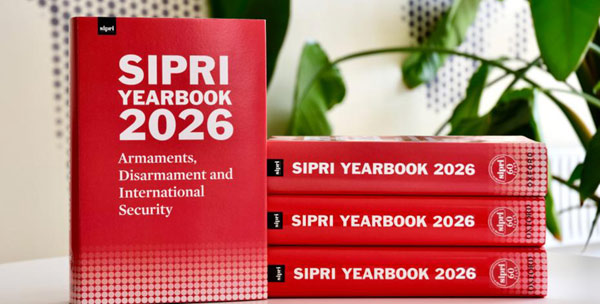
– Report name: SIPRI Annual Report 2026
Estimated Nuclear Weapons Stockpile of India
– 2026: 190
– 2025: 180
– 2024: 172
– 2023: 164
– 2022: 160
– 2021: 156
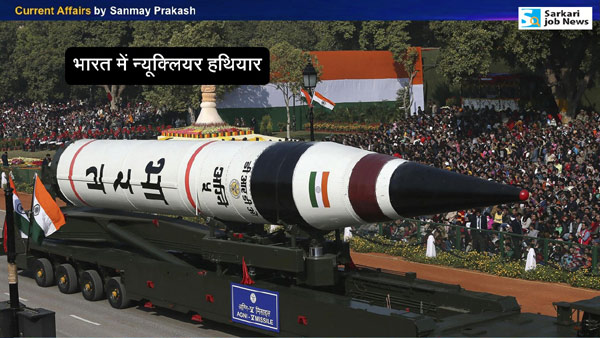
India Deployed Nuclear Weapons for the First Time
– The report states that India has deployed 12 nuclear weapons for the first time.
– The 2025 report mentioned no deployed nuclear weapons, whereas the 2026 report mentions the deployment of 12 nuclear weapons.
– Although India follows a “No First Use” policy, meaning it will not use nuclear weapons first, it reserves the right to retaliate with nuclear weapons if India or Indian forces are subjected to a major biological or chemical attack anywhere.
– More than 90% of the world’s nuclear weapons are possessed by Russia and the United States.
– According to the SIPRI Yearbook 2026, the world is entering a new era of nuclear competition.
Nuclear Weapons Held by Neighboring Countries
– Pakistan: 170 (same as the previous year)
– China: China has expanded its nuclear arsenal the fastest. It possesses a total of 620 nuclear weapons, of which 34 are deployed.
Who Controls Nuclear Weapons in India?
– Nuclear weapons are under the responsibility of the Strategic Forces Command (SFC).
– It was established on 4 January 2003 by the Vajpayee government.
– It is a command of the Indian Armed Forces (Army, Navy, and Air Force).
– The Strategic Forces Command (SFC), sometimes called the Strategic Nuclear Command, is part of India’s Nuclear Command Authority (NCA).
– It is responsible for the management and administration of both strategic and non-strategic nuclear weapons.
—————
2. According to SIPRI’s Annual Report 2026, which country is estimated to possess the largest number of nuclear weapons in the world?
a. United States
b. Russia
c. United Kingdom
d. India
Answer: b. Russia (5,420)
– A total of 9 countries possess nuclear weapons.
– The world currently has 12,121 nuclear weapons.
– Russia possesses the largest number, with 5,420 nuclear weapons.
– The United States follows with 5,042 nuclear weapons.
– China ranks third with 620 nuclear weapons.
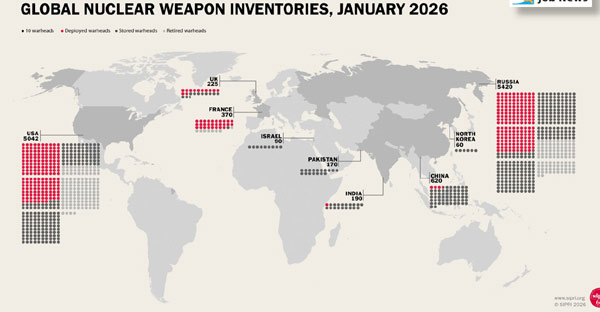
Global Nuclear Powers
Country : 2025 : 2026
1) Russia : 5,459 : 5,420
2) USA : 5,177 : 5,042
3) China : 600 : 620
4) France : 290 : 370
5) UK : 225 : 225
6) India : 180 : 190
7) Pakistan : 170 : 170
8) Israel : 90 : 90
9) North Korea : 50 : 60
Total : 12,512 : 12,121
Note
– The 2026 report shows a decline in the nuclear arsenals of Russia and the USA.
Nuclear arsenals increased in all countries except the USA, Russia, the UK, Pakistan, and Israel.
The USA, Russia, China, India, Pakistan, and other nuclear-armed states are rapidly upgrading their weapons and delivery systems.
Deployed Nuclear Weapons
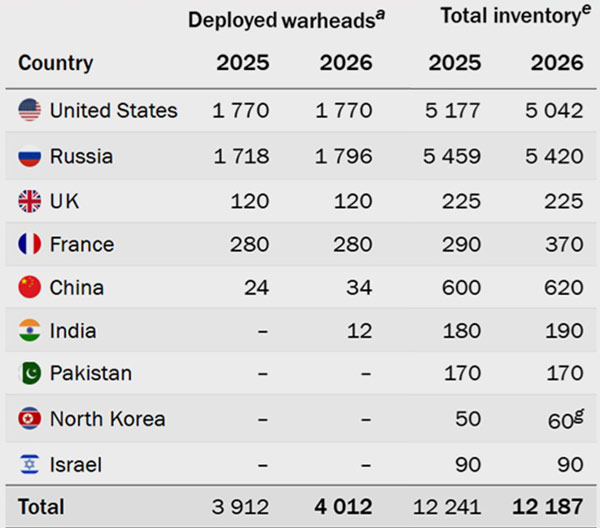
Country : Deployed Nuclear Weapons
– Russia 1,770
– USA 1,796
– France 280
– UK 120
– China 24
– India 12
Note: In 2026, a total of 4,012 nuclear weapons were deployed on missiles or aircraft, compared to 3,912 in 2025.
————–
3. According to the SIPRI Annual Report 2026, what was India’s rank in global military spending in 2025?
a. 10th
b. 5th
c. 4th
d. 3rd
Answer: b. 5th
– India’s defence expenditure reached USD 92.1 billion (₹8.78 lakh crore) in 2025, an increase of 8.9% compared to 2024.
– Only the USA, China, Russia, and Germany spent more on defence than India.
– This marked the 11th consecutive year of growth in military spending.
Top 5 Countries in Global Military Spending
– USA: USD 954 billion
– China: USD 336 billion
– Russia: USD 190 billion
– Germany: USD 114 billion
– India: USD 92.1 billion
————–
4. According to the SIPRI Annual Report 2026, which country ranked first in global military spending in 2025?
a. China
b. India
c. Russia
d. USA
Answer: d. USA
Top 5 Countries
– USA: USD 954 billion
– China: USD 336 billion
– Russia: USD 190 billion
– Germany: USD 114 billion
– India: USD 92.1 billion
Why Are Military Expenditure and the Nuclear Arms Race Increasing?
– The rise in military expenditure and nuclear competition is driven by major geopolitical and strategic changes.
– Nuclear weapons are increasingly viewed as the “Ultimate Security Guarantee.”
Reasons Behind Rising Military Spending and Nuclear Weapons
– Collapse of the Global Security Order: The global order established after the Cold War has weakened. The Russia–Ukraine war, tensions in the Middle East, and China’s assertive stance in the South China Sea have reduced confidence in international institutions such as the UN. Countries feeling insecure tend to increase defence spending.
– Great Power Competition: Strategic rivalry among the USA, China, and Russia has intensified. China is expanding its nuclear arsenal at the fastest rate, while the USA and Russia continue modernizing their nuclear forces.
————–
5. According to the SIPRI Annual Report 2026, which country was the world’s second-largest arms importer during the 2021–25 period?
a. Pakistan
b. China
c. India
d. Germany
Answer: c. India
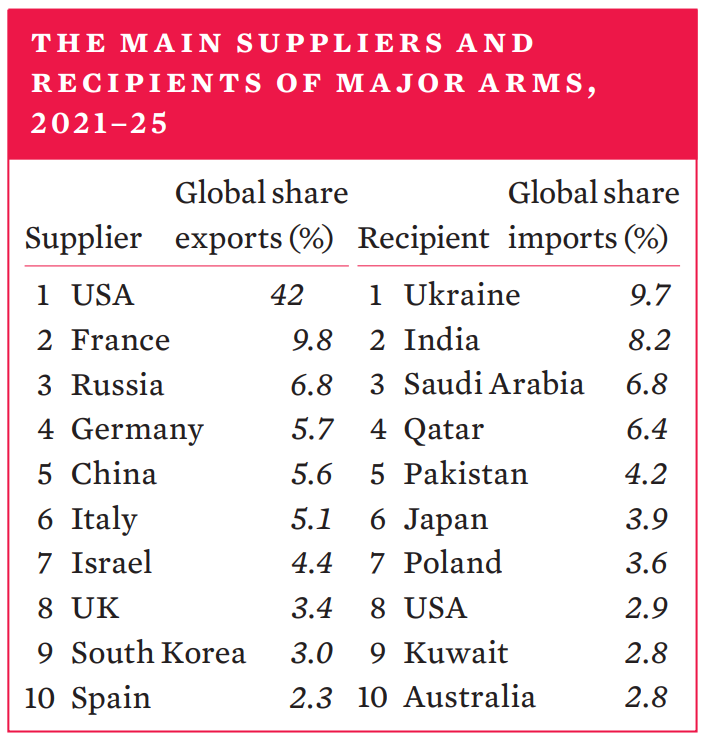
– During 2021–25, India was the world’s second-largest arms importer.
– India’s share in global arms imports was 8.2%.
– Ukraine, India, Saudi Arabia, Qatar, and Pakistan together accounted for 35% of global arms imports.
– According to SIPRI, India primarily imports weapons from Russia, France, the United States, and Israel.
Major Arms Suppliers to India
1) Russia: With a share of about 36–40%, Russia remains India’s largest arms supplier. India imports fighter aircraft, submarines, and missile systems such as the S-400 from Russia.
2) France: With a share of 28–31%, France is India’s second-largest supplier. Rafale fighter aircraft and submarines are among the major imports from France.
3) United States: Around 13% of India’s defence imports come from the USA. These include heavy transport aircraft, helicopters such as Chinook and Apache, and advanced drones.
4) Israel: With a share of about 11%, Israel supplies important weapons and radar systems to India.
————–
6. What was the last major treaty between the United States and Russia regulating the number of nuclear weapons, which expired in early 2026?
a. INF Treaty (Intermediate-Range Nuclear Forces Treaty)
b. New START (Strategic Arms Reduction Treaty)
c. Comprehensive Nuclear-Test-Ban Treaty (CTBT)
d. Non-Proliferation Treaty (NPT)
Answer: b. New START (Strategic Arms Reduction Treaty)
– The New START Treaty was the last active treaty limiting nuclear weapons between the United States and Russia.
– Since it was not renewed, it expired in early 2026.
– Its expiration has contributed to a renewed global nuclear arms race.
Key Facts
– Signed: 8 April 2010 in Prague.
– Came into force: 5 February 2011.
– Extended: In 2021, both countries agreed to extend it until 5 February 2026.
– Final status: Russia suspended implementation in 2023 due to deteriorating relations following the Ukraine war. The treaty expired on 5 February 2026 without a successor agreement.
—————
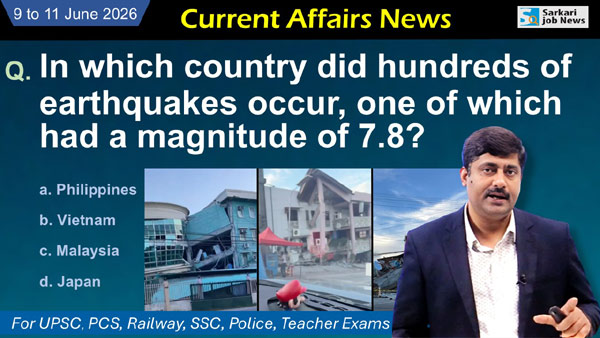
7. In which country did hundreds of earthquakes occur in June 2026, with the strongest one reaching a magnitude of 7.8?
a. Philippines
b. Vietnam
c. Malaysia
d. Japan
Answer: a. Philippines
– A powerful earthquake struck the Philippines on 8 June 2026 at 5:07 a.m.
– Hundreds of aftershocks followed in the next few hours.
– Most of the affected structures were shops, offices, and commercial buildings.
– According to the US Geological Survey (USGS), the epicenter was in the sea near Mindanao Island.
– The Philippine Institute of Volcanology and Seismology reported that the earthquake was caused by activity in the Cotabato Trench at a depth of 10 km.
Tsunami Followed the Earthquake
– The highest recorded wave reached 1.4 metres (about 4.6 feet).
– The greatest damage occurred in General Santos, a port city with a population of more than 700,000.
– Several buildings developed cracks, some small structures partially collapsed, and a bridge was damaged.
Tremors Felt in Indonesia and Malaysia
– Earthquake tremors were felt in North Sulawesi and North Maluku in Indonesia.
– Residents of Manado reported strong shaking.
– Indonesia’s Meteorology and Geophysics Agency (BMKG) issued a tsunami warning for its northeastern coast.
– Coastal regions of Malaysia were also warned about waves up to one metre high.
Aftershocks Continue
– Several aftershocks were recorded in the same region.
– Experts stated that aftershocks are a normal phenomenon after major earthquakes.
– They can continue for days, weeks, or even years.
– In some cases, aftershocks may equal or exceed the magnitude of the main quake.
Philippines Lies in the Ring of Fire
– The Philippines, Indonesia, and Japan are located in the Pacific Ring of Fire.
– It is the world’s most active seismic zone.
– Frequent earthquakes and volcanic eruptions occur due to tectonic plate movements.
– This makes the Philippines one of the most disaster-prone countries in the world.
Philippines: Quick Facts
– Capital: Manila
– Population: 117 million
– Languages: Filipino and English
– Currency: Philippine Peso
– Maritime Neighbours: Taiwan, China, Vietnam, Malaysia, and Indonesia
————–
8. When is World Oceans Day celebrated?
a. 5 June
b. 6 June
c. 7 June
d. 8 June
Answer: d. 8 June
Theme for 2026 : Reimagine: Beyond the world we know, a new relationship with our ocean
————–
9. For the how-many-th time did India win the SAFF Women’s Championship title in 2026?
a. First time
b. Third time
c. Fifth time
d. Sixth time
Answer: d. Sixth time
– India defeated defending champion Bangladesh 3–1 in the final to win a record sixth title.
– SAFF stands for South Asian Football Federation.
– The 2026 SAFF Women’s Championship was hosted by India.
– The Indian women’s football team, known as the Blue Tigresses, displayed outstanding performance throughout the tournament.
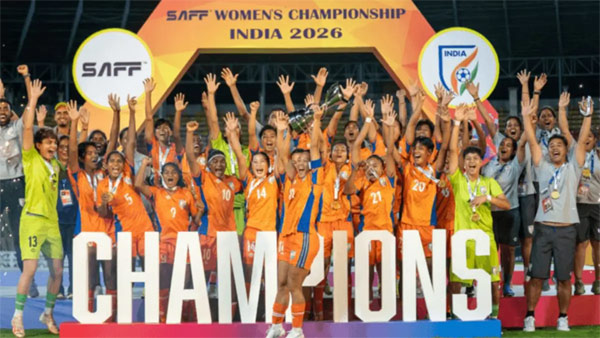
Tournament Details
– Host: India
– Venue: Pandit Jawaharlal Nehru Stadium (Fatorda Stadium), Margao, Goa
– Duration: 25 May – 6 June 2026
– Edition: 8th
– Teams: India, Bangladesh, Nepal, Bhutan, Sri Lanka, and Maldives
Major Awards
– Champions: India
– Runners-up: Bangladesh
– Most Valuable Player (MVP): Sanfida Nongrum (India)
– Top Scorer: Aveka Singh (India) – 4 goals
– Best Goalkeeper: Panthoi Chanu Elangbam (India)
– Fair Play Award: Nepal
—————
10. Indian sports legend Dangmei Grace announced her retirement from international sports in June 2026. Which sport does she play?
a. Hockey
b. Football
c. Cricket
d. Basketball
Answer: b. Football
– Dangmei Grace announced her retirement on 6 June 2026 in Goa immediately after India’s SAFF Women’s Championship victory over Bangladesh.
– She represented India in 95 international matches.
The 30-year-old forward has been a key pillar of India’s attacking line for more than a decade.
Career Highlights
– International debut: 2013
– Total caps: 95
– International goals: 24
– Hometown: Dimdailong village, Churachandpur district, Manipur (Rongmei tribe)
Individual Honours
– AIFF Emerging Player of the Year: 2018–19
– IWL Emerging Player Award: 2017–18
– FPAI Indian Player of the Year (Women): 2023
—————
11. The under-construction Zojila Tunnel is between which two UTs/States, whose ‘breakthrough’ (completion of excavation from both ends) was achieved in June 2026?
a. Himachal Pradesh and Ladakh
b. Himachal Pradesh and Jammu & Kashmir
c. Jammu & Kashmir and Ladakh
d. Ladakh and Delhi
Answer: c. Jammu & Kashmir and Ladakh
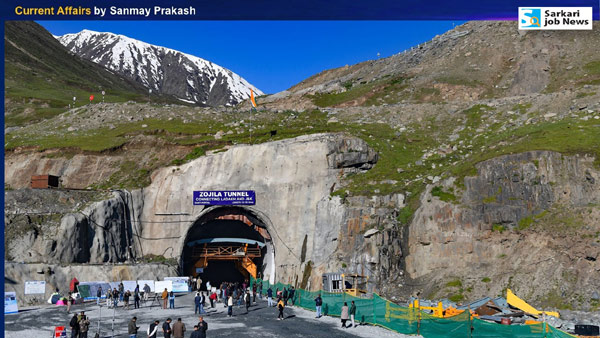
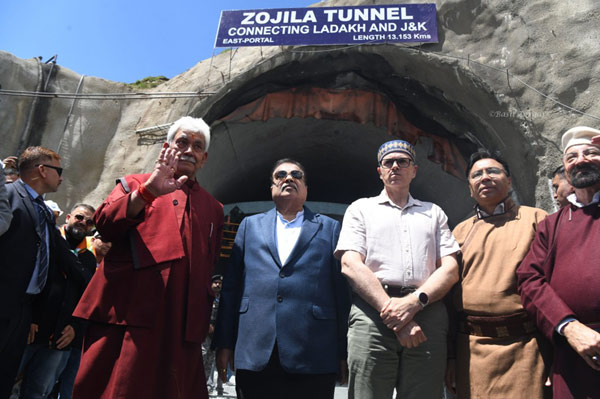
– On 9 June 2026, the tunnel achieved its breakthrough six months ahead of schedule.
– Length and Design: It is a 13.153-km-long, horseshoe-shaped, single-tube bi-directional tunnel.
– Record: It is the world’s longest single-tube bi-directional tunnel at such a high altitude and Asia’s longest tunnel of its type.
– Altitude: Approximately 11,578 feet above sea level.
– Connectivity: Located on the Srinagar–Leh National Highway (NH-1), it connects Baltal in Ganderbal district of Jammu & Kashmir with Minamarg in Drass district of Ladakh.
– Construction Agency: Executed by Megha Engineering & Infrastructure Limited (MEIL) under the supervision of NHIDCL.
– Technology Used: New Austrian Tunnelling Method (NATM).
Strategic and Security Importance
– Provides all-weather connectivity to Ladakh.
– Ensures uninterrupted military access to border areas facing China and Pakistan.
– Facilitates year-round movement of troops, tanks, weapons, and ammunition.
Economic and Social Importance
– Travel time across Zojila Pass will reduce from 1–1.5 hours to about 15 minutes.
– Will boost tourism, especially winter tourism in Ladakh.
– Ensures uninterrupted supply of medicines, food, and fuel during winter months.
Major Challenges
– Fragile Himalayan geology.
– Extreme weather conditions and avalanche threats.
Brief History of the Project
– Initial survey began in 1997 by the Border Roads Organisation (BRO).
– The need became especially evident during the 1999 Kargil War.
– Officially announced by Prime Minister Manmohan Singh in 2005.
– Foundation stone laid by Prime Minister Narendra Modi in May 2018.
– Re-modelled in 2020 to reduce project cost.
– Breakthrough achieved on 9 June 2026.
– Expected to open fully by February 2028.
—————
12. Name the winning team of the Under-18 Hockey Asia Cup 2026.
a. Japan
b. India
c. Nepal
d. Sri Lanka
Answer: b. India
– India defeated host Japan 4–1 in the final to win the Under-18 Hockey Asia Cup 2026.
– The final was held in Kakamigahara, Japan, in June 2026.
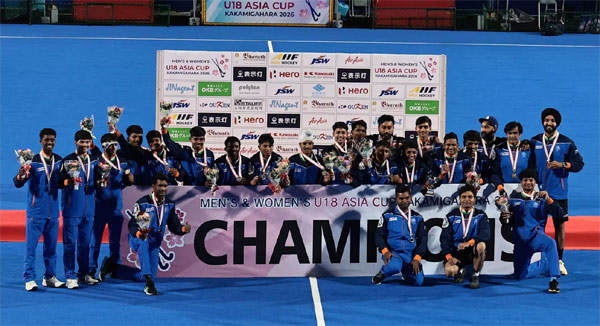
Medal Winners
– Gold: India
– Silver: Japan
– Bronze: Pakistan
—————
13. Which country secured the top position in the First World Yogasana Championship 2026?
a. India
b. Japan
c. Argentina
d. Nepal
Answer: a. India
– India topped the medal table in the First World Yogasana Championship 2026.
– India won a total of 114 medals, including 102 gold medals.
– The five-day championship was held at EKA Arena, Ahmedabad, Gujarat.
– Athletes from 79 countries participated.
Medal Table
Rank : Country : Gold : Silver : Bronze
1) India : 102 : 9 : 3
2) Japan : 3 : 3 : 5
3) Argentina : 2 : 3 : 0
4) Singapore : 2 : 2 : 3
5) Nepal : 1 : 36 : 15
—————
14. When is the Martyrdom Day of Birsa Munda observed?
a. 9 June
b. 10 June
c. 11 June
d. 12 June
Answer: a. 9 June
– Birsa Munda passed away in Ranchi Jail on 9 June 1900.
– He is revered as a divine figure among tribal communities in Bihar, Odisha, Jharkhand, Chhattisgarh, and West Bengal.
– Birsa Munda is remembered as one of the greatest tribal freedom fighters against British rule.
—————
15. When is World Accreditation Day celebrated?
a. 9 June
b. 10 June
c. 11 June
d. 12 June
Answer: a. 9 June
Theme for 2026 : “Innovation, Trust and Sustainability: The Power of Accreditation”
– The day was established in 2007 through a joint initiative of the International Laboratory Accreditation Cooperation (ILAC) and the International Accreditation Forum (IAF).
– Accreditation helps build trust among consumers, businesses, and regulators by ensuring that products, services, and systems meet international standards.
—————
16. Who is India’s longest-serving elected Prime Minister?
a. Lal Bahadur Shastri
b. Jawaharlal Nehru
c. Indira Gandhi
d. Narendra Modi
Answer: d. Narendra Modi
– On 10 June 2026, Prime Minister Narendra Modi became India’s longest-serving continuously elected Prime Minister.
– He surpassed Jawaharlal Nehru’s record of 4,398 consecutive days as an elected Prime Minister (13 May 1952 – 27 May 1964).
Important Clarification
– Jawaharlal Nehru served as Prime Minister continuously from 15 August 1947 until his death on 27 May 1964, totaling 6,130 days.
– Therefore, in terms of total uninterrupted tenure as Prime Minister, Nehru remains ahead.
– The distinction being highlighted relates specifically to the period after being elected through a general election.
– Following the adoption of the Constitution on 26 January 1950, India’s first general election was held, and Nehru’s elected tenure is counted from 13 May 1952.
– Based on this interpretation, Narendra Modi is being recognized as the longest-serving continuously elected Prime Minister.
PDF Download: Click here