This is the current affairs 4 to 7 July 2026. Here are questions and answers of daily current affairs for better preparation of competitive exams for government jobs.
1. Dr. Teejan Bai was associated with which famous folk art form, who passed away on 4 July 2026?
a. Panthi Dance
b. Pandwani Singing
c. Sua Dance
d. Raut Nacha
Answer: b. Pandwani Singing (A folk art form of Chhattisgarh)
————–
2. Pandwani folk singer Dr. Teejan Bai passed away on 4 July 2026. Which civilian honour had she been awarded?
a. Padma Vibhushan
b. Padma Bhushan
c. Padma Shri
d. All of the above
Answer: d. All of the above (Padma Vibhushan {2019}, Padma Bhushan {2003}, Padma Shri {1988})
– Teejan Bai was the only personality from Chhattisgarh to receive all three major Padma Awards of India (Padma Shri, Padma Bhushan, and Padma Vibhushan).
What is Pandwani Art?
– It is a unique folk singing tradition of Chhattisgarh in which stories from the Mahabharata are narrated in a musical form with musical instruments such as the tambura and kartal.
– Kapalik Style: Teejan Bai was the most renowned artist of the ‘Kapalik Style’ of Pandwani. In this style, the artist does not remain seated but performs while standing on the stage, dancing, and using the tambura as a mace to vividly portray different characters such as Bhima through live acting.
– Vedamati Style: In this style, the artist narrates the story while remaining seated in a graceful manner. (Jhaduram Dewangan was one of its leading artists.)
About Teejan Bai
– She was born on 8 August 1956 in Ganiyari/Atari (Patan), Durg district of Chhattisgarh.
– She started singing Pandwani at the age of just 13 after being inspired by her grandfather (maternal grandfather), Brijlal Pardhi.
– Dr. Teejan Bai is the first woman artist to adopt the Kapalik Style of Pandwani and brought this traditionally male-dominated art form beyond its conventional boundaries.
Major Awards Received by Teejan Bai
– 1988: Padma Shri (India’s fourth-highest civilian award)
– 1995: Sangeet Natak Akademi Award
– 2003: Padma Bhushan (India’s third-highest civilian award)
– 2016: M. S. Subbulakshmi Centenary Award
– 2018: Fukuoka Prize (Awarded by the Government of Japan for contributions to art and culture)
– 2019: Padma Vibhushan (India’s second-highest civilian award)
—————
3. Which patient sample is collected for the RT-PCR test for the ‘Bundibugyo strain’ of Ebola, which has received WHO Emergency Use Listing (EUL) approval?
a. Saliva
b. Urine
c. Blood
d. Sputum
Answer: c. Blood
– For the first time in history, an RT-PCR test kit for the Bundibugyo strain of Ebola has received official Emergency Use Listing (EUL) approval from the WHO.
– This test is also known as a Molecular Test.
– Immediately after the approval (on 2 July 2026), the first human treatment trial for this disease was launched in the Democratic Republic of the Congo (DRC).
– Following this approval, countries around the world can now directly procure and use this test kit without undergoing lengthy legal or regular regulatory procedures.
– This will reduce testing time from months to just a few days, making it easier to contain outbreaks at an early stage.
– This new molecular test directly detects the virus’s genetic material (RNA) from a blood sample, providing immediate and highly accurate results without any confusion.
Important Facts
– Bundibugyo Virus (BDBV): It is a rare and deadly strain of the Ebola virus. In humans, it causes Bundibugyo Virus Disease (BVD). This strain is currently spreading in the Democratic Republic of the Congo (DRC).
– First Molecular Test: WHO has approved the first molecular diagnostic test/RT-PCR for its diagnosis, which identifies the virus’s genetic material in blood samples and provides rapid results.
– Emergency Use Listing (EUL): It is a WHO risk-based procedure aimed at accelerating the availability of unlicensed vaccines, medicines, and in-vitro diagnostics (IVDs) during a Public Health Emergency of International Concern (PHEIC).
– PHEIC (Public Health Emergency of International Concern): Due to the outbreak spreading in the Democratic Republic of the Congo (DRC) and Uganda, WHO has declared it a Public Health Emergency of International Concern.
————–
4. Who is the Indian Paralympian who achieved the World No. 1 ranking (in July 2026) in the Men’s Shot Put (F57) category?
a. Devendra Jhajharia
b. Hokato Hotozhe Sema
c. Murlikant Petkar
d. Dharambir
Answer: b. Hokato Hotozhe Sema
– Hokato Hotozhe Sema is a leading para-athlete from Nagaland and serves as a Subedar in the Indian Army’s 9 Assam Regiment.
– In the World Para Athletics Rankings released on 2 July 2026, he became the World No. 1 athlete in the Men’s Shot Put F57 category.
– He won the bronze medal at the Paris 2024 Paralympic Games with a personal best throw of 14.65 metres.
Major Civilian and Military Honours:
– He became the first Paralympian in the country to receive the Ati Vishisht Seva Medal (AVSM).
– He has also been honoured with the Arjuna Award (2024/2025) by the President for his outstanding contribution to sports.
– After losing his left leg in a landmine explosion during an anti-terror military operation in 2002, he started competing in shot put at the age of 32.
What is the Shot Put F57 Category?
– F57 Classification: It is a special classification in para-athletics for athletes with impairment or weakness in the lower limbs who compete in seated throws using a wheelchair or a fixed throwing chair.
Send “next” and I’ll continue with Questions 5 onward in the same format.
—————
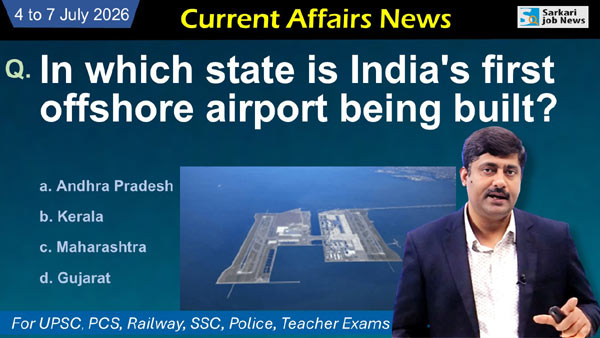
5. In which state is India’s first Offshore Airport being built?
a. Andhra Pradesh
b. Kerala
c. Maharashtra
d. Gujarat
Answer: c. Maharashtra
– The Government of Maharashtra has ordered the preparation of a Detailed Project Report (DPR) for India’s first offshore airport on the state’s western coast.
– The proposed site is located near Kore Beach in Palghar district.
– The airport is planned to have two parallel runways.
– Its design capacity will be 90 million passengers and 30 million metric tonnes of cargo annually.
– It is planned to be connected with the Uttan–Virar Sea Route, the Mumbai–Ahmedabad Bullet Train Station, and the Vadodara–Mumbai Expressway.
– Construction is expected to begin in 2026, with operations likely to commence in the early 2030s.
What is an Offshore Airport?
– An offshore airport is an airport built on reclaimed land or floating platforms in the sea, away from the mainland.
– Such airports are constructed to overcome problems such as land scarcity, urban congestion, and noise pollution.
– Hong Kong International Airport and Kansai International Airport (Japan) are prominent examples of offshore airports.
—————
6. The ‘Bukhman International Booker Prize’ is actually the new name of which prestigious literary award?
a. Booker Prize
b. International Booker Prize
c. Pulitzer Prize
d. Nobel Prize in Literature
Answer: b. International Booker Prize
– From 2027, the International Booker Prize will officially be known as the ‘Bukhman International Booker Prize.’
Why was the name changed?
– 10-Year Sponsorship: The Booker Prize Foundation has signed a historic 10-year sponsorship agreement with Bukhman Philanthropies. The award has been renamed to provide long-term financial security and further promote translated literature across the world.
– Prize Money Doubled: Under this new partnership, the prize money has been increased from £50,000 to £100,000. The amount will be equally shared (50:50) between the original author and the English translator.
What is Bukhman Philanthropies?
– It is a charitable foundation run by British-Russian billionaire brothers Dmitry Bukhman and Igor Bukhman, the co-founders of one of the world’s leading mobile gaming companies, Playrix. The foundation works in the fields of health, mental health, and literature.
Difference Between the Booker Prize and the International Booker Prize
– Booker Prize: It was established in 1969. It is awarded only to original novels written in English. (For example, Arundhati Roy received it for The God of Small Things.)
– International Booker Prize: It was established in 2005. It is awarded to promote translated literature. (For example, Geetanjali Shree received it in 2022 for the English translation of her Hindi novel Ret Samadhi, titled Tomb of Sand.)
————–
7. Which Indian industrialists have been included among the 44 founding members of the ‘AI for Good Global Commission’?
a. Mukesh Ambani and Sunil Bharti Mittal
b. Lakshmi Mittal
c. Gautam Adani and Ratan Tata
d. Both a and b
Answer: d. Both a and b (Mukesh Ambani, Sunil Bharti Mittal, and Lakshmi Mittal)
– The commission has primarily been established by the International Telecommunication Union (ITU), the United Nations’ specialized agency, in partnership with two other global leaders.
– ITU Secretary-General Doreen Bogdan-Martin officially launched the commission.
– President Paul Kagame of Rwanda is its Co-Chair.
– Marc Benioff, Chairman and CEO of the global technology company Salesforce, is the third Co-Chair.
– The commission held its first official meeting during the AI for Good Global Summit 2026 in Geneva, Switzerland.
Main Objective of the AI for Good Global Commission
– Its primary objective is to build public trust in Artificial Intelligence (AI), ensure equitable access to AI technologies across all countries, and develop practical policies to address global challenges.
————-
8. Who became the youngest Indian player to make his debut in international cricket?
a. Kartik Sharma
b. Vaibhav Suryavanshi
c. Shafali Verma
d. Parthiv Patel
Answer: b. Vaibhav Suryavanshi
– Vaibhav Suryavanshi played his first international match at the age of 15 years and 99 days, surpassing the records of Sachin Tendulkar and Shafali Verma.
– He made his debut in the India vs England T20 match.
– On 4 July 2026 in Manchester, India’s vice-captain Tilak Varma presented him with his debut cap.
– He became emotional and broke into tears afterward.
– Master Blaster Sachin Tendulkar made his international debut (Test cricket) against Pakistan in Karachi on 15 November 1989 at the age of 16 years and 205 days.
– Shafali Verma made her international debut at the age of 15 years and 239 days.
– Vaibhav became India’s youngest-ever international cricketer and the fourth-youngest international cricketer in the world.
– Jersey’s Nia Charlotte Greig is the youngest cricketer ever to play international cricket.
– She played her first T20 International in 2019 at the age of 11 years and 40 days.
– Among men, Romania’s Marian Gerasim is the youngest male cricketer to make an international debut.
– He played his first T20 International in 2020 at the age of 14 years and 16 days.
—————
9. “Seabuckthorn” (Chharma) from which region of Himachal Pradesh received the GI Tag?
a. Kullu
b. Kinnaur
c. Spiti
d. Lahaul
Answer: c. Spiti
– On 1 July 2026, Seabuckthorn (Chharma) from Spiti, along with eight other products from Himachal Pradesh, received the GI Tag.
– With this, the total number of GI-tagged products in Himachal Pradesh has increased to 17.
– Seabuckthorn (Chharma) is a medicinal shrub that naturally grows in the high-altitude regions of Himachal Pradesh, including Lahaul-Spiti, Kinnaur, Upper Kullu, and the valleys of Chamba.
– It is rich in Vitamin C and Omega Fatty Acids (3, 6, 7, and 9).
– Rich in antioxidants, this bright orange fruit is also known as the “Sanjeevani Herb” and the “King of Vitamin C.”
– Oil extracted from its seeds and fruits is used in cosmetic products for treating skin wounds, wrinkles, eczema, and maintaining healthy hair.
—————
10. “Salooni White Maize” from which region of Himachal Pradesh received the GI Tag?
a. Kullu
b. Kinnaur
c. Spiti
d. Chamba
Answer: d. Chamba
– Salooni White Maize is a traditional and highly nutritious crop cultivated in the Salooni Tehsil of Chamba district, Himachal Pradesh.
– Compared to yellow maize, white maize has a softer texture and is naturally less sweet in taste.
– It received the GI Tag because of its unique regional identity, traditional agricultural heritage, and distinctive characteristics.
—————
11. “Chamba Metal Craft” from which region of Himachal Pradesh received the GI Tag?
a. Chamba
b. Kufri
c. Shimla
d. Kangra
Answer: a. Chamba
– Chamba Metal Craft is a world-famous ancient handicraft tradition of Chamba district in Himachal Pradesh.
– It received the GI Tag for its unique origin and cultural significance.
– It includes idols, masks (Mohra), and intricately engraved decorative plates made of brass, copper, and bronze.
– This ancient technique, which has been practiced since the 10th century (also known as the “Cire Perdue” or Lost-Wax Casting Technique), involves first making a wax model, then covering it with clay and heating it so that the wax melts away, after which molten metal is poured into the hollow cavity.
– A Chamba Thal is an engraved brass plate decorated with images of Lord Ganesha, incarnations of Lord Vishnu, Radha-Krishna, or traditional artistic motifs using a chisel and hammer.
– These plates are commonly used for worship, festivals, and gifting.
—————
12. “Sirmauri Loiya” from which state received the GI Tag?
a. Uttarakhand
b. Himachal Pradesh
c. Punjab
d. Jammu & Kashmir
Answer: b. Himachal Pradesh
– Sirmauri Loiya is a famous traditional handwoven woollen garment or cloak from Sirmaur district, especially the Giripar region of Himachal Pradesh.
– It is the most trusted and warmest traditional attire worn by local people to protect themselves from severe cold and snowfall.
– It is not just a garment but also a symbol of the simplicity, traditional knowledge, and social heritage of the people of Sirmaur.
– It extends up to or below the knees (similar to an overcoat) and is handcrafted by local artisans.
—————
13. “Kinnauri Cap” from which state received the GI Tag?
a. Uttarakhand
b. Ladakh
c. Himachal Pradesh
d. Jammu & Kashmir
Answer: c. Himachal Pradesh
– The Kinnauri Cap is a traditional and prestigious woollen cap from Kinnaur district of Himachal Pradesh.
– It received the GI Tag for its distinctive style, warm woollen weaving, and velvet border.
– It is handwoven from pure sheep wool.
– The front portion features a woollen strip called “Patti” along with a bright velvet (or chenille) band.
– The cap is a symbol of the cultural identity, honour, and pride of the Kinnauri community.
—————
14. “Sepu Badi” from which region of Himachal Pradesh received the GI Tag?
a. Solan
b. Hamirpur
c. Una
d. Mandi
Answer: d. Mandi
– Sepu Badi is a traditional and highly popular dish from Mandi district of Himachal Pradesh.
– It is served as one of the main delicacies during the state’s traditional cultural feasts and festivals, known as “Dham.”
– It is primarily prepared from urad dal.
—————
15. “Kinnauri Apple” from which state received the GI Tag?
a. Himachal Pradesh
b. Punjab
c. Chandigarh
d. Jammu & Kashmir
Answer: a. Himachal Pradesh
– Kinnauri Apples are premium-quality apples grown at an altitude of over 9,000 feet above sea level in Kinnaur district of Himachal Pradesh.
– They received the GI Tag for their natural sweetness, long shelf life, and exceptional crispness.
– Due to the high altitude, clean air, and glacier-fed water, these apples are larger in size and have a deeper, more attractive colour.
– The Sangla Valley of Kinnaur is the primary and most famous production centre of Kinnauri Apples.
—————
16. “Kinnauri Ornaments” from which state received the GI Tag?
a. Punjab
b. Himachal Pradesh
c. Chandigarh
d. Jammu & Kashmir
Answer: b. Himachal Pradesh
– Kinnauri Ornaments are an important symbol of the rich cultural heritage of the Kinnaur tribe of Himachal Pradesh.
– These ornaments are made from silver, copper, and turquoise stones.
—————
17. “Jalbhara Sandesh” sweet received the GI Tag from which state?
a. West Bengal
b. Bihar
c. Odisha
d. Jharkhand
Answer: a. West Bengal
– Jalbhara Sandesh is a famous sweet from Chandannagar in Hooghly district, West Bengal.
– It contains aromatic sugar syrup filled inside the sweet.
– When placed in the mouth, the syrup does not spill out but dissolves pleasantly, enhancing its taste.
– It was first prepared in 1818 by Suryakumar Modak as a special experiment on the occasion of Jamai Shashthi.
– This sweet is popularly known as “Jamai Thokano Mishti.”
– According to local folklore, it was specially created for the Bandyopadhyay family of Telinipara to surprise their sons-in-law.
—————
18. “Janai-er Manohar,” the famous traditional sweet of which district of West Bengal received the GI Tag?
a. Howrah
b. Hooghly
c. Malda
d. Nadia
Answer: b. Hooghly
– Famous for its distinctive outer sugar coating and soft chhena (cottage cheese) filling, Manohar has remained a beloved Bengali sweet for generations.
– This sweet originated in the Janai and Champadanga regions of Hooghly district.
—————
19. The traditional “Boat-Building Heritage” of Balagarh in which state received the GI Tag?
a. Punjab
b. Odisha
c. Uttar Pradesh
d. West Bengal
Answer: d. West Bengal
– Balagarh, located in Hooghly district of West Bengal, is famous for its unique 600-year-old traditional boat-building craftsmanship.
– This craft has been mentioned in the writings of Mughal historian Abul Fazl as well as in devotional literature from the 13th to the 18th century.
– Balagarh boats are spoon-shaped and are built using the traditional “Joinery” method, in which wooden joints are generally used instead of nails.
– These boats are extremely useful during floods, but the industry continues to struggle due to the rising cost of timber and declining income of artisans.
—————
20. When is International Co-operative Day celebrated?
a. First Monday of July
b. First Tuesday of July
c. First Saturday of July
d. First Sunday of July
Answer: c. First Saturday of July (4 July in 2025)
Theme for 2026: – Cooperatives for a Peaceful World
– International Co-operative Day brings together individuals, communities, and organizations around the world to celebrate the impact of cooperative enterprises.
—————
21. When is International Plastic Bag Free Day observed?
a. 2 July
b. 3 July
c. 4 July
d. 30 June
Answer: b. 3 July
– The objective of this day is to spread awareness about the issue of plastic pollution and its harmful impact on the natural environment.
– Plastic causes significant damage to the environment.
– A single plastic bag can take 100 to 500 years to decompose.
—————
22. When is World Chocolate Day celebrated?
a. 7 July
b. 8 July
c. 9 July
d. 10 July
Answer: a. 7 July
– World Chocolate Day was first celebrated in 2009.
– It is also believed that people began celebrating 7 July as International Chocolate Day because it marks the day when chocolate was first introduced to Europe in 1550.
PDF Download: Click here