
This is the current affairs 6 to 8 June 2026. Here are questions and answers of daily current affairs for better preparation of competitive exams for government jobs.
1. Through radiocarbon dating, India’s oldest living banyan tree (over 700 years old) has been certified in which state and district?
a. Uttar Pradesh, Lucknow
b. West Bengal, Howrah
c. Bihar, Munger
d. Madhya Pradesh, Gwalior
Answer: c. Bihar, Munger
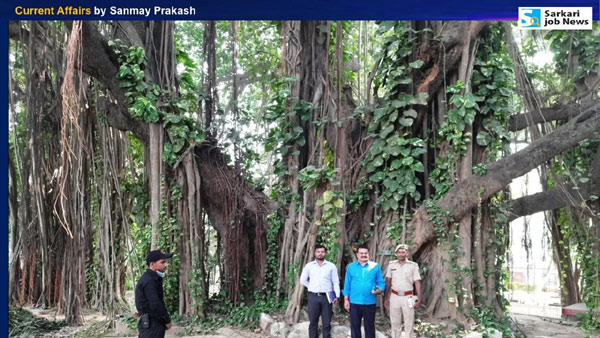
– A banyan tree located in Munger, Bihar, has been confirmed to be more than 700 years old. It is considered the oldest living tree in India.
– The Bihar Forest Department has initiated the process of declaring it a Heritage Tree.
– Due to its hundreds of aerial roots, the tree appears more like a dense forest than a single tree.
Geographical and Scientific Facts
– Location: The giant banyan tree is situated within the premises of the Indian Tobacco Company (ITC) in Munger district, Bihar.
– Research Team: Research began in 2022 under the leadership of scientist Dr. Trina Bose and research scholar Avneesh Mishra from the Birbal Sahni Institute of Palaeosciences (BSIP), Lucknow, at the invitation of the Bihar Forest Department.
– Scientific Evidence: After three years of intensive research and the use of advanced radiocarbon dating techniques, BSIP scientists confirmed that the tree is more than 700 years old.
– Scientific Method: Normally, the age of trees is estimated through annual growth rings (dendrochronology). However, banyan trees do not form such rings. Therefore, scientists used radiocarbon dating to determine its age accurately.
– The aerial roots of a banyan tree gradually penetrate the ground and develop into new trunks.
India’s Second Oldest Tree
– The Great Banyan Tree: Located in the Acharya Jagadish Chandra Bose Indian Botanic Garden near Kolkata, West Bengal, this banyan tree is more than 250 years old.
– It spreads across 4.67 acres and has over 3,700 roots.
What is Radiocarbon Dating?
– It is a scientific method that determines the age of organic materials by measuring the rate of decay of the radioactive isotope Carbon-14.
– Mainly two types of carbon are found in nature, known as Carbon-12 and Carbon-14. The entire process is based on these two forms. Both are present in carbon dioxide in very small quantities.
– Carbon-12: It has existed on Earth since the beginning. It is a completely stable form of carbon. This means that even after thousands of years, the amount of Carbon-12 remains unchanged. It neither decays, nor gets destroyed, nor transforms.
– Carbon-14: When cosmic rays collide with nitrogen in the atmosphere, they convert it into Carbon-14. It is an unstable and radioactive isotope. Its nature is such that it gradually breaks down and disappears over time (scientifically known as decay).
– While Living: As long as a tree, plant, or animal remains alive, it continuously absorbs carbon from the atmosphere through respiration or food. As a result, a fixed ratio of Carbon-12 and Carbon-14 is maintained within its body.
– After Death: As soon as an organism dies (or a part of a tree dries and separates), it stops taking in carbon from outside. Carbon-12 remains unchanged, but Carbon-14 gradually decreases.
– In humans and animals, both forms of carbon ultimately come from plants.
If the Tree is Still Alive, How Did Carbon-14 Decrease?
– The trunk of a tree has two main parts: Heartwood (center) and Sapwood (outer layer).
– Heartwood (Center): As a tree grows older and thicker, the innermost and oldest portion of the trunk gradually stops transporting water. After many years, this central portion becomes dark and dead. Resins and gums accumulate in it. It no longer carries water and only provides iron-like strength to the tree.
– Sapwood (Outer Layer): This is the lighter, living portion outside the heartwood. It acts as the tree’s actual water transportation system.
Scientists drilled into the tree and collected a sample from the heartwood.
– When scientists took a sample from the Munger banyan tree to the laboratory, they measured how much Carbon-14 had decreased in comparison to Carbon-12. The greater the reduction in Carbon-14, the older the object is.
Importance of a ‘Heritage Tree’
– The purpose of declaring a tree as a ‘Heritage Tree’ is to provide legal protection to its biodiversity, historical significance, and ecological value.
– Under this status, the area surrounding the tree is protected and special efforts are undertaken for its conservation and development.
—- Question for Prelims —-
Q. With reference to the ‘oldest living banyan tree in India’ that was recently in the news, consider the following statements:
1) This historic banyan tree is located in Munger district of Bihar.
2) Since banyan trees lack annual rings, radiocarbon dating technology was used to determine its age.
3) The radiocarbon dating method is based on the rate of decay of Carbon-12, a completely stable isotope of carbon.
Which of the statements given above is/are correct?
a. 1 and 2 only
b. 2 and 3 only
c. 1 and 3 only
d. 1, 2 and 3
Answer: (A) 1 and 2 only
Explanation
– Statements 1 and 2 are correct: The tree is located in Munger, Bihar, and because it lacks annual rings, carbon dating was used to determine its age.
– Statement 3 is incorrect: Radiocarbon dating is based not on Carbon-12 but on Carbon-14, which is unstable and radioactive. Carbon-12 remains stable, whereas Carbon-14 decreases over time. Scientists estimate age by measuring this reduction.
—————
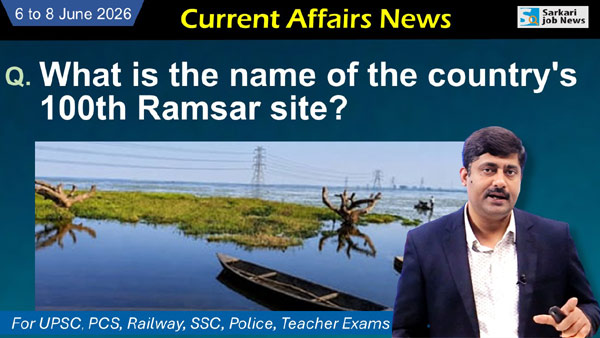
2. Name the country’s 100th Ramsar Site.
a. Shekha Lake
b. Sur Sarovar (Keetham Lake)
c. Sandi Bird Sanctuary
d. Jay Prakash Narayan Bird Sanctuary (Surha Tal)
Answer: d. Jay Prakash Narayan Bird Sanctuary (Surha Tal) (located in Ballia, Uttar Pradesh)
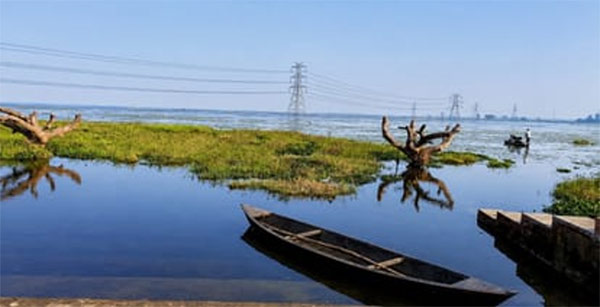
– On the occasion of World Environment Day (5 June 2026), Jay Prakash Narayan Bird Sanctuary (Surha Tal) became India’s 100th Ramsar Site.
– Location: Situated in the Bansdih region of Ballia district, Uttar Pradesh, in the Middle Ganga Basin.
– It is a natural perennial oxbow lake, formed when a meander of the Ganga River became separated from the main channel. Freshwater enters through three major water channels.
– History: The wetland was formed in 1991 by integrating approximately 3,432.93 hectares of land from 45 villages. In 2002, it was renamed as Jay Prakash Narayan Bird Sanctuary.
List of Major Ramsar Sites in Uttar Pradesh (up to May 2026)
1) Upper Ganga River (Brijghat to Narora) (2005): Bulandshahr/Amroha (Largest)
2) Nawabganj Bird Sanctuary (Shaheed Chandrashekhar Azad Bird Sanctuary) (2019): Unnao
3) Parvati Arga Bird Sanctuary (2019): Gonda
4) Samaspur Bird Sanctuary (2019): Raebareli
5) Sandi Bird Sanctuary (2019): Hardoi
6) Saman Bird Sanctuary (2019): Mainpuri
7) Sarsai Nawar Lake (2019): Etawah
8) Sur Sarovar (Keetham Lake) (2020): Agra
9) Bakhira Wildlife Sanctuary (2021): Sant Kabir Nagar
10) Haiderpur Wetland (2021): Muzaffarnagar/Bijnor
11) Patna Bird Sanctuary (2026): Etah (Smallest)
12) Shekha Lake Bird Sanctuary (2026): Aligarh
13) Jay Prakash Narayan Bird Sanctuary (Surha Tal), Ballia
What is a Wetland?
– A wetland is an area where water accumulates, especially during the rainy season, and supports a rich diversity of bird species.
– Ramsar designation helps strengthen conservation efforts for such ecosystems.
Why is it called a Ramsar Site?
– Ramsar is a city in Iran.
– On 2 February 1971, countries signed the Ramsar Convention on Wetlands there.
– The convention came into force in 1975.
– Its formal title is the Convention on Wetlands of International Importance especially as Waterfowl Habitat.
– India signed the convention in 1982.
– In India, the Ministry of Environment, Forest and Climate Change is the nodal ministry for wetland conservation.
100 Ramsar Sites of India (as of 8 May 2026)
1) Ashtamudi Wetland, Kerala
2) Beas Conservation Reserve, Punjab
3) Bhitarkanika Mangroves, Odisha
4) Bhoj Wetlands, Madhya Pradesh
5) Chandertal Wetland, Himachal Pradesh
6) Chilika Lake, Odisha
7) Deepor Beel, Assam
8) East Kolkata Wetlands, West Bengal
9) Harike Lake, Punjab
10) Hokersar Wetland, Jammu & Kashmir
11) Kanjli Lake, Punjab
12) Keoladeo Ghana National Park, Rajasthan
13) Keshopur-Miani Community Reserve, Punjab
14) Kolleru Lake, Andhra Pradesh
15) Loktak Lake, Manipur
16) Nalsarovar Bird Sanctuary, Gujarat
17) Nandur Madhameshwar, Maharashtra
18) Nangal Wildlife Sanctuary, Punjab
19) Nawabganj Bird Sanctuary, Uttar Pradesh
20) Parvati Arga Bird Sanctuary, Uttar Pradesh
21) Point Calimere Wildlife and Bird Sanctuary, Tamil Nadu
22) Pong Dam Lake, Himachal Pradesh
23) Renuka Wetland, Himachal Pradesh
24) Ropar Lake, Punjab
25) Rudrasagar Lake, Tripura
26) Saman Bird Sanctuary, Uttar Pradesh
27) Samaspur Bird Sanctuary, Uttar Pradesh
28) Sambhar Lake, Rajasthan
29) Sandi Bird Sanctuary, Uttar Pradesh
30) Sarsai Nawar, Uttar Pradesh
31) Sasthamkotta Lake, Kerala
32) Sundarban Wetland, West Bengal
33) Surinsar-Mansar Lakes, Jammu & Kashmir
34) Tso Moriri Lake, Jammu & Kashmir
35) Upper Ganga River, Uttar Pradesh
36) Vembanad-Kol Wetland, Kerala
37) Wular Lake, Jammu & Kashmir
38) Asan Conservation Reserve, Uttarakhand
39) Kabartal (Kanwar Lake), Bihar
40) Keetham Lake (Sur Sarovar), Uttar Pradesh (Agra)
41) Lonar Lake, Maharashtra
42) Tsarstapuk Tso and Tso Kar Lakes, Ladakh
43) Sultanpur National Park, Haryana
44) Bhindawas Wildlife Sanctuary, Haryana
45) Thol Lake Wildlife Sanctuary, Gujarat
46) Wadhvana Wetland, Gujarat
47) Haiderpur Wetland, Uttar Pradesh
48) Khijadia Bird Sanctuary, Gujarat
49) Bakhira Wildlife Sanctuary, Uttar Pradesh
50) Koonthankulam Bird Sanctuary, Tamil Nadu
51) Pallikaranai Marsh Reserve Forest, Tamil Nadu
52) Pichavaram Mangroves, Tamil Nadu
53) Pala Wetland, Mizoram
54) Sakhya Sagar Wetland, Madhya Pradesh
55) Koonthankulam Bird Sanctuary, Tamil Nadu
56) Satkosia Gorge, Odisha
57) Nanda Lake, Goa
58) Gulf of Mannar Marine Biosphere Reserve, Tamil Nadu
59) Ranganathittu Bird Sanctuary, Karnataka
60) Vembannur Wetland Complex, Tamil Nadu
61) Vellode Bird Sanctuary, Tamil Nadu
62) Sirpur Wetland, Madhya Pradesh
63) Vedanthangal Bird Sanctuary, Tamil Nadu
64) Udayamarthandapuram Bird Sanctuary, Tamil Nadu
65) Tampara Lake, Odisha
66) Hirakud Reservoir, Odisha
67) Ansupa Lake, Odisha
68) Yashwant Sagar, Madhya Pradesh
69) Chitrangudi Bird Sanctuary, Tamil Nadu
70) Suchindram Theroor Wetland Complex, Tamil Nadu
71) Vaduvoor Bird Sanctuary, Tamil Nadu
72) Kanjirankulam Bird Sanctuary, Tamil Nadu
73) Thane Creek, Maharashtra
74) Hygam Wetland Conservation Reserve, Jammu & Kashmir
75) Shallabugh Wetland Conservation Reserve, Jammu & Kashmir
76) Aghanashini Estuary, Karnataka
77) Ankasamudra Bird Conservation Reserve, Karnataka
78) Magadi Kere Conservation Reserve, Karnataka
79) Karaivetti Bird Sanctuary, Tamil Nadu
80) Longwood Shola Reserve Forest, Tamil Nadu
81) Nagi Bird Sanctuary, Bihar
82) Nakti Bird Sanctuary, Bihar
83) Nanjarayan Bird Sanctuary, Tamil Nadu
84) Kazhuveli Bird Sanctuary, Tamil Nadu
85) Tawa Reservoir, Madhya Pradesh
86) Sakkarakottai Bird Sanctuary, Tamil Nadu
87) Therthangal Bird Sanctuary, Tamil Nadu
88) Khecheopalri Wetland, Sikkim
89) Udhwa Lake, Jharkhand
90) Menar Wetland Complex, Rajasthan (Udaipur)
91) Khichan Wetland, Rajasthan (Jodhpur)
92) Gokul Reservoir, Bihar (Buxar)
93) Udaypur Lake, Bihar (West Champaran)
94) Gogabil Lake, Bihar (Katihar)
95) Kopra Reservoir, Chhattisgarh (Bilaspur)
96) Siliserh Lake, Rajasthan (Alwar)
97) Patna Bird Sanctuary, Uttar Pradesh (Etah)
98) Chhari-Dhand Wetland, Gujarat (Kutch)
99) Shekha Lake, Uttar Pradesh (Aligarh)
100) Jay Prakash Narayan Bird Sanctuary (Surha Tal), Uttar Pradesh (Ballia)
—- Question for Prelims Examination —-
Q. With reference to Ramsar Sites and wetland conservation in India, consider the following statements:
1) Jay Prakash Narayan Bird Sanctuary (Surha Tal) has been included as India’s 100th Ramsar Site and serves as a major refuge for migratory birds on the Central Asian Flyway.
2) The Ramsar Convention is an intergovernmental treaty related to wetland conservation and came into force in 1975.
3) Jay Prakash Narayan Bird Sanctuary (Surha Tal), located in Ballia district of Uttar Pradesh, is a completely man-made artificial reservoir.
4) In India, the Ministry of Environment, Forest and Climate Change acts as the nodal ministry for matters related to wetland conservation.
How many of the above statements are correct?
a. Only one statement
b. Only two statements
c. Only three statements
d. All four statements
Answer: c. Only three statements (1, 2 and 4 are correct)
Explanation
– Statement 1 is correct: On World Environment Day (5 June 2026), Jay Prakash Narayan Bird Sanctuary (Surha Tal) in Ballia, Uttar Pradesh, was declared the country’s 100th Ramsar Site. It serves as an important winter refuge for migratory birds under the Central Asian Flyway (CAF).
– Statement 2 is correct: The Ramsar Convention was signed in Ramsar, Iran, on 2 February 1971 and came into force globally in 1975.
– Statement 3 is incorrect: Surha Tal is a natural perennial oxbow lake formed due to the separation of a meander of the Ganga River. It is not a man-made or artificial reservoir.
Statement 4 is correct: The Ministry of Environment, Forest and Climate Change (MoEFCC) is the nodal agency for all regulatory and implementation matters related to the Ramsar Convention and wetland conservation in India.
—————
3. Whom did the Government of India appoint as the new Executive Director at the World Bank?
a. Neelkanth Mishra
b. Vinay Muralidhar
c. K. Satyanarayana Raju
d. Raghavendra Bhat
Answer: a. Neelkanth Mishra

– The Appointments Committee of the Cabinet appointed Neelkanth Mishra on 4 June 2026.
– He is an economist and market strategist.
– He will represent India at the World Bank Headquarters in Washington, D.C. for three years.
– He succeeded Neelkanth Parameswaran Iyer in this position.
World Bank Executive Director
– The World Bank Group has 25 Executive Directors who form part of its Board of Directors.
– They represent the institution’s 189 member countries.
– India’s Executive Director usually also represents neighboring countries such as Bangladesh, Bhutan, and Sri Lanka.

World Bank
– Established: July 1944
– President: Ajay Banga
– Managing Director & CFO: Anshula Kant
– Headquarters: Washington, D.C., USA
Who is the Executive Director of the World Bank?
– The World Bank Group has 25 Executive Directors who form part of its Board of Directors.
– These Directors represent the Bank’s 189 member countries.
– India’s Executive Director generally has the responsibility of representing not only India but also Bangladesh, Bhutan, and Sri Lanka.
– India is the largest shareholder within this constituency; therefore, appointments to this position are always made by the Government of India.
– This position is considered important for the country’s economic diplomacy at the global level, mobilizing funds for infrastructure, and influencing development policies.
Responsibilities for India at the World Bank
– As Executive Director, Neelkanth Mishra will represent India on the World Bank Board.
– This Board oversees decisions related to the World Bank’s loan operations, development projects, financial policies, and governance.
– Through this role, India participates in discussions concerning global development financing, infrastructure investment, and economic growth.
– Largest Shareholder Countries in the World Bank (Top 10 Countries)
Country – Voting Share (%)
USA – 15.85%
Japan – 6.84%
China – 4.42%
Germany – 4.00%
United Kingdom – 3.75%
France – 3.75%
India – 2.91%
Russia – 2.77%
Saudi Arabia – 2.77%
Italy – 2.64%
Total Shareholding of India’s Constituency
India: 2.91%
Bangladesh: 0.44%
Sri Lanka: 0.10%
Bhutan: 0.01%
Important Rules
– America’s Unofficial Veto Power
– According to World Bank rules, approval from 85% of voting shares is required for any major policy change or decision.
– Since the United States alone possesses 15.85% of the voting share, no major change in the World Bank can be made without American consent.
– This is often regarded as America’s “unofficial veto.”
Developed vs. Developing Countries
– Since its establishment, the World Bank has largely been dominated by Western and developed countries, particularly the United States and European nations.
– However, in recent years, due to the growing economic influence of emerging economies such as India and China, their quotas and voting shares have seen some improvement.
—- Question for Prelims Examination —-
Q. With reference to the position of ‘Executive Director’ in the World Bank and the related appointments that were recently in the news, consider the following statements:
1) In June 2026, Neelkanth Mishra was appointed by the Government of India as India’s new Executive Director at the World Bank.
2) The World Bank Board of Directors consists of a total of 25 Executive Directors who represent all 189 member countries.
3) India’s Executive Director on the World Bank Board is responsible only for representing India and does not represent neighboring countries.
4) At the time of his appointment, Neelkanth Mishra was serving as the part-time Chairman of the Unique Identification Authority of India (UIDAI) and was also a member of the Prime Minister’s Economic Advisory Council.
Which of the above statements are correct?
a. 1, 2 and 3 only
b. 2, 3 and 4 only
c. 1, 2 and 4 only
d. 1, 2, 3 and 4
Answer: c. 1, 2 and 4 only
Explanation
– Statement 1 is correct: On 4 June 2026, the Appointments Committee of the Cabinet appointed renowned economist Neelkanth Mishra as India’s new Executive Director at the World Bank headquarters in Washington for a period of three years. Before him, Parameswaran Iyer held this position.
– Statement 2 is correct: The Board of Directors of the World Bank Group consists of 25 Executive Directors who represent all 189 member countries and oversee financial policies and development projects.
– Statement 3 is incorrect: India’s Executive Director generally represents not only India but also neighboring countries such as Bangladesh, Bhutan, and Sri Lanka.
– Statement 4 is correct: Neelkanth Mishra served as the Chief Economist of Axis Bank, a member of the Prime Minister’s Economic Advisory Council, and also as the part-time Chairman of the Unique Identification Authority of India (UIDAI).
—————
4. For what type of food products did the Food Safety and Standards Authority of India (FSSAI) release a new logo?
a. Junk Food
b. Organic Food
c. Vegan Food
d. Fortified Food
Answer: c. Vegan Food

– FSSAI has made it mandatory for all approved vegan food products to carry a new standardized logo on their packaging from 1 July 2027.
– The requirement applies to products covered under the Food Safety and Standards (Vegan Foods) Amendment Regulations, 2026.
– According to FSSAI, a vegan product contains no ingredients derived from animals.
– The official vegan logo is a green square symbol featuring a stylized “V,” a sprouting leaf, and the word “VEGAN.”
– Vegan foods exclude milk, curd, paneer, butter, ghee, eggs, meat, fish, honey, and other animal-derived ingredients.
—————-
5. When is World Food Safety Day celebrated?
a. 5 June
b. 6 June
c. 7 June
d. 8 June
Answer: c. 7 June
– Theme for 2026: “From burden to solutions – safe food everywhere.”
– The day was established in 2018 by the World Health Organization (WHO) and the Food and Agriculture Organization (FAO).
– Its objective is to promote safer food systems and prevent food-borne diseases.
—————
6. Whom did the Central Government appoint as the new Vice Chief of the Air Staff in June 2026?
a. Air Marshal S.P. Dharkar
b. Air Marshal Ashutosh Dixit
c. Air Marshal Nagesh Kapoor
d. Tarun Chaudhary
Answer: b. Air Marshal Ashutosh Dixit

– He assumed the position of Vice Chief of the Air Staff on 1 July 2026.
– He succeeded Air Marshal Nagesh Kapoor.
– Air Marshal Ashutosh Dixit was commissioned into the fighter stream of the Indian Air Force (IAF) on 6 December 1986.
– The Chief of the Air Staff is Air Chief Marshal Amar Preet Singh.
—————
7. Who is the new Chairman of the Central Board of Secondary Education (CBSE)?
a. Himanshu Gupta
b. Rahul Singh
c. Lokhande Prashant Sitaram
d. Varun Bhardwaj
Answer: c. Lokhande Prashant Sitaram
– The Central Government appointed him as the new CBSE Chairman on 2 June 2026.
– Former Chairman Rahul Singh was transferred and appointed as Joint Secretary in the Ministry of Agriculture.
– Senior IAS officer Lokhande Prashant Sitaram was appointed to replace him.
– He is currently serving as Additional Home Secretary in the Ministry of Home Affairs.
—————-
8. Which Indian male Grandmaster won the Norway Chess 2026 title?
a. D. Gukesh
b. Vincent Keymer
c. Magnus Carlsen
d. R. Praggnanandhaa
Answer: d. R. Praggnanandhaa

– R. Praggnanandhaa won the title by defeating German player Vincent Keymer in the tenth and final round on 5 June 2026.
– The 20-year-old became the first Indian to win this prestigious tournament.
– He became only the second player from India to defeat Magnus Carlsen twice in the same tournament.
– Magnus Carlsen has won the Norway Chess tournament a record seven times, including in 2025.
Major Achievements of Praggnanandhaa
– Became an International Master (IM) at the age of 10.
– Reached the FIDE World Cup Final in 2023.
– Was part of the Indian team that won gold at the 45th Chess Olympiad in 2024.
– Won the Tata Steel Chess Tournament in 2025.
– Became champion of the Superbet Chess Classic Romania in 2025.
– Became India’s No. 1 rated chess player in 2025.
—————-
9. Which female Grandmaster won the Norway Chess 2026 title?
a. Bibisara Assaubayeva
b. Zhu Jiner
c. Divya Deshmukh
d. Koneru Humpy
Answer: a. Bibisara Assaubayeva
– Kazakhstan’s Bibisara Assaubayeva won the women’s title with 16.5 points.
– China’s Zhu Jiner finished second.
– Ukraine’s Anna Muzychuk secured third place with 15 points.
– India’s Divya Deshmukh finished fifth, while Koneru Humpy finished sixth.
About Norway Chess
– Norway Chess is one of the world’s most prestigious annual chess tournaments.
– Both the Open and Women’s categories featured only six players each.
– The player with white pieces receives more time but is expected to win.
– If a classical game ends in a draw, additional points are awarded through an armageddon format, ensuring a decisive outcome in every round.
—————-
10. Which player won the Men’s Singles title at the French Open 2026?
a. Jannik Sinner
b. Alexander Zverev
c. Flavio Cobolli
d. Casper Ruud
Answer: b. Alexander Zverev

– Germany’s Alexander Zverev won the first Grand Slam title of his career.
– He defeated Italy’s Flavio Cobolli in the final.
– The final was played in Paris on 7 June 2026.
The Four Grand Slam Tournaments
– Australian Open
– French Open
– Wimbledon
– US Open
—————-
11. Which player won the Women’s Singles title at the French Open 2026?
a. Aryna Sabalenka
b. Maja Chwalińska
c. Mirra Andreeva
d. Monica Seles
Answer: c. Mirra Andreeva

– The 19-year-old Russian tennis player won her first Grand Slam title.
– She defeated Poland’s Maja Chwalińska 6–3, 6–2 in the final.
– The final was held on 6 June 2026.
– With this victory, Mirra Andreeva became the youngest woman to win the French Open since Monica Seles in 1992.
– Monica Seles won the title at the age of 18.
—————-
12. Which players won the Men’s Doubles title at the French Open 2026?
a. N. Sriram Balaji and Marcelo Demoliner
b. Quentin Halys and Pierre-Hugues Herbert
c. Harri Heliovaara and Henry Patten
d. Marcel Granollers and Horacio Zeballos
Answer: d. Marcel Granollers and Horacio Zeballos

– Spain’s Marcel Granollers and Argentina’s Horacio Zeballos won the French Open Men’s Doubles title for the second consecutive year.
– In the final, they defeated Finland’s Harri Heliovaara and Britain’s Henry Patten 6–4, 6–2.
– The final was played in Paris on 6 June 2026.
– The pair, aged 40 and 41 respectively, won their second French Open and third Grand Slam title together.
– They had also won the French Open and US Open titles in 2025.
—————
13. Which players won the Women’s Doubles title at the French Open 2026?
a. Kateřina Siniaková and Taylor Townsend
b. Anna Danilina and Aleksandra Krunić
c. Shuko Aoyama and En-Shuo Liang
d. Luisa Stefani and Latisha Chan
Answer: a. Kateřina Siniaková and Taylor Townsend

– The title was won by Kateřina Siniaková of the Czech Republic and Taylor Townsend of the United States.
– It was their first French Open title and third Grand Slam title as a pair.
– They defeated the second-seeded team of Anna Danilina (Kazakhstan) and Aleksandra Krunić (Serbia) in the final.
– The final was played on 7 June 2026.
—————
14. Which players won the Mixed Doubles title at the French Open 2026?
a. Olivia Gadecki and John Peers
b. Sara Errani and Andrea Vavassori
c. Ivan Dodig and Latisha Chan
d. Evan King and Gabriela Dabrowski
Answer: b. Sara Errani and Andrea Vavassori

– The Italian pair of Sara Errani and Andrea Vavassori defeated American Evan King and Canadian Gabriela Dabrowski 4–6, 6–3, [10–4] in the final.
– The final was played on 4 June 2026 at Court Philippe-Chatrier, Stade Roland-Garros, Paris.
– This was their fourth Mixed Doubles Grand Slam title in seven Grand Slam appearances.
– Their achievements include consecutive US Open titles in 2024 and 2025.
French Open 2026 Winners
– Men’s Singles: Alexander Zverev (Germany)
– Women’s Singles: Mirra Andreeva (Russia)
– Men’s Doubles: Marcel Granollers (Spain) & Horacio Zeballos (Argentina)
– Women’s Doubles: Kateřina Siniaková (Czech Republic) & Taylor Townsend (USA)
– Mixed Doubles: Sara Errani & Andrea Vavassori (Italy)
—————-
15. In which Northeastern state of India was a new species of cascade-dwelling frog, Amolops kamal, recorded on 29 May 2026?
a. Nagaland
b. Arunachal Pradesh
c. Assam
d. Tripura
Answer: a. Nagaland
– Scientists from the Zoological Survey of India (ZSI) discovered a new species of cascade frog in Singrep village of Kiphire district, Nagaland.
– The species was recorded during a field survey conducted in August 2024 in hill-stream habitats near the Myanmar border.
– It was named Amolops kamal after Kamal Choudhury, teacher of the lead author of the research paper at B. Borooah College, Guwahati.
– Its common name is the Nagaland Cascade Frog.
The research was published in the latest issue of the journal Records of the Zoological Survey of India.
About Cascade Frogs
– Cascade frogs belong to the genus Amolops.
– They inhabit fast-flowing mountain streams and waterfalls.
– The genus is classified under the family Ranidae, commonly known as the true frogs.
Nagaland
– Capital: Kohima
– Governor: Nand Kishore Yadav
– Chief Minister: Neiphiu Rio
– Official Languages: English and Nagamese
– Neighboring States: Arunachal Pradesh, Assam, and Manipur
—————
16. Actor and National Award winner Salim Kumar passed away on 6 June 2026. He was associated with which language cinema?
a. Bhojpuri
b. Kannada
c. Malayalam
d. Bengali
Answer: c. Malayalam
– Malayalam actor Salim Kumar passed away at the age of 56 due to cardiac arrest.
– He began his film career with Ishtamanu Nooru Vattam in 1997.
– He acted in more than 300 Malayalam films.
– He also appeared in Tamil and Odia films.
– Some of his notable films include Adaminte Makan Abu, Pulival Kalyanam, Achanurangatha Veedu, Meesa Madhavan, and Mayavi.
– He initially gained popularity through comic roles.
Awards and Honors
– Won the National Film Award for Best Actor and the Kerala State Film Award for Best Actor for Adaminte Makan Abu (2010).
– Won the Kerala State Film Award for Second Best Actor for Achanurangatha Veedu (2005).
– Won the Kerala State Film Award for Best Comedian for Ayalum Njanum Thammil (2013).
– Received the Kerala State Film Award for Best Story for Karutha Joothan (2017).
—————-
17. Which bank won the Finacle Innovation Gold Award 2026?
a. Punjab National Bank
b. Karnataka Bank
c. J&K Bank
d. HDFC Bank
Answer: c. J&K Bank

– Jammu & Kashmir (J&K) Bank won the Gold Award in the category of “Technology-Led Innovation – Data Insights and Analytics Platform” at the Finacle Innovation Awards 2026.
– The award was received by MD & CEO Amitava Chatterjee and General Manager (Strategy & IT/CIO) Mohammad Muzaffar Wani at an event organized by Infosys Finacle in Mumbai on 3 June 2026.
– The event was based on the theme “Recomposing Banking – A Playbook for the Next Phase of Banking Transformation.”
– More than 200 banking and technology leaders from across the country participated in Finacle India Connect 2026.
—————
18. Asian Games medalist and legendary shot putter Balwinder Singh Dhaliwal passed away on 1 June 2026. Which honors had he received?
a. Khel Ratna
b. Maharaja Ranjit Singh Award
c. Arjuna Award
d. Both b and c
Answer: d. Both b and c

– Balwinder Singh Dhaliwal passed away at the age of 67 after battling lung cancer.
– He won a Bronze Medal at the 1982 New Delhi Asian Games.
– He also won: Silver Medal at the 1983 Asian Athletics Championships, Gold Medal in 1985, Bronze Medal in 1987
– In 1986, he set a new Asian record with a throw of 18.71 metres in an international meet.
– He received the Maharaja Ranjit Singh Award in 1983 and the prestigious Arjuna Award in 1987.
– His name was included in the Limca Book of Records in 1988.
– He served as an athletics coach at Panjab University from 2016 to 2024.
– He was also Vice-President of the Chandigarh Athletics Association.
—————-
19. How many artists were presented with the Uttar Pradesh Sangeet Natak Akademi Awards for the years 2021, 2022, 2023, and 2024 in June 2026?
a. 51
b. 93
c. 77
d. 87
Answer: a. 51

– The awards were presented on 5 June 2026 in Lucknow by Uttar Pradesh Deputy Chief Minister Brajesh Pathak.
– The ceremony was organized by the Uttar Pradesh Sangeet Natak Akademi at Lok Bhavan.
– The event celebrated the rich cultural traditions of Uttar Pradesh and India.
Awardees for 2021
– Pt. Deenanath Mishra (Classical Vocal Music)
– Shrikant Vaishya (Folk Singing)
– Jawahar Lal (Shehnai)
– Jagmohan Rawat (Stage Lighting)
– Bhumikeshwar Singh (Theatre Direction)
– Rajkumar Srivastava (Nautanki Direction)
– Vijay Pandit (Playwriting)
– Mohan Swaroop Bhatia (Art Promotion)
– Mala Hombal (Bharatanatyam)
– Prabhu Dayal (Nakkara Instrument)
– Manoj Kumar Mishra (Safdar Hashmi Award)
– Satish Anand (B.M. Shah Award)
Awardees for 2022
– Anand Kumar Malik
– Madhuri Sharma
– Pt. Anuj Mishra
– Pankaj Kumar Srivastava
– Shashikant Pathak
– Sunil Pawagi
– Mohan Lal Kunwar
– Manju Kaushal
– Meraj Alam
– Vijay Shankar Mishra
– Padmakant Sharma
– Rajesh Singh
– Kamal Jain
Awardees for 2023
– Dr. Ramshankar
– Manoj Kumar Gupta
– Rakesh Kumar Srivastava
– Dr. Akanksha Srivastava
– Anup Banerjee
– Chetan Kumar Joshi
– Sanjay Shriram Deglurkar
– Rajkumar Upadhyay
– Uma Trigunayat
– Dr. Omendra Kumar
– Arjundas Kesari
– Ajay Kumar
– Ravishankar Khare
Awardees for 2024
– Ritesh–Rajnish Mishra
– Marath Pandey
– Mukta Chatterjee
– Sugam Singh Shekhawat
– Mangal Prasad
– Sukhdev Mishra
– Rajesh Shah
– Sushma Sharma
– Ravikant Shukla “Shibbu”
– Rajesh Pandit
– Shashiprabha Tiwari
– Shubhdeep Raha
– Sanjay Mehta
—————-
20. When is World Brain Tumor Day observed?
a. 6 June
b. 7 June
c. 8 June
d. 9 June
Answer: c. 8 June
– World Brain Tumor Day was first observed on 8 June 2000 by the German Brain Tumor Association (Deutsche Hirntumorhilfe e.V.) to support brain tumor patients.
– The association was established in 1998.
– It has more than 500 registered members from 14 countries.
– The day aims to raise awareness about brain tumors, promote early diagnosis, support patients and caregivers, and encourage research into treatment and prevention.
PDF Download: Click here