
This is the current affairs of 1 & 2 October 2025. Here are questions and answers of daily current affairs for better preparation of competitive exams for government jobs.
PDF Download: Click here
1. Why did the US government shutdown start on October 1, 2025?
a. Failure to pass a budget bill in Congress
b. Federal employee strikes
c. Tax and foreign aid disputes
d. Courts blocking federal spending
Answer: a. Failure to pass a budget bill in Congress
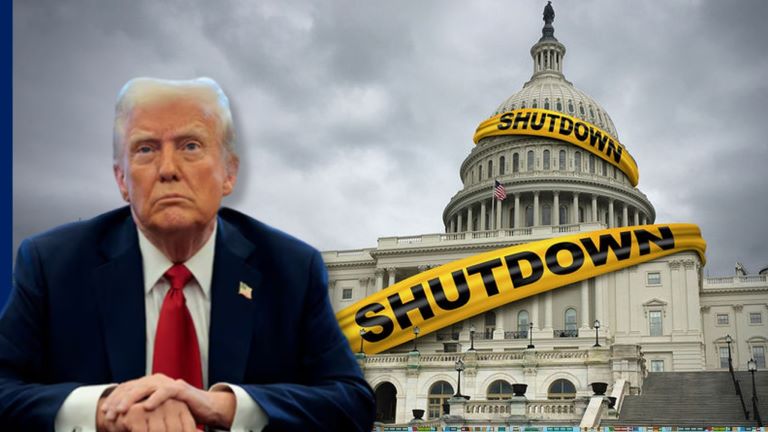
– A government shutdown was implemented in the United States (USA) on October 1, 2025.
– The reason is that President Donald Trump failed to get the funding bill passed in the Senate.
– As a result, many non-essential government operations have come to a halt, forcing around 900,000 government employees to go on unpaid leave.
– In fact, voting on the bill took place late at night on September 30, 2025. The bill received 55 votes in favor and 45 against. It needed 60 votes to pass.
– Trump’s Republican Party needed support from opposition Democrat lawmakers, but the Democrats voted against the bill.
– However, Republican leaders have said that the bill will continue to be presented daily until the Democrats support it.
When is the fiscal year in the USA?
– From October 1 to September 30 of the following year (whereas in India, the fiscal year runs from April 1 to March 31).
– The fiscal year in the USA, also known as the “spending year,” begins on October 1. It is essentially the government’s financial year during which it plans its spending and budget.
– During this time, the government decides where to allocate funds — for example, to defense, healthcare, or education. If the new budget is not passed by this date, government operations shut down. This is known as a shutdown.
How is the budget passed in the USA?
– Let’s compare it with India — the Indian government’s budget includes a complete account of expenditure and income, which must be passed by the Parliament. It is known as the Finance Bill. In contrast, the US budget is divided into multiple parts.
– In the US, the budget is discussed by House and Senate committees of Congress. They prepare 12 Appropriations Bills related to it.
– Each bill legally authorizes spending for a particular department or program.
– If the budget or these Appropriations Bills are not passed on time, the government loses the legal authority to spend money.
What does a government shutdown mean?
– In the USA, the government must pass its budget every year. If Congress doesn’t agree on the budget, the funding bill doesn’t pass, and the government stops receiving money.
– As a result, some government departments and services don’t receive funds. Non-essential services are shut down. This is known as a government shutdown.
– Trump has blamed the Democrats for this shutdown. He has already threatened to lay off government employees.
– The US has seen a government shutdown again in 2025, the first since 2019. The last one was also during Trump’s term and lasted 35 days.
What is the issue over which the opposition isn’t giving support?
– The two major US parties, the Democrats and Republicans, are in conflict over the Obama Healthcare Subsidy Program. The Democrats want healthcare (insurance) subsidies to be increased.
– Republicans fear that if subsidies are increased, the government will need more money to cover the expenses, which could affect other government operations.
– To prevent a shutdown, President Trump and Democratic leaders held a meeting at the White House on Monday, but it ended without any resolution.
Does Trump gain or lose from the shutdown?
– During a shutdown, the Trump administration can decide — through the Office of Management and Budget (OMB) — which services are essential and non-essential.
– This allows them to classify Democrat-backed programs like education, environment, and health subsidies as non-essential, while labeling defense and immigration as essential. Trump himself has said that “many good things” will come from the shutdown.
– Due to the shutdown, a large number of people may be laid off. In 2025 alone, there has already been a reduction of 300,000 federal jobs — a part of Trump’s policy.
– In the last 50 years, the U.S. has experienced 20 shutdowns due to funding bill delays. During Trump’s previous term alone, the government faced three shutdowns.
————-
2. The Free Trade Agreement (FTA) between India and which countries of the European Free Trade Association (EFTA) came into effect on October 1, 2025?
a. Hungary, Ireland
b. Iceland, Liechtenstein
c. Norway, Switzerland
d. Both b and c
Answer: d. Both b and c (Iceland, Liechtenstein, Norway, and Switzerland)
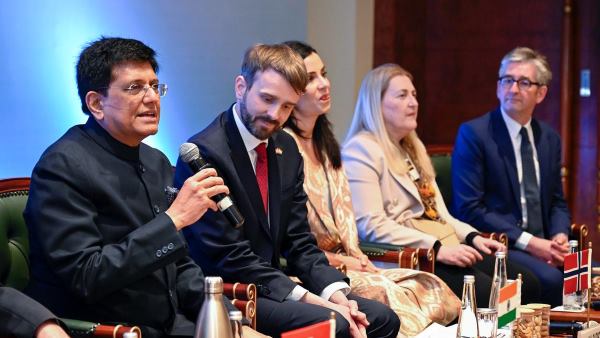
– On October 1, 2025, Commerce and Industry Minister Piyush Goyal announced that the Free Trade Agreement (FTA) between India and the group of four European countries (EFTA) has come into effect.
– This agreement will open new opportunities for trade, investment, and job creation, benefiting both individuals and businesses.
When was the agreement signed?
– On March 10, 2024, India signed a Free Trade Agreement (FTA) with the European Free Trade Association (EFTA), a group of four countries: Iceland, Liechtenstein, Norway, and Switzerland.
– These four countries are not part of the European Union (which consists of 27 member states).
What is a Free Trade Agreement (FTA)?
FTA – Free Trade Agreement
– This type of agreement is designed to simplify trade between two or more countries.
– Under an FTA, customs duties, regulatory laws, subsidies, and quotas on imports and exports are relaxed or eliminated.
– Either very low or zero tariffs are applied, and there are minimal restrictions on the import or export of products.
What’s included in the agreement?
– The goal of the agreement is to bring $100 billion (approximately ₹8.27 lakh crore) in investment into India over the next 15 years and to generate up to 1 million jobs.
– This means these four European countries will invest $100 billion in India.
– Products like Swiss watches, chocolates, and cut and polished diamonds will now be allowed at reduced or zero tariffs.
– The agreement also aims to promote investment and exports in domestic service sectors such as IT, audio-visual services, and the movement of skilled professionals.
First-Ever Investment from EFTA Countries into India
– Commerce Minister Piyush Goyal said that, for the first time in world history, India has signed a Free Trade Agreement (FTA) with EFTA countries that includes a binding commitment to invest $100 billion in India.
Since When Has the FTA Been in Discussion?
– Talks for this trade agreement began in 2008, but stalled towards the end of 2013 due to certain reasons.
– After a decade-long gap, negotiations resumed in 2023.
– Before finalizing the agreement, 21 rounds of negotiations took place. The agreement was signed on March 10, 2024.
What will India gain?
– Among the four countries with which the agreement has been made, Switzerland has the largest trade with India.
– India will reduce or remove customs duty on high-quality Swiss products such as Swiss watches, chocolates, and biscuits for some time. Currently, India imposes 30% import duty on chocolates and 20% on watches.
– The global leadership of EFTA countries will open new doors for collaboration in several sectors including digital trade, banking and financial services, transport and logistics, industrial machinery, biotechnology, pharmaceuticals, chemicals, food processing, and clean energy.
– India has similar agreements with the UAE and Australia as well.
Country Profiles of the EFTA Members:
Iceland
– A Nordic island nation known for volcanoes, geysers, and hot springs.
– Capital: Reykjavík
– Prime Minister: Kristrún Frostadóttir
– Currency: Icelandic Krona
Norway
– A Nordic country known for mountains, glaciers, and deep coastal fjords.
– Capital: Oslo
– King: Harald V
– Prime Minister: Jonas Gahr Støre
– Currency: Norwegian Krone
Switzerland
– A landlocked country in Central Europe.
– Capital: Bern
– President: Karin Keller-Sutter
– Currency: Swiss Franc
Liechtenstein
– A small landlocked country in Europe.
– Capital: Vaduz
– Prime Minister: Brigitte Haß
– Currency: Swiss Franc
– Area: 160 square kilometers (about the same size as the Indian city of Jhansi)
——
Questions for UPSC and State PCS Prelims Exam
Q1. What is the main objective of the India-EFTA Free Trade Agreement (FTA)?
a. Eliminate all customs duties on imports and exports.
b. Create 1 million jobs and generate $100 billion in investment in India over 15 years.
c. Promote e-governance and digital services only.
d. Increase India’s trade with the European Union (EU).
Answer: b. Create 1 million jobs and generate $100 billion in investment in India over 15 years.
—–
Q2. Which statement is correct about the India–EFTA FTA?
a. All EFTA members are part of the European Union (EU).
b. The agreement underwent 21 rounds of negotiations and was signed on March 10, 2024.
c. The agreement applies only to trade in goods, not services.
d. India signed the agreement only with Norway and Switzerland.
Answer: b. The agreement underwent 21 rounds of negotiations and was signed on March 10, 2024.
——
Q3. What type of investment commitment is the India-EFTA FTA?
Options:
a. Non-binding only
b. Binding commitment
c. Temporary
d. Conditional
Correct answer: b. Binding commitment
—–
UPSC and State PCS Mains Exam Level Questions
– GS Paper 2 (Governance, Constitution, Polity, Social Justice & International Relations)
– GS Paper 3 (Economic Development, Technology, Environment)
Q. India also has FTAs with the UAE and Australia. Compare the benefits and challenges of these agreements from an EFTA perspective.
How to write the answer:
– EFTA: Focus on the European market, high-quality products, digital trade, and financial services.
– UAE/Australia: Emphasis on regional supply chains, natural resources, agriculture, and services.
– Challenge: Competition with domestic industries, investment management, and protection of sensitive sectors.
– Logical link: Every FTA has different regional and sectoral importance, so balancing these in policy-making is essential.
————-
3. Jane Goodall, who died on October 1, 2025, at the age of 91, was related to which field?
a. Nuclear physics
b. Primatology and conservationism
c. Space science
d. Climate geography
Answer: b. Primatology and conservationism
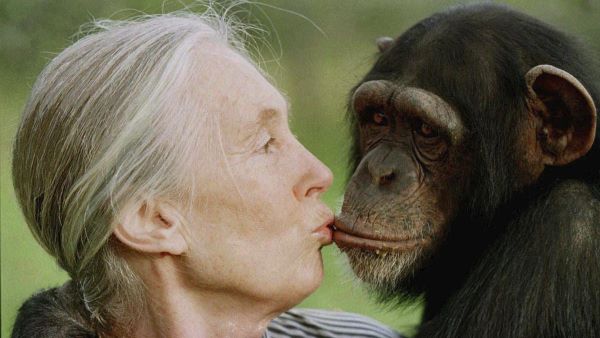
– Jane Goodall passed away in the United States on October 1, 2025, at the age of 91.
– Born in London in 1934; grew up in Bournemouth, England.
– Inspired by stuffed gorilla toys from her father and books like “Tarzan” and “Dr. Dolittle.”
– Kenya trip: Reached Kenya by boat in 1957. After meeting famous anthropologist Louis Leakey and his wife Mary Leakey, she began primate studies.
As a primatologist and environmentalist, Jane
– Jane Goodall conducted her major study on chimpanzees at Gombe National Park, Tanzania.
– Her discoveries changed the direction of ethology (the study of animal behavior).
– She worked on chimpanzees’ social behavior, tool use, and emotional life.
– She demonstrated that chimpanzee groups, especially chimpanzees, are not just simple creatures but possess complex social behavior, tool use, and emotional life.
– Her perspective challenged old notions of the human-animal divide.
– In 1977, she founded the Jane Goodall Institute, which works on primate conservation, ecological education, and raising awareness in local communities.
– She was the first to show that chimpanzees use leaf stems to extract insects — challenging the then-common belief that only humans could make tools.
– Over time, she realized that the conservation of chimpanzees and other animals is linked to nature conservation.
– Since then, she took on the role of an environmental activist.
Meaning of Primatologist
– Primatology is the scientific study of primates, which includes the behavior, development, ecology, and conservation of primate species such as humans, monkeys, apes, and others.
– It is connected to ethology (animal behavior science), anthropology, and biodiversity conservation.
– The study of primates and Jane Goodall’s work are directly linked to Charles Darwin’s Theory of Evolution (Theory of Evolution by Natural Selection, 1859).
– She believed that all living beings have evolved from a common ancestor. Those organisms that adapted better to their environment survived (Survival of the Fittest).
Darwin’s Theory of Evolution
– In his book The Origin of Species, Darwin concluded that species evolve through natural selection.
– He believed that all living beings on Earth share some common ancestors.
– Since natural resources are limited and climate changes are common, some individuals of a species learn to adapt better than others.
– Their chances of survival were better compared to those who failed to adapt to the changing environment and perished.
– Those who survived reproduced and passed their traits to their offspring, ensuring that only the fittest generations continued to live.
– The acquisition of traits that help different species survive can be called evolution.

————-
4. Which state government declared Balod district as India’s first child marriage free district?
a. Madhya Pradesh
b. Odisha
c. Chhattisgarh
d. Jharkhand
Answer: c. Chhattisgarh
————-
5. Which district was declared as India’s first child marriage free district by the Chhattisgarh government?
a. Balod
b. Kabirdham
c. Mahasamund
d. Bastar
Answer: a. Balod
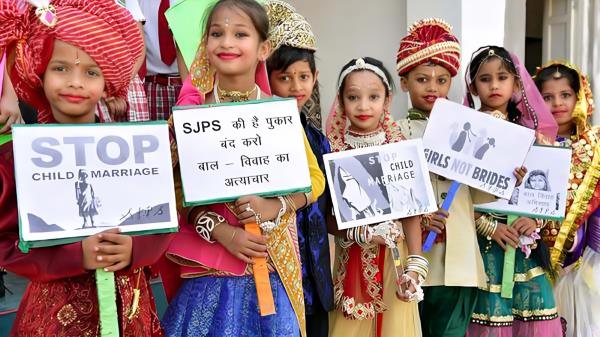
– The Chhattisgarh government claimed on September 30, 2025, that Balod has become India’s first child marriage-free district, officially declared as child marriage-free.
– All 436 gram panchayats and nine urban bodies in the district have been formally awarded certificates by the state government.
– In the last two years, no cases of child marriage have been reported in Balod.
– Divya Umesh Mishra, the district collector of Balod, credited this achievement to the collective efforts of the district administration, anganwadi workers, public representatives, and the community.
Child Marriage-Free India Campaign
– Balod district achieved this milestone under the ‘Child Marriage-Free India’ campaign launched by Prime Minister Narendra Modi on August 27, 2024.
Goal of a Child Marriage-Free State
– The Chief Minister said the goal is to make the entire state child marriage-free by 2028-29.
– This is not just a government plan but a strong effort to bring about change in society.
– He also said that the process of declaring more panchayats and urban bodies child marriage-free is being accelerated.
What is the Child Marriage Law?
– The Prohibition of Child Marriage Act, 2006 (PCMA, 2006) was implemented to prevent child marriages and ensure their eradication from society.
– It is a law aimed at curbing child marriages and punishing those involved in them.
– The legal marriage age is 18 years for girls and 21 years for boys.
– Child marriage is illegal but not invalid.
– There is a provision of up to two years’ imprisonment for child marriage.
– The court can issue an order to stop the marriage even after it has taken place.
– Under this Act, the offense is non-bailable.
How many child marriages occur annually in India?
– Child marriage prevalent in society is evidence of gender inequality and discrimination.
– According to UNICEF estimates, 1.5 million (15 lakh) girls under the age of 18 get married every year in India.
– India has the highest number of child marriages in the world, accounting for about one-third of all child marriages globally.
States with the highest number of child marriages:
– West Bengal
– Bihar
– Jharkhand
– Rajasthan
– Tripura
– Assam
– Andhra Pradesh
————-
6. PM Modi released a commemorative coin of Rs 100 at the centenary celebrations of RSS, which picture has been inscribed on Indian currency for the first time?
a. Mahatma Gandhi
b. Taj Mahal
c. Bharat Mata
d. Red Fort
Answer: c. Bharat Mata
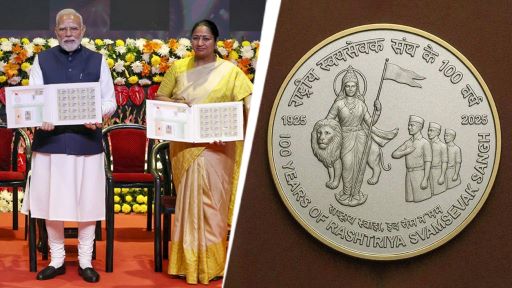
– On October 1, 2025, Prime Minister Narendra Modi released a special postage stamp and a commemorative coin on the occasion of the centenary celebrations of the Rashtriya Swayamsevak Sangh (RSS), featuring, for the first time, an image of Bharat Mata (Mother India) on Indian currency. During this event, PM Modi also released the postage stamp.
What is depicted on the coin and the postage stamp?
– The ₹100 coin has the national emblem on one side.
– On the other side, there is a grand image of Bharat Mata in Varada Mudra (the hand gesture symbolizing blessing or giving) alongside a lion.
– The coin also bears the RSS motto “Rāṣṭrāya Svāhā, Idaṁ Rāṣṭrāya, Idaṁ Na Mama,” which means “Everything is dedicated to the nation, everything belongs to the nation, nothing is mine.”
– The postage stamp depicts the participation of RSS volunteers in the Republic Day parade of 1963.
About RSS (according to The Hindu newspaper)
– The RSS was founded in 1925 in Nagpur by Keshav Baliram Hedgewar. It is a volunteer-based organization aimed at promoting cultural understanding, discipline, a spirit of service, and responsibility towards society among people.
————-
7. When is the International Day for Universal Access to Information (IDUAI) observed?
a. 28 September
b. 29 September
c. 30 September
d. 1 October
Answer: a. 28 September
Theme 2025
– Ensuring Access to Environmental Information in the Digital Age
– This day highlights that the right to information is essential not only at the national level but also at the international level for democratic governance, transparency, and accountability.
– The United Nations (UN) and UNESCO believe that access to accurate information empowers citizens, reduces corruption, and helps achieve the Sustainable Development Goals (SDGs).
————-
8. When is International Translation Day celebrated?
a. 28 September
b. 29 September
c. 30 September
d. 1 October
Answer: c. 30 September
Theme 2025
– Translation, shaping a future you can trust
– This day is celebrated to promote linguistic diversity, dialogue, and intercultural exchange.
– In 1953, the International Federation of Translators (FIT) started observing this day for the first time.
– In fact, St. Jerome, who passed away on September 30, is considered a great scholar who translated the Bible and is regarded as the Patron Saint of Translators.
– In 2017, the United Nations General Assembly (UNGA) officially declared September 30 as “International Translation Day.”
————-
9. Mohsin Naqvi deposited the Asia Cup trophy at the ACC office.
– Pakistan Cricket Board (PCB) chief and Asian Cricket Council (ACC) head Mohsin Naqvi has deposited the Asia Cup trophy at the ACC office.
– In fact, after the Asia Cup final held on September 28, the Indian team refused to accept the trophy from Naqvi’s hands.
– After that, instead of giving the trophy to the team through another ACC official, Naqvi took it with him to the hotel. He insisted that he would give the trophy only to the Indian team himself.
– Two days later, on Tuesday, the ACC’s annual meeting was held. The Board of Control for Cricket in India (BCCI) asked Naqvi to return the trophy as soon as possible.
– NDTV reported citing sources that Indian officials warned Naqvi that if he did not comply, impeachment proceedings could be initiated to remove him from the post of ACC chief.
– After this, Naqvi deposited the trophy. Now, a decision is pending on how this trophy will be given to India.
————-
10. Who has become the new Director General (DG) of CISF?
a. Rakesh Kumar
b. Ajay Verma
c. Rashmi Kumari
d. Praveer Ranjan
Answer: d. Praveer Ranjan
– He joined on September 30, 2025.
– He is a 1993 batch IPS officer.
PDF Download: Click here