
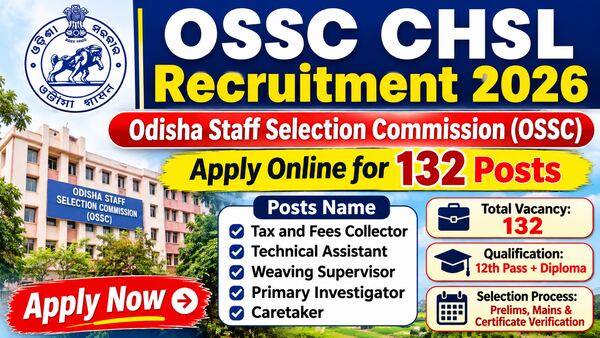
Odisha Staff Selection Commission (OSSC) Recruitment 2026: Odisha Staff Selection Commission (OSSC) has recently announced a recruitment drive for the position of Caretaker, Weaving Supervisor, Primary Investigator, Technical Assistant, Tax and Fees Collector This recruitment is set to fill 132 posts.
Department: Odisha Staff Selection Commission (OSSC)
Posts: Caretaker, Weaving Supervisor, Primary Investigator, Technical Assistant, Tax and Fees Collector
Total posts: 132
Eligibility: 10th Pass/12th Pass/ Diploma
Age Limit: 18 years to 42 years
Last date: 25 November 2026 to 28 December 2026
Apply Fee: Rs.500/-
Salary: Level-4 to Level-9
Job Location: Odisha
Apply Mode: Online
Note: – If you have any query regarding selection process then you must see the notification and read carefully.
Odisha Staff Selection Commission (OSSC) Vacancy Details:
Total Vacancy: 132
Name of post: Caretaker, Weaving Supervisor, Primary Investigator, Technical Assistant, Tax and Fees Collector
Tax and Fees Collector: 80
Technical Assistant: 32
Weaving Supervisor: 15
Primary Investigator: 03
Caretaker: 02
Eligibility Criteria: 10th Pass / 12th Pass + Post-specific Diploma/Technical Qualification/Basic Computer Knowledge
Age Limit: 18 years to 42 years
Age Relaxation:
SC/ST/SEBC/Women: 5 Years
PwD: 10 Years
Ex-Servicemen: As per rules.
Application fee: Rs.500/-
Exam Pattern:
| Exam Stage | Exam Type | Total Marks |
|---|---|---|
| Preliminary Exam | Objective (MCQ) | 150 |
| Main Written Exam | Post-wise Technical Paper | 200 |
| Certificate Verification | Document Checking | — |
Syllabus:
1. Preliminary Examination (Common Syllabus)
Arithmetic & Data Interpretation, Logical Reasoning, Analytical Ability, Mental Ability, General Awareness & Current Affairs, Computer & Internet Awareness
2. Main Examination (Post-wise Technical Syllabus)
Caretaker: Communication Skills, Front Office Operation, Accommodation Operation, Customer Relation, Management, Employability Skills, Rooms Division Management, Facility Management, Human Resuorce, Management, Entrepreneurship Development, Fundamentals of Marketing Skills, Financial Management, Basics of Computer Applicatio
WEAVING SUPERVISOR
A. FIBRE SCIENCE
Classification, Manufacturing, Properties, Uses and Identification of both Natural andSynthetic Fibres.
Melt, Wet and Dry Spinning
B. YARN MANUFACTURE
Objectives and Mechanism of Ginning, Carding, Drawing, Doubling. Drafting, Combing andCompact
Spinning Machineries used and their functions, maintenance of machineries, Yarndefects with
remedial measures.
C. FABRIC MANUFACTURE
Objectives of Warp & Weft Winding. Types, Features & Mechanism of different WindingMachines,
Fabric Defects and remedial measures. Sizing, Parts of different looms and theirfunctions with
working principle. Fabric Designs, Drafting, Lifting and Denting.
D. TEXTILE CHEMICAL PROCESSING
Objectives of various pre-treatment like Singeing, De sizing, Scouring, Souring,
Bleaching,Mercerising and their Methodologies using different machineries. Classification of
Dyestuffs.Dyeing & Printing. Dyeing Recipes, Working principles of Dyeing Machineries.
ColourFastness, Printing Pastes. Different Finishes like Calendaring, Heat Setting, Anti Crease,Water
Proof, Flame Retardant, Softening, Stiffening, Moth Proof, Optical Whitening , Antimicrobial.
E. TEXTILE TESTING
Factors influencing Testing of Fibre, Yarn and Fabric. Fibre. Yarn and Fabric Quality.Principle of
Testing. Air & Water Permeability, Tensile, Tearing, Bursting Strength,Evenness, Fibre Maturity,
Impurities, Abrasion Resistance and Pilling. Machineries used inTextile Testing and their functions.
TECHNICAL ASSISTANT
Fabric Structure & Cloth Analysis, Weaving Mechanism, Textile Chemistry, Textile Calculations,Tie & Dye (Ikat Technology),Made-up Garments (Theory),Handloom Economics & Management,Computer-Aided Design (CAD)
PRIMARY INVESTIGATOR
Indian Economy: Status of Indian Economy, Sectoral Composition & Development,
Economic Planning and economic Reforms, New Economic Policy. Current Challenges Facing
in the Indian Economy, Nature of Population problem, Poverty, In-equality, Un-employment etc.
Introductory Micro Economics:- Introduction, Demand and Supply Analysis, Concept of
Elasticity.
Utility Analysis:– Ordinal and Cardinal Utility, Law of Marginal Utility.
Production Function:– Concepts, Laws of Return and return to scale.
Cost and Revenue:- Meaning, Average and Marginal cost curves, Nature of short run and
long run cost curves.
Market Equilibrium:- Perfect competition, Monopoly and Monopolistic competition, Price
determination and different markets.
Introductory Macro Economics:-Meaning of Macro Economics.
National Income Accounting:- Concepts of GDP, GNP, NDP and National Income and
measurement.
Money and Banking:- Nature and function of money, value of money, inflation and deflation,
role of monetary policy, Credit Control measure with special reference to RBI.
Public Finance:- Nature, Scope and Importance of public finance, Fundamental ideas on public
Budget.
STATISTICS
1. Probability Theory-I
Definition of Probability:- Classical, Empirical and Axiomatic Approach, Sample Space and events,
Concept of sets. Correspondence between sets and events.
Probability by direct enumeration. Laws of addition and multiplication, conditional Probability and
independence of events.
2. Probability Theory-II
Concept of Random Variable, Discrete and Continuous Random Variables and their probability
distribution. Mathematical expectation of random variables. Addition and Multiplication laws of
exception. Variance of Sum of Random Variables.
3. Statistical Method-I
Definition, Scope and Limitation of Statistics, Collection of Data; Primary and Secondary Data,
Classification of data, Tabulation of data, One way tables. Presentation of Data, Diagram-Simple,
Multiple, Subdivision and percentage bar diagrams, pie diagrams, Graphs Frequency curve,
Frequency Polygon, Ogives (Cumulative Frequency Curve) and Histogram.
4. Statistical Method-II
Frequency distribution, Measures of Central Tendency: Arithmetic Mean, Geometric Mean, Harmonic
Mean, Median and Mode, Quartiles, Measures of Dispersion; Range, Inter -Quartile range. Quartile
Deviation, Mean absolute deviation, Standard Deviation. Coefficient of Variation and Moments: Raw
and Central moments of various orders. Skewness and its different measures, Kurtosis and its measure
based on moments.
TAX & FEE COLLECTOR
1. Arithmetic: Simple Interest and Compound Interest, Profit, Loss, and Discount, Fractions & Decimals,Partnership
Time and Work,Time and Distance, HCF and LCM, Squares and Square Roots, Ratio and Proportion, Mensuration
Number Series, Cubes and Cube Roots, Percentage and Averages, Number System
2. English:Verbs, Tenses, Active and passive voice, Subject-verb agreement, Connectors, Types of sentences, Direct and indirect speech, Comparison., Articles, Noun, Pronoun, Prepositions, Unseen passage with a variety of comprehension questions.
3. Odia: – Parts of speech (Noun Adjectives, verb), Derivation of words, Synonyms and Antonyms, Idioms.
Comprehension of an unseen prose passage.
4. General Knowledge: – Matching Historical events with dates, personalities and places, Geographical facts with places, States, Countries and Institutions with headquarters, Scientific facts and discoveries with dates, persons and uses, Current events with places and personalities.
5. Computer:- Basic Knowledge about computer, MSWORD, MSWINDOWS, M.S. EXCEL, M.S. POWERPOINT, Internet communication.
How to apply: Online
Odisha Staff Selection Commission (OSSC) Recruitment 2026 Important Dates:
Starting date for online application: 25 November 2026
Last date for online application: 28 December 2026
Last date for payment of fee: 28 December 2026
Click here for Officially Notification
About: The Odisha Staff Selection Commission (OSSC) conducts the Combined Higher Secondary (10+2) Level Recruitment Examination to recruit eligible candidates for various specialist posts under different departments of the Odisha Government.