This is the current affairs 1 to 4 November 2026. Here are questions and answers of daily current affairs for better preparation of competitive exams for government jobs.
1. Which country won the men’s title at the first Commonwealth Kabaddi Championship in 2026?
a. India
b. Sri Lanka
c. Canada
d. Australia
Answer: a. India
– India won the title on 31 October 2026 at the Veer Savarkar Sports Complex in Ahmedabad.
– India defeated Sri Lanka 54-20 in the final.
About the Games
– Organizer: Organized by the Amateur Kabaddi Federation of India (AKFI), with the approval of the International Kabaddi Federation (IKF).
– Duration: 23 to 31 October 2026
– Venue: Veer Savarkar Sports Complex, Ahmedabad
– Participating Countries: More than 400 players from 13 countries.
– It is being organized with the aim of getting Kabaddi officially included in the upcoming Commonwealth Games and promoting the sport at the international level.
Participating Countries
– India
– Sri Lanka
– Bangladesh
– Nigeria
– Kenya
– Tanzania
– Canada
– Singapore
– Malaysia
– Uganda
– England
– Scotland
– Australia
————–
2. Which country won the women’s title at the first Commonwealth Kabaddi Championship in 2026?
a. Bangladesh
b. India
c. Uganda
d. Malaysia
Answer: b. India
– The women’s team won the gold medal by defeating Uganda 35-15 in the final.
– The women’s team won all 6 of its matches.
————–
3. Which Indian player won the women’s singles title at the Hylo Open 2026 (Badminton)?
a. P. V. Sindhu
b. Anmol Kharb
c. Pornpawee Chochuwong
d. Line Kjaersfeldt
Answer: a. P. V. Sindhu
– The tournament was held in Germany.
– Indian badminton player P. V. Sindhu defeated Denmark’s Line Kjaersfeldt in the final held on 1 November.
– This is Sindhu’s second BWF Tour title this season.
What is BWF?
– The BWF World Tour is an international badminton tournament circuit organized by the Badminton World Federation (BWF).
– Tournaments are held throughout the year in different countries around the world.
– Players receive ranking points and prize money based on their performances in these tournaments.
– The tour includes tournaments ranging from Super 100 to Super 1000. Super 1000 tournaments are the highest-level tournaments.
—————
4. Which Indian player won the Hylo Open 2026 men’s singles title for the second time?
a. Toma Junior Popov
b. Lakshya Sen
c. Anders Antonsen
d. Jonatan Christie
Answer: b. Lakshya Sen
– India’s Lakshya Sen defeated Indonesia’s Jonatan Christie in the final held on 1 November.
– The match took place at the Saarlandhalle Arena in Saarbrücken, Germany.
– 25-year-old Lakshya Sen had previously won the Hylo Open title in 2021.
————–
5. Who became the youngest Formula One (F1) champion by winning the world championship at the Formula One Mexico Grand Prix auto race?
a. George Russell
b. Lewis Hamilton
c. Max Verstappen
d. Kimi Antonelli
Answer: d. Kimi Antonelli (Italy)
– Italy’s Antonelli was crowned champion on 1 November 2026.
– Mercedes driver Andrea Kimi secured the Formula One World Championship title at the Mexico City Grand Prix by finishing third at the age of just 20 years and 68 days.
– He broke the record of Germany’s Sebastian Vettel, who won his first Formula One World Championship in 2010 at the age of 23 years and 134 days.
– In the 71-lap race held at the Autódromo Hermanos Rodríguez Circuit in Mexico, Antonelli started from fourth position and finished the race in third place.
– Antonelli became the first Italian driver to win the Formula One Drivers’ World Championship since Alberto Ascari in 1953.
– He made his Formula One debut with Mercedes in 2025.
————–
6. Which states celebrate their Foundation Day on November 1st?
a. Karnataka, Kerala
b. Madhya Pradesh, Tamil Nadu
c. Haryana, Chhattisgarh
d. All of the above
Answer: d. All of the above (Karnataka, Kerala, Tamil Nadu, Madhya Pradesh, Chhattisgarh and Haryana)
– November 1 is a very special day for several states and Union Territories of India because many states were formed or reorganized on this day on linguistic and administrative grounds.
– Although the years of formation of all these states were different, November 1 is recorded as a historic date for all of them.
Foundation Day of 6 States
– Madhya Pradesh: Madhya Pradesh was reorganized on 1 November 1956. This day is celebrated as ‘Madhya Pradesh Foundation Day’, during which various programmes are organized.
– Chhattisgarh: It was the 26th state to be formed in India. It came into existence on 1 November 2000 after being separated from Madhya Pradesh, and the state celebrates its Foundation Day on this day.
– Haryana: Haryana was formed as a separate state from Punjab on linguistic grounds on 1 November 1966. Various programmes are organized by the state government on this day.
– Karnataka: Karnataka was reorganized on 1 November 1956 under the States Reorganisation Act by merging Kannada-speaking regions.
– Kerala: This southern Indian state was also formed on 1 November 1956 by merging the regions of Malabar, Cochin and Travancore.
– Tamil Nadu: On 1 November 1956, the then Madras Presidency was divided on linguistic grounds under the States Reorganisation Act. However, in 1969, the name Madras was changed to Tamil Nadu.
—————
7. Which Union Territories celebrate their Foundation Day on November 1st?
a. Lakshadweep, Puducherry
b. Chandigarh, Delhi
c. Andaman and Nicobar Islands
d. All of the above
Answer: d. All of the above
– Delhi: On 1 November 1956, under the States Reorganisation Act, Delhi was changed from a ‘Part-C’ State into a Union Territory.
– Chandigarh: The foundation stone of this Union Territory was laid in 1952. However, on 1 November 1966, during the reorganization of states, when Punjab and Haryana were formed, the city was made the capital of both Punjab and Haryana.
– Andaman and Nicobar Islands: Under the States Reorganisation Act, 1956, the Andaman and Nicobar Islands were also changed from a ‘Part-C’ State into a Union Territory on this day.
– Lakshadweep: Lakshadweep was formed as a separate Union Territory of India on 1 November 1956, and on 1 November 1973, the island group was officially named a Union Territory.
– Puducherry: Although the British left India in 1947, French rule continued until 1954. On 1 November 1954, the French-controlled territories in India were transferred to the Indian Union, after which it became a Union Territory.
—————
8. What did Dictionary.com choose as the ‘Word of the Year 2026’?
a. Gen Alpha
b. Affordability
c. Data Center
d. Maxxing
Answer: d. Maxxing
– This word is derived from ‘Maximum’ and ‘Max’ and became popular through the internet culture of Gen Z and Gen Alpha.
– It is often used by combining it with other words.
– The idea behind maxxing is to maximize whatever you are doing.
– This word reflects the growing popularity of online trends that focus on achieving maximum results in everyday life.
– The word was announced on 26 October after an assessment of online searches, social media conversations and news coverage.
– Affordability, Odyssey and Data Center were the other words considered by Dictionary.com in the race.
————–
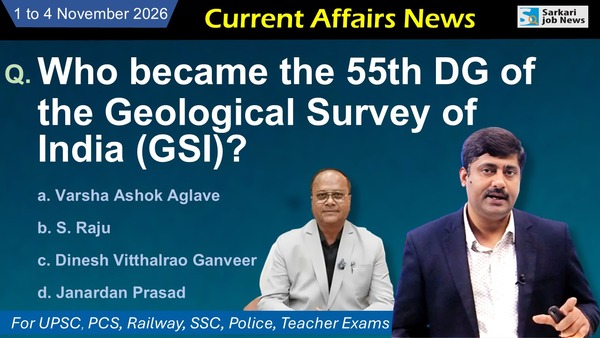
9. Who became the 55th Director General (DG) of the Geological Survey of India (GSI)?
a. Varsha Ashok Agalawe
b. S. Raju
c. Dinesh Vitthalrao Ganvir
d. Janardan Prasad
Answer: c. Dinesh Vitthalrao Ganvir
– Dinesh V. Ganvir took charge on 1 November 2026.
– He replaced Varsha Ashok Agalawe, who retired on 31 October.
– She was the first woman Director General in its 176-year history.
– Dinesh V. Ganvir was serving as Additional Director General and Head of the Central Region (Nagpur) of GSI.
– He was also holding the position of National Mission Head-II.
– He was appointed to GSI on 1 July 1994.
– 56-year-old Dinesh V. Ganvir, a resident of Nagpur, obtained a Master’s degree in Geology from Rashtrasant Tukadoji Maharaj Nagpur University (RTMNU).
– He has experience in geological mapping, mineral exploration, engineering geology and multidisciplinary geoscientific investigations.
GSI
– It is a major scientific and geological research organization functioning under the Ministry of Mines, Government of India.
– Headquarters: Kolkata, West Bengal
– Established: 4 March 1851
————–
10. Which neighbouring country presented the sacred Buddhist Stupa No. 76 to Prime Minister Narendra Modi?
a. Bhutan
b. Bangladesh
c. Sri Lanka
d. Myanmar
Answer: a. Bhutan
– The King of Bhutan, Jigme Khesar Namgyel Wangchuck, consecrated these 108 Buddhist stupas on 1 November 2026 in Gelephu Mindfulness City, Bhutan.
– These stupas were constructed in nine hours.
– After this, Sacred Buddhist Stupa No. 76 was dedicated to Narendra Modi.
– The local name of these stupas is Jangchub Chortens.
– Union Minister Kiren Rijiju represented India at the ceremony held during Lhabab Duchen.
– This consecration was celebrated during the Buddhist festival of Lhabab Duchen, which commemorates Gautama Buddha’s descent from heaven.
Which Project Are the Stupas Part Of?
– Stupa No. 76 is part of the 108 Buddhist Stupas Project.
– Its objective is to develop Gelephu Mindfulness City as a major centre of Vajrayana Buddhism.
– Each stupa is 15 metres high.
– A distance of 108 metres has been maintained between the stupas.
– These stupas have been constructed along the Ai (Mau) River over a stretch of 11.7 kilometres.
– This dedication symbolizes the strong spiritual and cultural relations between India and Bhutan.
Bhutan
– Capital: Thimphu
– Prime Minister: Tshering Tobgay
– Population: 8 lakh (2026)
– Language: Dzongkha
– Currency: Bhutanese Ngultrum
– Neighbouring Countries: India and China.
————–
11. When is World Vegetarian Day celebrated?
a. 1 November
b. 2 November
c. 3 November
d. 4 November
Answer: a. 1 November
– World Vegetarian Day was established in 1977 by the North American Vegetarian Society.
– After this, the day began to be celebrated throughout the world.
– Approximately 22% of the global population is vegetarian, and this number may increase.
————–
12. To which class does the third Anti-Submarine Warfare Shallow Water Craft (ASW-SWC), INS Mangrol, which has been inducted into the Indian Navy, belong?
a. Arnala Class
b. Mahe Class
c. Kalvari Class
d. Nilgiri Class
Answer: b. Mahe Class
Third Ship of the Mahe-Class Series
– INS Mangrol is the third vessel of the Mahe-Class in the Anti-Submarine Warfare Shallow Water Craft (ASW-SWC) series.
– It was formally commissioned into the Indian Navy at the Naval Dockyard in Mumbai.
– Built by Cochin Shipyard Limited (CSL) under the Make in India and Aatmanirbhar Bharat initiatives, this warship uses more than 80% indigenous content.
Coastal Security and Precise Striking Capability
– It has been specially designed for operations in coastal areas, ports and shallow waters, where the movement of larger ships is limited.
– Equipped with waterjet propulsion technology, this vessel can successfully carry out anti-submarine operations, mine warfare, coastal surveillance and low-intensity maritime operations (LIMO).
Rich Maritime Heritage
– It has been named after ‘Mangrol’, a historic coastal town and major fishing port in Junagadh district of Gujarat.
– The new INS Mangrol carries forward the legacy of the Navy’s older minesweeper vessel INS Mangrol (M85), which served in the Indian Navy from 1983 to 2004.
————–
13. What type of vessel is ‘INS Samarthak’, which was commissioned in Karwar, Karnataka?
a. Anti-Submarine Shallow Water Craft
b. First Indigenous Multi-Purpose Vessel
c. Guided Missile Destroyer
d. Nuclear-Powered Submarine
Answer: b. First Indigenous Multi-Purpose Vessel
Formal Commissioning into the Navy
– The Indian Navy’s first Indigenous Multi-Purpose Vessel (MPV), INS Samarthak, was formally commissioned into the Navy on 16 October 2026 at the Naval Base in Karwar, Karnataka.
– It has been built by Larsen & Toubro (L&T) at its Kattupalli (Chennai) Shipyard.
An Example of Indigenous Shipbuilding
– Built with more than 75% indigenous content, INS Samarthak is an excellent example of India’s growing defence industrial capability, advanced technological expertise and domestic shipbuilding strength.
Multi-Dimensional Missions and Advanced Testing Capabilities
– INS Samarthak will serve as a dedicated testbed and versatile platform for the trials and evaluation of next-generation weapons, modern sensors and new technologies for the Indian Navy.
– Apart from this, it will play an important role in maritime surveillance, offshore patrolling, reconnaissance missions, the operation of drones and unmanned systems (UAVs/USVs), towing of ships, and Humanitarian Assistance and Disaster Relief (HADR) operations.
————-
14. What changes did the central government make to the Agnipath scheme?
a. The service period of 75% of Agniveers has been increased from 4 years to 6 years.
b. Another opportunity to become regular soldiers has been provided after 2 additional years of service.
c. Provision has been made to pay higher salaries during the additional 2 years of service.
d. All of the above
Answer: d. All of the above
– Agniveers will now be able to serve for 6 years instead of 4 years. After this, if they wish to continue serving in the Army, they will have to undergo the selection process. If they qualify, they will also be granted permanent commission.
– Chief of Defence Staff General NS Raja Subramani announced this on 4 November 2026.
– This will benefit approximately 3.18 lakh Agniveers deployed across the three armed forces.
– Earlier, there was a provision to recruit 25% of each batch as regular soldiers on the basis of merit, while the remaining 75% had to leave the forces after completing four years of service.
5 Major Changes in the New Agniveer Rules
– Service period extended to 6 years: After the initial 4 years of service, 75% of Agniveers will get an opportunity to serve for an additional 2 years.
– Second opportunity to become regular soldiers: After completing the additional 2 years, Agniveers will be given another opportunity to become permanent soldiers.
– Existing provision of 25% retained: After completing the initial 4 years, 25% of Agniveers will continue to be selected for permanent service on the basis of merit, as before.
– Higher salary during additional service: Agniveers will be paid a higher salary during the second 2 years of service.
– Changes in Seva Nidhi and seniority: The seniority of Agniveers made permanent after six years will be lower than that of the 25% of Agniveers selected after four years.
18,300 Agniveers Were Scheduled to Complete Their Tenure by December
– By 31 December 2026, approximately 18,300 Agniveers from the first batch were scheduled to complete their four-year tenure.
– They constitute approximately 75% of the 24,400 Agniveers recruited in the first batch.
– According to the earlier plan, 75% of Agniveers were to be gradually released from service starting in mid-November.
– Under the new arrangement, they will now get an additional two years. This extension of service will be subject to the consent of the Agniveers.
What Is the Agnipath Scheme?
– The scheme was launched on 4 June 2022. Its official name is the ‘Agnipath Scheme’, and the youth recruited under it are called ‘Agniveers’.
– Through this scheme, young people aged 17.5 to 21 years are recruited into the three armed forces for a period of 4 years.
– They receive a monthly salary for 4 years and, upon completion of their service, receive a lump sum amount of approximately ₹11.71 lakh, but there is no pension.
– After 4 years, there is a provision to retain only 25% of Agniveers permanently in the armed forces.
– Under the initial rules, the remaining 75% of young recruits were to be released after receiving the Seva Nidhi package. They are given relaxation in recruitment to the police and security forces.
Why Was This Change Needed?
– The four-year tenure of the first batch recruited under the Agnipath Scheme is coming to an end in 2026. Approximately 18,000 Agniveers were scheduled to be released from service by December 2026.
– Therefore, this change has been introduced to continue utilising the experience of trained soldiers in the armed forces and to provide them with an opportunity to continue serving.
Has the Agnipath Scheme Been Completely Changed?
– No. The initial four-year service period under the scheme remains unchanged. The changes are mainly related to providing the remaining 75% of Agniveers with an additional two-year service opportunity and another pathway to selection for regular service thereafter.
Agniveer Recruitment: Age, Eligibility and Selection Process
– What should be the age? The minimum age is 17 years and 6 months. The maximum age is generally 22 years for the Army and 21 years for the Navy and Air Force. The final age limit is determined by the respective recruitment notification.
– Eligibility: Depending on the post, candidates must have passed Class 8, 10 or 12. Generally, Class 10 qualification is required for General Duty and Navy Matric Recruit (MR) posts, while Class 12 qualification is required for Technical, Clerk, SSR and several Air Force posts.
PDF Download: Click here