
This is the current affairs of 3 February 2026. Here are questions and answers of daily current affairs for better preparation of competitive exams for government jobs.
PDF Download: Click here
1. Under the India–US trade deal, how much tariff will the US impose on Indian goods?
a. 20%
b. 18%
c. 16%
d. 0%
Answer : b. 18%
——————
2. According to Donald Trump, what tariff will be imposed on American exports to India under the India–US trade deal?
a. 20%
b. 18%
c. 16%
d. 0%
Answer : b. 0%
– Finally, after months of negotiations, agreement on the trade deal between India and the United States was reached on 2 February 2026.
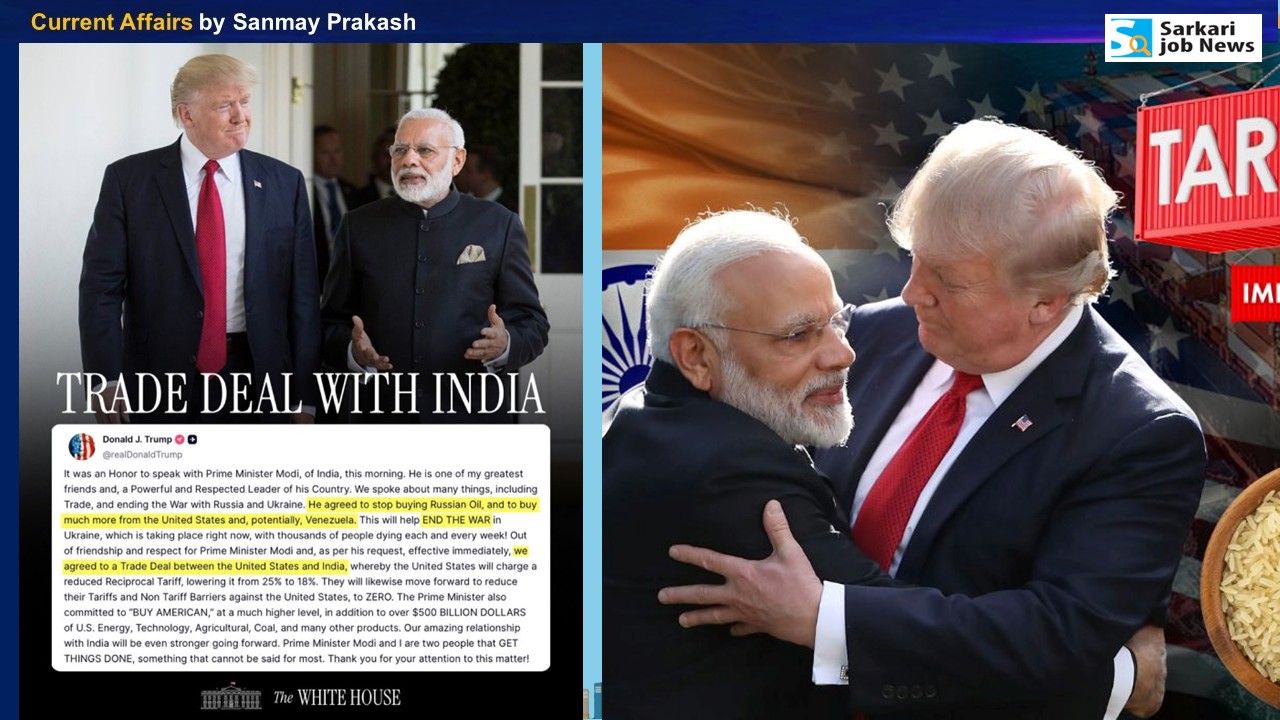
– US President Donald Trump announced that the US has reduced the tariff on India from 25% to 18% and abolished the 25% penalty. This means the tariff has come down from 50% to 18%, which will be implemented “with immediate effect.”
– This agreement came after India accepted several US demands in the budget and began aggressively pursuing trade agreements with other countries, including the UK and the European Union.
– Trump said that India has agreed to stop buying Russian oil and to buy more oil from the US and Venezuela.
– Under the trade deal, India has also agreed to purchase US energy, agriculture, coal, and other products worth $500 billion (about ₹45 lakh crore).
What PM Modi said
– After Trump’s announcement, Prime Minister Narendra Modi issued a statement on social media platform X:
“It was great to speak today with my dear friend President Trump. I am happy that the tariff on Made in India products has now been reduced to 18%. On behalf of India’s 1.4 billion people, many thanks to President Trump for this wonderful announcement. President Trump’s leadership is very important for peace, stability, and prosperity across the world. India fully supports his efforts for peace.”
Agreement after India accepted US demands
– This situation arose after significant changes in trade relations.
– India had begun increasing imports of crude oil from the US, which now account for about 10% of its total oil imports.
– India has also signed an LPG agreement, under which Indian public sector refineries have entered into a one-year agreement to import LPG from the US.
– Additionally, the Sustainable Harnessing and Advancement of Nuclear Energy for Transforming India (SHANTI) Bill, 2025, has been passed, allowing private companies to enter the strictly regulated nuclear energy sector.
– In this way, major US demands have been fulfilled.
Has the agriculture sector been opened to the US?
– After Trump became President for the second time, the US signed trade agreements with several countries, including the European Union, Japan, and Vietnam.
– However, due to US demands related to access to the agricultural market, an agreement with India could not be reached earlier.
– Increasing pressure, Trump doubled the tariff on India to 50% on 7 August 2025.
– Agriculture has been a sector that India has traditionally been reluctant to open to foreign/US agricultural products.
– The Indian government has consistently said that it would not compromise on farmers’ interests.
– But the tweet posted by Trump after the India–US trade deal was finalized on 2 February 2026 suggests something different.
– According to the trade deal, India will buy $500 billion (about ₹45 lakh crore) worth of goods from the US, including energy, technology, agriculture, coal, and other products.
– There has been no indication from the Indian government or Prime Minister Modi regarding how much and which goods the US has promised to buy from India.
– Attention will now focus on which American agricultural products Prime Minister Modi has promised Trump to allow for open import into India.
Claim by the US Agriculture Secretary
– The US Agriculture Secretary claimed that the deal also covers American agricultural products for India. Thanking President Trump, she tweeted:
– “The new US–India deal will allow more American agricultural products to be exported to India’s large market, increasing prices and bringing cash into rural America.”
– “In 2024, the US had a $1.3 billion agricultural trade deficit with India. India’s growing population is an important market for American agricultural products, and today’s deal will greatly help reduce this deficit.”
Both India and the US were waiting for the deal
– India was waiting for the trade deal, and there was eager anticipation in the US as well.
– Many people in the US who understand South Asian politics believed that by imposing such high tariffs, Trump had effectively isolated India.
– This was happening at a time when the US was in competition with China.
– The US is India’s largest partner. China is still India’s second-largest trade partner.
– The US is the only country with which India has a trade surplus.
– Trade with China is about $110 billion, of which nearly $100 billion consists of Chinese exports to India.
– Given Trump’s nature, this should not be seen as a final word. Blind trust in Trump is not possible.
– China has also improved its relations with India.
Key points
– India did not get into direct confrontation with Trump. Many statements were made against India, but India did not react.
– Pressure was increasing on the US, because it is difficult to ignore the country with the world’s largest consumer base.
– In the meantime, India signed a trade agreement with the European Union.
– The European Union also felt that blind trust in Trump was not possible.
– Third, in the past one or two weeks, Western leaders have been visiting China one after another.
– This displeased Trump, as it was visible that America’s closest allies were meeting Xi in China.
Tariffs on other countries
– The tariff with partners like Japan is 15%.
– A tariff of 19% has been imposed on Pakistan.
Questions being raised
– How is it a victory if Indian goods that earlier faced 2–3% tariffs now face an 18% tariff?
– How is it a victory to reduce tariffs on American goods from 50–70% to zero in return?
– If the agriculture sector has been opened, the destruction of Indian farmers and dairy producers is certain.
– Additionally, India will have to buy expensive oil from the US.
—————–
3. Under which article of the Constitution did the Supreme Court consider the right to menstrual health and access to menstrual hygiene management (MHM) measures in educational institutions as part of the fundamental right to life and dignity?
a. Article 14
b. Article 19
c. Article 20
d. Article 21
Answer : d. Article 21 (Following the verdict, free sanitary pads and separate toilets will now be a constitutional right for every girl student in both private and government educational institutions.)
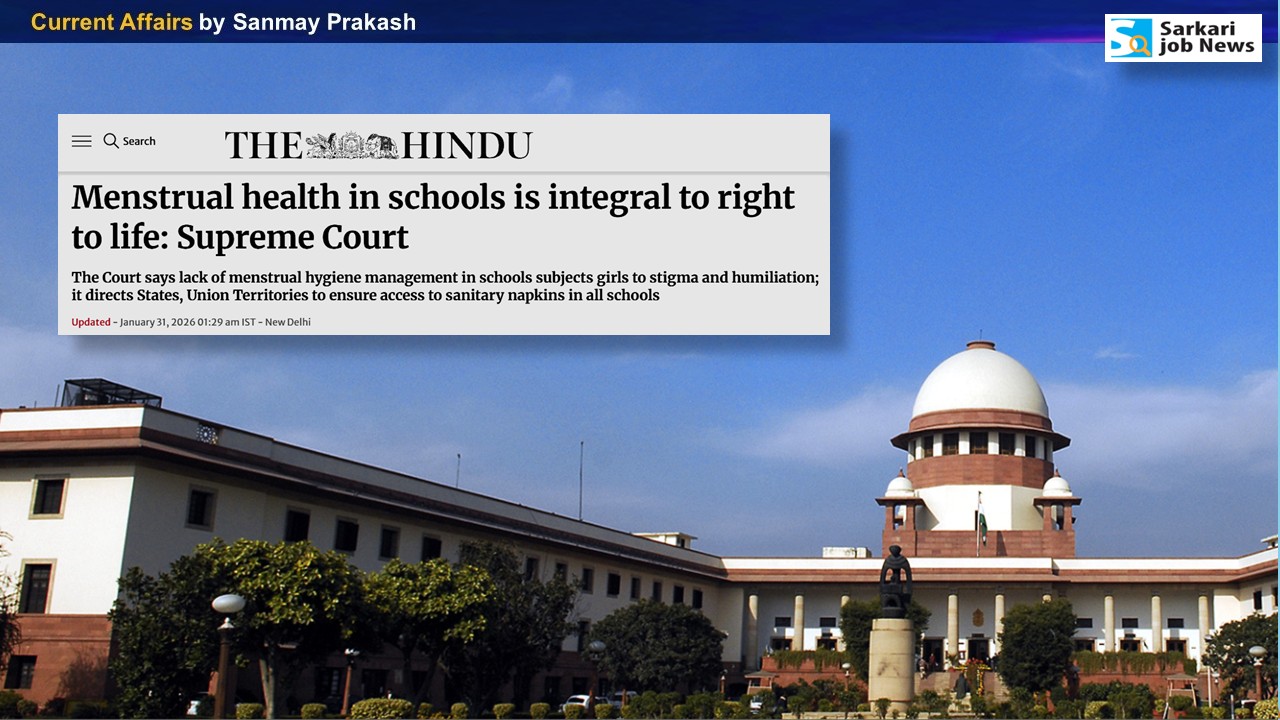
– The Supreme Court issued this order on 30 January 2026.
– A bench of Justice J. B. Pardiwala and Justice R. Mahadevan issued these directions to all states and Union Territories.
– With this decision, free sanitary pads have now become a constitutional right for every girl student.
– All government and private schools across the country will now have to provide free biodegradable sanitary pads and separate toilets for girl students from classes 6 to 12.
– Strict action will be taken against schools that fail to comply.
– The biggest impact of this decision will be on private schools.
– Until now, many private schools had ignored these facilities.
– The court clearly stated that if private schools do not provide free pads and proper toilet facilities, their recognition will be cancelled.
Article 21
– Article 21 of the Indian Constitution is one of the most important fundamental rights, guaranteeing the protection of life and personal liberty to every citizen.
– It provides that “no person shall be deprived of his life or personal liberty except according to procedure established by law.”
– Scope: This right is available to citizens as well as foreigners.
– Broad interpretation: Over time, the Supreme Court has interpreted it to include the right to live with dignity, the right to privacy, the right to a clean environment, health, education, and the right to live with a partner of one’s choice.
– Relation: It is directly linked to personal dignity and a dignified life.
– Exception: Life or liberty may be taken away only by following a valid procedure established by law.
———————
4. Who is the winner of the Australian Open Men’s Singles 2026?
a. Carlos Alcaraz
b. Novak Djokovic
c. Alexander Zverev
d. Alex de Minaur
Answer : a. Carlos Alcaraz {Spain} (defeated Novak Djokovic {Serbia})
– World No. 1 Carlos Alcaraz won the Australian Open 2026 title for the first time.
– The 22-year-old Spanish star defeated Serbian legend Novak Djokovic in the final.
– The match was played on 1 February 2026 at Rod Laver Arena in Melbourne and lasted 3 hours and 2 minutes.
– This was Djokovic’s first defeat in an Australian Open final.
– Earlier, he had reached the final 10 times and won the title every time.
Carlos Alcaraz’s career journey
– With this victory, Alcaraz completed a career Grand Slam.
– The Australian Open was the only Grand Slam title missing from his collection.
– By winning it, he became the youngest male player to complete a career Grand Slam.
– Alcaraz had earlier won the US Open twice, Wimbledon twice, and the French Open twice.
– A career Grand Slam means winning all four Grand Slam tournaments at least once in a career.
– They do not need to be won in the same calendar year.
——————
5. Who is the winner of the Australian Open Singles (Women’s) 2026?
a. Zhang Shuai
b. Elena Rybakina
c. Aryna Sabalenka
d. Jessica Pegula
Answer : b. Elena Rybakina {Kazakhstan} (defeated Aryna Sabalenka {Belarus})
– Elena Rybakina is a tennis star from Kazakhstan.
– She defeated top-seeded Belarusian star Aryna Sabalenka in the final match played on 31 January 2026.
– Elena became the first woman from Kazakhstan to win this title.
– The 26-year-old Rybakina won this Grand Slam title for the first time.
– Three years earlier, she had reached the final but lost to Sabalenka.
————–
6. Who is the winner of the Australian Open Men’s Doubles 2026?
a. Christian Harrison and Marc Polmans
b. Neal Skupski and Jason Kubler
c. Christian Harrison and Neal Skupski
d. Jason Kubler and Marc Polmans
Answer : c. Christian Harrison and Neal Skupski
– Christian Harrison is American and Neal Skupski is a British tennis player.
– In the match played on 31 January, the American–British pair defeated Australia’s Jason Kubler and Marc Polmans 7-6(4), 6-4.
——————-
7. Who were the winners of the Australian Open Women’s Doubles 2026?
a. Aleksandra Krunić and Zhang Shuai
b. Elise Mertens and Anna Danilina
c. Anna Danilina and Aleksandra Krunić
d. Elise Mertens and Zhang Shuai
Answer : d. Elise Mertens and Zhang Shuai
– Elise Mertens is from Belgium and Zhang Shuai is from China.
– The pair defeated Anna Danilina (Kazakhstani player born in Russia) and Aleksandra Krunić (Serbia) in the final.
– With the 2026 win, Mertens’ total number of Grand Slam doubles titles has reached six, three of which she has won in Australia.
– Zhang Shuai now has three Grand Slam doubles trophies.
– Earlier, Zhang won the women’s doubles titles at the 2019 Australian Open and the 2021 US Open with Samantha Stosur.
———————
8. Who were the winners of the 2026 Australian Open mixed doubles?
a. Olivia Gadecki and John Peers
b. Kristina Mladenovic and Manuel Guinard
c. Jana Novotna and Jim Pugh
d. Kristina Mladenovic and Olivia Gadecki
Answer : a. Olivia Gadecki and John Peers (Australian pair)
– The mixed doubles final was played on 30 January 2026.
– The Australian pair Olivia Gadecki and John Peers defeated the French pair Kristina Mladenovic and Manuel Guinard.
———–
Australian Open 2026 Winners and Runners-up
Men’s Singles
– Winner: Carlos Alcaraz (Spain)
– Runner-up: Novak Djokovic (Serbia)
Women’s Singles
– Winner: Elena Rybakina (Kazakhstan)
– Runner-up: Aryna Sabalenka (Belarus)
Men’s Doubles
– Winners: Christian Harrison (USA) and Neal Skupski (Britain)
– Runners-up: Jason Kubler and Marc Polmans (Australia)
Women’s Doubles
– Winners: Elise Mertens (Belgium) and Zhang Shuai (China)
– Runners-up: Anna Danilina (Kazakhstani player born in Russia) and Aleksandra Krunić (Serbia)
Mixed Doubles
– Winners: Olivia Gadecki and John Peers (Australian pair)
– Runners-up: Kristina Mladenovic and Manuel Guinard (French pair)
—————-
9. Who won the World Badminton Federation World Tour Super 300 title at the Thailand Masters 2026?
a. Chiharu Shida
b. Devika Sihag
c. Goh Jin Wei
d. Seed Supanida
Answer : b. Devika Sihag
– India’s 20-year-old shuttler Devika Sihag achieved this victory in the final match played in Bangkok on 1 February 2026.
– She defeated Malaysia’s Goh Jin Wei.
– Earlier, this achievement was held by PV Sindhu and Saina Nehwal.
—————
10. Prime Minister Narendra Modi announced that which airport in Punjab would be named after Sant Guru Ravidas Ji?
a. Pathankot Airport
b. Adampur Airport
c. Patiala Airport
d. Bathinda Airport
Answer : b. Adampur Airport
– Prime Minister Narendra Modi attended a program in Jalandhar, Punjab, on 1 February 2026 on the occasion of Guru Ravidas Jayanti.
– There, he announced that Adampur Airport would be renamed after Sant Guru Ravidas.
– Narendra Modi said that the teachings of Guru Ravidas continue to inspire and energize society.
– During this visit, the Prime Minister also inaugurated the new terminal building at Halwara Airport in Ludhiana.
Punjab
Capital: Chandigarh
Governor: Gulab Chand Kataria
Chief Minister: Bhagwant Mann
Language: Punjabi
Neighboring states: Jammu and Kashmir (Union Territory), Himachal Pradesh, Haryana, and Rajasthan.
—————-
11. In which state was a death case due to Kyasanur Forest Disease (KFD – Monkey Fever) reported in January 2026?
a. Karnataka
b. Kerala
c. Telangana
d. Andhra Pradesh
Answer : a. Karnataka
– A 29-year-old man from Thirthahalli taluk in Karnataka, who was confirmed to have the KFD virus, died on 28 January at a hospital in Udupi district.
– The youth complained of fever on 20 January.
– His blood samples were taken for testing.
– The report received on 23 January confirmed the KFD virus.
– However, it has not yet been confirmed whether the cause of death was the virus.
KFD
– Kyasanur Forest Disease is a viral infection, also known as monkey fever, as monkeys are also affected by it.
– The disease spreads through ticks.
– People who go to forest areas to graze cattle or collect firewood are more susceptible to this infection.
– The district administration is running awareness campaigns in forest-adjacent areas to prevent infection.
Karnataka
Capital: Bengaluru
Governor: Thawar Chand Gehlot
Chief Minister: Siddaramaiah
Language: Kannada
Neighboring states: Maharashtra, Goa, Telangana, Andhra Pradesh, Tamil Nadu, and Kerala.
—————
12. Which state became the first to start government-run menopause clinics?
a. Chhattisgarh
b. Gujarat
c. Maharashtra
d. Bihar
Answer : c. Maharashtra
– To promote women’s health, Maharashtra inaugurated the country’s first menopause clinic on 28 January 2026.
– The initiative was led by Minister of State for Public Health Meghna Bordikar.
– These clinics provide specialist medical consultation, mental health counseling, bone, heart, and hormonal health check-ups, along with medicines and guidelines at one place.
– Menopause clinics are special health facilities located in government hospitals, urban health centers, or district hospitals.
– They specialize in addressing the medical and psychosocial needs of women undergoing menopause.
– The government aims to address hormonal imbalance, bone disorders, sleep disturbances, cardiovascular risks, and mental health concerns among menopausal women.
Menopause
– It is the natural stage in a woman’s life when menstrual periods permanently stop.
– It is usually identified after 12 consecutive months without menstruation.
– It occurs between the ages of 45 and 55, during which symptoms such as hormonal changes, hot flashes, and sleep problems may be experienced.
– It occurs due to aging of the ovaries.
Maharashtra
Governor: Acharya Devvrat
Chief Minister: Devendra Fadnavis
Language: Marathi
Neighbouring states: Madhya Pradesh, Gujarat, Chhattisgarh, Telangana, Karnataka, Goa, and Dadra and Nagar Haveli.
—————–
PDF Download: Click here