
This is the current affairs of 17 January 2026. Here are questions and answers of daily current affairs for better preparation of competitive exams for government jobs.
PDF Download: Click here
1. Which operation did India launch in January 2026 to bring back its citizens from Iran?
a. Operation Sindhu
b. Operation Middle
c. Operation Fatah
d. Operation Swadesh
Answer: d. Operation Swadesh
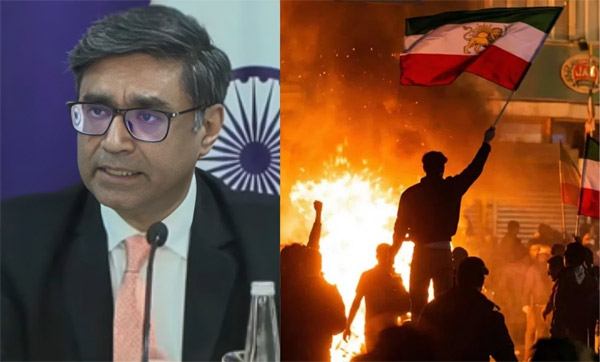
– Amid ongoing anti-government violent protests in Iran, the Government of India launched Operation Swadesh in January 2026.
– Around 10,000 Indians live in Iran, and they were brought back to India through this operation.
– Under Operation Swadesh, the first special flight arrived in New Delhi from Tehran on 16 January 2026.
– On 14 January 2026, External Affairs Minister S. Jaishankar received a call from Iran’s Foreign Minister Seyyed Abbas Araghchi.
– They discussed the situation in Iran. The Ministry of External Affairs (MEA) advised Indian citizens not to travel to Iran.
– According to the MEA, around 10,000 Indian nationals are present in Iran.
– Out of these, 2,500–3,000 are students who went there for medical studies.
– The MEA has also advised avoiding travel to Iran.
– The Jammu and Kashmir Students Association (JKSA) said in a statement that all students have been registered.
– The Indian Embassy has collected their personal details and passports.
Names of some previous rescue operations
– Operation Swadesh (January 2026): To bring Indians back during protests in Iran
– Operation Sindhu (June 2025): To bring citizens back from Iran amid Iran–Israel conflict
– Operation Indravati (2024): During criminal gang violence in Haiti
– Operation Ajay (2023): During the Hamas–Israel war
– Operation Kaveri (2023): During the civil war in Sudan
– Operation Ganga (2022): After the Russian attack on Ukraine
– Operation Rahat (2015): During the conflict in Yemen
—————-
2. Amid rising tensions between Iran and the United States, which port did India temporarily withdraw from operating in January 2026?
a. Isfahan Port
b. Rajouri Port
c. Persian Port
d. Chabahar Port
Answer: d. Chabahar Port
– India had constructed and was operating the Shahid Beheshti Terminal at Chabahar Port.
– In January 2026, the United States imposed strict economic sanctions on Iran.
– Due to these sanctions, India had to stop its work at Chabahar Port.
Why is Chabahar Port important?
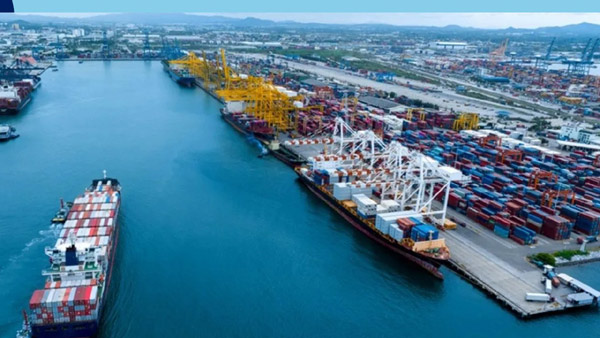
– Chabahar Port is a very important seaport in Iran.
– India was developing it to enable direct trade with Afghanistan and Central Asia.
– This route does not pass through Pakistan, making it strategically important for India.
– It facilitates easier trade between India and neighboring regions.
– It is also a significant trade corridor.
Sanctions waiver
– In October 2025, the US had granted India a six-month sanctions waiver to gradually wind down its activities.
– However, this waiver is set to expire in April 2026.
US threat of 25% tariff
– Iran is witnessing intense anti-government protests.
– Meanwhile, US President Donald Trump threatened a 25% tariff on countries trading with Iran.
– As a result, India found it difficult to continue operating the port independently.
India halted its operations
– India has gradually shut down the work of IPGL (India Ports Global Limited).
– The company’s director resigned, and the official website related to the port was also taken down.
– Since the United States reimposed sanctions on Iran, continued active involvement could have exposed India or its agencies to potential US sanctions or economic penalties. Therefore, India fulfilled its financial obligations and decided to strategically withdraw from the project.
How much money did India transfer to Iran and why?
– India had already transferred approximately $120 million (over ₹1,000 crore) to Iran.
– This amount was part of India’s commitment to develop and operationalize Chabahar Port.
– The transfer was made before the reimposition of US sanctions, to avoid difficulties later and to fulfill India’s financial commitments.
– By doing so, India ensured that no future financial liabilities would remain, reflecting fiscal responsibility.
Government statement
– The Ministry of External Affairs clarified that discussions are still ongoing and efforts are being made to manage the situation, although work had to be halted due to US sanctions.
—————-
3. Which country’s court declared the attempt to impose martial law illegal and sentenced former President Yoon Suk-yeol to five years in prison?
a. South Korea
b. North Korea
c. Venezuela
d. Mauritius
Answer: a. South Korea
– A South Korean court sentenced former President Yoon Suk-yeol to five years in prison on 16 January 2026.
– While in office, he attempted to impose martial law in December 2024.
– The court termed it a misuse of power.
– Reports say Yoon had locked himself inside his house a few days earlier and deployed several guards outside to prevent investigators from entering.
– The police later arrested him and produced him before the court.
– Multiple cases are being tried against Yoon, the most serious charge being rebellion.
– Petitioners in court have demanded the death penalty for him.
– The court will deliver its next verdict in February 2026.
South Korea
– Capital: Seoul
– President: Lee Jae-myung
– Currency: South Korean Won
– Language: Korean
– Neighboring country: North Korea
—————

4. Which state approved the proposal for six new North–South corridors to connect districts from north to south?
a. Punjab
b. Himachal Pradesh
c. Uttar Pradesh
d. Uttarakhand
Answer: c. Uttar Pradesh
– This is the first such North–South corridor initiative in Uttar Pradesh.
– So far, expressways and highways in the state have mainly run east–west.
– The North–South corridors are expected to boost economic activity and generate employment.
– The Public Works Department’s plans for these corridors have been approved.
– Efforts are underway to get cabinet approval for the estimates.
Six new North–South corridors
– Shravasti–Prayagraj Corridor: Ikauna (Shravasti)–Ayodhya–Sultanpur–Prayagraj; total length 262 km.
– Kushinagar–Varanasi Corridor: Kushinagar–Deoria–Dohri Ghat–Ghazipur–Zamania–Varanasi; total length 220 km. Parts are already four-lane.
– Nepal Border to Prayagraj: Pipri (India–Nepal border)–Bansi (Siddharthnagar)–Prayagraj; total length 295 km.
– Lakhimpur to Banda: Lakhimpur–Sitapur–Lucknow–Nawabganj–Lalganj–Chaudagra–Jonihah–Lalaulee–Atarahat–Banda; total length 502 km.
– Bareilly to Lalitpur: Bareilly–Agra–Jhansi–Lalitpur; total length 547 km.
– Pilibhit to Orai–Harpalpur: Mustafabad (Pilibhit Tiger Reserve)–Shahjahanpur–Orai–Harpalpur; total length 514 km.
—————
5. When is National Startup Day celebrated?
a. 18 January
b. 17 January
c. 16 January
d. 15 January
Answer: c. 16 January
– The day has been celebrated since 16 January 2016.
– The number of startups has reached 118,000.
– India ranks third globally in the number of unicorn startups, after the US and China.
– India currently has over 100 unicorn startups.
– A startup with a valuation exceeding $1 billion is called a unicorn.
– More than 36,000 startups were recognized in 2023.
– By 2030, total capital of Indian startups is estimated to exceed $300 billion.
—————
6. Which bank won the ‘Best Fintech and DPI Adoption’ award at the Indian Banks Association (IBA) Banking Technology Awards?
a. State Bank of India
b. Bank of Baroda
c. Karnataka Bank
d. HDFC Bank
Answer: c. Karnataka Bank
– Additionally, Karnataka Bank was declared runner-up in the ‘Best Technology Talent’ category and received special mentions for ‘Best Technology Bank’, ‘Best Digital Financial Inclusion’, and ‘Best Digital Sales’.
– Managing Director and CEO Raghavendra S. Bhat said the awards reflect joint efforts of IT and business teams in promoting digital innovation and customer-centric banking solutions.
– Headquarters: Mangaluru (Karnataka)
—————
7. Which winner of the 2025 Nobel Peace Prize handed over their award to US President Trump?
a. Nicolás Maduro
b. María Corina Machado
c. Roger Binny
d. Emmanuel Macron
Answer: b. María Corina Machado
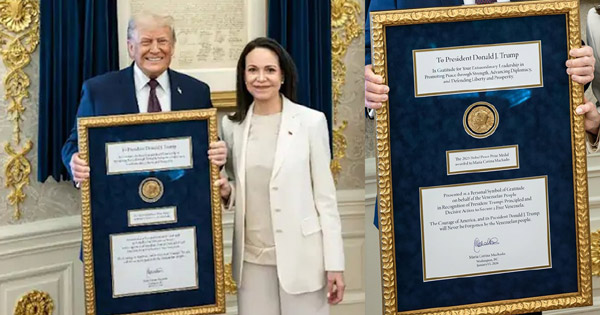
– US President Donald Trump met Venezuelan opposition leader and 2025 Nobel Peace Prize winner María Corina Machado at the White House on 15 January 2026.
– This was his first meeting with any Venezuelan leader after the kidnapping of President Nicolás Maduro.
– Machado said she presented the Nobel Peace Prize medal to Trump, dedicating it to him.
– She called it a historic day for Venezuelans and said they could trust President Trump.
– However, Trump has not endorsed Machado as Venezuela’s new leader.
– Trump stated he is working with interim President Delcy Rodríguez.
Nobel Institute’s statement
– The Nobel Committee said the Nobel Prize cannot be revoked, shared, or transferred after announcement.
– While ownership of a medal can change, the title of Nobel Peace Prize laureate cannot.
Awarded in October 2025
– Machado received the Nobel Peace Prize in October 2025 for her efforts to secure democratic rights for Venezuelans and her peaceful struggle against dictatorship.
—————-
8. Which American scientist won the Tyler Prize 2026 for mycorrhizal research?
a. Johan Rockström
b. Toby Kiers
c. Sandra Díaz
d. Eduardo Brondízio
Answer: b. Toby Kiers
– American evolutionary biologist Toby Kiers was honored with the Tyler Prize for environmental achievement.
– The prize is known as the Nobel Prize of the environment.
Mycorrhizal networks
– A vast underground fungal network exists beneath forests, grasslands, and farms that quietly regulates Earth’s climate.
– These are called mycorrhizal networks.
– They exchange nutrients with plant roots.
– They absorb over 13 billion tons of carbon dioxide annually.
– Once neglected, they are now considered among the most important life-support systems on the planet.
– Toby Kiers, a university research chair at Vrije Universiteit Amsterdam, has revolutionized scientific understanding of soil ecosystems.
Tyler Prize
– Established in 1973 by John and Alice Tyler.
– Recognizes individuals and organizations in environmental science, policy, and sustainability.
– Managed by the University of Southern California (USC).
– Carries a cash award of $250,000.
—————-
9. Which southern state protested against the Malayalam Language Bill–2025 passed by the Kerala Legislative Assembly, calling it a violation of minorities’ educational and cultural rights?
a. Karnataka
b. Telangana
c. Andhra Pradesh
d. Tamil Nadu
Answer: a. Karnataka
– Amid allegations of Hindi imposition by the central government, linguistic disputes in South India have intensified.
– Karnataka strongly opposed the Malayalam Language Bill–2025 passed by the Kerala Assembly.
– The bill mandates Malayalam as the first language from Classes 1 to 10 in all schools in Kerala, including Kannada-medium schools in Kasaragod district.
– Karnataka Chief Minister Siddaramaiah urged Kerala Chief Minister Pinarayi Vijayan to withdraw the bill.
– He stated that for linguistic minorities, language is not just a subject but a matter of identity, dignity, access, and opportunity.
– He described Kasaragod as emotionally connected to Karnataka and its people as fully Kannadiga.
Kerala
– Capital: Thiruvananthapuram
– Language: Malayalam
– Neighboring states: Tamil Nadu and Karnataka
—————
10. What type of visa facility did German Chancellor Friedrich Merz announce for Indian citizens during his visit to India?
a. Full visa-free entry
b. Tourist visa-on-arrival
c. Exemption from airport transit visa
d. Long-term work visa
Answer: c. Exemption from airport transit visa
– The decision was announced on 12–13 January 2026 during Chancellor Friedrich Merz’s official visit to India.
– It was made public at a joint press conference with Prime Minister Narendra Modi.
What will change?
– Indian passport holders will no longer need an Airport Transit Visa (Schengen Type A) if they:
– Transit through a German international airport,
– Are traveling onward to another country (such as the US, Canada, or the UK),
– Remain within the international transit zone, and
– Have onward flights within 24 hours.
– This does not permit entry into Germany; leaving the transit zone will still require a regular visa.
Previous rule
– Earlier, Indian citizens needed a transit visa even if they stayed within the airport.
– Fees ranged from €60–€90, and processing took several days.
Why is this important?
– Easier and faster travel without visa applications and waiting.
Reduced costs.
– Improved connectivity via hubs like Frankfurt and Munich.
– Smoother international routes, especially India–USA/Canada connections.
PDF Download: Click here