This is the current affairs of 22 November 2025. Here are questions and answers of daily current affairs for better preparation of competitive exams for government jobs.
PDF Download: Click here
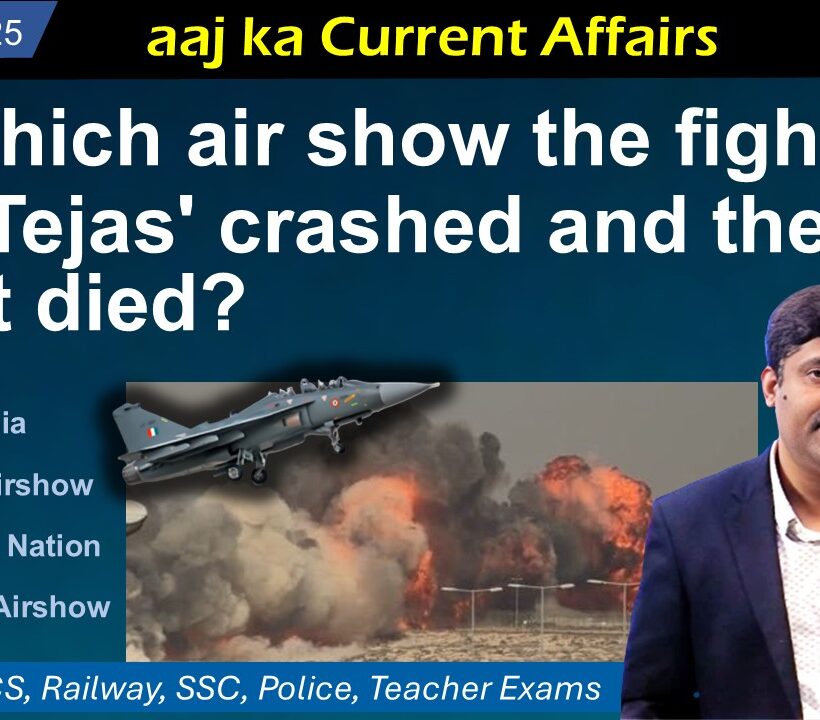
1. In which air show the fighter jet ‘Tejas’ crashed and the pilot died?
a. Aero India
b. Dubai Airshow
c. Aviation Nation
d. Danish Airshow
Answer: b. Dubai Airshow (crashed on November 21, 2025)
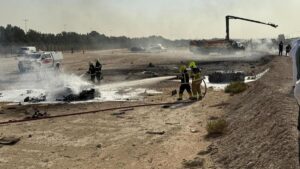
– On November 21, 2025, at the Dubai Airshow, an Indian Air Force Tejas fighter jet was performing aerobatics in the air when everything came to a screeching halt.
– The Tejas crashed into the ground in front of thousands of spectators and hundreds of cameras.
– The crash was followed by a fireball and then a huge plume of smoke.
– Everything happened so quickly that even the pilot could not save himself.
– The crash of India’s most ambitious fighter jet, the Tejas, at an international event left many questions unanswered.
– Initial visuals of the crash show the aircraft suddenly nose-down and in free fall.
– This was the second accident in the aircraft’s 24-year operational history, and the first involving fatalities; the previous crash occurred in May near Jaisalmer, in which the pilot ejected safely.
Why is the crash of the Tejas at the Dubai Air Show being considered a major setback for India?
– The Dubai Air Show showcases international aircraft. Here, the world’s leading aerospace companies, airlines, air forces, and technology firms showcase their new aircraft, helicopters, weapon systems, and aerospace technology.
– In such cases, the true cause of the crash is rarely known.
– However, if a technical defect caused this, it will have two effects.
– First, questions will arise about its induction into our fighter fleet.
– This is also a setback for the Indian Air Force’s modernization. India also wants to sell it to several countries. This accident will also impact such deals.
– The Indian Air Force said in a statement that a Court of Inquiry is being formed to determine the cause of the accident.
What is Tejas and why does India consider it so special?
– According to the description on HAL’s website, Tejas is a 4.5-generation fighter aircraft designed for offensive air support, close combat, and ground attack missions.
– Built for versatility, it is also designed for land and sea operations, making it one of India’s most adaptable indigenous platforms.
– The Tejas family includes single-seat fighter versions for both the Air Force and Navy, as well as two-seat trainer versions for each service.
– Preparations for inducting the Light Combat Aircraft (LCA) into the Indian Air Force fleet began as early as 1983.
– Once the government gave the green light, Indian scientists worked day and night to accomplish their mission.
– At this time, the LCA had only two objectives:
– First: to develop a new fighter jet as an alternative to the Russian fighter MiG-21.
– Second: to develop an indigenous and light fighter jet.
– It was designed by the Aeronautical Development Agency (ADA) and manufactured by Hindustan Aeronautics Limited (HAL).
– The Indian Air Force has only been able to field two operational squadrons of the Tejas, comprising a total of 38 aircraft.
Tejas in the Air Force
– After the retirement of the MiG-21 in October 2025, the Tejas is expected to play a key role for the Indian Air Force.
– Orders for 182 aircraft have already been placed, and there are plans to induct 351 Tejas fighters in the future.
– The Indian Air Force had previously stated that older MiG squadrons would be replaced by Tejas-flying squadrons.
– But questions remain about the aircraft’s capabilities.
– The Indian Air Force has frequently questioned HAL’s delay in Tejas deliveries.
– In February 2025, Air Chief Marshal Amar Preet Singh said, “I was promised that 11 Tejas Mk1As would be ready when I come here in February. But not a single one is ready… I think HAL is simply not in mission mode.”
– These delays have been particularly worrying given the IAF’s declining operational capabilities.
– With the retirement of the MiG-21 aircraft, the Indian Air Force’s fighter squadrons are now down to 29, less than 70% of the approved strength.
– And this number is set to decrease further, as the IAF plans to retire older aircraft, including the MiG-29, Jaguar, and Mirage 2000, by 2035.
– Without detailing the IAF’s specific complaints about the Tejas Mk1 aircraft currently in service, Air Chief Marshal Singh stated in February that the Mk1A model presented to the IAF did not meet the IAF’s requirements. He stated that merely “changing the software” would not improve the aircraft’s capabilities. “It’s not fun,” he said.
– A notable problem with the Tejas has been its engines. This has raised concerns about the aircraft’s capabilities and delayed deliveries.
—————
2. Who won the title of Miss Universe 2025?
a. Manika Vishwakarma
b. Fatima Bosch Fernandes
c. Stephanie Absali
d. Atisa Manalo
Answer: b. Fatima Bosch Fernandes

– Fatima Bosch Fernandez of Mexico won the title of Miss Universe 2025.
– Pravneer Singh of Thailand took second place in Miss Universe.
– Manika Vishwakarma of India reached the top 30 but failed to make it to the top 12.
– The awards ceremony was held on November 21, 2025, in Thailand.
Why Fatima Bosch was in the news before winning the title
– During the sash ceremony on November 4, 2025, Nawat Itsaragrisil, director of the organizing Miss Universe Thailand, called Miss Mexico Fatima Bosch a dumbhead for not participating in promotional events.
– When Miss Mexico protested, Nawat called security and tried to remove her from the hall.
– Seeing this, all the contestants present began to leave the ceremony, including Miss Universe 2024 Victoria Thelwig.
– Nawat repeatedly threatened the contestants with consequences if they walked out, but all the contestants left the ceremony out of respect.
– After leaving the ceremony, Fatima said that it was a matter of her self-respect and dignity.
– The video of the ceremony went viral on social media, raising questions about the mistreatment of contestants in the competition. Following the controversy, Miss Universe co-founder Raul Rocha released a video strongly criticizing Nawat’s actions and ordered the ceremony to be halted. He also announced Nawat’s exclusion from official activities.
Question to Fatima Bosh: What challenges do women face in 2025?
– Miss Mexico Fatima Bosh was asked, “From your perspective, what are the challenges of being a woman in 2025, and how will you use the title of Miss Universe to create a safe space for women around the world?”
In response, she said, “As a woman and Miss Universe, I will use my voice and my power to serve others, because in today’s time, we are here to speak out, to create change, and to see things clearly. We are women, and it is the brave women who stand up and make history.”
About the Miss Universe Title
– This pageant is organized by the Miss Universe Organization of the United States. The headquarters are in Newark.
– It began on June 28, 1952.
– The first winner was Armi Kuusela of Finland in 1952.
Miss Universe List
2025: Fatima Bosch Fernandez (Mexico)
2024: Victoria Kjær Thelvig (Denmark)
2023: Sheyanice Palacios (Nicaragua)
2022: R’Bonnie Gabriel (USA)
2021: Harnaaz Sandhu (India)
India at Miss Universe
1994: Sushmita Sen – India’s first Miss Universe
2000: Lara Dutta – India’s second Miss Universe
2021: Harnaaz Sandhu – India’s third Miss Universe
India at Miss World
1966: Reita Faria – India’s first Miss World
1994: Aishwarya Rai – India’s second Miss World
1997: Diana Hayden – India’s third Miss World
1999: Yukta Mookhey – India’s fourth Miss World
2000: Priyanka Chopra – India’s fifth Miss World
2017: Manushi Chhillar – India’s sixth Miss World
Mexico
– Capital: Mexico City
– President: Claudia Sheinbaum
– Currency: Mexican peso
– Neighboring countries: USA, Guatemala, Belize
—————-
3. President Draupadi Murmu invoked which Article of the Constitution to seek advisory opinion from the Supreme Court on the bill assent powers of the Governors, to which she received a reply?
a. Article 161
b. Article 324
c. Article 143(1)
d. Article 360
Answer: c. Article 143(1)
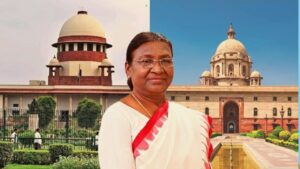
– In a rare constitutional move, President Draupadi Murmu sought the Supreme Court’s advice on May 13, 2025, citing Article 143(1) of the Constitution.
– The Supreme Court, after several hearings, responded on November 20, 2025.
– Broadly, the President asked whether judicial orders could determine the time and manner in which the President and Governors should act under Articles 200 (provisions covering the process for granting assent by Governors to State Bills) and 201 (when Governors reserve Bills for the President’s assent) of the Constitution.
– The Supreme Court said, “We do not think Governors have absolute power to veto Bills passed by the Legislative Assemblies.” “Governors have three options: either assent, send the Bills for reconsideration, or refer them to the President.” The Supreme Court stated that no deadline can be set for the approval of bills. If there is a delay, we may intervene.
– This advisory opinion of the Supreme Court overrules the previous order, which gave the Governor one month and the President a maximum of three months.
Article 143 of the Constitution
– Article 143 of the Indian Constitution empowers the President to seek the opinion of the Supreme Court.
– This helps resolve constitutional difficulties. It primarily provides for two types of opinions.
– Article 143 (1): The President can seek the opinion of the Supreme Court on any legal or factual question. It need not be related to an existing dispute. For example, before enacting a new law, an opinion can be sought on its constitutional validity.
– Article 143 (2): If a dispute relates to a treaty, agreement, or other document that existed before the Constitution came into force on January 26, 1950, the President can seek the opinion of the Supreme Court.
What is the latest development?
– This action by President Draupadi Murmu follows the Supreme Court’s decision on April 8, 2025, regarding the Tamil Nadu Governor’s delay in deciding on bills.
– The Constitution does not specify the time within which the Governor or President must approve or disapprove a bill passed by the Legislative Assembly.
– The Constitution simply states that they must take a decision “as soon as possible.”
– In fact, in its April 2025 decision, the Supreme Court defined “as soon as possible” as meaning that if a state government sends a bill for approval, the Governor must take action within one month.
– If the Governor sends the bill to the President, the President will also have three months to decide on it.
– If the delay exceeds this time, they must provide a valid reason.
– If the Governor or President does not take action within the time limit, the state government can approach the court.
– This raised the question whether the Supreme Court can also issue directions to the President.
– Following this, President Draupadi Murmu sought the Supreme Court’s advisory opinion on 14 questions.
—————
4. What was the Supreme Court’s response to the advisory opinion sought by the President? Question: When a bill is presented to the Governor under Article 200, what constitutional options does he have?
a. To approve or indefinitely withhold a bill.
b. Not to approve a bill without the President’s approval.
c. To approve or to send it back for reconsideration or to the President.
d. None of these.
Answer: c. Approve or send for reconsideration or refer to the President
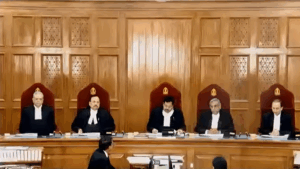
– In a rare constitutional move, President Draupadi Murmu on May 13, 2025, cited Article 143(1) of the Constitution and sought the Supreme Court’s advice on 14 questions.
– After several hearings, the Supreme Court responded on November 20, 2025.
President’s Questions and the Supreme Court’s Advisory Opinion
Question 1. What are the constitutional options available to the Governor when a bill is presented to him under Article 200 of the Constitution?
Answer: We do not believe that Governors have absolute power to veto bills passed by the Legislative Assemblies. Governors have three options: either assent, return the bills to the Legislative Assemblies for reconsideration, or refer them to the President (except for money bills).
(Note: Article 200: A provision setting out the procedure for granting assent by Governors to State Bills.)
Question 2. Is the Governor bound by the advice tendered by the Council of Ministers under Article 200?
Answer: The Governor has discretion and is not bound by the aid and advice of the Council of Ministers.
Question 3. Are discretionary decisions made by the Governor under Article 200 subject to judicial review?
Answer: Generally not, but in clear circumstances of indefinite inaction, the court has limited power to issue a mandamus to the Governor to take a decision within a reasonable period.
Question 4. Does Article 361 impose a complete bar on judicial review of the Governor’s actions under Article 200?
Answer: Article 361 of the Constitution imposes a complete bar on subjecting the Governor personally to judicial proceedings.
Question 5. Can a time limit be set for exercising powers under Article 200?
Answer: This is not appropriate as the Constitution is silent on this matter.
Question 6. Are decisions taken by the President under Article 201 subject to judicial scrutiny?
Answer: Following the argument given regarding the Governor, the President’s assent under Article 201 is also not subject to judicial review.
(Note: Article 201 is used when Governors reserve bills for the President’s assent.)
Question 7. Can judicial orders direct the President as to how and when to exercise his powers under Article 201?
Answer: For the same reasons as for the Governor, the President cannot be bound by judicially prescribed time limits.
Question 8. When the Governor reserves a bill for the President’s assent, is the President required to consult the Supreme Court?
Answer: The President is not required to consult the Supreme Court. The President’s personal satisfaction is sufficient.
Question 9. Can the decisions of the Governor and the President under Articles 200 and 201 of the Constitution be subject to judicial scrutiny of the contents of a Bill before it becomes law?
Answer: No, there is no judicial scrutiny of the contents of a Bill before it becomes law.
Question 10. Can the exercise of constitutional powers and orders of the President/Governor be substituted in any way under Article 142?
Answer: The exercise of constitutional powers and orders of the President/Governor cannot be substituted in any way under Article 142, nor does it allow the concept of ‘deemed assent’ to bills.
(Note: Article 142: It empowers the Supreme Court to pass any order necessary to ensure complete justice.)
Question 11. Can a bill passed by the State Legislature be considered a “law in force” without the Governor’s assent?
Answer: Under Article 200, no law passed by the State Legislature can come into effect without the Governor’s assent.
Question 12. Does Article 145(3) not mandate that any bench first decide whether a case involves substantial legal questions and whether it should be referred to a bench of at least five judges?
Answer: Returned unanswered. Irrelevant to the context.
(Note: Article 145: Provides the framework for the rules of procedure in the courts of India. It empowers the Supreme Court and High Courts to make rules to regulate the functioning and procedure of these courts. According to Article 145(3) of the Constitution, Constitution Benches consisting of five or more judges are constituted in important cases. The number of judges in such Constitution Benches is usually 5, 7, 9, 11, or 13.)
Question 13. Are the powers of the Supreme Court under Article 142 of the Indian Constitution limited to matters of procedural law?
Answer: It is not possible to answer definitively. The scope of Article 142 is given as part of Question 10.
Question 14. Does the Constitution prohibit the Supreme Court from resolving Centre-State disputes through any means other than litigation under Article 131?
Answer: Irrelevant to the functional nature of the reference. Therefore, returned unanswered.
(Note: Article 131: It empowers the Supreme Court to exercise original jurisdiction over any dispute between different units of India’s federal structure. These disputes are:
(i) between the Centre and one or more States; (ii) between the Centre and a State or States on one side and one or more States on the other; (iii) between two or more States.)
– This advisory opinion of the Supreme Court rejects the previous order, in which the Governor was given one month and the President was given a maximum of three months.
—————-
5. When is World Television Day celebrated?
a. November 20th
b. November 21st
c. November 22nd
d. November 23rd
Answer: b. November 21st
– The first World Television Forum was held on this day.
– Therefore, in December 1996, the United Nations General Assembly declared this day as World Television Day.
—————
6. How many medals did India win in the World Boxing Cup 2025, including 9 gold medals in the men’s and women’s categories?
a. 10
b. 20
c. 25
d. 30
Answer: b. 20 (Nine gold, six silver and five bronze)
– Indian boxers made a historic performance at the World Boxing Cup Finals on November 20, 2025.
– Athletes created a new record by winning medals in all 20 weight categories.
– India won a total of nine gold, six silver, and five bronze medals. Of these, women boxers won seven gold medals.
– The final match took place in Greater Noida, India.
World Boxing Cup 2025: India’s Medal Winners
Women: Gold Medals (7)
– Meenakshi Hooda: Gold Medal in 48 kg
– Nikhat Zareen: Gold Medal in 51 kg
– Preeti Pawar: Gold Medal in 54 kg
– Jasmine Lamboria: Gold Medal in 57 kg
– Arundhati Chaudhary – Gold Medal in 70 kg
– Nupur Sheoran – Gold Medal in 80+ kg
– Parveen Hooda – Gold Medal in 60 kg
Women: Silver Medal (1)
– Pooja Rani – Silver Medal in 80 kg
Women: Bronze Medal (2)
– Neeraj Phogat – Bronze Medal in 65 kg
– Sweety Bora – Bronze Medal in 75 kg
—
Men’s Gold Medals (2)
– Sachin Siwach: Gold Medal in 60 kg
– Hitesh Gulia: Gold Medal in 70 kg
Men’s Silver Medals (5)
– Jadumani Singh: Silver Medal in 50 kg
– Pawan Bartwal: Silver Medal in 55 kg
– Abhinash Jamwal: Silver Medal in 65 kg
– Ankush Panghal: Silver Medal in 80 kg
– Narendra Berwal: Silver Medal in 90+ kg
Men’s Bronze Medals (3)
– Sumit Kundu: Bronze Medal in 75 kg
– Jugnoo: Bronze Medal in 85 kg
– Naveen: Bronze Medal in 90 kg
—————–
7. When is World Remembrance Day for Road Traffic Victims observed?
a. First Sunday of November
b. Second Sunday of November
c. Third Sunday of November
d. Fourth Sunday of November
Answer: c. Third Sunday of November (November 16 in 2025)
Theme for 2025:
– Remember. Support. Act.
– The purpose of this day is to remember those killed and injured on the roads, along with their families, friends and other affected people.
– This day was recognized by the United Nations General Assembly in 2005.
United Nations Statistics (Road Accidents)
– Globally, 1.35 million people die in road accidents every year. This means one death occurs on the road every 24 seconds.
– Road traffic injuries are the eighth leading cause of death worldwide.
– Road traffic injuries are the leading cause of death among children aged 5 to 14 and young people aged 15 to 29.
—————
8. In which city did the UN COP30 Climate Summit, scheduled to be held in November 2025, catch fire?
a. Belém (Brazil)
b. Mumbai (India)
c. Paris (France)
d. Johannesburg (South Africa)
Answer: a. Belém (Brazil)
– A fire broke out at the main venue of the ongoing UN COP30 Climate Summit in Belém, Brazil, on Thursday, injuring 13 people.
– India’s Environment Minister Bhupendra Yadav was present with the Indian delegation at the time of the fire. However, he and other officials safely left the venue.
– More than 50,000 diplomats, journalists, and activists from over 190 countries were present at the pavilion at the time of the incident.
– According to the local fire department, the fire was probably started by an electronic device (possibly a microwave). However, other causes are being investigated.
– The fire was brought under control shortly after the incident.
—————
9. Who led the Indian delegation at the UN COP30 Climate Summit 2025?
a. Narendra Modi
b. Rajnath Singh
c. Bhupendra Yadav
d. Amit Shah
Answer: c. Bhupendra Yadav (India’s Minister of Forests and Environment)
– India’s Forest and Environment Minister Bhupendra Yadav led the Indian delegation at the UN COP30 summit.
– He said the world needs to collectively increase climate funding.
– COP30 is the 30th annual climate conference of the United Nations, held in Belém, Brazil, from November 11 to 22, 2025.
– More than 56,000 leaders, diplomats, scientists, journalists, and climate activists from almost all countries of the world participated in it.
– Its main objective is to create a new and strong plan to keep global warming below 1.5 degrees Celsius.
– This includes a roadmap for complete transition from fossil fuels (coal, oil, and gas), up to $1 trillion annually for climate assistance to poor countries, and major decisions to save forests and the Amazon.
The COP was established in 1995, and every country in the world is a member.
– The COP (Conference of Parties) was established in 1995. It is the annual meeting of the United Nations Framework Convention on Climate Change (UNFCCC).
– It was established at the 1992 Earth Summit in Rio de Janeiro, Brazil.
– The treaty entered into force in 1994 and has 198 members.
– Almost all countries in the world (197 countries + the European Union) are members.
– The first COP was held in Berlin, Germany, in 1995, and is known as COP1.
—————
10. In which neighbouring country did a 5.7 magnitude earthquake occur in November 2025?
a. Bangladesh
b. Sri Lanka
c. Pakistan
d. Afghanistan
Answer: a. Bangladesh
– According to the United States Geological Survey (IASG), the epicenter of the earthquake was in the town of Narsingdi, about 40 km (25 mi) from Bangladesh’s capital Dhaka.
– When and how strong the earthquake was: 5.7 on the Richter scale on November 21, 2025
– Epicenter: Narsingdi, on the northeastern outskirts of Dhaka, at a depth of 10 kilometers
– Strong tremors were felt in Kolkata and other parts of western India.
– The earthquake killed several people and damaged many buildings. Many people were injured.
Is Bangladesh’s earthquake risk high or low?
– According to The Hindu newspaper, experts have long argued that Bangladesh is at high risk for major earthquakes because it is located on active tectonic plate boundaries.
Earlier earthquakes in Afghanistan
– Before Bangladesh, an earthquake struck Afghanistan in August 2025, killing more than 1,400 people.
– According to a report by the United Nations Office for the Coordination of Humanitarian Affairs, earthquakes in Afghanistan have killed more than 7,000 people in the past decade.
Why do earthquakes occur?
– There are many tectonic plates beneath the Earth, resting on molten lava. These plates are constantly moving.
– The place where these plates collide frequently is called a fault line.
– When plates collide repeatedly, the corners of the plates bend.
– Due to excessive pressure on the plates, these plates begin to break.
– Then, the energy from below finds a way to escape, and after a significant disturbance, an earthquake occurs.
– About five lakh earthquakes occur on Earth every year.
– Only about 20 thousand to one lakh are felt, of these, only about 100 earthquakes cause major damage.
– The most devastating earthquake occurred in Chile in 1960. Its magnitude was 9.6. It killed about 6,000 people.
– On December 26, 2004, an earthquake in Indonesia caused a tsunami in the Indian Ocean, killing about 2.30 lakh people.
How much impact depends on the intensity of the earthquake
Richter Scale – Impact
0 to 1.9: Determinable only by seismograph.
2 to 2.9: Mild shaking.
3 to 3.9: Feels like a truck passing nearby.
4 to 4.9: Windows may break and objects hanging on walls may fall.
5 to 5.9: Heavy objects like sofas and boxes may move.
6 to 6.9: Building foundations may crack and upper floors may be damaged.
7 to 7.9: Buildings may collapse and underground pipes may burst.
8 to 8.9: Buildings and major bridges may collapse.
9 or more: Severe devastation, earth shaking will be visible and possible, plus the risk of a tsunami.
Bangladesh
– Capital: Dhaka
– President: Mohammad Shahabuddin
– Chief Advisor: Muhammad Yunus
—————
11. Who became the chairman of Jammu and Kashmir Bank (J&K Bank)?
a. Rajesh Verma
b. S. Krishnan
c. Ajay Kumar
d. Vinod Sharma
Answer: b. S. Krishnan
The Reserve Bank of India (RBI) has approved his appointment. The appointment is effective November 13, 2025, and will remain valid until March 26, 2028.
S. Krishnan is a seasoned and senior banker with decades of experience in public sector banking. He has held several key leadership roles, such as:
—————
What is Cloudflare and why did half the internet go down on November 18th?
a. An Indian company and due to network problems
b. An American company and due to network problems
c. An American hacker and due to his hacking
d. An Indian hacker and due to his hacking
Answer: b. An American company and due to network problems
– On November 18th, an internet outage disrupted the daily lives of millions of people around the world.
– From ChatGPT to X (formerly Twitter), and a variety of apps, everything refused to open.
– X was displaying internal server errors, and productivity tools like Canva wouldn’t load at all.
– The internet outage wasn’t a problem with any one app, server, or Wi-Fi, nor was it a major cyberattack. The real problem was with the company that powers a large part of the internet: Cloudflare.
– Following the outage, the company acknowledged a service issue that affected many customers, causing error messages and disrupted connections to application programming interfaces (APIs).
– Internet outages can cause significant damage to the world in a short time, as most work is done online these days.
Why did the latest outage affect so many?
– The outage on Tuesday, November 18th, demonstrated how many services rely on Cloudflare every day.
– From social media to productivity tools and AI platforms, Cloudflare’s infrastructure supports a large portion of the global internet.
– And, when Cloudflare’s network experienced problems, services built on it went down.
What is Cloudflare?
– Cloudflare Inc. is a US-based company that provides content delivery network (CDN) services, cybersecurity solutions, and, most importantly, protection against distributed denial of service (DDoS) attacks.
– It’s one of the most influential companies on the internet, even though the general public doesn’t know much about it.
– The company provides a cloud-based service that acts as a security shield, a traffic manager, or even a performance booster for millions of websites worldwide.
– “Cloudflare is based on an intelligent, secure, high-speed global network.”
– It was founded in 2009 by Matthew Prince, Lee Holloway, and Mitchell Zaitlin. The company is headquartered in San Francisco, California.
—————–
PDF Download: Click here