This is the current affairs of 4 to 6 November 2025. Here are questions and answers of daily current affairs for better preparation of competitive exams for government jobs.
PDF Download: Click here
1. Which African country will send eight cheetahs to India’s Kuno National Park in December?
a. Lesotho
b. Namibia
c. Botswana
d. Mozambique
Answer: c. Botswana
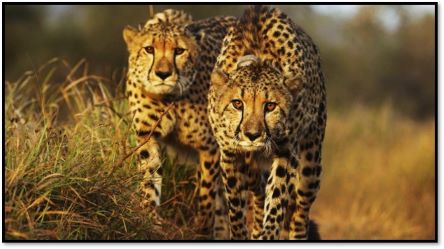
– Eight cheetahs from the African country of Botswana are ready to arrive in India in the third week of December.
– Environment, Forest and Climate Change Minister Bhupendra Yadav said that upon arrival in India from Botswana, these cheetahs will be placed in quarantine again.
– During this time, they will undergo various medical examinations. After that, they will be kept with the other cheetahs in Kuno National Park in Madhya Pradesh.
Eight cheetahs were brought to Kuno in 2022
– The cheetah cubs will become adults in the next two months.
Of the 27 cheetahs in the country, 16 were born in India.
– Under Project Cheetah in the country, eight cheetahs were brought to Kuno in Madhya Pradesh from Namibia in September 2022.
– After that, 12 cheetahs were brought from South Africa in February 2023. Of the total 27 cheetahs, 24 are in Kuno and 3 in Gandhi Sagar.
—————
2. In the QS (Quacquarelli Symonds) World University Rankings: Asia 2026, which university is in the first position?
a. University of Hong Kong
b. Peking University
c. National University of Singapore
d. Fudan University
Answer: a. University of Hong Kong (In the 2025 rankings, “Peking University” was in the first position)
– The “QS World University Rankings: Asia 2026” released on November 4, 2025, evaluated more than 1500 universities/institutes, and more than 500 new ones have been added.
– It includes the highest number of 394 universities from China and 294 from India.
Top 10 Universities
1) University of Hong Kong, Hong Kong SAR, China
2) Peking University, China (Mainland)
3) Nanyang Technological University, Singapore
4) National University of Singapore (NUS), Singapore
5) Fudan University, China (Mainland)
6) Hong Kong University of Science and Technology, Hong Kong SAR, China
7) City University of Hong Kong (CityUHK), Hong Kong SAR, China
8) Chinese University of Hong Kong (CUHK), Hong Kong SAR, China
9) Tsinghua University, China (Mainland)
10) Hong Kong Polytechnic University, Hong Kong SAR, China
Basis (Parameters) for Ranking
– QS World University Rankings: Asia is an annual ranking that rates the top universities in the Asian continent.
– These rankings are based on 8-11 indicators such as academic reputation, employer reputation, research output, faculty-student ratio, international faculty and students.
—————-
3. In the QS (Quacquarelli Symonds) World University Rankings: Asia 2026, which Indian institution received the best ranking?
a. JNU
b. IISc Bangalore
c. IIT Delhi
d. IIT Bombay
Answer: c. IIT Delhi (Rank 59)
– IIT Delhi is at the 59th position this year and has been declared the best Indian institution for the fifth consecutive year.
Indian Institutions in Top 100
1) IIT-Delhi (Rank 59)
2) IISc Bangalore (Rank 64)
3) IIT-Madras (Rank 70)
4) IIT-Bombay (Rank 71)
5) IIT-Kanpur (Rank 77)
6) IIT-Kharagpur (Rank 77)
7) Delhi University (Rank 95)
Indian Institutes in Top 200 List
Rank and Institution
109: Chandigarh University
114: IIT Roorkee
115: IIT Guwahati
130: JNU, Delhi
154: Birla Institute of Technology and Science, Pilani
156: Vellore Institute of Technology (VIT), Vellore
159: Shoolini University of Biotechnology and Management Sciences
163: O.P. Jindal Global University (JGU)
163: University of Petroleum and Energy Studies
187: Amity University
187: Lovely Professional University (LPU)
197: Jamia Millia Islamia, Delhi
200: Symbiosis International (Deemed University)
How many Indian institutions improved in ranking
– Compared to last year, the rankings of 36 Indian institutions have improved, 16 have seen no change, and 105 have declined.
– The maximum improvement has been by Satyamba Institute of Science and Technology, which climbed 111 places to reach the 262nd position.
————–
4. Which country tested the world’s first nuclear-powered cruise missile 9M730 Burevestnik?
a. India
b. USA
c. Russia
d. China
Answer: c. Russia
– Russia tested the world’s first nuclear-powered cruise missile (nuclear energy-powered cruise missile) in October 2025.
– Its name is the 9M730 Burevestnik missile.
– NATO has named it SSC-X-9 Skyfall.
– Being a nuclear-powered cruise missile, it challenges the global strategic balance with unlimited range and hypersonic speed.
– Russia conducted the test of this missile at a time when tensions with the US and Europe over the Ukraine crisis are ongoing.
About the 9M730 Burevestnik (Burevestnik) Missile
Development:
– Started in 2007, announced by President Vladimir Putin in 2018.
– It is inspired by Soviet-era nuclear propulsion concepts (such as 1960s Keldysh Bureau’s nuclear ramjet ideas or Project Orion).
Technical Features:
– Engine: Powered by a nuclear reactor (ramjet), which can fly without fuel shortage.
– Range: 20,000 km+ (unlimited).
– Speed: Mach 8-10 (hypersonic).
– Payload: 1-2 megaton nuclear warhead.
– Launch: From mobile launcher or submarine.
Testing History:
– Unsuccessful tests in 2017-2019, explosion in Arkhangelsk in 2019 (radiation leak, 5 deaths).
– Successful tests in 2024-25, deployment target by 2026.
Global Significance:
– Strategic Impact: Low-level flight and unpredictable trajectory can evade US defenses (THAAD). Russia calls it “invincible.”
– Arms Control: Accused of violating INF Treaty (1987) (US withdrew in 2019). Impact on New START (expires 2026).
– Risks: Radiation and environmental hazards from nuclear propulsion.
– Current Context (2025): Russia’s nuclear signaling in Ukraine war; NATO called it a “game-changer.”
Relevance for India:
– Security Challenges: Russia-China alliance disrupts Indo-Pacific balance; compared to India’s Agni-V (5,000 km) or BrahMos (900 km), Burevestnik has global range.
– Strategic Partnership: Balance in India-Russia S-400 and BrahMos deals; with QUAD/AUKUS.
– Policy Impact: Pressure on India’s No First Use (NFU) policy; Russia’s support in NSG.
—————
5. In which sea did the cyclonic storm ‘Montha’ form?
a. Arabian Sea
b. Bay of Bengal
c. Red Sea
d. Persian Gulf
Answer: b. Bay of Bengal
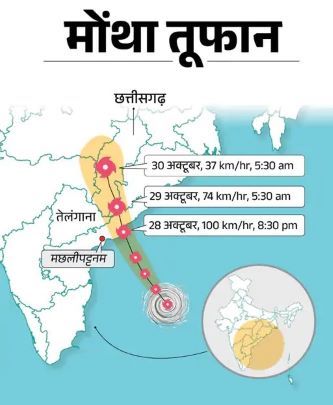
– The cyclone ‘Montha’ formed in the Bay of Bengal, located in the Indian Ocean region.
– On October 28, 2025, this cyclone hit the Machilipatnam coast in Andhra Pradesh.
– During this time, winds blew at 90-100 km per hour, reaching up to 110 km per hour.
– Its impact was seen in several states across the country. Alerts were issued for the coasts of Tamil Nadu, Andhra Pradesh, Puducherry, and Odisha.
Damage in Andhra Pradesh
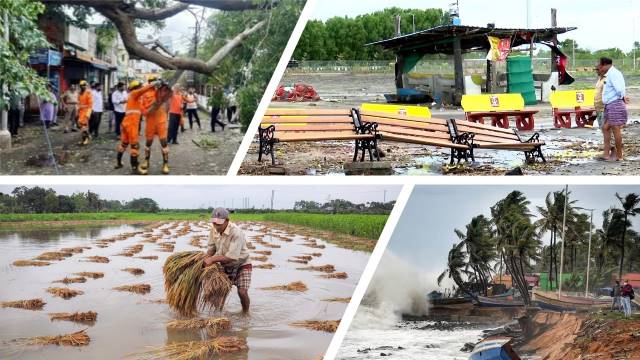
– The severe cyclone Montha damaged 1.58 lakh hectares of crops in Andhra Pradesh.
– About 80,000 farmers were affected. Several people died.
How do cyclonic storms form?
– When a low-pressure area forms in the sea, a cyclonic storm arises.
– The question here is, what is a low-pressure area in the sea and how does it form?
– Global warming is responsible for this.
– When the sea temperature rises or when the sea starts getting warmer, the heat causes the air to rise up, and to fill that empty space (creating a vacuum-like area), surrounding air rushes in. This is called a low-pressure area.
– Since seas are vast, this process becomes very extensive.
– The warm air rises up, and air from a large area comes here, but the rising air also cools down because as we go higher in altitude, the temperature decreases.
– In this way, the upper air, which has cooled, also wants to come down, and it turns into a storm.
– The wind rotates very rapidly.
– The sea absorbs a large part of global warming or heat on Earth.
– In a way, it can be said that cyclonic storms are the sea’s way of trying to cool itself.
Cyclones have different names in different parts of the world
– America – Hurricane / Tornado
– Caribbean Sea – Hurricane
– China Sea – Typhoon
– Indian Ocean – Tropical Cyclone
– Japan – Typhoon
– Northern Australia – Willy Willies
– Philippines – Baguio
—————
6. Which country named the cyclonic storm ‘Montha’?
a. Thailand
b. Bangladesh
c. India
d. Saudi Arabia
Answer: a. Thailand
– The name ‘Montha’ was given by Thailand and it is a Thai word.
– In Thai language, “Montha” means fragrant flower or beautiful flower.
Previous Storms and Naming
– Montha – Thailand (October 2025: Hit Machilipatnam coast in Andhra Pradesh)
– Shakti – Sri Lanka (Western coast, mainly Gujarat and Maharashtra)
– Fengal – Saudi Arabia (November 2024: Hit Puducherry and Tamil Nadu)
– Dana – Qatar
– Asna – Pakistan
– Remal – Oman
How are names decided for cyclones in the Indian Ocean?
– The system for naming cyclones is set up by the United Nations World Meteorological Organization (WMO) / ESCAP (United Nations Economic and Social Commission for Asia and the Pacific) Panel.
– 13 countries in the Indian Ocean region decide the names of cyclonic storms.
– These countries include India, Pakistan, Sri Lanka, Bangladesh, Maldives, Myanmar, Oman, Thailand, Iran, Qatar, Saudi Arabia, UAE, and Yemen.
– These 13 countries prepare a list of names in advance.
– As soon as a cyclone reaches any part of these countries, a different name from the list is given to this cyclone.
– This not only makes it easy to identify the cyclone but also helps in rescue operations.
– Names are used in rotation after being given to a cyclone and are not reused. For example, after Fengal, the next cyclone will be named Shakti, as suggested by Sri Lanka.
—————
7. Which countries affected by storm Melissa did India send humanitarian aid to?
a. Jamaica and Cuba
b. Cuba and Haiti
c. Jamaica and Florida
d. Florida and Cuba
Answer: a. Jamaica and Cuba
– After the devastation from storm Melissa in Jamaica and Cuba, India sent 20-20 tons of relief material.
– Foreign Minister Dr. S. Jaishankar shared the information via a social media post. The relief material includes medicines, medical equipment, food and daily use items, power generators, shelter assistance, and hygiene kits.
Over 50 people died in the Caribbean due to the storm
– Storm Melissa caused devastation in Jamaica, Haiti, and Cuba. Strong winds destroyed homes and blocked roads.
– The speed of the stormy winds was up to 190 kilometers per hour.
– This storm has taken the lives of at least 50 or more people in the Caribbean, and the numbers may increase.
– In Jamaica, it struck as a Category 5 storm, leaving more than 60% of the island without power, and more than half of the water supply systems shut down.
————–
8. INS Ikshak is what type of vessel inducted into the Indian Navy?
a. Hydrographic survey vessel
b. Aircraft carrier
c. Replenishment oiler
d. Submarine
Answer: a. Hydrographic survey vessel
– INS Ikshak is the third ship in the Survey Vessel (Large) category.
– It is an indigenously built Survey Vessel (Large) [SVL] to enhance the Indian Navy’s hydrographic survey capabilities.
– INS Ikshak was commissioned into the Navy on November 6, 2025, at the Kochi Naval Base.
About INS Ikshak
– The ship ‘Ikshak’ was built by Garden Reach Shipbuilders and Engineers (GRSE) in Kolkata.
– More than 80% indigenous equipment and materials have been used in it.
– ‘Ikshak’ means ‘guide’ in Sanskrit, which reflects its role.
– The ship is designed for surveying ports, coasts, and seas.
– The data obtained from these surveys will strengthen safe navigation, maritime security, and strategic infrastructure.
Indian Navy Chief
– Admiral Dinesh K. Tripathi
—————-
9. Which country became the first in the world to impose a generational ban on tobacco, vaping, and e-cigarette products?
a. Myanmar
b. Maldives
c. Bhutan
d. Nepal
Answer: b. Maldives
– Maldives has imposed a generational ban on smoking.
– This ban also applies to vaping and e-cigarette products.
– This ban came into effect from November 1, 2025.
– This is a bold step or significant initiative towards a smoke-free future for Maldives.
What is the generational ban on smoking?
– This is a law introduced by Maldives.
– It prohibits individuals born in January 2007 or later from purchasing, using, or selling tobacco in all forms.
– The South Asian island nation has also imposed a comprehensive ban on the import, sale, distribution, possession, and use of electronic cigarettes and vaping products, which applies to all individuals regardless of age.
What is the penalty?
– Strict punishment is provided for violating the law.
– If a shopkeeper is caught selling tobacco to minors, a fine of 50,000 Maldivian Rufiyaa (approximately 2.9 lakh rupees) will be imposed.
– If a person is caught using vaping devices (e-cigarettes, etc.), a fine of 5,000 Rufiyaa (approximately 29,000 rupees) will be imposed.
Why is the ban on smoking a big step?
– According to World Health Organization (WHO) data, smoking causes more than 70 lakh deaths globally every year.
– According to WHO data, about 25.5 percent of the population aged 15 to 69 in Maldives in 2024 were tobacco users.
Has such a step been taken before?
– Such attempts have been made before, but they could not be implemented.
– The most famous example is the New Zealand law from 2002.
– Under this, selling tobacco to anyone born after January 1, 2009, was to be banned.
– This law was to be implemented from 2024, but the government repealed it a year earlier to raise funds for tax cuts.
Situation of deaths from smoking in India
– In India, about 13.5 lakh deaths occur every year due to tobacco, including both smoking and smokeless tobacco (like gutkha).
About 42% of cancer deaths in India are linked to tobacco. Recently, there has been an increase in mouth, lung, and throat cancers.
Maldives
– Capital: Male
– President: Mohamed Muizzu
– Currency: Maldivian Rufiyaa
—————
10. When was World Tsunami Awareness Day celebrated?
a. 3 November
b. 5 November
c. 7 November
d. 9 November
Answer: b. 5 November
– This day is celebrated to raise awareness about tsunamis and share new ideas to reduce risks.
Theme for 2025:
– Be Tsunami Ready: Invest in Tsunami Preparedness
– World Tsunami Awareness Day is being observed following Japan’s initiative.
– The first World Tsunami Awareness Day was celebrated worldwide on November 5, 2016.
– The United Nations General Assembly announced it on December 22, 2015.
—————
11. When is the International Day to Prevent Exploitation of the Environment in War and Armed Conflict observed?
a. 3 November
b. 4 November
c. 5 November
d. 6 November
Answer: d. 6 November
– This day was declared by the United Nations in 2021.
– UNEP estimates that conflicts over control of natural resources are likely to double in the coming times.
—————
12. Where did the Central Board of Secondary Education (CBSE) organize its first International Sahodaya Conference?
a. Muscat
b. Dubai
c. Abu Dhabi
d. Muscat
Answer: b. Dubai
– CBSE organized the conference in Dubai on November 4-5, 2025. The theme is “Knowledge Embedded, Moving Forward with Vision: Reimagining Education through NEP 2020.”
– More than 1,000 school principals and teachers from CBSE-affiliated institutions in India and abroad participated in this conference.
– There are more than 100 CBSE schools following the Indian curriculum in the United Arab Emirates alone.
Theme and Objectives
– To promote meaningful partnerships among CBSE-affiliated schools globally.
– To develop practical strategies for implementing the National Education Policy 2020 (NEP 2020) in diverse educational contexts.
– To showcase innovations in teaching methods and school management.
– To encourage strategic collaborations that support holistic education—emphasizing critical thinking, creativity, and global citizenship.
—————
13. For the 2028 Olympic Games, which women’s weight category was removed, in which Mirabai Chanu won a silver medal at the Tokyo Olympics?
a. 45 kg weight category
b. 49 kg weight category
c. 50 kg weight category
d. 51 kg weight category
Answer: b. 49 kg weight category
– The International Olympic Committee (IOC) has set the minimum category for women in Olympic Games to 53 kg.
– 31-year-old Mirabai Chanu won a silver medal in the 49 kg category at the Tokyo Olympics.
– India’s chief national coach Vijay Sharma believes that increasing weight up to 53 kg will be beneficial for Chanu.
– However, this athlete from Manipur will continue to compete in her old weight category of 49 kg until the 2026 Asian Games.
– After that, she will have two years to gradually move to the 53 kg category for Olympic preparation.
– The total number of weightlifting events in the Olympics has been set to 12.
– This is the second time in less than a year that the International Weightlifting Federation (IWF) has changed categories.
– Chanu had moved to the 48 kg category at the beginning of 2025 when IWF removed the 49 kilogram category from the Olympics.
– However, the 49 kg category has now been reinstated for competitions like the World Championships, but it will not be included in the Olympics.
In 2028 Olympics, these will be the women’s weight categories: 53 kg, 61 kg, 69 kg, 77 kg, 86 kg, over 86 kg.
– Men: 65 kg, 75 kg, 85 kg, 95 kg, 110 kg, over 110 kg.
—————-
14. Who inaugurated the new building of the Chhattisgarh Legislative Assembly on the State Foundation Day (November 1, 2025)?
a. President
b. Prime Minister
c. Chief Minister
d. Home Minister
Answer: b. Prime Minister (Narendra Modi)
– PM Modi will participate in the Chhattisgarh Silver Jubilee celebrations marking the 25th anniversary of the state’s formation.
– During this, he inaugurated the new building of the Chhattisgarh Legislative Assembly and a tribal museum.
And unveiled the statue of former Prime Minister Atal Bihari Vajpayee.
Inauguration of projects worth how many crores
– PM Modi inaugurated and laid the foundation stone for development projects worth Rs 14,260 crore in key sectors like roads, industry, health services, and energy in the state.
Which trees were planted
– Under Prime Minister Modi’s “One Tree for Mother” campaign, trees like Gulmohar, Teak, Mango, Peepal, and Neem have been planted throughout the complex. The corridors are adorned with traditional Bastar and Surguja art, while beautiful gardens enhance its beauty.
About the New Assembly
– The new assembly is in Sector-19, Nava Raipur.
– Built at a cost of 324 crore rupees, this complex spans 51 acres. Approximately 2,06,390 square meters.
– The building is completely eco-friendly (environmentally friendly).
– The assembly hall has a total area of 16,000 square feet, with a seating capacity of 200 people. Currently, the assembly has 90 members.
– The building’s gallery has seating for 320 people, including media personnel, special guests, and invited spectators.
– On the first floor, there is a conference room with a capacity of 100 members in an area of 2,400 square feet.
– On the second floor, a central hall with a capacity of 200 members in an area of 3,200 square feet has been built.
– The upper floor has 24 rooms for ministers, two committee rooms, and a cabinet hall.
– The lower floor has allopathic, homeopathic, and ayurvedic dispensaries, a bank, post office, and canteen.
– The complex has a modern auditorium with a capacity of 500 people and parking for 850 vehicles.
Note: The ceiling of the new assembly building’s sanctum has been given the shape of the “Rice Bowl.”
The assembly’s first session in a school
– After the state came into existence on November 1, 2000, the Chhattisgarh Legislative Assembly initially started functioning from a school (Rajkumar College) hall because the building was not ready.
– Therefore, the first session ran in this school hall from December 14 to 19, 2000.
– Later, it was shifted to a central government research institute, from where it has now been moved to the new complex.
About Chhattisgarh
– Formation: November 1, 2000 (separated from Madhya Pradesh)
– Capital: Raipur
– Governor: Ramen Deka
– Chief Minister: Vishnu Dev Sai
– Neighboring States: Uttar Pradesh, Jharkhand, Odisha, Telangana, Andhra Pradesh, Maharashtra, and Madhya Pradesh.
—————
15. Who is the Director General of the Bureau of Indian Standards (BIS)?
a. Sanjay Garg
b. Pramod Tiwari
c. Pradeep Sharma
d. Tushar Pandey
Answer: a. Sanjay Garg
– Sanjay Garg is a 1994 batch IAS officer of the Kerala cadre.
– He assumed charge on November 1, 2025.
– He has more than 30 years of diverse administrative experience.
– He has worked in several important positions in the agriculture sector.
Bureau of Indian Standards (BIS)
– It is India’s national standards body, responsible for standardization, certification, and related activities.
– It develops Indian Standards for goods and services, implements hallmarking, and protects consumer interests.
Headquarters is located in New Delhi.
PDF Download: Click here