
This is the current affairs of 1 to 4 September 2025. Here are questions and answers of daily current affairs for better preparation of competitive exams for government jobs.
PDF Download: Click here
1. All the districts of which state were flooded in August – September 2025, which was described as the worst flood since 1988?
a. Haryana
b. Bihar
c. Punjab
d. Kerala
Answer: c. Punjab
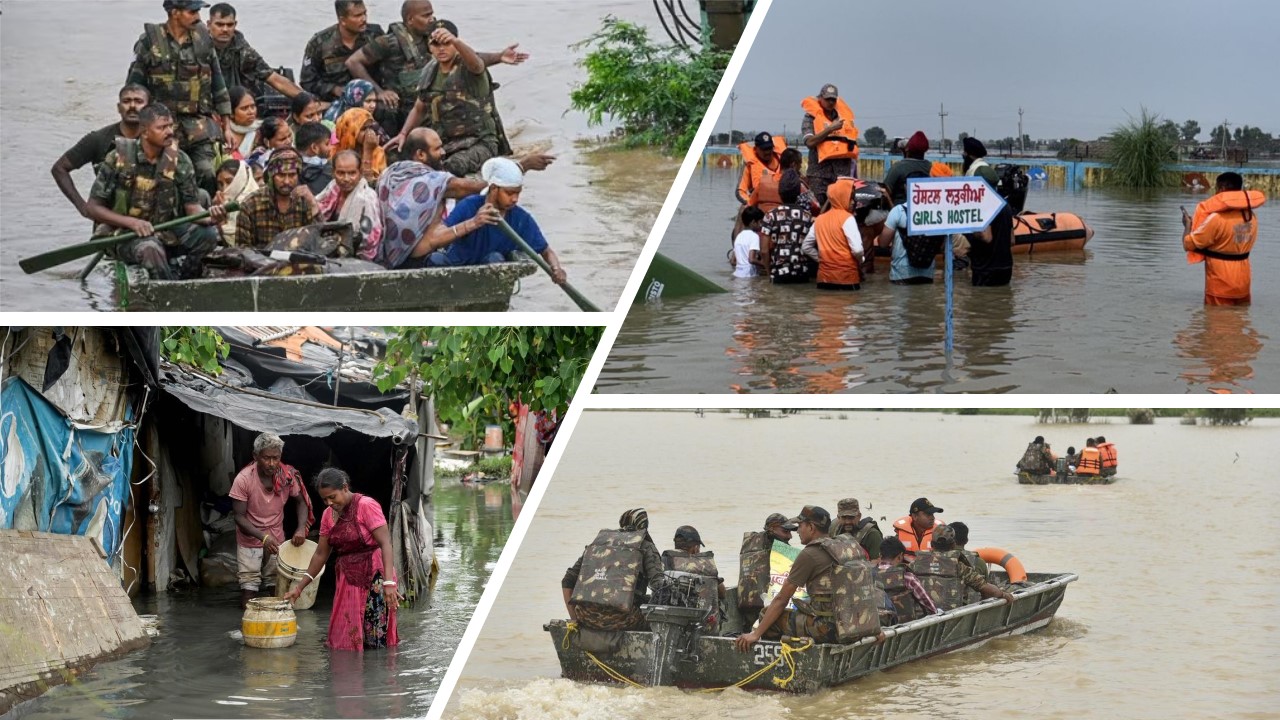
– The flood situation that began in August spread across the entire Punjab in September.
– All 23 districts of Punjab have been affected by floods.
– More than 3.55 lakh people in 1,655 villages have been impacted.
– All schools, colleges, and universities in the state have extended their holidays.
– Due to heavy rainfall and water released from Himachal Pradesh and Jammu & Kashmir, the major rivers of the state—Satluj, Beas, and Ravi—are in spate.
Damage
– From August 1 to September 3, floods have caused the death of 37 people.
– More than 1.48 lakh hectares of standing crops have been destroyed due to floods in Punjab. In many areas, fields have turned into ponds and lakes with depths reaching 8 to 10 feet. Villagers are moving around by boats. Farmers are also suffering losses of livestock.
Floods in other states
– Many areas in Haryana are also submerged in floods. The state has reported 11 deaths.
– All schools in Hisar, Panchkula, Ambala, and Rohtak had to be closed temporarily.
– Meanwhile, in Delhi, water from the Yamuna river has entered the city.
– Relief camps for flood-affected people near Mayur Vihar Phase-1 got flooded with Yamuna water. A part of the flyover on National Highway-44 in Alipur collapsed.
Punjab details
– Chief Minister: Bhagwant Mann
– Governor: Gulab Chand Kataria
– Capital: Chandigarh
————-
2. Which two main tax slabs were decided in the 56th meeting of the GST Council?
a. 5% and 12%
b. 12% and 18%
c. 5% and 18%
d. 0% and 28%
Answer: c. 5% and 18% (Apart from this, another tax slab of 40% will be applicable on tobacco products, luxury cars and others, other tax slabs 12% and 28% have been removed.)
– The purpose of these changes is to provide relief to the common man, support small businesses, and reduce the use of harmful products like tobacco by increasing their taxes.
– Now, instead of 4 GST slabs, there will be only two slabs: 5% and 18%. This will make everyday essentials like soap and shampoo, as well as items like air conditioners and cars, cheaper.
– This decision was taken in the 56th meeting of the GST Council.
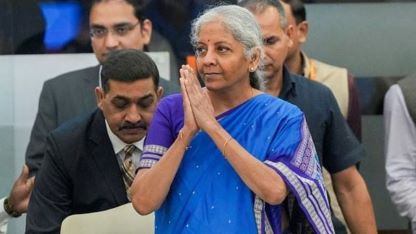
– Finance Minister Sitharaman stated that many food items including milk, bread, paratha, and chhena will be GST-free. Additionally, individual health and life insurance will also be exempt from tax. Thirty-three life-saving medicines, as well as medicines for rare and serious diseases, will be tax-free.
– Luxury items and tobacco products will now attract 40% GST instead of the earlier 28%. Medium and large cars, and motorcycles with engines above 350cc will fall under this slab.
New slabs will be effective from 22nd September
– The new slabs will come into effect on the first day of Navratri, i.e., 22nd September. However, the new 40% GST rate on tobacco products will not be implemented immediately.
GST on These Goods Now
Everyday Items
– Soap, shampoo, toothpaste (previously 18%, now 5%)
– Ghee, butter, noodles and snacks, utensils, baby bottles, sanitary napkins, diapers, and sewing machines (previously 12%, now 5%)
– Milk, chhena (cottage cheese), paneer, roti, chapati, paratha (now 0%)
Agriculture
– Tractor tires, tractors, irrigation machines, agricultural machinery (previously 12%, now 5%)
Health
– Health insurance, thermometer (previously 18%, now 5%)
– Oxygen, diagnostic kits (previously 12%, now 5%)
Automobiles
– Small cars, motorcycles (previously 28%, now 18%)
Education
– Maps, charts, globes, pencils, crayons (previously 12%, now 0%)
– Exercise books (previously 5%, now 0%)
Electronic Devices
– Air conditioners, TVs (larger than 32 inches), washing machines (previously 28%, now 18%)
Luxury Items and Tobacco Products Will Become More Expensive (date to be announced later)
– Pan masala, tobacco products, additional sugar products (previously 28%, now 40%)
– Non-alcoholic beverages (previously 18%, now 40%)
– Carbonated and caffeinated beverages, motorcycles with engines over 35,000 cc, aircraft, yachts, luxury cars, revolvers, and pistols (previously 28%, now 40%)
Will Reducing GST Rates Cause Loss to the Government?
– The Finance Minister acknowledged that reducing tax on everyday items may initially impact revenue. According to SBI Research, an annual revenue loss of ₹85,000 crore is possible.
– However, Sitaraman said that increased consumption will compensate for this loss in the long run. Additionally, preventing tax evasion and improving compliance will increase revenue. Good income is also expected from luxury and sin goods under the 40% slab.
About GST
– The government implemented GST across the country on 1st July 2017. After this, 17 taxes and 13 cesses imposed by the central and state governments were abolished. On the completion of 7 years of GST, the Ministry of Finance posted about the achievements made during these seven years.
– GST is an indirect tax. It was introduced in 2017 to replace several types of indirect taxes like VAT, service tax, purchase tax, excise duty, etc. GST has four slabs: 5%, 12%, 18%, and 28%.
GST is divided into four parts:
– CGST (Central GST): Collected by the Central Government.
– SGST (State GST): Collected by the State Governments.
– IGST (Integrated GST): Applicable on interstate transactions and imports, shared between the Center and the States.
– Cess: An additional charge levied on specific goods (like luxury items, tobacco) to raise funds for specific purposes.
————-
3. Who has been appointed by the Central Government as the new Controller General of Accounts of the country?
a. TCA Kalyani
b. Madhumita Basu
c. V.K. Shunglu
d. Shashi Chandra
Answer: a. TCA Kalyani
– She is a 1991 batch officer of the Indian Civil Accounts Service (ICAS).
– TCA Kalyani took charge on 1st September 2025.
What does the CGA do?
– The CGA (Controller General of Accounts) is a key officer of the Government of India working under the Department of Expenditure, Ministry of Finance.
– The CGA acts as the principal advisor to the central government on accounting matters.
– The responsibility of preparing and submitting accounts of the central government lies with the CGA.
– The CGA is also responsible for exchequer control and internal audits.
– The fiscal deficit is also calculated by the CGA.

————-
4. In which neighbouring country a 6.0 magnitude earthquake followed by a 5.2 magnitude earthquake struck, killing over 1400 people?
a. Bangladesh
b. Sri Lanka
c. Pakistan
d. Afghanistan
Answer: d. Afghanistan
– When and how strong was the earthquake? On August 31, a 6.0 magnitude earthquake struck, followed by another of 5.2 magnitude on September 3, 2025.
– Epicenter of the earthquake: About 27 kilometers northeast of Jalalabad in Nangarhar province.
– The earthquake struck at 11:47 PM when most people were asleep or about to sleep.
– More than 1,400 people lost their lives.
– The Taliban appealed for international aid.
– The worst devastation occurred in the remote Kunar province.
– Several villages were completely destroyed; relief and rescue operations are underway on the ground.
– Earlier in 2024, over 1,000 people died due to earthquakes in western Afghanistan.
– The disaster on August 31, 2025, came at a time when Afghanistan was already struggling with severe drought, aid cuts, and a food crisis.
– The World Food Programme described the ongoing hunger crisis in Afghanistan as unprecedented, meaning more dangerous than ever before.
– The country also lacks proper infrastructure systems.
India Sent Aid
– External Affairs Minister S. Jaishankar said that tents for 1,000 families were delivered to Kabul the day after the earthquake.
– The Indian Mission also immediately delivered 15 tons of food supplies from Kabul to Kunar. Additional relief materials were sent from India thereafter.
7,000 Deaths from Earthquakes in a Decade
– According to a report by the UN Office for the Coordination of Humanitarian Affairs (OCHA), more than 7,000 people have died in earthquakes in Afghanistan over the past decade.
– On average, about 560 deaths occur annually due to earthquakes.
– In May 1998, a major earthquake in the Takhar and Badakhshan provinces of northern Afghanistan killed 4,000 people.
– Around 100 villages and 16,000 homes were damaged at that time.
– Around 45,000 people were left homeless during that disaster.
Capital: Kabul
– Supreme Leader: Hibatullah Akhundzada
– Prime Minister: Hasan Akhund
– Population: 500 million
– Languages: Dari and Pashto
– Currency: Afghani
————-
5. Australia’s fast bowler Mitchell Starc has announced his retirement from which format of international cricket?
a. One Day International
b. T-20
c. Test Cricket
d. IPL
Answer: b. T-20
– 35-year-old Mitchell Starc made this decision to focus on Test cricket and the 2027 ODI World Cup.
– Starc said, “Test cricket has always been my top priority. I’ve enjoyed every minute of every T20 match I played for Australia — especially the 2021 World Cup — not just because we won, but also because we had an incredible group and the fun we had was unmatched.”
Cricket Career:
– Last T20 match was played in the 2024 World Cup.
– Mitchell Starc made his T20I debut in 2012.
– He has played 65 T20 International matches so far.
– He is the second-highest wicket-taker for Australia in T20Is.
– His best performance came in 2022 against West Indies (4 wickets).
– Starc was part of the Australian team that won the T20 World Cup in 2021, held in the UAE.
————-
6. Which city has been ranked as the safest city for women in India in the National Annual Women Safety Report and Index (NARI) 2025?
a. Kohima
b. Aizawl
c. Itanagar
d. All of the above
Answer: a. Kohima (Capital of Nagaland)
– The ‘National Annual Report and Index 2025 on Women’s Safety’, prepared by data science company PValue Analytics, was released by National Commission for Women Chairperson Vijaya Rahatkar at an event on August 28.
– Scores were recorded as follows: Kohima (82.9%), Visakhapatnam (72.7%), Bhubaneswar (70.9%), Aizawl (70.6%), Gangtok (70.4%), Itanagar (70.4%), and Mumbai (70.2%).
– Key factors contributing to this safe environment include strong gender equality, civic participation, effective policing, and women-friendly infrastructure.
National Safety Score set at 65%
– The index is based on a survey of 12,770 women across 31 cities.
– The national safety score was set at 65%.
– Cities were categorized as ‘Well Above’, ‘Above’, ‘Average’, ‘Below’, or ‘Well Below’ the benchmark based on this score.
Points of the report
– In educational institutions, 86% of women feel safe during the day, but at night or outside the campus, they remain concerned about their safety.
– Around 91% of women feel safe at their workplace, but half of them are unsure whether their workplace has a sexual harassment prevention policy in place.
– Only one-fourth of the women surveyed said they trust authorities to take effective action on safety-related complaints.
– 69% of women said that the current safety efforts are somewhat adequate, while more than 30% pointed out major shortcomings.
– Only 65% reported real improvement in safety during 2023–2024.
– 7% of women stated that they faced harassment in public spaces during 2024.
– For women under the age of 24, this figure was found to be 14%.
– In the survey, neighborhoods (38%) and public transport (29%) were identified as places where women face higher incidents of harassment.
– Only 1 in 3 victims comes forward to report incidents of harassment.
– 2 out of every 3 women in the survey do not report harassment, which means most incidents never make it to NCRB (National Crime Records Bureau) data.
————-
7. Which city has been ranked as the most unsafe city for women in India in the National Annual Women Safety Report and Index (NARI) 2025?
a. Ranchi
b. Delhi
c. Patna
d. Jaipur
Answer: a. Ranchi
– According to the survey, Ranchi received the lowest score.
– Other cities ranked as unsafe include Srinagar, Kolkata, Delhi, Faridabad, Patna, and Jaipur.
– These scores are linked to poor infrastructure, patriarchal norms, or weak institutional accountability.
– To prepare this index, the perceptions and experiences of 12,770 women were taken into account.
– The report emphasizes that National Crime Records Bureau (NCRB) data represents only a small fraction of the actual number of crimes reported.
————-
8. When is World Coconut Day celebrated?
a. 30 August
b. 31 August
c. 1 September
d. 2 September
Answer: d. 2 September
Theme 2025
– “Uncovering Coconut’s Power, Inspiring Global Action.”
– This day has been declared by the intergovernmental organization of coconut-producing countries — the International Coconut Community (ICC).
– The day serves as an opportunity to raise awareness about the economic, nutritional, and cultural importance of coconuts in different parts of the world.
————-
9. Which neighbouring country celebrated the Victory Day parade in September 2025 to mark 80 years of Japan’s defeat in World War II, in which many modern weapons were showcased for the first time?
a. Pakistan
b. Bangladesh
c. Sri Lanka
b. China
Answer: d. China
– On September 3, 2025, China celebrated Victory Day to mark 80 years since Japan’s defeat in World War II.
– It was the largest military parade ever held in China.
– Before the parade, Chinese President Xi Jinping appeared on stage along with Russian President Vladimir Putin, North Korean leader Kim Jong-un, and leaders from 25 other countries.
– From India’s neighborhood, Pakistan’s Prime Minister Shehbaz Sharif, Pakistan’s Army Chief Asim Munir, Nepal’s Prime Minister K.P. Sharma Oli, and Maldives President Mohamed Muizzu were present at the parade.
What is China trying to prove?
– According to reports, Beijing aimed to use this parade to show that it is a global alternative to the United States and that it has the power to lead non-Western nations.
– President Xi Jinping took the salute at Tiananmen Square in Beijing.
– After his speech, a grand military parade was held.
– Xi stated that China is not afraid of any threats and will always keep progressing.
Display of Modern Weapons:
– The parade included hypersonic glide vehicles, the YJ-21 anti-ship cruise missile, and the JL-3 submarine-launched ballistic missile.
– China also displayed its first hypersonic cruise missile, CJ-1000.
– In addition, lasers, stealth jets, missiles, drones, and robotic dogs were showcased as examples of China’s modern military technology.
————-
10. When is National Nutrition Week celebrated?
a. 1 to 7 September
b. 31 August to 6 September
c. 2 to 8 September
d. 4 to 10 September
Answer: a. 1 to 7 September
Theme 2025: ‘Eat right for a better life’
– This day is an initiative by the Ministry of Health and Family Welfare to raise awareness about healthy eating and nutrition literacy.
– The National Nutrition Week was started in 1982 by the Food and Nutrition Board (under the Ministry of Women and Child Development) to promote awareness about the importance of a balanced diet.
————-
11. Which microprocessor chip was handed over by Union Minister Ashwini Vaishnav to PM Modi at the Semicon India 2025 event, which is being called India’s first ‘Made in India’ processor?
a. Vikram 3201 (32-bit microprocessor)
b. Kalam 32-bit microprocessor
c. Ajay 32-bit microprocessor
d. Veer 32-bit microprocessor
Answer: a. Vikram 3201 (32-bit microprocessor)
– At Semicon India 2025, the Prime Minister of India was presented with Vikram, a 32-bit launch vehicle-grade microprocessor manufactured in India.
Vikram3201
– Joint Development: Developed by ISRO’s Vikram Sarabhai Space Centre (VSSC) and Semiconductor Laboratory (SCL), Mohali.
– Process Technology: 180 nm CMOS fabrication.
– Developed alongside KALPANA3201 (a 32-bit microprocessor designed to work with open-source software tools).
– It is an advanced version of the 16-bit VIKRAM1601.
Usage and Wide Impact
– Space missions – used for navigation, guidance, and mission management in rockets and satellites.
– Strategic sectors – defense, aerospace, high-performance automobiles, and energy.
– Has been used in ISRO launch vehicle avionics since 2009.
– Designed for space flight applications, capable of withstanding extreme temperatures from -55°C to 125°C.
– Features a custom instruction set architecture optimized for the Ada programming language, widely used in safety-critical systems. It can also handle complex tasks like floating-point computation.
Semicon India 2025
– Theme: “Building the Next Semiconductor Powerhouse.”
– The Semicon India program, implemented through India Semiconductor Mission (ISM), showcases India’s growing capabilities in chip design, packaging, and manufacturing.
Promoting the Chip Ecosystem
– This initiative is linked to India’s Design-Linked Incentive (DLI) scheme. So far, more than ₹1.60 lakh crore investment has been announced in the semiconductor sector.
————-
12. Who became the new CEO of Food Safety and Standards Authority of India (FSSAI) on 1 September 2025?
a. Rajan Kohli
b. Vinod Verma
c. Ajay Roopam
d. Rajit Punhani
Answer: d. Rajit Punhani
– He is a 1991 batch IAS officer of the Bihar cadre.
About FSSAI
– Full Form: Food Safety and Standards Authority of India
– Established under: Food Safety and Standards Act, 2006
– Under which ministry: Ministry of Health and Family Welfare
– Headquarters: New Delhi
————-
13. Which Indian state/UT got the hosting of Badminton World Championship 2026?
a. Hyderabad
b. Mumbai
c. Delhi
d. Lucknow
Answer: c. Delhi
– This tournament will be held in August 2026 and will return to India after 17 years.
– The Badminton World Federation (BWF) announced this during the closing ceremony of the 2025 Championship in Paris.
– Previously, this championship was held in India in 2009 in Hyderabad.
PDF Download: Click here