This is the current affairs 20 May 2026. Here are questions and answers of daily current affairs for better preparation of competitive exams for government jobs.
1. Which state announced an incentive of ₹30,000 for the birth of a third child and ₹40,000 for the birth of a fourth child, while releasing a new population management policy?
a. Bihar
b. Punjab
c. Andhra Pradesh
d. Maharashtra
Answer: c. Andhra Pradesh
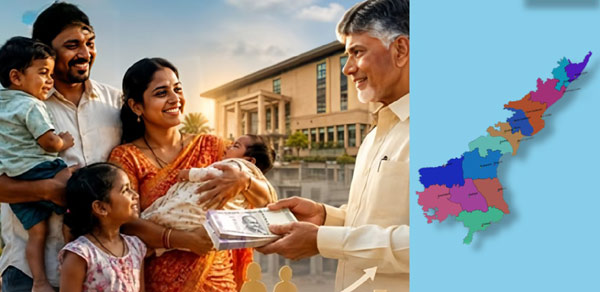
– The Andhra Pradesh government has announced financial incentives under a new Population Management Policy to encourage population growth in the state.
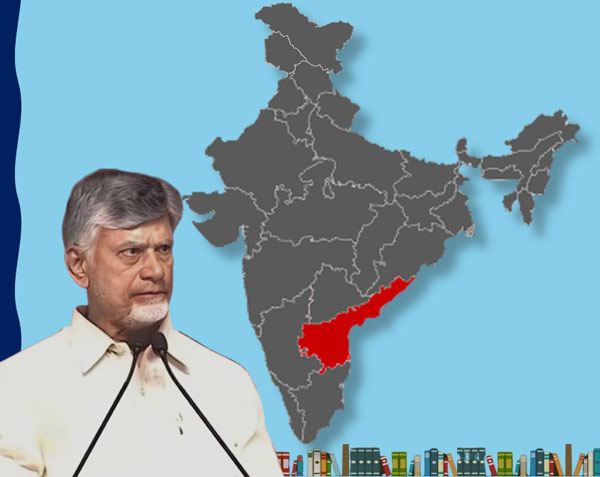
– The announcement was made by Chief Minister N. Chandrababu Naidu in May 2026.
New Population Policy and Demographic Changes
– Financial incentives: The government will provide a one-time incentive of ₹30,000 for the birth of a third child and ₹40,000 for the birth of a fourth child.
– Objective: To ensure the availability of human resources for future development. Chief Minister Naidu stated that “population will be the real wealth in the future.”
– ‘Thalliki Vandanam Scheme’: Under this scheme, which encourages fathers to send children to school, the government has indicated an increase in financial assistance (currently ₹15,000 per child).
Reason Behind the New Population Policy
– Andhra Pradesh’s decision to encourage population growth was not sudden; it is driven by deep demographic, economic, and political concerns.
– To maintain a stable population, the ‘Replacement Level Total Fertility Rate (TFR)’ should be 2.1 (meaning an average woman gives birth to 2.1 children).
– In Andhra Pradesh and most southern states, the TFR has fallen far below this level (around 1.5 to 1.6).
– This means the population is gradually shrinking instead of growing.
Crisis of an Aging Population
– A low birth rate directly reduces the number of young people in society while increasing the elderly population (60+).
– Economic burden: As the working-age population decreases, the number of taxpayers will decline. At the same time, government expenditure on pensions and healthcare for the elderly will rise.
– Labour shortage: Industries and agriculture may face a severe shortage of human resources in the future, slowing economic growth.
Fear of Political and Financial Loss
– Loss of parliamentary seats (Delimitation): In the coming years, Lok Sabha seats will be reallocated based on population. States such as Uttar Pradesh and Bihar, which were less successful in population control, may gain seats. In contrast, southern states that successfully implemented family planning may lose seats, reducing their influence in national politics.
– Financial allocation (Finance Commission): Population is also a major factor in deciding the share of central taxes allocated to states. A declining population may reduce the share of central funds received by southern states.
Shift in Economic Thinking: From ‘Quantity’ to ‘Quality’
– Earlier, a large population was considered a burden on the country (Malthusian Theory).
– Modern economics, however, views humans as ‘Human Capital’ rather than a burden.
– Chief Minister Naidu’s statement that “population will be the real wealth in the future” reflects this global thinking.
– Countries such as China and Japan are currently struggling with declining populations and aging societies, and they too are offering major incentives to encourage childbirth.
————–
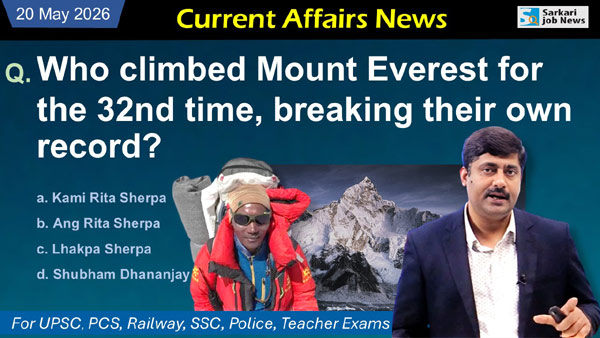
2. Name the ‘Everest Man’ who holds the record for climbing Mount Everest the most times—32 times?
a. Kami Rita Sherpa
b. Ang Rita Sherpa
c. Lhakpa Sherpa
d. Shubham Dhananjay
Answer: a. Kami Rita Sherpa
– Nepali mountaineer and guide Kami Rita Sherpa, popularly known as the “Everest Man,” has successfully climbed Mount Everest for the 32nd time.
– He created the new record on 17 May 2026.
– He is 56 years old.
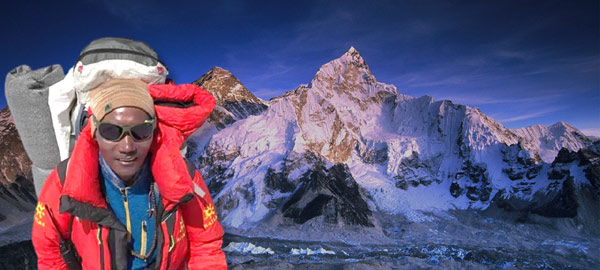
Kami Rita Sherpa
– Born on 17 January 1970, he developed a deep passion for climbing at a young age and has been climbing mountains for more than two decades.
– Rita first climbed Mount Everest on 13 May 1994.
– Apart from Everest, he has also climbed K2, Mount Lhotse, Mount Manaslu, and Cho Oyu.
– Since his first ascent, Sherpa has climbed Everest almost every year and has now completed 32 successful ascents.
Sherpas: A Community of Mountain Experts
– Sherpas are an ethnic group living in the snowy Himalayan regions, mainly in Nepal, though they are also found in India and Tibet.
– The word “Sherpa” comes from the Tibetan words “Shar” and “Pa,” meaning “people from the east.”
– Sherpas are highly skilled in high-altitude climbing and mainly work as guides and porters for mountaineers.
————–
3. Name the first woman to set the record for climbing Mount Everest for the 11th time, who is known as the “Mountain Queen.”
a. Junko Tabei
b. Bachendri Pal
c. Sharon Wood
d. Lhakpa Sherpa
Answer: d. Lhakpa Sherpa
– Lhakpa Sherpa is a famous Nepali mountaineer. She is 52 years old.
– On 17 May 2026, she successfully climbed Mount Everest (8,848.86 meters) for the 11th time.
– With this achievement, she strengthened her own world record for the highest number of Everest summits by any woman.

Known as the “Mountain Queen”
– Lhakpa Sherpa is popularly known worldwide as the “Mountain Queen.”
– In 2000, she became the first Nepali woman to successfully climb Everest and return safely.
– She completed her 11th Everest ascent on the same day that fellow Nepali climber Kami Rita Sherpa set the men’s record with his 32nd ascent.
Note – The first woman to climb Mount Everest was Bachendri Pal on 23 May 1984.
Mount Everest
– Everest is the highest mountain peak in the world.
– It is part of the Himalayas.
– Earlier, it was known as Peak XV.
– Height above sea level: 8,848.86 meters (29,032 feet)
—————
4. When is World Bee Day celebrated?
a. 17 May
b. 18 May
c. 19 May
d. 20 May
Answer: d. 20 May
Theme for 2026: “Bee Together for People and the Planet – A partnership that sustains us all”
– The day is observed in memory of the birth of Anton Janša (1734), who is regarded as a pioneer of beekeeping.
Honey Production in India
– Beekeeping is a traditional Indian practice that has become increasingly popular due to market demand.
– Besides honey, bees also produce royal jelly and beeswax, providing additional income to farmers.
– India is a major exporter of honey.
– India produced approximately 133,200 metric tons of honey in 2021–2022.
– More than half of this production was exported.
– Major export markets for Indian honey include the United States, Saudi Arabia, the United Arab Emirates, Bangladesh, and Canada.
————–
5. Name the King of Norway who conferred the country’s highest civilian honor, the ‘Grand Cross of the Royal Norwegian Order of Merit,’ upon PM Modi.
a. Harald V
b. Harald II
c. George III
d. Robert Varera
Answer: a. Harald V
– Prime Minister Narendra Modi was awarded Norway’s highest civilian honor, the “Grand Cross of the Royal Norwegian Order of Merit,” on 18 May 2026.
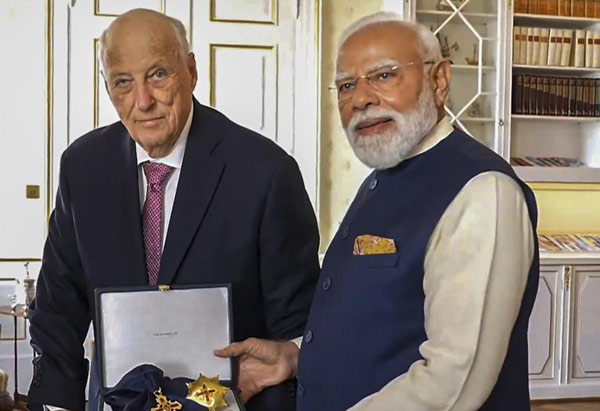
– The honor was conferred by Harald V.
– The “Grand Cross” is the highest class of this order and is awarded for exceptional service in promoting Norway’s interests and international relations.
– This was PM Modi’s 32nd international honor.
– Just a day earlier, he had also received Sweden’s highest honor, the “Royal Order of the Polar Star.”
————–
6. Controversy in Norway after PM Modi did not answer media questions, following a similar controversy in the Netherlands
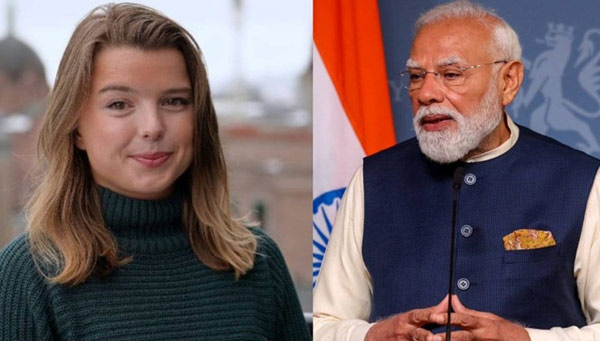
– During Prime Minister Modi’s Europe visit in May 2026, controversy arose in Norway after, similar to the Netherlands, no media questions were taken during the joint press briefing.
– In response to questions raised by Norwegian media, India’s Ministry of External Affairs strongly defended India’s democratic record, constitutional rights, and humanitarian values.
– Earlier in the Netherlands, Dutch Prime Minister Rob Jetten had raised concerns regarding the freedom of the Indian media.
Developments and Diplomatic Tension
– In Oslo, after the joint statement by Prime Minister Narendra Modi and Norwegian Prime Minister Jonas Gahr Støre, Norwegian journalist Hele Ling Svends raised sharp questions regarding the absence of a press conference and issues related to human rights.
– Within a short time, the issue became widely discussed on social media in India and around the world.
India’s Official Position
– MEA Secretary (West) Sibi George strongly defended India’s position, stating that India is a “civilizational nation.”
– He said the Indian Constitution fully guarantees fundamental rights to citizens and equal rights to women.
Nordic Political Culture vs Indian Diplomacy
– European norms: In countries such as Norway, Sweden, and the Netherlands, press freedom and direct questioning of national leaders are considered a normal part of democratic political culture.
– Indian diplomatic approach: India often prefers to focus on bilateral agreements, strategic partnerships, and economic cooperation during such events.
– India has repeatedly emphasized that there cannot be a single “Western model” of democracy. India is the world’s largest and oldest civilizational democracy with its own unique systems.
————-
7. How many Memorandums of Understanding (MoUs) were signed between the two countries during Prime Minister Modi’s visit to the Netherlands in May 2026?
a. 5
b. 10
c. 17
d. 27
Answer: c. 17
– These agreements were signed in the presence of PM Narendra Modi and Dutch PM Rob Jetten.
Key Areas of Agreements
– Technological Sovereignty (Chips & Minerals)
– Sustainable Development (Water & Green Hydrogen)
– Human Capital Exchange (Mobility & Higher Education)
– Cultural and Economic Diplomacy (Chola Artefacts & Customs)
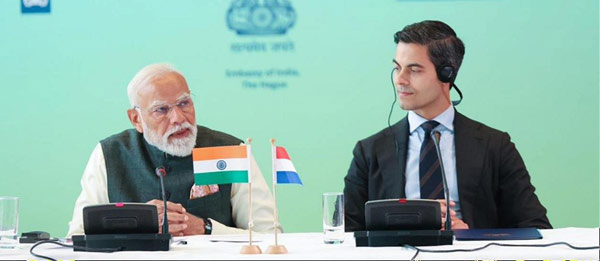
List of Agreements
Strategic and Diplomatic Roadmap
1) India–Netherlands Strategic Partnership Roadmap (2026–2030): A major framework for cooperation in trade, investment, defence, space, AI, and quantum computing over the next five years.
High-Tech and Semiconductors
2) Cooperation between Tata Electronics and ASML: A historic agreement to strengthen the semiconductor fab project in Dholera, Gujarat, and the global supply chain.
3) ‘Brain Bridge’ for Semiconductor Research: Collaboration between Dutch universities and six leading Indian technical institutes including IISc Bengaluru and IITs.
4) Agreement on Critical Minerals: Cooperation in exploration, recycling, and secure supply chains for strategic minerals.
Energy Transition and Climate
5) Green Hydrogen Roadmap: Joint action plan to promote Indian green hydrogen exports to Europe and increase its usage in both countries.
6) Joint Working Group on Renewable Energy: Sharing of clean energy, bio-energy, and battery storage technologies.
7) Energy Cooperation with NITI Aayog: Joint projects for diversified and secure energy systems and green jobs.
“WAH” Agenda (Water, Agriculture, and Health)
8) Technical cooperation for the Kalpasar Project in Gujarat.
9) Indo-Dutch Centre of Excellence for Floriculture in West Tripura.
10) Indo-Dutch Dairy Training Centre in Bengaluru.
11) Cooperation in livestock and dairy sectors.
12) Health collaboration between ICMR and Dutch health institutions on public health research and antimicrobial resistance.
Education and Mobility
13) Migration and Mobility MoU: Easier visa rules for Indian students, researchers, and professionals, along with a Young Professionals Scheme.
14) Cooperation in Higher Education: Promotion of joint degree programs and academic exchanges.
15) Partnership between Nalanda University and the University of Groningen for research and student exchange.
Trade and Cultural Diplomacy
16) Customs Mutual Administrative Assistance Agreement to facilitate safer and smoother trade.
17) Return of Chola Copper Plates and archaeological cooperation between Dutch institutions and the Archaeological Survey of India (ASI).
————–
8. When is the International Day against Homophobia, Transphobia and Biphobia observed?
a. 17 May
b. 18 May
c. 19 May
d. 20 May
Answer: a. 17 May
– The day is observed to raise awareness about LGBT rights and to encourage international action in support of LGBT communities worldwide.
LGBT – Lesbian, Gay, Bisexual, and Transgender
————-
9. Which state’s Cabinet approved the formation of a ‘Dedicated Backward Classes Commission for Local Rural Bodies’ to legally and constitutionally determine the proportional reservation of seats for OBCs in three-tier Panchayat elections?
a. Bihar
b. Jharkhand
c. Uttar Pradesh
d. Madhya Pradesh
Answer: c. Uttar Pradesh
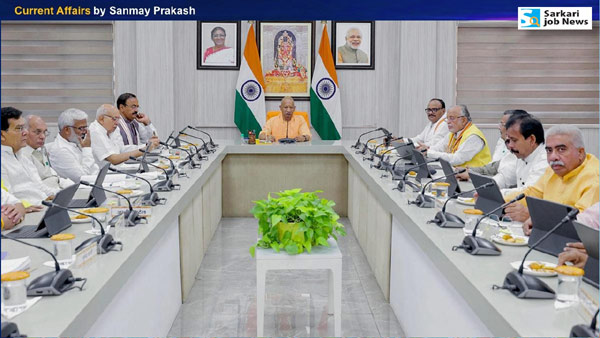
– The commission will consist of five members, headed by a retired High Court judge, and will have a tenure of six months.
– The commission has been constituted in compliance with landmark Supreme Court judgments such as Krishna Murthy vs Union of India (2010) and Vikas Kishanrao Gawali vs State of Maharashtra (2021).
– The Supreme Court made it clear that states must fulfill the conditions of the “Triple Test” before granting OBC reservation in local body elections.
The Triple Test Conditions
– Dedicated Commission: Formation of a dedicated commission to examine the nature and implications of backwardness in local bodies.
– Empirical Data Collection: Conducting practical studies regarding backwardness, population, and political representation of OBCs at the local level.
– Ceiling Limit: Total reservation for SCs, STs, and OBCs together must not exceed 50% of the total seats.
————–
10. Between which two countries is the ‘Siliguri Corridor’ (Chicken’s Neck) situated, a major portion of which has been transferred by the West Bengal government to central agencies?
a. China and Bhutan
b. Nepal and Bangladesh
c. Nepal and Bhutan
d. Bangladesh and Myanmar
Answer: b. Nepal and Bangladesh
(The Siliguri Corridor is geographically located between Nepal and Bangladesh and is only 20–22 km wide. It connects mainland India with the eight northeastern states.)
– The West Bengal government has given in-principle approval to transfer seven important national highway stretches from the state Public Works Department (PWD) to central agencies such as NHAI and NHIDCL.
– The decision was taken in May 2026.
– The move is considered important for India’s territorial integrity, national security, and uninterrupted connectivity with the northeastern states.
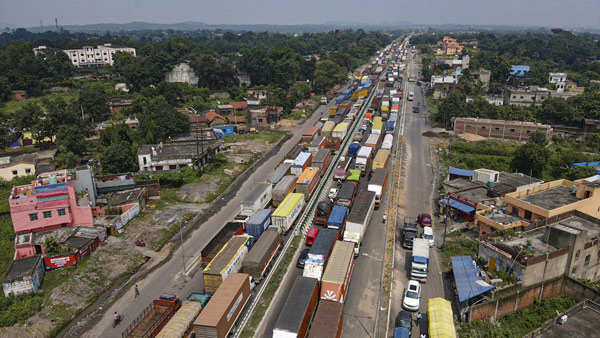
Routes Handed Over to NHAI
– NH-312: Connecting Jangipur, Omorpur, Krishnanagar, Bangaon, and Basirhat up to the Indo-Bangladesh border at Ghojadanga.
– NH-31: From the Bihar–West Bengal border to Gajole.
– NH-33: Up to Farakka.
Routes Handed Over to NHIDCL
– New NH-10: Sevok Army Cantonment – Coronation Bridge – Kalimpong – Sikkim border route.
– Additional routes near the India–Bhutan border, Bangladesh border, and Siliguri–Darjeeling hill route.
Strategic Importance of the Siliguri Corridor
– The “Chicken’s Neck” is a narrow strip of land near Siliguri in northern West Bengal, only 20–22 km wide.
– It lies between Nepal and Bangladesh, while Bhutan and China’s Chumbi Valley are located nearby.
– It is the only land link connecting mainland India with the northeastern states.
– In the event of war or geopolitical conflict, disruption of this corridor could completely cut off Northeast India from the mainland, making it India’s most sensitive military chokepoint.
Why Central Control is Important
– After the 2017 Doklam standoff and recent India-China border tensions, it became clear that all-weather roads are essential for rapid military deployment of troops, missiles, and heavy equipment.
– Central control is expected to reduce bureaucratic delays and improve strategic infrastructure management.
————–
11. When is International Museum Day celebrated?
a. 16 May
b. 17 May
c. 18 May
d. 19 May
Answer: c. 18 May
Theme for 2026: “Museums Uniting a Divided World”
– The day was declared by the International Council of Museums in 1977.
– It is observed to highlight the importance of museums in preserving and promoting culture and heritage.
PDF Download: Click here