This is the current affairs 15 to 17 August 2026. Here are questions and answers of daily current affairs for better preparation of competitive exams for government jobs.
1. In which city is the 16th edition of the biennial Aero India show scheduled to be held?
a. Mumbai
b. Bengaluru
c. Delhi
d. Patna
Answer: b. Bengaluru (at the Air Force Station located in Yelahanka in February 2027)
– Bengaluru, the capital of Karnataka, will continue to be the host city of this five-day event.
– The city has been the venue for the Aero India show since 1993.
– After the conclusion of the previous edition of Aero India in February 2025, there were rumors that the show would be shifted from the Yelahanka Air Force Station to some other location. But these rumors have now been put to rest.
– Today, it is the largest air show in Asia.
– More than 930 exhibitors from over 90 countries participated in the previous edition (2025) of the air show.
————–
2. Which Independence Day did the countrymen celebrate on August 15, 2026?
a. 80th
b. 77th
c. 78th
d. 79th
Answer: a. 80th
– India became independent on August 15, 1947.
– Prime Minister Narendra Modi delivered his address for the 13th consecutive time from the ramparts of the historic Red Fort.
– During the hoisting of the national flag, Indian Army officer Captain Sonia Singh Chauhan was present alongside the Prime Minister.
– During this, the national anthem and national song were sung.
————–
3. What is the theme for the 80th Independence Day (August 15, 2026)?
a. ‘150 Years of Vande Mataram’
b. ‘150 Years of Vande Mataram’ and ‘Yuva Shakti for Viksit Bharat@2047’
c. ‘Viksit Bharat 2047’
d. ‘Viksit Bharat’
Answer: b. ‘150 Years of Vande Mataram’ and ‘Yuva Shakti for Viksit Bharat 2047’
– For the first time, Vande Mataram was also sung during the Independence Day celebrations.
Why was this theme chosen for Independence Day?
– Vande Mataram completes 150 years in 2026.
– Therefore, by including it in the Independence Day celebrations, its historic contribution to the freedom movement is being remembered.
– In 2047, India will complete 100 years of independence.
– The government’s goal is to make India a developed nation by 2047.
– India’s large young population is considered the most important force for achieving this goal.
– Therefore, emphasis is being placed on the role of youth in education, skills, innovation, entrepreneurship, and nation-building.
————–
4. On the 80th Independence Day, PM Modi spoke about ‘Saptadhara’ for India’s development; what is it?
a. Manufacturing Power, Agriculture and Food Processing
b. Technology and Innovation, Gati Shakti, Defence Power
c. Green Economy and Blue Economy, Soft Power
d. All of the above
Answer: d. All of the above
Saptadhara: Seven Streams for Viksit Bharat
– It means seven streams of development.
The seven streams are as follows:
– Manufacturing Power
– Agriculture and Food Processing
– Technology and Innovation
– Gati Shakti
– Defence Power
– Green Economy and Blue Economy
– Soft Power
Major Announcements by PM Modi on Independence Day
Mission/Initiative – Major Announcement/Target
– AI Training Mission: Training 1 crore youth in AI next year
– Free Online Coaching: Free online coaching for youth preparing for competitive examinations
– National Sports Talent Search Mission: Identifying sports talent among children, especially for preparation for the Olympics
– Semiconductor Mission: Target of establishing 7–8 new semiconductor plants within 1–2 years
– Nuclear Energy Mission: Target of increasing nuclear energy capacity to 100 GW by 2047
– Samudra Manthan Mission: Exploration of energy and mineral resources beneath the sea and emphasis on energy security
– Modern Civil Defence Network: Strengthening the civil defence system across the country
————–
5. How many gallantry awards did the President announce on the eve of the 80th Independence Day?
a. 77
b. 76
c. 75
d. 78
Answer: d. 78
– 78 gallantry awards were approved for the defence forces and Central Armed Police Forces.
– Of these, 13 awards will be given posthumously.
List of Gallantry Awards on the Eve of the 80th Independence Day
– 9 Kirti Chakras (7 posthumously)
– 1 Bar to Shaurya Chakra
– 19 Shaurya Chakras (1 posthumously)
– 36 Sena Medals (Gallantry), (5 posthumously, including 5 Bars)
– 3 Nao Sena Medals (Gallantry)
– 5 Vayu Sena Medals (Gallantry)
The Country’s Highest Gallantry Awards: Wartime and Peacetime
– Highest Wartime Gallantry Awards: Param Vir Chakra, Maha Vir Chakra, Vir Chakra
– Highest Peacetime Gallantry Awards: Ashoka Chakra, Kirti Chakra, Shaurya Chakra
– Other Gallantry Awards: Sena Medal, Nao Sena Medal, Vayu Sena Medal
What does the word ‘Bar’ mean?
– In gallantry awards, the word ‘Bar’ means that the same gallantry award is being awarded to the same person again.
– That is, the recipient is given separate recognition along with the original medal for repeated acts of gallantry.
– Suppose a military officer receives a Shaurya Chakra.
– Later, he again displays exceptional bravery, for which he becomes eligible to receive the Shaurya Chakra again.
– In such a case, instead of giving him a second Shaurya Chakra, a ‘Bar’ is given along with the original Shaurya Chakra.
9 Kirti Chakra Awardees
1. Lieutenant Colonel Maneo Francis PF, SC – 21 Para (Special Forces), Army
2. Major Jitendra Rathi – 2 Para (Special Forces), Army
3. Havildar Gajendra Singh – 2 Para (Special Forces), Army (Posthumously)
4. Jagbir Singh – Head Constable, Jammu and Kashmir Police (Posthumously)
5. Jaswant Singh – Special Grade Constable, Jammu and Kashmir Police (Posthumously)
6. Balwinder Singh – Special Grade Constable, Jammu and Kashmir Police (Posthumously)
7. Tariq Ahmad Hussain – Special Grade Constable, Jammu and Kashmir Police (Posthumously)
8. Bashir Ahmad – Head Constable (Posthumously)
9. Sunil Kumar – Inspector (STF) (Posthumously)
Major Shaurya Chakra Awardees (2026)
1. Major Parmveer, Garhwal Rifles, 36 Rashtriya Rifles, Army
2. Major Tarun Vasudevan, Corps of Engineers, 57 Rashtriya Rifles, Army
3. Major Keshav Kumar, 12 Dogra, Army
4. Major Gaurav Singh Brijwal, 21 Grenadiers, Army
5. Major Vipin Kumar (Corps of Signals, 11 Rashtriya Rifles, Army)
6. Naib Subedar Shankar Ram, 3 Assam Rifles, Army
7. Naib Subedar Dabbal Singh Bisht, 21 Para (Special Forces), Army
8. Havildar Jagtar Singh, 4 Para (Special Forces), Army
9. Lance Naik Narendra Sindhu, Rajputana Rifles, 9 Rashtriya Rifles (Posthumously, Army)
10. Lance Naik Kapil Dev, (Dogra Regiment, 11 Rashtriya Rifles, Army)
11. Sepoy Jaswinder Singh, (7 Sikh Light Infantry, Army)
12. Lieutenant Commander Shivam Kumar (Navy)
Army
13. Squadron Leader Sudhir Kumar, Flying (Pilot), Air Force
14. Dheeraj Singh Katoch, DySP, Ministry of Home Affairs
15. Ajay Singh Chib, Inspector, Ministry of Home Affairs
16. Sukhvir Singh, Deputy Special Director, Ministry of Home Affairs
17. Niaz Ahmad, Assistant Sub-Inspector, Ministry of Home Affairs
18. Anjani Kumar, Deputy Commandant, Ministry of Home Affairs
19. Deepak Sah, Constable, Ministry of Home Affairs
– In addition, the President also approved 89 Mention-in-Despatches, including 75 personnel from the Indian Army, 4 from the Indian Navy, and 10 from the Indian Air Force.
————–
6. What is the maximum duration of advertisements per hour for TV channels for which the Government of India has decided to remove the limit?
a. 12 minutes
b. 17 minutes
c. 20 minutes
d. 10 minutes
Answer: a. 12 minutes
– The Central Government has decided to remove the limit of a maximum of 12 minutes of advertisements per hour for television channels.
– The Ministry of Information and Broadcasting informed about this on August 14, 2026.
– According to the ministry, the existing rules related to advertisement duration have been reviewed in view of the changes that have taken place in the broadcasting sector.
– This change will be made through an amendment to the Cable Television Networks Rules, 1994.
– Under the existing rules, TV channels cannot show more than 12 minutes of advertisements in an hour.
– This includes up to 10 minutes of commercial advertisements and up to 2 minutes of the channel’s own promotion.
– This limit is applicable under Rule 7(11) of the Cable Television Networks Rules.
– Following the government’s new decision, this provision will be amended.
– When the advertisement limit was introduced in 2006, there were only 62 TV channels in the country.
– Now their number has crossed 900.
– The television broadcasting sector has changed significantly, and advertising is a major source of revenue for channels in India.
– Besides, there is no similar limit on advertisement duration in digital media.
– Therefore, the level of competition between traditional TV channels and digital media was not equal.
– The government says that the objective of changing the rules is to promote fair competition and ease of doing business.
————–
7. How many monuments did the Central Government remove from the list of centrally protected sites in August 2026?
a. 17
b. 18
c. 19
d. 20
Answer: b. 18
– Union Culture Minister Gajendra Singh Shekhawat said that these 18 monuments have been removed from the list of protected monuments since 2021.
– This is because they no longer remained monuments and archaeological sites and remains of national importance under the provisions of the Ancient Monuments and Archaeological Sites and Remains Act, 1958.
– Now, 3,688 centrally protected monuments/sites are under the supervision and maintenance of the Archaeological Survey of India (ASI).
– The Ministry of Culture also stated that India had recovered 662 historical artefacts from foreign countries by June 2026.
– Of these, 589 artefacts were recovered from the United States.
Protected Monuments
– These are sites that have been declared to be of national importance under the Ancient Monuments and Archaeological Sites and Remains (AMASR) Act, 1958.
These were removed from the list of protected monuments:
1. Nicholson Statue and Platform, Delhi
2. Kos Minar No. 13, Mujesar, Gurugram, Haryana
3. Kos Minar Shahabad, Karnal, Haryana
4. Inscriptions of Bachhaun Fort, Satna (Madhya Pradesh)
5. Bara Khamba Cemetery (Delhi)
6. Inchla Wali Gumti, Mubarakpur Kotla, (Delhi)
7. 12th-century Temple, Baran, (Rajasthan)
8. Inscriptions of Jaipur Fort, (Rajasthan)
9. Kuntubari Area – 13/16 Nalis, Dwarahat, Almora, (Uttarakhand)
10. Ancient Banyan Grove with remains of ancient buildings, Bharnali, Ghazipur, (Uttar Pradesh)
11. Closed Cemetery, Katra Naka, Banda, (Uttar Pradesh)
12. Tomb of Gunner Burkill in Rangoon, Jhansi, (Uttar Pradesh)
13. Cemetery, Gaughat, Lucknow, (Uttar Pradesh)
14. Cemetery at Miles 6 and 8 on Zahraila Road, Lucknow, (Uttar Pradesh)
15. Tombs located at Miles 3, 4 and 5 on the Lucknow-Faizabad Road (Uttar Pradesh)
16. Remains of three small Lingam temples, Mirzapur, (Uttar Pradesh)
17. Teliya Nala Buddhist Remains, Varanasi, (Uttar Pradesh)
18. Plaque installed on the Treasury Building, Varanasi, (Uttar Pradesh)
————–
8. In which Southeast Asian country did a massive earthquake with a magnitude of 7.7 strike on August 15, 2026, resulting in more than 50 deaths?
a. Indonesia
b. France
c. Germany
d. East Timor
Answer: a. Indonesia
– Its epicentre was under the sea, about 68 kilometres from the city of Ende.
– Several aftershocks were also recorded in the area following the initial earthquake.
– These included tremors of magnitudes 5.9, 5.6 and 6.1.
– Initially, a tsunami warning was issued for several coastal areas, which was withdrawn a few hours later.
– After the earthquake, seawater suddenly receded in the Nagekeo area.
– People panicked and ran towards higher ground, considering it a sign of a tsunami.
– Later, the tsunami warning was withdrawn.
– Morning prayers were underway at St. Peter Major Seminary in Sikka when part of the roof of the assembly hall collapsed.
– Beds, IV stands and oxygen cylinders were set up outside hospitals.
– Earthquake tremors were felt across a large part of Flores Island.
– Several buildings were damaged.
Why do so many earthquakes occur in Indonesia?
– Indonesia is a country of about 17,500 islands.
– These islands are located in the area of the Pacific Ocean known as the ‘Ring of Fire’.
– The Eurasian tectonic plate is moving southward there.
– The Indo-Australian tectonic plate is moving northward. The Philippine Plate is moving westward.
– Due to collisions or movements among these three plates, volcanic eruptions occur frequently.
– If a strong earthquake occurs beneath the sea and causes the seawater to suddenly move up and down, a tsunami can occur.
Indonesia
Capital: Jakarta
President: Prabowo Subianto
Language: Bahasa Indonesia
Currency: Indonesian Rupiah
Neighbouring Countries: Malaysia, Papua New Guinea, Timor-Leste.
————–
9. When is World Elephant Day celebrated?
a. August 12
b. August 10
c. August 09
d. August 08
Answer: a. August 12
– The objective of this day is to spread information and awareness about Asian and African elephants.
– It was first observed on August 12, 2012, as International Elephant Day.
– India is home to the largest share of Asian elephants in the world, accounting for 60 percent of them.
– The first elephant census in the country was conducted in 2017, when 30,000 elephants were living in forests.
————–
10. When is World Organ Donation Day celebrated?
a. August 14
b. August 13
c. August 12
d. August 11
Answer: b. August 13
– World Organ Donation Day is observed on August 13 to spread awareness about the importance of organ donation.
Organ Donation Day: History and Significance
– The history of organ transplantation dates back to the beginning of the 20th century, with several important milestones in its development.
– The first successful kidney transplant took place in 1954, when Ronald Lee Herrick donated a kidney to his identical twin brother in a pioneering procedure performed by Dr. Joseph Murray.
Note: National Organ Donation Day is observed in India on November 27.
—————
11. When is ‘Partition Horrors Remembrance Day’ celebrated?
a. August 15
b. August 14
c. August 13
d. August 12
Answer: b. August 14
– This day was first announced in 2021 by Prime Minister Narendra Modi.
– The day is observed to remember the victims and suffering of people during the Partition of India and Pakistan.
————–
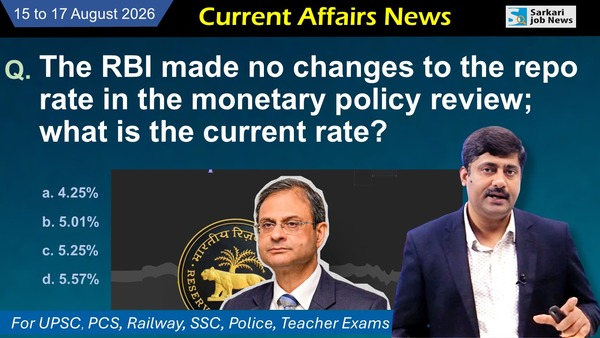
12. RBI did not make any change in the repo rate in the bi-monthly monetary policy review (August 2026), then what is the repo rate?
a. 4.25%
b. 5.01%
c. 5.25%
d. 5.57%
Answer: c. 5.25%
– The Monetary Policy Committee (MPC) of the Reserve Bank of India (RBI) unanimously decided to keep the repo rate unchanged at 5.25% in its August 2026 review meeting.
When was the repo rate reduced last time?
– In December 2025, the Monetary Policy Committee (MPC) reduced the repo rate by 25 basis points from 5.50% to 5.25%.
– Since then, there has been no change in the repo rate.
What is the Repo Rate (Repurchase Rate or Repo Rate)?
– In simple terms, banks give us loans and we have to pay interest on those loans.
– Similarly, banks also need large amounts of money for their day-to-day operations and they borrow from the Reserve Bank of India (RBI).
– The rate at which the Reserve Bank charges interest from them on this loan is called the repo rate.
Effect of the Repo Rate on the Common Man
– The RBI has a powerful tool in the form of the repo rate to fight inflation.
– When inflation is very high, the RBI tries to reduce the flow of money in the economy by increasing the repo rate.
– When banks get loans at a lower interest rate, that is, when the repo rate is lower, they can also provide cheaper loans to their customers.
– And if the Reserve Bank increases the repo rate, borrowing becomes expensive for banks and they make loans more expensive for their customers.
– The new base year for the Consumer Price Index (CPI)-based retail inflation rate is 2024.
Reverse Repo Rate
– It is the opposite of the repo rate.
– When banks have a large amount of money left after their day-to-day operations, they keep that money with the Reserve Bank.
– The RBI pays them interest on this amount.
– The rate at which the Reserve Bank pays interest on this money is called the reverse repo rate.
Note: Ex-officio Chairperson of the 6-member Monetary Policy Committee – RBI Governor (Sanjay Malhotra)
PDF Download: Click here