
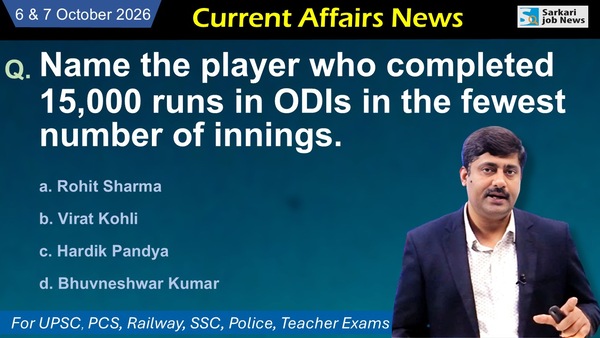
This is the current affairs 6 & 7 october 2026. Here are questions and answers of daily current affairs for better preparation of competitive exams for government jobs.
1. Name the winner of Nobel Prize 2026 in the field of Medicine/Physiology?
a. Victor Ambros and Gary Ruvkun
b. Katalin Karikó and Drew Weissman
c. Karl Deisseroth, Peter Hegemann and Georg Nagel
d. Mary E. Brunkow, Fred Ramsdell and Shimon
Answer: c. Karl Deisseroth, Peter Hegemann and Georg Nagel
Winner Scientists:
– Karl Deisseroth – USA
– Peter Hegemann – Germany
– Georg Nagel – Germany
Note –
Physiology: Physiology
Medicine: Medicine
The Nobel Prize is awarded in 6 fields –
– Physiology or Medicine
– Physics
– Chemistry
– Literature
– Peace
– Economics
About the Nobel Prize
– This award is given in the name of scientist and inventor Alfred Bernhard Nobel, based on his will.
– In his will, he instructed that most of his vast fortune should be used to reward those who had conferred the greatest benefit to humanity during the preceding year.
– The Nobel Prizes were first awarded in 1901.
– Alfred Nobel has 355 patents to his name today, but people know him more because of dynamite.
– The Nobel Peace Prize is awarded in Norway.
– While all other category prizes are awarded in Stockholm, the capital of Sweden.
About Alfred Bernhard Nobel
– Born: 21 October 1833 in Stockholm, Sweden
– Family: His father, Immanuel Nobel, was a skilled engineer and inventor who was involved in explosives and bridge construction.
– In the mid-19th century, an explosive called ‘Nitroglycerin’ was used, which was extremely dangerous and could explode with the slightest shock.
– Alfred’s younger brother Emil also died in an explosion during an experiment.
– After this, Alfred researched ways to make it safer and invented ‘Dynamite’ in 1867. He mixed nitroglycerin with a special soil (Kieselguhr) to create a safer form that could be easily transported anywhere.
– In addition, he registered more than 350 patents in his name, including synthetic rubber, artificial silk and several other types of explosives.
– The invention of dynamite revolutionized mining, tunnel construction and road construction around the world, making Alfred Nobel very wealthy. However, dynamite also began to be used as a weapon in wars.
– A newspaper mistake changed his life: In 1888, Alfred’s brother Ludwig died, but a French newspaper mistakenly published the news of Alfred’s death. The headline was: “The Merchant of Death is Dead.” It stated that Alfred Nobel had made his fortune by finding new ways to kill people.
– Deep impact on his heart: When Alfred read this about himself, he was deeply shocked. He did not want history to remember him as a ‘destroyer’.
– To ensure the proper use of his image and wealth, Alfred Nobel signed his final Will on 27 November 1895.
– He placed about 94% of his vast fortune into a fund.
– He ordered that the interest from this fund should be used every year to honor people who had done the best work for humanity in the fields of Physics, Chemistry, Medicine, Literature and Peace.
– Later, in 1968, the Nobel Prize in Economics was also added.
– Death: He died of a heart attack on 10 December 1896 in San Remo (Italy).
Indian Winners
– Indians who have won the Nobel Prize include Rabindranath Tagore (the first Indian), C.V. Raman, Mother Teresa, Amartya Sen and Kailash Satyarthi.
Previous Awards
– 2024 winners in Physiology/Medicine: Mary E. Brunkow, Fred Ramsdell and Shimon Sakaguchi, for their discoveries concerning peripheral immune tolerance
– 2024 winners in Physiology/Medicine: Victor Ambros (USA) and Gary Ruvkun (USA), for the discovery of microRNA
– 2023 winners (Medicine/Physiology) – Katalin Karikó and Drew Weissman. They enabled the development of mRNA vaccines. Because of this, the COVID-19 vaccine could be developed quickly.
————–
2. For which achievement (research) in the field of medicine were Karl Deisseroth, Peter Hegemann, and Georg Nagel selected for the 2026 Nobel Prize?
a. For the discovery of the double-helix structure of DNA
b. For the development of mRNA vaccine technology
c. For the discovery of optogenetics (control of nerve cells through light)
d. For the discovery of the Hepatitis C virus
Answer: c. For the discovery of optogenetics (control of nerve cells through light)
Main Research Timeline
– Early research: 2002 – 2003
– Major breakthrough and naming of the technology: 2005 – 2006
– Nobel Prize: 2026 (after approximately 20 years of continuous successful trials and medical applications)
What did the three do?
– In simple words – these three scientists together discovered a technology through which neurons in the brain can be controlled with the help of light (turned ON/OFF).
– This technology is called Optogenetics. It has given a new dimension to the field of neuroscience in studying the functioning of the brain, memories, emotions and various diseases.
What is Optogenetics and how does it work?
– Brain network: Our brain is made up of billions of small cells (neurons). These cells communicate with each other through small electrical signals, which allows us to think, feel, move or form memories.
– Switching ON/OFF with light: Scientists found a light-sensitive protein in a particular type of algae. When this protein is introduced into brain cells, it works like a remote or switch.
– When special light is shone on it, the cell becomes ‘ON’ (Active), and as soon as the light is removed, it becomes ‘OFF’.
What will be the benefit to science and treatment?
– Understanding the brain: Earlier, scientists could not understand which part of the brain was responsible for which emotion or behavior (such as fear, pain, hunger, thirst, attention). Now, by turning a particular part ON/OFF with light, its exact role can be identified.
– Treatment of blindness (Vision Restoration): Trials are underway to help people whose eye cells have been destroyed by diseases such as retinitis pigmentosa to see again with the help of special glasses and light.
– Hearing ability (Cochlear Implants): Attempts are being made to use light instead of electrical signals in cochlear implants in the ear to provide clearer sound.
Impact on Medical Science (How are we using it today?)
– Understanding brain diseases: Earlier, in diseases such as Alzheimer’s, Parkinson’s, depression, epilepsy and schizophrenia, it was difficult to identify which neurons in the brain were not functioning properly. With optogenetics, scientists are now turning individual cells ON/OFF to find where the actual root of the disease lies.
– Creating a precise map of memories, fear and neurology: Scientists have understood which parts of the brain are involved in fear or old traumatic memories. Optogenetics has made it easier to identify the neurons associated with these memories.
– Accelerating drug discovery: To test new medicines, scientists no longer need to observe the effects on the entire brain. They can apply drugs only to the affected neurons and observe the precise effect through optogenetics.
How was the algae protein delivered to the brain neurons?
– Genetic engineering and modified viruses are used to deliver the light-sensitive protein from algae into brain neurons.
– Scientists extracted the specific part from the DNA of algae that produces the light-operated ‘switch’ (protein). This is our ‘letter’.
– Now, this ‘letter’ cannot be sent directly into the brain. For this, scientists use a very safe and inactive virus such as an ‘Adeno-Associated Virus’ (AAV).
– The disease-causing components inside the virus are removed.
– Then the algae gene is placed inside the virus. Here, the virus only acts as a ‘postman’ who comes to deliver the material.
– Through a very fine needle (Micro-injection), this virus (postman) is inserted into the specific part of the brain where the cells (neurons) need to be controlled.
– When this virus reaches inside the brain cell, the cell reads the algae code and produces the ‘light switch’ (protein) on its own.
How does it work?
– Light cannot reach inside the brain, so scientists place a very thin and flexible optical fiber cable (a very fine thread made of glass or plastic) into the specific part of the brain where the algae protein has been introduced.
– When scientists shine blue light through this fiber cable, the protein attached to the cells immediately opens.
– As soon as the protein opens, an electrical signal starts running inside the cell and the cell turns ON / Active.
– As soon as scientists switch off the light, the protein immediately switches off and the neurons return to a quiet or ‘OFF / Inactive’ state.
– In some cases, yellow or red light is also used to switch the cells off.
Real Example
– Movement of a rat: When scientists shine blue light on the part of a rat’s brain that controls movement, the rat immediately starts moving in circles or running. As soon as the light is switched off, the rat immediately stops.
– Sleeping and waking: When light is shone on the cells responsible for sleep and wakefulness, a sleeping rat immediately wakes up.
————-
3. Name the winner of the 2026 Nobel Prize in Physics?
a. Victor Ambros
b. John Clarke
c. Katalin Karikó
d. Francis Halzen
Answer: d. Francis Halzen (dual citizen of the United States and Belgium)
– Francis Halzen holds dual citizenship of the United States and Belgium.
– He was born in Belgium and later acquired American citizenship.
Previous Winner
– Physics Nobel Prize 2025: John Clarke (United Kingdom), Michel H. Devoret (France), and John M. Martinis (United States) were awarded the Nobel Prize for the discovery of macroscopic quantum mechanical tunnelling and energy quantization in an electric circuit.
————–
4. For which achievement (research) in the field of physics was Francis Halzen selected for the 2026 Nobel Prize?
a. Contribution to the IceCube Neutrino Observatory and discovery of high-energy neutrinos
b. Theoretical prediction of black hole formation
c. Quantum entanglement and photon experiments
d. None of these
Answer: a. Contribution to the IceCube Neutrino Observatory and discovery of high-energy neutrinos
– Francis Halzen was awarded this prize for his leadership in the construction of the IceCube Neutrino Observatory, built inside the ice in Antarctica, and for the discovery of high-energy neutrinos of cosmic origin.
– IceCube is a giant “neutrino camera” built in the ice of Antarctica, which has opened a completely new way for us to observe distant black holes and other extremely powerful sources in the universe.
Prize Money: He will receive an amount of 12 million Swedish kronor (approximately $1.2 million).
How many types of observatories are there for observing space?
– Ordinary Telescope: Understands the universe by observing light
– Radio Telescope: Understands the universe through radio waves
– Gravitational-Wave Detector: Studies events through gravitational waves
– IceCube Neutrino Observatory: Observes the universe through neutrinos.
Note –
Through observatories, scientists can investigate questions such as the extreme conditions around black holes, active galaxies, events like supernovae, and where and how cosmic rays are produced.
– Another important advantage is that neutrinos can escape from places from which light cannot easily escape. Therefore, neutrinos can also provide information about events occurring behind dust, gas, or extremely dense matter.
IceCube Neutrino Observatory
– It is one of the world’s largest neutrino detectors, built inside the ice at the South Pole in Antarctica.
– Its purpose is to detect highly energetic neutrinos coming from space and understand how energy is produced in the most powerful sources in the universe.
– The IceCube detector is spread across approximately 1 cubic kilometer of ice. Its approximately 5,160 Optical Modules are installed inside the ice at depths of about 1,450 to 2,450 meters. These sensors are installed on 86 long strings.
How were the sensors installed in the ice?
– First, a deep hole about 2.5 kilometers deep and approximately 60 centimeters wide was created in the ice by releasing a powerful stream of very hot water using special machines.
– After this, the entire string equipped with optical modules was lowered into the hole. Then the water froze again, and the sensors became permanently installed inside the ice.
How does the IceCube Neutrino Observatory work?
– Neutrinos are extremely tiny particles with almost no electric charge that interact very weakly with matter. Therefore, they can easily pass through the Earth and ice.
– Sometimes, a neutrino collides with an atom in the ice. This can produce charged particles such as a muon or electron.
– These particles move at very high speeds through the ice and produce an extremely faint glow called Cherenkov Light.
– The Optical Modules of IceCube detect this light.
– By analyzing the timing and direction of the light, scientists determine the direction from which the neutrino came and its energy.
Who funded its construction?
– IceCube was built primarily with funding from the U.S. National Science Foundation (NSF), but it is an international scientific project involving scientists and institutions from many countries.
What major information has it provided?
– In 2013, IceCube detected highly energetic neutrinos coming from outside the universe for the first time with clear evidence. This demonstrated that extremely powerful sources in space produce such particles.
– In 2017, a neutrino with an energy of approximately 300 TeV was detected. When its direction was determined, it was found to have come from the direction of a Blazar named TXS 0506+056. It is an active galaxy located approximately 3.7 billion light-years away, with a massive supermassive black hole at its center. This established an important connection between such powerful black-hole sources and high-energy neutrinos.
– In 2023, IceCube also created a neutrino map of the Milky Way Galaxy. This means that scientists can now observe our galaxy not only through light but also through neutrinos.
– In addition, IceCube observed the Glashow Resonance associated with a neutrino having an energy of 6.3 PeV, confirming a theoretical prediction made approximately 60 years ago.
————–
5. When is World Teachers Day celebrated?
a. 6 October
b. 7 October
c. 5 October
d. 4 October
Answer: c. 5 October
Theme for 2026:
– Standing with teachers: 60 years of protecting the profession, advancing its status and shaping our futures
– Standing with teachers: 60 years of protecting the profession, advancing its status and shaping our futures.
Why this theme?
– The main objective of this theme is not only to recognize teachers but also to examine whether education systems are providing them with the professional and material support necessary to do their work.
About the Day
– This day was declared by UNESCO and the International Labour Organization (ILO).
– World Teachers Day is celebrated on 5 October. However, it is observed on different dates at the national level in different countries.
– For example, in India, it is celebrated on 5 September, on the birth anniversary of Sarvepalli Radhakrishnan.
– In Singapore, Teachers’ Day is celebrated on the first Friday of September.
– In China, this day is celebrated on 10 September.
Need for 44 Million Teachers Worldwide by 2030
– UNESCO estimates that the world will need 44 million (4.4 crore) more primary and secondary teachers by 2030 to achieve the goal of universal basic education.
– Of these, approximately 15 million (1.5 crore) teachers are needed in Sub-Saharan Africa.
– In South Asia, where India is located, the teacher shortage is 7.8 million according to UNESCO’s analysis.
————–
6. The famous writer and politician Jeffrey Archer, from which country, passed away on October 5, 2026?
a. India
b. Australia
c. United Kingdom
d. Saudi Arabia
Answer: c. United Kingdom
– He was a politician who worked as a Conservative MP and was the author of a series of bestselling novels.
– However, he was also convicted of giving false testimony.
– More than 300 million copies of his novels have been sold.
—————
7. Which countries decided to deploy their troops to Saudi Arabia under the ‘Mecca Defense Coalition’ against attacks by Houthi rebels?
a. Pakistan and Türkiye
b. China and Turkey
c. USA and India
d. Türkiye and Egypt
Answer: a. Pakistan and Türkiye
– Pakistan, Saudi Arabia and Türkiye agreed on 5 October 2026 to immediately implement their collective defense commitments and ensure the “rapid deployment” of agreed military forces and capabilities in Saudi Arabia.
– The three countries stated this in a joint statement issued by Pakistan’s Ministry of Foreign Affairs.
– In fact, the Saudi-led coalition fighting Yemen’s Houthi rebels had said on 1 October 2026 that the Iran-backed group had attacked an electricity distribution station in the Saudi city of Medina, which supplies electricity to the Prophet’s Mosque, one of the holiest sites in Islam.
Mecca Joint Defense Pact
– Pakistan, Saudi Arabia and Türkiye signed a defense pact on 7 August 2026 to increase security cooperation.
– It is being called the ‘Mecca Joint Defense Pact’.
– It was signed in Mecca by Saudi Crown Prince Mohammed bin Salman, Turkish President Recep Tayyip Erdoğan and Pakistan’s Prime Minister Shehbaz Sharif.
– The three countries will increase defense cooperation with each other.
– With this agreement, Pakistan, Saudi Arabia and Türkiye have taken a step toward a ‘Muslim NATO’.
– This agreement is an attempt to enhance security jointly among Muslim countries like NATO.
– The three countries will provide military assistance to each other when necessary.
These are the rules of the pact
– If one country is attacked, it will be considered an attack on all three countries.
– In the event of an external attack, all three countries will stand together for security.
– Military coordination and defense cooperation will be strengthened.
– The three countries will work toward increasing their collective capacity to respond.
– They will cooperate in dealing with terrorism and other security threats.
Why a new joint defense agreement?
– The need for a new military alliance has increased at a time when questions are being raised in other countries about U.S. security policy.
– Saudi Arabia and, to some extent, Türkiye have long considered the United States an important security partner.
– However, amid growing uncertainty over U.S. foreign policy under President Donald Trump, several countries are looking for other options.
————-
8. Who will become the Chief Information Commissioner of Bihar in October 2026?
a. Alok Kumar
b. Vinay Kumar
c. Rakesh Paswan
d. Ajay Nishad
Answer: b. Vinay Kumar (Former DGP)
– Governor Syed Ata Hasnain administered the oath of office and secrecy to former DGP Vinay Kumar as the Chief Information Commissioner of Bihar on 1 October 2026.
– Vinay Kumar was a 1991-batch IPS officer.
– He took voluntary retirement (VRS) before completing his tenure.
Right to Information (RTI) Act, 2005
– The Right to Information (RTI) Act, 2005 is a landmark law implemented in India to ensure transparency and accountability in government functioning.
– Under this, any Indian citizen can ask questions to government departments and obtain documents or information.
– The Public Information Officer (PIO) is required to respond within 30 days of receiving an application.
Major Recent Changes (Amendments)
RTI Amendment Act, 2019
– Tenure and service conditions: Under the original law, the tenure of the Central and State Information Commissioners was fixed at 5 years (or until the age of 65). After the 2019 amendment, the power to determine their tenure was given to the Central Government.
– Salary and allowances: Earlier, the salary of the Chief Information Commissioner was fixed at the same level as that of the Election Commissioner. Now, the salaries, allowances and service conditions of Information Commissioners are completely determined by the Central Government.
Changes under the Digital Personal Data Protection (DPDP) Act, 2023
– Amendment to Section 8(1)(j): Earlier, personal information could be withheld under the RTI Act only when there was no public interest involved. After the implementation of the DPDP law, all types of “personal information” have now been completely exempted from disclosure.
– Priority to privacy: This change has increased the protection of personal data, but according to critics, important information related to public interest may also be rejected by labeling it as “private data”.
————-
9. Under the Bihar Green Hydrogen Policy 2026, what is the target percentage for the production of non-conventional energy by the year 2047?
a. 25%
b. 40%
c. 50%
d. 75%
Answer: c. 50%
– The Bihar Cabinet approved the draft of the Bihar Green Hydrogen Policy 2026 on 29 September 2026.
– Its objective is to promote renewable energy through wind and solar power and reduce dependence on imports of natural gas.
– Under the Bihar Green Hydrogen Policy 2026, the target is to produce up to 50% non-conventional energy by 2047.
– The Central Government has set a target of increasing the share of renewable energy in total energy consumption to 50 percent by 2047.
– In the same direction, the green hydrogen sector will be developed in Bihar to promote the use of clean and renewable energy.
– Through the use of green hydrogen and related projects, the target is to reduce carbon emissions by approximately 1 million tonnes.
– The Bihar Renewable Energy Development Agency (BREDA) has been designated as the nodal agency for green hydrogen-related activities.
– Under this policy, emphasis will also be placed on developing the necessary infrastructure to promote the production, storage, transportation and use of green hydrogen and providing a favorable environment for investors.
What is Green Hydrogen?
– Green hydrogen is a clean hydrogen gas produced through the electrolysis of water using renewable energy.
– This entire process does not produce any carbon emissions or pollution.
How is it made? (Production Process)
– Renewable Energy: Electricity is generated from solar energy or wind energy.
– Electrolysis: This environmentally friendly electricity is passed through water using a machine called an electrolyzer.
– Separation: This process separates water into hydrogen and oxygen.
– By-product: Only oxygen and water vapor are released as by-products, which are completely safe for the environment.
Different Types of Hydrogen
– Green Hydrogen: Electrolysis of water (using solar/wind energy): Zero Emission
– Grey Hydrogen: From natural gas (Methane): High carbon emissions
– Blue Hydrogen: From natural gas (with carbon capture technology): Low carbon emissions
————-
10. Name the player who completed 15,000 runs in ODIs in the fewest number of innings.
a. Rohit Sharma
b. Virat Kohli
c. Hardik Pandya
d. Bhuvneshwar Kumar
Answer: b. Virat Kohli
– Cricketer Virat Kohli completed his 15,000 runs in One Day Internationals in 303 innings in September 2026.
– He achieved this milestone while playing a match against the West Indies in Thiruvananthapuram.
– He became the player to reach this milestone in the fewest number of innings.
– He broke Sachin Tendulkar’s record. Sachin achieved this feat in 377 innings against South Africa in 2007.
– However, Virat Kohli is behind Sachin Tendulkar in terms of the highest number of runs.
– Sachin holds the record of 18,426 runs in 463 matches.
PDF Download: Click here