This is the current affairs 29 & 30 September 2026. Here are questions and answers of daily current affairs for better preparation of competitive exams for government jobs.
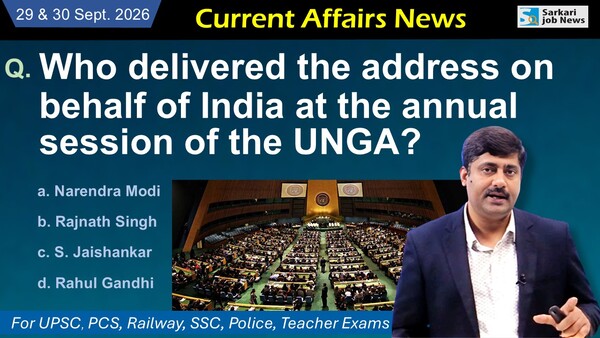
1. Who addressed the 81st annual session of the United Nations General Assembly (UNGA) on behalf of India?
a. Narendra Modi
b. Rajnath Singh
c. S. Jaishankar
d. Rahul Gandhi
Answer: c. S. Jaishankar
– The annual session is an occasion when every country presents its official position on national and international issues before the entire world.
– In different years, the President, Prime Minister, or External Affairs Minister has presented India’s position at the UNGA.
– External Affairs Minister S. Jaishankar addressed the 81st annual session of the UNGA on 25 September 2026.
– The address took place at the United Nations Headquarters in New York.
United Nations General Assembly
– Established: 1945 (under the United Nations Charter)
– Headquarters: New York, United States of America
– Membership: Currently, it consists of a total of 193 member countries.
– Special Feature: It is the only organ of the UN in which all member countries have equal representation and an equal vote (1 country = 1 vote).
– Note: Unlike the Security Council (UNSC), resolutions passed by the General Assembly are not legally binding on member countries. Instead, they represent global public opinion and moral pressure.
————–
2. Where was the multinational air exercise ‘Tarang Shakti-2026’ held?
a. Ahmedabad, Gujarat
b. Chandigarh, Punjab
c. Jodhpur, Rajasthan
d. Kargil, Ladakh
Answer: c. Jodhpur, Rajasthan
Air Exercise ‘Tarang Shakti-2026’
– When: 26 September to 12 October 2026
– Where: Jodhpur Air Force Station, Jodhpur, Rajasthan
– Which Edition: Second edition (the first was held in 2024)
– Organiser: Indian Air Force
– Number of Participating Countries: 8 countries
– Participating Countries: India (host country), USA, France, UAE, Germany, Australia, Sri Lanka, Bangladesh
These “Fighter Jets” Roared in the Sky
– Six American fifth-generation stealth fighter jets, F-35 (which participated for the first time in an air exercise in India)
– Seven French Rafale jets
– Six UAE F-16 jets, MRTT, KC-135
– Australia’s C-130 aircraft
– India’s fighter jets: Sukhoi, Tejas, Mirage-2000, Rafale
————-
3. The 24th edition of the maritime exercise ‘Varuna’ was held between India and which country, with the participation of the Indian Navy’s INS Trishul?
a. USA
b. France
c. United Kingdom
d. Australia
Answer: b. France (The exercise was held in Toulon, France, in September 2026.)
– The 24th edition of the bilateral maritime exercise ‘Varuna’ was held in Toulon, France, on 22 September 2026.
– The exercise included cross-deck visits, operational discussions, and sporting activities both onshore and at sea.
– The objective of the exercise is to enhance interoperability and strengthen the capabilities of the navies of both countries.
————–
4. Under which mission did the Indian Coast Guard (ICG) ship ‘Shaunak’ reach Perth (Australia) from Chennai in September 2026?
a. Maritime Exercise ‘Varuna’
b. QUAD-at-Sea Ship Observer Mission
c. Malabar Naval Exercise
d. Indra Naval Exercise
Answer: b. QUAD-at-Sea Ship Observer Mission
– The Indian Coast Guard (ICG) ship ‘Shaunak’ participated in the ‘QUAD-at-Sea Ship Observer Mission’.
– The QUAD comprises India, Australia, Japan, and the United States.
– The objective of the mission is to enhance mutual understanding of maritime operations and establish professional relations among the four QUAD countries.
– ‘Shaunak’ is a vessel of the Indian Coast Guard used for operational deployments and training-related voyages.
– During its journey from Chennai to Perth, the vessel became part of a multinational observer mission involving all four QUAD member countries.
————–
5. Who has been appointed as the Chairperson of the Central Board of Secondary Education (CBSE)?
a. Mandeep K. Bhandari
b. B. P. Khandelwal
c. Pradeep Kumar Sinha
d. Vinay Muralidhar
Answer: a. Mandeep K. Bhandari
– The Appointments Committee of the Cabinet appointed Mandeep K. Bhandari as the Chairperson of CBSE on 25 September 2026.
– 52-year-old Mandeep K. Bhandari is a 2001-batch IAS officer.
– He belongs to the AGMUT cadre. This cadre includes Arunachal Pradesh, Goa, Mizoram, and Union Territories.
Three Chairpersons Changed Within a Few Months
– Rahul Singh was the CBSE Chairperson until May 2026.
– On 2 June, the government removed him amid the On-Screen Marking (OSM) controversy.
– IAS officer Lokhande Prashant Sitaram was then given additional charge.
– On 2 July, he was appointed Additional Secretary in the Ministry of Home Affairs (MHA).
– However, he continued to hold the additional charge of CBSE Chairperson.
– In September 2026, Mandeep Bhandari was appointed to the position.
– In fact, CBSE had declared the Class 12 results on 13 May.
– For the first time, answer sheets were evaluated on computer screens through the OSM service.
– After the results were announced, several students complained about their marks.
– The controversy escalated, and an investigation into the entire matter was initiated.
————–
6. When is World Heart Day celebrated?
a. 25 September
b. 26 September
c. 27 September
d. 29 September
Answer: d. 29 September
Theme for 2026
– Don’t Miss a Beat
– This day is organised by the World Heart Federation.
– Its objective is to raise awareness about heart diseases and strokes and encourage people to adopt a healthy lifestyle.
Facts
– According to Harvard Health, the heart beats approximately 2.5 billion times during an average lifetime, pumping millions of gallons of blood to every part of the body.
– According to The Lancet, cardiovascular diseases are a leading cause of death and disability in India. The cardiovascular disease epidemic among Indians is characterised by a high relative risk burden, an early age of disease onset, increasing mortality, and an increase in premature deaths.
– A 2014 report by the World Economic Forum and Harvard School of Public Health estimated that India would suffer an economic loss of approximately 2.17 trillion dollars due to heart disease between 2012 and 2030.
What Is the Heart, and Why Is It Important for Our Overall Health?
– The heart is a muscular organ that pumps blood throughout your body and supplies it with oxygen and nutrients.
– It is important for overall health because it ensures that all your organs and tissues receive the resources they need to function properly.
What Are the Major Risk Factors for Heart Disease, and How Can I Assess My Risk?
– Major risk factors for heart disease include high blood pressure, high cholesterol, smoking, obesity, diabetes, family history, and a sedentary lifestyle.
– You can assess your risk through medical check-ups and risk assessment tools provided by healthcare professionals.
How Does a Healthy Diet Affect Heart Health, and Which Foods Should I Include or Avoid for a Healthy Heart?
– A healthy diet can have a significant impact on heart health.
– Include foods such as fruits, vegetables, whole grains, lean proteins, and healthy fats in your diet.
– For a healthy heart, avoid or limit saturated fats, trans fats, excess salt, and added sugars.
How Much Exercise Is Recommended to Maintain a Healthy Heart?
– Aim for at least 150 minutes of moderate-intensity aerobic exercise or 75 minutes of vigorous-intensity exercise per week, along with muscle-strengthening activities on two or more days.
– Activities such as brisk walking, swimming, and cycling are beneficial.
What Is Cholesterol, and How Is It Related to Heart Health? How Can I Control It?
– Cholesterol is a waxy substance present in your blood. High levels of LDL (bad) cholesterol can increase the risk of heart disease.
– Control it by following a heart-healthy diet, exercising regularly, and taking medicines prescribed by a doctor.
————–
7. When is International Translation Day celebrated?
a. 28 September
b. 29 September
c. 30 September
d. 1 October
Answer: c. 30 September
Theme for 2026
– Linguistic Diversity and Language Rights
– This day is celebrated to promote linguistic diversity, communication, and intercultural exchange.
– In 1953, the International Federation of Translators (FIT) began observing this day for the first time.
– In fact, St. Jerome, who is regarded as a great scholar who translated the Bible and the Patron Saint of Translators, died on 30 September.
– In 2017, the United Nations General Assembly (UNGA) officially declared 30 September as “International Translation Day”.
————–
8. Which ports were granted ‘Mega Port’ status by the Central Government in September 2026 under Section 73 of the Indian Ports Act, 2025?
a. Deendayal Port
b. Jawaharlal Nehru Port
c. Paradip Port and Mundra Port
d. All of the above
Answer: d. All of the above (Deendayal Port, Jawaharlal Nehru Port, Paradip Port, and Mundra Port)
– This status was granted for five years on 25 September under the Indian Ports Act, based on high cargo-handling capacity and efficiency.
Paradip Port
– It is a major natural deep-water port located on the coast of the Bay of Bengal in Jagatsinghpur district of Odisha, India.
– It has become the only port on India’s eastern coast to receive the status of a “Mega Port”.
– Paradip Port set its highest-ever annual record by handling 156.45 million tonnes of cargo during the financial year 2025-26.
Deendayal Port
– It is a major tidal port located in the Gulf of Kutch on the western coast of Gujarat.
– It is an important hub for the movement of bulk, liquid, and general cargo.
– The government has set a benchmark of annual cargo capacity exceeding 150 million metric tonnes (MMT+) for classification as a Mega Port.
– Deendayal Port secured the top position among the country’s major government ports by handling 160.11 MMT of cargo in the financial year 2025-26.
Jawaharlal Nehru Port
– It is India’s largest container port, located south of Mumbai in Maharashtra.
– It is considered the country’s most modern port, equipped with state-of-the-art automated systems and digital platforms.
– This port handles approximately 50% of the total containerised cargo volume among India’s major ports.
Mundra Port
– It is India’s largest private and busiest commercial port, operated by the Adani Group.
– It is a major centre for international trade and coal imports into the country.
– Mundra Port has met the standards of 150 million metric tonnes of annual cargo handling prescribed by the government.
‘Mega Port’
– It is a statutory and administrative category granted to ports with very high capacity that handle cargo on a very large scale.
– These ports also play a strategic role in global trade.
– Under the Indian Ports Act, a port must have an annual cargo-handling capacity of at least 150 million metric tonnes to receive Mega Port status.
————–
9. Which state government declared 265 out of the state’s 358 talukas as drought-affected in September 2026?
a. Gujarat
b. Rajasthan
c. Maharashtra
d. Odisha
Answer: c. Maharashtra
– On 26 September 2026, the Maharashtra government issued a Government Resolution (GR) declaring 265 out of the state’s 358 talukas as drought-affected.
– This was because prolonged rainfall deficiency in the state had damaged crops.
– The state recorded 755.9 mm of rainfall between 1 June and 18 September 2026, whereas normal rainfall should have been 932.3 mm.
– This means rainfall was 18.8% below normal.
– The drought is spread across 32 districts of the state.
– The most affected talukas include Yavatmal, Jalgaon, Ahilyanagar, Nanded, Amravati, and Nagpur.
– Kharif crops have suffered heavy damage due to low rainfall.
– Chief Minister Devendra Fadnavis had visited the affected areas.
– The state government has announced several relief measures, including restructuring crop loans, waiving land revenue, postponing the recovery of agriculture-related loans, and providing concessions on electricity bills for agricultural pumps.
————–
10. In which ocean did a cyclone-like situation in September 2026 get dubbed ‘Arnab’ on social media—a name rejected by the India Meteorological Department (IMD) as it did not classify the system as a cyclone?
a. Arabian Sea
b. Bay of Bengal
c. Pacific Ocean
d. Mediterranean Sea
Answer: b. Bay of Bengal
– A cyclone-like situation developed in the Bay of Bengal in September 2026, but the Meteorological Department classified it as being outside the definition of a cyclone. Therefore, it was not officially named.
– This cyclone-like situation had already started weakening. However, it hit India, and some parts of Andhra Pradesh and Odisha were inundated.
– After this, heavy rainfall and strong winds occurred in several states of North and Central India.
Where Did the Name Arnab Come From?
– Actually, the names of cyclonic storms are decided in advance. A complete list is prepared beforehand. As soon as the next cyclone develops and meets the definition of a cyclone, it is given a name.
– For this reason, it was called ‘Arnab’ on social media and some media websites, but the IMD later rejected this name.
– The IMD stated that no cyclonic storm named ‘Arnab’ had come into existence.
– The weather system that developed in the Bay of Bengal was only a ‘Deep Depression’.
– According to IMD rules, a storm is given a name only when its wind speed crosses the cyclonic threshold of 63 km/h.
– Since this system did not reach that intensity, it was not officially given this name.
How Are Storms in the Indian Ocean Named?
– The system for naming storms has been established by the World Meteorological Organization (WMO) / ESCAP (United Nations Economic and Social Commission for Asia and the Pacific) Panel.
– Thirteen countries in the Indian Ocean region decide the names of cyclonic storms.
– These countries include India, Pakistan, Sri Lanka, Bangladesh, Maldives, Myanmar, Oman, Thailand, Iran, Qatar, Saudi Arabia, UAE, and Yemen.
– These 13 countries prepare a list of names in advance.
– As soon as a cyclone develops in the region, it is given a different name from the list.
– This not only makes it easier to identify cyclones but also helps in rescue operations.
How Do Cyclonic Storms Form?
– A cyclonic storm develops when a low-pressure area forms over the sea.
– The question here is: What is a low-pressure area over the sea, and how does it form?
– Global warming is responsible for this.
– When the temperature of the sea rises, or in other words, when the sea starts warming up, the heat causes the air to rise. The surrounding air rushes in to fill the empty space (creating a vacuum-like area). This is called a low-pressure area.
– Since the oceans are vast, this process continues on a very large scale.
– The warm air rises, and air from a large surrounding area moves towards this region. However, the rising air also cools down because the temperature decreases as we move higher in the atmosphere.
– In such a situation, the upper air, which has cooled down, also tends to move downward, and this develops into a storm.
– The air rotates very rapidly.
Cyclones Are Known by Different Names in Different Parts of the World
America – Hurricane / Tornado
Caribbean Sea – Hurricane
China Sea – Typhoon
Indian Ocean – Tropical Cyclone
Japan – Typhoon
Northern Australia – Willy-Willies
Philippines – Baguio
—————
11. Which team did India’s men’s kabaddi team defeat in the final to win the gold medal at the 2026 Asian Games?
a. Japan
b. South Korea
c. Iran
d. Bangladesh
Answer: c. Iran
– India defeated Iran 40-34 in the match held on 26 September 2026.
– The men’s team won a medal for the 10th consecutive time at the Asian Games.
– The men’s team has won a total of 10 medals from 1990 to the present.
—————
12. Which team did the women’s kabaddi team defeat in the final to win the gold medal at the 2026 Asian Games?
a. Japan
b. South Korea
c. Iran
d. Bangladesh
Answer: c. Iran
– India defeated Iran 37-34 in the match held on 26 September 2026.
– India won two medals in kabaddi on the same day.
—————
13. Who won the silver medal for India in the men’s marathon at the 2026 Asian Games?
a. Praveen Kumar
b. Avinash Sable
c. Tajinderpal Singh Toor
d. Sawan Barwal
Answer: d. Sawan Barwal
– Sawan Barwal of Himachal Pradesh broke his own national record on 26 September 2026.
– 28-year-old Sawan completed the distance of 42.195 kilometres in 2 hours, 11 minutes, and 37 seconds.
– India won a medal in the men’s marathon at the Asian Games after 44 years.
– Before this, India had won a bronze medal in this event at the 1982 Delhi Asian Games.
– A marathon race is 42 kilometres long, whereas a half marathon is 21.097 kilometres long.
—————
14. Which Northeastern states had most of their areas declared a ‘disturbed area’ by the Central Government for six months, effective from 1 October 2026?
a. Arunachal Pradesh
b. Manipur
c. Nagaland
d. All of the above
Answer: d. All of the above
– The Ministry of Home Affairs (MHA) issued a notification on 25 September 2026.
– According to the MHA order, the law-and-order situation in these states was reviewed, and the decision was taken on that basis.
– The entire state of Manipur, except for the areas falling under 13 specified police stations, has been declared a “disturbed area” under the Armed Forces (Special Powers) Act, 1958.
– The Armed Forces (Special Powers) Act (AFSPA) has been extended in the state.
– Ethnic conflict and violence between the Kuki and Meitei communities of Manipur have been continuing since 3 May 2023.
Which Are the 13 Police Station Areas?
– Imphal, Lamphal, City, Singjamei, Patsoi, Wangoi, Porompat, Heingang, Irilbung, Thoubal, Bishnupur, and Kakching.
– AFSPA will continue in nine districts of Nagaland.
– These are Dimapur, Niuland, Chumoukedima, Mon, Kiphire, Noklak, Phek, Peren, and Meluri.
– In addition, specific areas falling under 21 police stations in Kohima, Mokokchung, Longleng, Wokha, and Zunheboto are also included within its scope.
– In Arunachal Pradesh, AFSPA has been extended to the districts of Tirap, Changlang, and Longding, as well as areas falling under the Namsai, Mahadevpur, and Chowkham police stations in Namsai district, which borders Assam.
– The reasons for imposing AFSPA in Arunachal Pradesh and Nagaland include the continued movement of armed insurgent groups active in these areas, incidents of violence, and extortion.
What Is AFSPA?
– Its full name is the Armed Forces (Special Powers) Act, 1958.
– This law is implemented in areas declared “disturbed areas” by the government, where the security situation is considered serious.
What Powers Are Granted Under AFSPA?
– The power to use force to maintain law and order.
– Arrest without a warrant under certain circumstances.
– Search without a warrant under certain circumstances.
– Special powers to take action in cases involving the use of weapons or explosives.
– In certain cases, prior approval from the Central Government is required to initiate legal proceedings against military personnel.
Why Is It Imposed?
– When the situation in an area is considered difficult for the normal administration to handle due to insurgency, armed violence, or serious security challenges, the area can be declared a “disturbed area” and AFSPA can be implemented.
Who Can Declare an Area “Disturbed”?
– The Central Government
– The Governor of a state
– The Administrator of a Union Territory
PDF Download: Click here