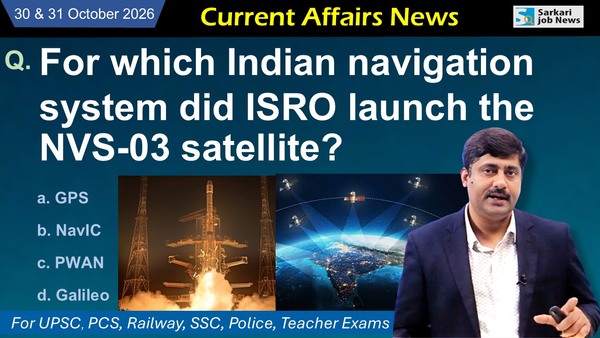
This is the current affairs 30 & 31 October 2026. Here are questions and answers of daily current affairs for better preparation of competitive exams for government jobs.
1. Which of the following statements is correct regarding the NVS-03 navigation satellite launched by ISRO?
a. It was launched using the PSLV-C62 rocket.
b. It was launched from the First Launch Pad of the Satish Dhawan Space Centre.
c. It was launched using the GSLV-F18 rocket.
d. It weighs approximately 1,500 kilograms.
Correct Answer: c. It was launched using the GSLV-F18 rocket.
– On 31 October 2026, ISRO successfully launched the NVS-03 navigation satellite using the GSLV-F18 rocket.
– This mission is an important step towards strengthening India’s indigenous satellite navigation system, NavIC, and reducing dependence on foreign technology.
Important Facts about the NVS-03 Satellite
– Mission Name: NVS-03
– Launch Vehicle: GSLV-F18
– Launch Date: 30 October 2026, at 11:51 PM
– Launch Site: Satish Dhawan Space Centre, Sriharikota (Andhra Pradesh)
– Launch Pad: Second Launch Pad
– Satellite Weight: Approximately 2,250 kilograms
– Orbit: Geosynchronous Transfer Orbit (GTO)
– The satellite will be placed at an altitude of approximately 35,786 kilometres. In this orbit, its orbital period is equal to the Earth’s rotation period. Therefore, when viewed from Earth, the satellite appears stationary at the same position.
Importance of the NVS-03 Satellite
– NVS-03 is part of India’s second-generation navigation satellites.
– It has been developed to modernise India’s regional navigation system, NavIC (Navigation with Indian Constellation), and replace older satellites.
—-
Features of the NVS-03 Satellite
Indigenous Rubidium Atomic Clock
– A major feature of the NVS series is the indigenous Rubidium Atomic Clock.
– It has been developed by ISRO’s Space Applications Centre (SAC).
– Its objective is to reduce dependence on the imported atomic clocks of the Swiss company SpectraTime, which were used earlier.
– NVS-03 includes both indigenous and imported types of clocks. However, ISRO has not made their detailed specifications public.
Support for the L1 Frequency Band
– In addition to the navigation frequencies already used in the NVS series, the L1 frequency band has also been included.
– This will make it easier to use NavIC on smartphones and other compatible devices.
– It will increase the interoperability of India’s navigation system with other systems, particularly the American GPS.
– It may also be important for services related to Indian Standard Time (IST).
—-
What is NavIC?
– NavIC is India’s indigenous regional satellite navigation system.
– Developer: ISRO
– Full Name: Navigation with Indian Constellation
– Its earlier name was IRNSS (Indian Regional Navigation Satellite System).
– Nature: Regional Satellite Navigation System
– Coverage: India and an area extending approximately 1,500 kilometres beyond its boundaries.
– The development of NavIC began after the 1999 Kargil War. At that time, India faced difficulties in obtaining the required information from the American GPS system. This highlighted the strategic risks associated with dependence on foreign navigation systems.
Major Uses of NavIC
– Transportation: Determining the location of vehicles and ships.
– Disaster Management: Assisting in relief and rescue operations during natural disasters.
– Military Sector: Providing indigenous navigation facilities to the Indian Armed Forces.
– Telecommunications: Time synchronisation in networks and communication systems.
– Financial Services: Accurate time determination in banking and other financial systems.
– Navigation: Obtaining information about location, direction and distance.
————-
2. Which ISRO institution developed the indigenous Rubidium Atomic Clock that was installed in the NVS-03 satellite?
a. Vikram Sarabhai Space Centre (VSSC)
b. ISRO Telemetry, Tracking and Command Network (ISTRAC)
c. Vikram Sarabhai Space Centre (VSSC)
d. Space Applications Centre (SAC)
Correct Answer: d. Space Applications Centre (SAC)
Indigenous Rubidium Atomic Clock
– A major feature of the NVS series is the indigenous Rubidium Atomic Clock.
– It has been developed by ISRO’s Space Applications Centre (SAC).
– Its objective is to reduce dependence on the imported atomic clocks of the Swiss company SpectraTime, which were used earlier.
– NVS-03 includes both indigenous and imported types of clocks. However, ISRO has not made their detailed specifications public.
Rubidium Atomic Clock
– A Rubidium Atomic Clock is an extremely precise clock that measures time using the natural oscillation frequency (Atomic Transition Frequency) of rubidium atoms.
– Think of it as an ordinary clock, but one that measures time with such high accuracy that it is used in satellite navigation.
How Does It Work?
– Rubidium-87 atoms are used in it.
– Changes in the energy states of these atoms occur at a specific microwave frequency.
– This specific frequency is used by the clock to generate extremely accurate time signals.
– Its standard frequency is approximately 6.834 GHz.
Why Is It Needed in Satellites?
– In satellite navigation, extremely accurate time measurement is essential for determining location. For example:
– A satellite sends a signal to Earth.
– A mobile phone measures the time taken by the signal to reach it.
– Distance is calculated on the basis of this time and the speed of the signal.
– A mobile phone determines its location based on signals received from multiple satellites.
– An error of just 1 microsecond (one-millionth of a second) in time can result in an error of approximately 300 metres in distance calculation.
Importance for ISRO
– Earlier, atomic clocks manufactured by the Swiss company SpectraTime were used in India’s navigation satellites.
– Now, ISRO is developing indigenous Rubidium Atomic Clocks.
– These have been developed by ISRO’s Space Applications Centre (SAC).
– This will help reduce dependence on foreign technology and improve the reliability of NavIC.
————–
3. When is National Resolve Day (Rashtriya Sankalp Diwas) observed on the death anniversary of India’s first woman Prime Minister, Indira Gandhi?
a. 29 October
b. 30 October
c. 31 October
d. 1 November
Answer: c. 31 October
– The death anniversary of India’s first woman Prime Minister, Indira Gandhi, is observed on 31 October.
– On 31 October 1984, she was assassinated by her own security personnel at her official residence (1 Safdarjung Road) in New Delhi.
– National Resolve Day (National Reintegration Day): Indira Gandhi’s death anniversary is remembered in the country as National Resolve Day. On this day, people take a pledge to preserve the unity and integrity of the nation.
– Memorial Site: Her memorial in New Delhi is known as ‘Shakti Sthal’. On her death anniversary, prominent leaders and citizens of the country visit Shakti Sthal to pay tribute to her.
————–
4. What is India’s position in the medal table at the 2026 Asian Para Games?
a. 1
b. 2
c. 3
d. 4
Answer: d. 4 (India won a total of 114 medals, including 30 Gold, 35 Silver and 49 Bronze medals.)
2026 Asian Para Games Medal Table
Rank : Gold : Silver : Bronze : Total
1. China : 207 : 117 : 111 : 435
2. Japan : 64 : 60 : 62 : 186
3. Uzbekistan : 45 : 49 : 51 : 145
4. India : 30 : 35 : 49 : 114
5. Republic of Korea : 29 : 38 : 33 : 100
2026 Asian Para Games: India’s Medal Table by Sport
Sport : Gold : Silver : Bronze : Total
Para Athletics : 22 : 19 : 24 : 65
Para Swimming : 0 : 3 : 8 : 11
Para Table Tennis : 0 : 0 : 7 : 7
Para Shooting : 2 : 2 : 1 : 5
Para Judo : 0 : 1 : 1 : 2
Para Powerlifting : 0 : 2 : 0 : 2
Para Archery : 3 : 3 : 0 : 6
Para Badminton : 3 : 5 : 8 : 16
Total : 30 : 35 : 49 : 114
————-
5. How many Gold, Silver and Bronze medals, respectively, did Indian athletes win at the 2026 Asian Para Games?
a. 30, 35, 49
b. 45, 49, 51
c. 64, 60, 62
d. 29, 38, 33
Answer: a. 30, 35, 49 (India won a total of 114 medals, including 30 Gold, 35 Silver and 49 Bronze medals.)
Complete List of Indian Medal Winners
Gold Medals (30 Gold Medals)
Para Athletics
1. Nishad Kumar – Men’s Long Jump T-47
2. Soumya – Women’s 1500 Metres T-12/T-13
3. Rinku – Men’s Javelin Throw F-46
4. Deepthi Jeevanji – Women’s 400 Metres T-20
5. Pranav Soorma – Men’s Discus Throw F-51/F-52/F-53
6. Devendra Kumar – Men’s Discus Throw F-43/F-44/F-62/F-64
7. Nishad Kumar – Men’s High Jump T-47
8. Simran – Women’s 200 Metres T-12
9. Praveen Kumar – Men’s High Jump T-64
10. Sachin Sarjerao Khilari – Men’s Shot Put F-46
11. Ayush Verma – Men’s Shot Put F-53
12. Dilip Gavit – Men’s 100 Metres T-47
13. Simran – Women’s 100 Metres T-12
14. Anjanaben Bumbadiya – Women’s 400 Metres T-47
15. Shailesh Kumar – Men’s High Jump T-63
16. Dilip Gavit – Men’s 400 Metres T-47
17. Solaeraj Dharmaraj – Men’s Long Jump T-44/T-62/T-64
18. Sandeep Kumar – Men’s 400 Metres T-64
19. Haney – Men’s Javelin Throw F-37/F-38
20. Sumit Antil – Men’s Javelin Throw F-42 to F-44/F-61 to F-64
21. Pranav Soorma – Men’s Club Throw F-51
22. Suvarna Raj – Women’s Discus Throw F-54
Para Shooting
23. Mona Agarwal – Women’s 10 Metres Air Rifle Standing SH-1
24. Mona Agarwal – Women’s 50 Metres Rifle Three Positions
Para Archery
25. Sheetal Devi / Toman Kumar – Compound Mixed Team
26. Sheetal Devi – Women’s Compound
27. Harvinder Singh / Vijay Sundi – Men’s Recurve Doubles
Para Badminton
28. Nitesh Kumar – Men’s Singles SL-3
29. Naveen Shivkumar – Men’s Singles SL-4
30. Mansi Joshi / Thulasimathi Murugesan – Women’s Doubles SL-3/SU-5
—-
Silver Medals (35 Silver Medals)
Para Athletics
1. Radha Venkatesh – Women’s 1500 Metres T-12/T-13
2. Ajit Singh – Men’s Javelin Throw F-46
3. Pradeep Kumar – Men’s Javelin Throw F-53/F-54
4. Ram Ratan Singh – Men’s Discus Throw F-51/F-52/F-53
5. Preeti Pal – Women’s 200 Metres T-35
6. Bunty – Men’s High Jump T-64
7. Manjeet – Men’s Javelin Throw F-12/F-13
8. Mohammad Yasar – Men’s Shot Put F-46
9. Bhagyashree Jadhav – Women’s Shot Put F-34
10. Mohammad Morsingnakath – Men’s 100 Metres T-47
11. Akira Banothu – Men’s 400 Metres T-35/T-38
12. Preeti Pal – Women’s 100 Metres T-35
13. Tejalben Damor – Women’s 400 Metres T-12
14. Jayanti Behera – Women’s 400 Metres T-47
15. Varun Singh Bhati – Men’s High Jump T-63
16. Nimisha Chakungkalparambil – Women’s Long Jump T-47
17. Parmod – Men’s 1500 Metres T-46
18. Mahendra Gurjar – Men’s Javelin Throw F-42 to F-44/F-61 to F-64
Para Shooting
19. Avani Lekhara – Women’s 10 Metres Air Rifle Standing SH-1
20. Manish Narwal – Men’s 10 Metres Air Pistol SH-1
Para Judo
21. Kokila – Women’s J-2, 52 kg
Para Swimming
22. Ravi Budigina – Men’s 100 Metres Freestyle S-13
23. Kapil Kumar – Men’s 400 Metres Freestyle S-10
24. Ravi Budigina – Men’s 100 Metres Backstroke S-13
Para Powerlifting
25. Ashok – Men’s 65 kg
26. Kasturi Rajamani – Women’s 67 kg
Para Archery
27. Sheetal Devi / Payal Nag – Women’s Compound Doubles
28. Swati Chaudhary – Women’s W-1
29. Bhavana Chaudhary / Pooja Jatyan – Women’s Recurve Doubles
Para Badminton
30. Pramod Bhagat – Men’s Singles SL-3
31. Thulasimathi Murugesan – Women’s Singles SU-5
32. Nithya Sree Sivan – Women’s Singles SH-6
33. Krishna Nagar / Sivarajan Solaimallai – Men’s Doubles SH-6
34. Nitesh Kumar / Thulasimathi Murugesan – Mixed Doubles SL-3/SU-5
—-
Bronze Medals (49 Bronze Medals)
Para Athletics
1. Ravanni Valasaineni – Women’s 1500 Metres T-11
2. Ayush Verma – Men’s Javelin Throw F-53/F-54
3. Praveen Sharma – Men’s Shot Put F-11
4. Pradeep Kumar – Men’s Discus Throw F-43/F-44/F-62/F-64
5. Tejalben Damor – Women’s 200 Metres T-12
6. Hokato Hotozhe Sema – Men’s Shot Put F-56/F-57
7. Anubhav Chaudhary – Men’s 100 Metres T-35
8. Rakeshbhai Bhatt – Men’s 100 Metres T-37
9. Parveen – Men’s Shot Put F-46
10. Pranav Desai – Men’s 100 Metres T-64
11. Sukhchain – Men’s Javelin Throw F-55
12. Ravi Rongali – Men’s Shot Put F-40
13. Karamjyoti – Women’s Discus Throw F-55
14. Sharath Makanhalli – Men’s 1500 Metres T-12/T-13
15. Haney – Men’s Discus Throw F-37
16. Shailesh Kumar – Men’s Long Jump T-42/T-61/T-63
17. Rakeshbhai Bhatt – Men’s 100 Metres T-37
18. Ravanni Valasaineni – Women’s 400 Metres T-11
19. Ajay Kumar – Men’s 400 Metres T-64
20. Navdeep – Men’s Javelin Throw F-40/F-41
21. Sandeep – Men’s 100 Metres T-44
22. Sanjay Sargar – Men’s Javelin Throw F-42 to F-44/F-61 to F-64
23. Dharambir Nain – Men’s Club Throw F-51
Para Swimming
24. Himanshu Nandal – Men’s 400 Metres Freestyle S-11
25. Niranjan Mukundan – Men’s 200 Metres Individual Medley SM-7
26. Ravi Budigina – Men’s 50 Metres Freestyle S-13
27. Himanshu Nandal – Men’s 100 Metres Breaststroke SB-11
28. Rohit Kumar – Men’s 100 Metres Breaststroke SB-4
29. Swatik Patil – Men’s 100 Metres Breaststroke SB-9
30. Tejas Nandkumar – Men’s 100 Metres Backstroke S-7
31. Himanshu Nandal – Men’s 100 Metres Freestyle S-11
Para Badminton
32. Suhas Lalinakere Yathiraj – Men’s Singles SL-4
33. Sanjana Kumari – Women’s Singles SL-3
34. Abhijeet Sakhuja – Men’s Singles SL-4
35. Nithya Sree Sivan / Krishna Nagar – Mixed Doubles SH-6
36. Manisha Ramadass / Pramod Bhagat – Mixed Doubles WH-1/WH-2
37. Alfiya James / Pallavi Kaluvehalli – Women’s Doubles SL-3/SU-5
38. Manisha Ramadass – Women’s Singles SU-5
39. Suryakant Yadav / Naveen Shivkumar – Men’s Doubles SL-3/SU-5
Para Table Tennis
40. Jahan Madan – Men’s Singles Class-1
41. Sonalben Patel – Women’s Singles Class-3
42. Bhavina Patel – Women’s Singles Class-4/5
43. Prachi Pandey – Women’s Singles Class-6
44. Baby Sahana Ravi – Women’s Singles Class-9
45. Shubham Wadhwa / Bhavina Patel – Mixed Doubles Class XD-7
46. Jahan Madan / Shubham Wadhwa – Men’s Doubles MD-4
Para Shooting
47. Srishti Arora – Women’s 10 Metres Air Pistol SH-1
Para Judo
48. Kapil Parmar – Men’s J-1, 70 kg
————–
6. Who were India’s flag-bearers at the opening ceremony of the 2026 Asian Para Games?
a. Mona Agarwal and Nishad Kumar
b. Pramod Bhagat and Simran Sharma
c. Kapil Parmar and Srishti Arora
d. None of these
Correct Answer: b. Pramod Bhagat and Simran Sharma
– Pramod Bhagat is a Para Badminton player.
– Simran Sharma is a Para Athletics athlete (sprinter).
– Special Fact: Bhavina Patel’s name was included in the initial announcement, but Simran Sharma replaced her at the last moment.
————–
7. Who were India’s flag-bearers at the closing ceremony of the 2026 Asian Para Games?
a. Mona Agarwal and Nishad Kumar
b. Pramod Bhagat and Simran Sharma
c. Kapil Parmar and Srishti Arora
d. None of these
Correct Answer: a. Mona Agarwal and Nishad Kumar
– Mona Agarwal is a Para Shooting athlete. She won two gold medals.
– Nishad Kumar is a Para Athletics athlete. He won two gold medals in High Jump and Long Jump.
————–
8. Where were the 2026 Asian Para Games held?
a. Beijing, China
b. Hangzhou, China
c. Aichi-Nagoya, Japan
d. Jakarta, Indonesia
Correct Answer: c. Aichi-Nagoya, Japan
– Event Dates: 18 to 24 October 2026
– Edition: 5th Asian Para Games
– Official Mascot: Uzumin
– Motto: Imagine One Heart
————-
9. Who has been elected as the President of FICCI for the year 2026-27?
a. Adesh Tiwari
b. Vakil Singh
c. Rajendra Verma
d. Vijay Shankar
Correct Answer: d. Vijay Shankar
– Vijay Shankar is the Chairman of the Sanmar Group.
– Date of Taking Office: 18-19 November 2026, replacing Anant Goenka.
– It is an industrial company based in Chennai that operates in the fields of chemicals, speciality chemicals, engineering, steel foundry and shipping.
FICCI
– Full Name: Federation of Indian Chambers of Commerce and Industry
– Established: 1927
– It was established with the inspiration of Mahatma Gandhi during the Swadeshi Movement, with the objective of promoting the interests of Indian industrialists and opposing British-made policies.
– Since independence, FICCI has played an important role in India’s industrialisation, economic liberalisation (1991) and the development of a modern economy.
– It is a non-governmental and non-profit industry body.
– Headquarters: New Delhi
– Direct and Indirect Members: More than 250,000 (2.5 lakh) small, medium and large business enterprises are directly and indirectly associated with FICCI.
————–
10. How many questions in total will be asked during the door-to-door visits for the 2027 Census?
a. 20
b. 30
c. 40
d. 46
Answer: c. 40
– Under the second phase (Population Enumeration) of ‘Census 2027’, the process of self-enumeration will begin on 10 January 2027, and door-to-door data collection will begin on 25 January (whereas in poll-bound states, this second phase will begin earlier, from 16 November 2026).
– Mrityunjay Kumar Narayan, Registrar General and Census Commissioner of India, provided this information under the Gazette notification issued by the Ministry of Home Affairs.
– According to this notification, issued under Section 3 of the Census Act, 1948, the Reference Date for this census has been fixed as 00:00 hours on 1 March 2027.
– Note: The first phase (Houselisting Operations) was completed across the country (except Manipur) on 30 September 2026.
A Total of 40 Questions; 13 New Questions to Be Asked for the First Time
– This time, enumerators will ask citizens a total of 40 questions. These include 13 new questions, which will make the country’s first digital census more comprehensive:
1) Caste (including castes other than Scheduled Castes/Scheduled Tribes)
2) Religion
3) Place of birth and date of birth of both parents
4) Number of bank accounts
5) Name of spouse
6) Nationality
7) Digital literacy
8) Permanent residential address
9) Place of COVID-19 vaccination
10) Passport number (if available)
11) Driving licence (if available)
12) Mobile number (if available)
13) Aadhaar and Voter ID numbers (if available)
Process to Begin in Four Poll-Bound States from 16 November
– In Uttar Pradesh, Goa, Uttarakhand and Punjab, this exercise will be conducted earlier than in the rest of the country, between 16 November 2026 and 5 January 2027.
– In these states, the self-enumeration portal will go live from 16 November, while door-to-door enumeration will begin on 1 December.
– Additionally, this process has already been completed on 30 September in Ladakh and the snow-bound areas of Jammu and Kashmir, Himachal Pradesh and Uttarakhand.
– Meanwhile, the census process in Manipur, which has been affected by ethnic violence, has been postponed indefinitely.
PDF Download: Click here