This is the current affairs 27 & 28 September 2026. Here are questions and answers of daily current affairs for better preparation of competitive exams for government jobs.
1. The first Foreign Ministers’ meeting between India and the Visegrád Group (V4) took place in September 2026 during the 81st session of the United Nations; which countries make up this group?
a. Czech Republic, Hungary, Poland, Slovakia
b. Romania, Bulgaria, Poland, Czech Republic
c. Austria, Slovenia, Hungary, Slovakia
d. Estonia, Latvia, Lithuania, Poland
Answer: a. Czech Republic, Hungary, Poland, Slovakia
– The first meeting between the Foreign Ministers of the Visegrád Group and India was held during the 81st session of the United Nations General Assembly.
About the Visegrád Group V4
– V4 is a cultural and political alliance of the Central European countries: Czech Republic, Hungary, Poland, and Slovakia.
– It was established in 1991.
– Its objective is to promote cooperation in military, economic, cultural, and energy matters.
– All four countries are members of the European Union and NATO.
– India is not a member of V4.
– V4+India is a separate cooperation format through which India can engage collectively with these four countries.
– At the first meeting, both sides agreed to hold a Foreign Ministers’ meeting every year and an annual Business Forum.
– Emphasis was also placed on increasing cooperation in defence, technology, innovation, space, space, connectivity, and people-to-people contacts.
– All four V4 countries supported India’s permanent membership in the UNSC.
————–
2. Who has been selected for the Madhya Pradesh Government’s National Lata Mangeshkar Award 2026?
a. Anu Malik
b. Shantanu Moitra
c. Sonu Nigam
d. Uttam Singh
Answer: b. Shantanu Moitra
– Shantanu Moitra is a renowned music director.
– This award is presented by the Government of Madhya Pradesh.
– The official announcement of Shantanu Moitra’s name was made by the Madhya Pradesh Department of Culture on 23–24 September 2026.
– This award is presented on 28 September, on the occasion of the birth anniversary of the renowned Bollywood singer Lata Mangeshkar.
– Shantanu Moitra has composed music for several excellent films such as Parineeta, 3 Idiots, Lage Raho Munna Bhai, Madras Cafe, and Pink
————–
3. Until which date did ISRO and the European Space Agency (ESA) decide to extend their long-term cooperation agreement?
a. 10 January, 2028
b. 9 January, 2029
c. 7 January, 2030
d. 8 January, 2032
Answer: d. 8 January, 2032
– ISRO and ESA extended this agreement on 10 September 2026 during the International Space Summit in Paris.
– The extension was signed by ISRO Chairman Dr. V. Narayanan and ESA Director General Josef Aschbacher.
– This time, the agreement includes human and robotic exploration, space weather, and the sustainability of space activities.
– This partnership was first started in January 2002, under which work has continued in areas such as Earth observation, satellite navigation, space science, and mission support.
– Both organizations will also cooperate in sharing research and information related to space weather.
– Some collaborations between the European and Indian space agencies in 2026 include Aditya-L1, Proba-3, and the upcoming Chandrayaan-5 mission.
About the European Space Agency (ESA)
– It is an intergovernmental organization dedicated to space exploration and scientific research in Europe.
– Year of Establishment: 1975
– Headquarters: Paris, France
– Member Countries: 22 European countries
– Main Launch Station: Guiana Space Centre (Kourou, French Guiana)
– Space Launch Vehicles: ESA has developed Ariane and Vega series rockets, which are well known worldwide for placing satellites into orbit.
Relations between India (ISRO) and ESA
– India’s space agency ISRO and ESA have had long-standing cooperation.
– ESA provided ground station support for deep-space tracking and data acquisition during India’s Chandrayaan-3 and Aditya-L1 missions.
– Both agencies also work together to reduce Space Debris and on future interplanetary missions.
————-
4. When is World Contraception Day celebrated?
a. 25 September
b. 26 September
c. 27 September
d. 29 September
Answer: b. 26 September
Theme for 2026
– No Barriers, Just Choices: Contraceptive Access Now
————-
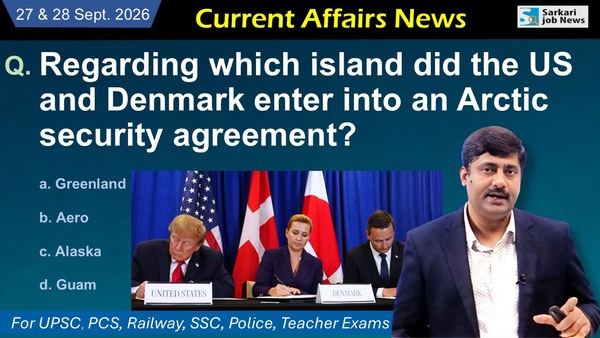
5. Regarding which island was an Arctic security agreement reached between the United States and Denmark in September 2026?
a. Greenland
b. Aero
c. Alaska
d. Guam
Answer: a. Greenland
– U.S. President Donald Trump signed this agreement on 22 September 2026 to strengthen security in the Arctic and North Atlantic regions.
– Under the agreement, the United States may increase its military presence in Greenland.
– For a long time, Trump has expressed a desire to make Greenland a part of the United States.
– Under the agreement, the United States has been permitted to establish two new defence areas/military bases in Narsarsuaq and Mestersvig in Greenland and expand Pituffik Space Base.
– This new agreement updates the old defence agreement of 1951.
– On paper, the agreement preserves Greenland’s integrity, Denmark’s sovereignty, and Greenland’s right to self-determination.
– Denmark and European countries strongly opposed Trump’s statements about buying or taking control of Greenland.
– After this, a tariff war and diplomatic deadlock had emerged.
Greenland is an autonomous territory of Denmark
– Greenland is an autonomous territory within the Kingdom of Denmark.
– Donald Trump said that the issue of control over Greenland was affecting America’s relations with NATO.
– Because Denmark does not receive much benefit from Greenland. – In reality, Denmark does not spend enough money to help Greenland.
– But it is very important for the United States.
– Ships from China and Russia are present around Greenland.
– We will not allow this to happen.
Why does the United States want Greenland?
– In fact, new sea routes are opening as the ice melts in the Arctic region.
– The United States wants to strengthen its control over this region to counter the increasing activities of Russia and China.
– Greenland has huge reserves of rare minerals, which are being eyed by the United States and other major powers.
————-
6. According to the 2025 WHO-UNICEF report, which country has the highest number of children deprived of sanitation facilities in schools?
a. India
b. Nigeria
c. Ethiopia
d. Indonesia
Answer: a. India (Number of children deprived of sanitation facilities in schools in India: 5 crore)
– Report Name: ‘Progress on Drinking Water, Sanitation and Hygiene in Schools 2015-2025’
– Released by: WHO and UNICEF
– Released on: 22 September 2026
– This report assesses progress towards achieving the United Nations Sustainable Development Goals (SDG-6: Clean Water and Sanitation) by 2030.
– This WHO and UNICEF report is part of the JMP (Joint Monitoring Programme) for sanitation and hygiene.
What is in the report?
– The report assesses the global status of drinking water, sanitation, and hygiene facilities in schools around the world.
– According to the report, by 2025, out of a total of 244 million children worldwide, India had the highest number of children deprived of sanitation facilities in schools, at 5 crore.
– Meanwhile, 3.4 crore school children in Nigeria, 2.6 crore in Ethiopia, 1.1 crore in the Democratic Republic of the Congo, and 80 lakh in Indonesia were deprived of sanitation facilities.
– On the positive side, India is among the 28 of the 62 countries that are progressing towards achieving universal access to basic drinking water in schools by 2030.
– In 2015, basic drinking water facilities in Indian schools were available at 55%, which increased to 97% by 2025.
– Despite this, by 2025, 25.8 crore children worldwide did not have access to drinking water facilities in their schools. Of these, 12 crore children were from Indian schools, meaning approximately 1 in every 20 children worldwide.
– In India, basic sanitation facilities were available in 81% of schools in 2025.
– Despite this, approximately 19% of schools were deprived of this facility.
– Around 5 crore children were in schools where there was no sanitation service at all.
– This is why India has been reported as the country with the highest number in this regard.
– These figures reflect both the progress and challenges faced by India in achieving the targets for water, sanitation, and hygiene under the Sustainable Development Goals (SDGs) set for 2030.
In 2025, worldwide:
– 46 crore school children were deprived of basic sanitation facilities.
– 24.4 crore children had no sanitation service at all in their schools.
– 21.6 crore children had facilities in their schools, but these did not meet basic standards, such as single-sex and usable facilities.
– Globally, 77% of schools had basic sanitation, 11% had limited sanitation, and 12% had no sanitation service.
————-
7. When is World Tourism Day celebrated?
a. 20 September
b. 25 September
c. 27 September
d. 28 September
Answer: c. 27 September
Theme for 2026
– Digital Agenda and Artificial Intelligence to Redesign Tourism
– The United Nations World Tourism Organization (UNWTO) declared World Tourism Day in 1980.
– Its objective is to promote the social, cultural, economic, and environmental importance of tourism.
Importance in the context of India:
– Economic Contribution: Tourism contributed 5% to GDP in the financial year 2022-2023 and created 7.6 crore jobs. In 2024, India attracted more than 90 lakh foreign tourists, which increased foreign exchange reserves.
– Cultural Importance: India’s diverse culture, historical sites (such as the Taj Mahal, Ajanta-Ellora), and religious centres (such as Varanasi and Tirupati) promote tourism. It encourages cultural exchange.
– Sustainable Tourism: Eco-tourism (such as the Sundarbans and Kerala backwaters) and rural tourism (such as Rajasthan and Himachal Pradesh) are being promoted in India, which empowers local communities.
– Policy Efforts: The government’s ‘Incredible India’ and ‘Dekho Apna Desh’ initiatives, along with the Swadesh Darshan and PRASHAD schemes, strengthen tourism infrastructure. The e-Visa facility has increased the number of foreign tourists.
– Challenges: Inadequate infrastructure, environmental damage, and regional security concerns are obstacles to tourism development.
————-
8. When is World Rivers Day celebrated?
a. On the fourth Sunday of August
b. On the fourth Sunday of September
c. On the first Sunday of October
d. None of these
Answer: b. On the fourth Sunday of September (27 September in 2026)
Theme for 2026
– No Forests, No Rivers, No Water, No Life
– The objective of this day is to spread awareness about the importance of rivers, their conservation, and their role in ecosystems.
– Origin: It was started in 2005 by Canadian environmentalist Mark Angelo, inspired by the United Nations Water Decade Programme.
– Importance: Rivers are important for drinking water, agriculture, biodiversity, and cultural values. This day emphasizes the need to protect rivers from pollution, over-exploitation, and climate change.
Major initiatives and schemes of the Government of India for river conservation
1) National River Conservation Plan (National River Conservation Plan)
– Started in: 1985
– Objective: Pollution control in major rivers of the country (such as Ganga, Yamuna, Godavari, and Krishna).
– Main Activities: Establishment of Sewage Treatment Plants (STPs), riverbank cleaning, and solid waste management. Projects covering 34 rivers.
2) National River Linking Project (NRLP)
– Started in: 2002
– Objective: 37 rivers will be linked through 30 links, including 15,000 km of canals, 3,000 storage dams, and waterways. Estimated cost: ₹5-10 lakh crore.
– Main Activities: In 2021, the Ken-Betwa Link (Madhya Pradesh-Uttar Pradesh) was approved, followed by the Kosi-Mechi Link (Bihar) in 2025. Work is underway on both.
3) National Water Mission
– Started in: 2011
– Objective: Sustainable management of water resources and addressing the effects of climate change.
– Main Activities: Rainwater harvesting, water-use efficiency, basin-level management, and maintaining river flows.
4) National Plan for Conservation of Aquatic Ecosystems (NPCA)
– Started in: 2013
– Objective: Conservation of the ecosystems of rivers, lakes, and reservoirs.
– Main Activities: Pollution control, improvement of water quality, and conservation of aquatic biodiversity.
5) Namami Gange
– Started in: 2014
– Objective: Conservation and rejuvenation of the Ganga River and its tributaries.
– Main Activities: Sewage treatment, ghat development, biodiversity conservation, industrial pollution control, and public awareness. 300+ projects approved.
6) Pradhan Mantri Krishi Sinchayee Yojana (PMKSY)
– Started in: 2015
– Objective: Sustainable use of water from rivers and water efficiency in agriculture.
– Main Activities: Drip/sprinkler irrigation, water harvesting, and management of small rivers and watersheds.
7) Jal Shakti Abhiyan
– Started in: 2019
– Objective: Promote water conservation and rainwater harvesting, and revive the sources of rivers.
– Main Activities: Cleaning riverbanks, desilting, plantation, and rainwater harvesting. Theme (2024): ‘Nari Shakti Se Jal Shakti’.
8) Jal Jeevan Mission
– Started in: 2019
– Objective: Tap water supply in rural areas and conservation of rivers and water sources.
– Main Activities: Water source conservation, laying pipelines, and sustainable use of river water.
9) Atal Bhujal Yojana
– Started in: 2019
– Objective: Groundwater conservation, although it affects the base flow of rivers.
– Main Activities: Groundwater recharge, watershed development, and community participation.
————-
9. International Week of the Deaf / Day of the Deaf is observed in the last week (till the last Sunday) of which month?
a. January
b. March
c. September
d. November
Answer: c. September (27 September in 2026)
————-
10. When is World Rabies Day observed?
a. 25 September
b. 27 September
c. 28 September
d. 29 September
Answer: c. 28 September
Theme for the year 2026
– Stronger Together
– The objective of observing this day is to spread awareness among people about rabies.
– Rabies is a deadly viral disease. The main cause of rabies is bites from pet or stray dogs.
– Approximately 20,000 deaths occur annually due to rabies in India – the highest in the world.
– Approximately 95% of rabies cases are caused by dog bites.
– The estimated dog population in India is 6-7 crore, most of which are stray dogs.
– Rabies is 100% preventable if timely vaccination and treatment are provided.
PDF Download: Click here