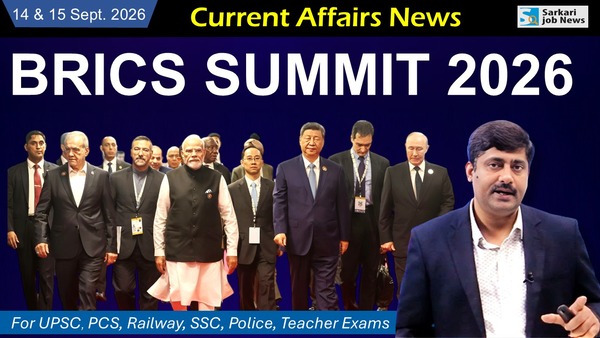
This is the current affairs 14 to 15 September 2026. Here are questions and answers of daily current affairs for better preparation of competitive exams for government jobs.
1. Where was the BRICS Summit 2026 held?
a. Yashobhoomi, Delhi
b. Bharat Mandapam, New Delhi
c. Vigyan Bhawan, New Delhi
d. Hyderabad House, New Delhi
Answer: b. Bharat Mandapam, New Delhi
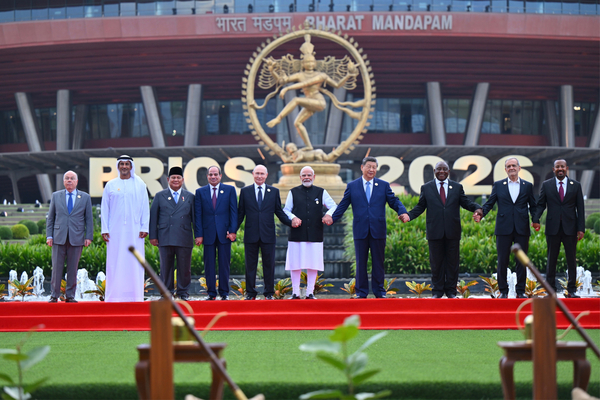
BRICS Summit
– Which summit: 18th
– When: 12-13 September 2026
– Where held: Bharat Mandapam, New Delhi
– Presidency / Host: India (under the chairmanship of Prime Minister Narendra Modi)
– Theme: Building for Resilience, Innovation, Cooperation and Sustainability
– Declaration: At the conclusion of the conference, the ‘New Delhi Declaration’ was issued with the consent of all member countries.
What is BRICS?
– The foundation of the group was laid in 2006 by Brazil, Russia, India and China (BRIC).
– Four years later, in 2009, when South Africa also joined it, it got its present name BRICS.
– Therefore, its establishment year is considered to be 2009.
– Since then, Egypt, Ethiopia, Iran, United Arab Emirates, Saudi Arabia and Indonesia have also joined the group.
– Approximately half of the world’s population lives in BRICS countries and their contribution to global Gross Domestic Product (GDP) is approximately 40 percent.
– It is an organization of 10 important emerging economies.
– This group represents 41 percent of the world’s population.
– Approximately 26 percent of the world’s GDP belongs to BRICS countries.
– India received the presidency for the fourth time in 2026. Before this, it had chaired the summits three times in 2012, 2016 and 2021.
Total BRICS members and year of joining
– Brazil: 2006
– Russia: 2006
– India: 2006
– China: 2006
– South Africa: 2011
– Iran: 2024
– Egypt: 2024
– Ethiopia: 2024
– United Arab Emirates: 2024
– Indonesia: 2025
Which BRICS member leaders participated?
– India (Host): Prime Minister Narendra Modi
– China: President Xi Jinping
– Russia: President Vladimir Putin
– South Africa: President Cyril Ramaphosa
– Iran: President Masoud Pezeshkian
– Ethiopia: Prime Minister Abiy Ahmed
– Indonesia: President Prabowo Subianto
– Egypt: President Abdel Fattah el-Sisi
– Brazil: Foreign Minister Mauro Vieira
– United Arab Emirates (UAE): Crown Prince Sheikh Khaled bin Mohamed bin Zayed Al Nahyan
—-
Heads and representatives of Outreach and Participating Countries
Asia and Southeast Asia
– Philippines: President Ferdinand R. Marcos Jr. (Distinguished Invitee as Chair of ASEAN 2026)
– Malaysia: Prime Minister Anwar Ibrahim
– Vietnam: Prime Minister Le Minh Hung
– Thailand: Deputy Prime Minister and Foreign Minister Sihasak Phuangketkeow
– Kazakhstan: President Kassym-Jomart Tokayev
– Uzbekistan: Deputy Prime Minister Jamshid Kuchkarov
Africa
– Nigeria: Vice President Kashim Shettima
– Uganda: Vice President Jessica Alupo
– Burundi: President Évariste Ndayishimiye
Europe and Latin America
– Belarus: Foreign Minister Maxim Ryzhenkov
– Cuba: Foreign Minister Bruno Rodríguez Parrilla
– Uruguay: Foreign Minister Mario Lubetkin
Heads of International Organizations
– United Nations (UN): Secretary-General António Guterres
– World Health Organization (WHO): Director-General Dr. Tedros Adhanom Ghebreyesus
– World Trade Organization (WTO): Director-General Dr. Ngozi Okonjo-Iweala
– New Development Bank (NDB): President Dilma Rousseff
– Asian Infrastructure Investment Bank (AIIB): President Zou Jiayi
15 Bilateral Meetings held by PM Modi
– During the BRICS Summit, Prime Minister Modi held 15 bilateral meetings with heads of state/government.
– This is in addition to the closed-door meetings held with various world leaders and leaders of international institutions.
Important events held at Bharat Mandapam so far
– 18th BRICS Summit: 12-13 September 2026
– Bharat Tex: February 2024 / May 2026 (the largest exhibition event of the global textile industry held in India so far.)
– G20 Summit: 9-10 September 2023
————-
2. For the how-many-th time did India hold the BRICS presidency in 2026?
a. First time
b. Second time
c. Fourth time
d. Fifth time
Answer: c. Fourth time
India has held the BRICS presidency four times:
– 2012: India held the BRICS presidency for the first time (4th Summit in New Delhi)
– 2016: India held the BRICS presidency for the second time (8th Summit in Goa)
– 2021: India held the BRICS presidency for the third time (13th Summit held virtually)
– 2026: India held the BRICS presidency for the fourth time (18th Summit in Delhi)
————-
3. What is the theme of BRICS for the year 2026 under India’s presidency?
a. Free India, Free World, Free Humanity
b. Vasudhaiva Kutumbakam
c. One Earth, One Family, One Future
d. Building for Resilience, Innovation, Cooperation and Sustainability
Answer: d. Building for Resilience, Innovation, Cooperation and Sustainability (Building for Resilience, Innovation, Cooperation and Sustainability)
‘Lotus’ is the BRICS Logo (Symbol)
– During India’s BRICS presidency, the logo of the summit is India’s national flower, the Lotus.
– The central part of the symbol is focused on the ‘Namaste’ greeting.
– It was selected through an open contest launched by the Ministry of External Affairs on the government’s citizen engagement platform.
– The logo (symbol) designed by Sudeep Subhash Gandhi was selected.
– He said that since India is the host of the 18th BRICS Summit, we included the Indian greeting ‘Namaste’ in the centre.
Theme
– Building for Resilience, Innovation, Cooperation and Sustainability
– It was emphasized that the country’s presidency would adopt a “Humanity First” and “people-centric” approach.
– India’s BRICS presidency is guided by the theme “Building for Resilience, Innovation, Cooperation and Sustainability”, which reflects the people-centric and humanity-first approach expressed by the Prime Minister at the 2025 Rio Summit (Brazil).
India’s stance on BRICS
– Clarifying India’s position, Modi emphasized that the group should not be understood merely as an anti-Western project. He said, “BRICS is not against anyone,” while arguing that the Global South should have a greater role in shaping global governance.
– Prime Minister Modi warned against the ‘weaponization’ of technology and critical minerals.
————-
4. Which famous temple’s corridor was used as a digital backdrop at Bharat Mandapam to welcome foreign heads of state during the 18th BRICS Summit?
a. Meenakshi Temple, Madurai
b. Ramanathaswamy Temple, Rameswaram
c. Brihadishvara Temple, Thanjavur
d. Jagannath Temple, Puri
b. Ramanathaswamy Temple, Rameswaram
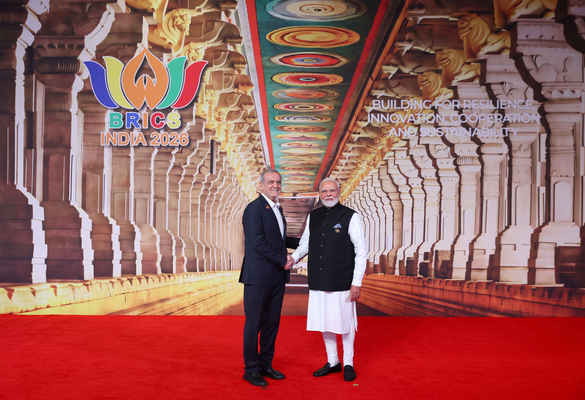
– During the BRICS Summit, Prime Minister Modi welcomed world leaders (such as Chinese President Xi Jinping, Russian President Vladimir Putin, etc.) with a digital image/projection of the famous 1,212-pillared corridor of the Ramanathaswamy Temple (Rameswaram) used in the background (Backdrop).
– Message: India is proudly presenting to the world, along with its modern economy and diplomatic power on the global stage, its rich civilizational and cultural heritage as well.
Religious and Mythological Significance of Ramanathaswamy Temple
– Char Dham and 12 Jyotirlingas: This temple is a highly sacred place in South India. It is one of the ‘Char Dhams’ (the other three: Badrinath, Dwarka, Jagannath Puri) and is also one of the 12 Jyotirlingas of Lord Shiva.
– Rameswaram is a major pilgrimage site for both Shaivites as well as Vaishnavites.
– Connection with the Ramayana: It is believed that after defeating Lanka’s King Ravana, Lord Rama established and worshipped a Shiva Lingam (Ramanathaswamy) at Rameswaram to get relief from the sin of Brahmahatya.
– Rameswaram is the sacred place of Lord Rameshwar, meaning the Lord (Shiva) established by Lord Rama.
Significance from the Architectural Perspective
– This temple is an excellent example of Dravidian Architecture.
– Its outer corridor is considered the world’s longest temple corridor, containing 1,212 magnificent carved granite pillars.
————–
5. Who will hold the presidency of BRICS in the year 2027?
a. India
b. China
c. Russia
d. Egypt
Answer: b. China
– China will be the Chair of BRICS in 2027 and the 19th BRICS Summit will also be held in China.
————–
6. ‘New Delhi Declaration 2026’
– At the 18th BRICS Summit, the ‘New Delhi Declaration 2026’ was adopted unanimously by all member countries.
– Despite differences among the members over the ongoing wars in Iran and Ukraine, the leaders of the BRICS group unanimously adopted a joint declaration on the first day of the two-day summit in New Delhi.
– The 140-point declaration and the major decisions taken at the summit are as follows:
Reform of Global Governance and 10-Point Roadmap
– Voice of the Global South: Prime Minister Narendra Modi presented a 10-point roadmap for restructuring global institutions (such as the United Nations, IMF and World Bank).
– UNSC Expansion: China and Russia reiterated their support for giving India and Brazil a more significant role in the United Nations Security Council (UNSC).
Multipolar World
– Reiterating “its commitment to strengthening multilateralism and multipolarity”, BRICS said that a multipolar world can expand opportunities for emerging markets and developing countries (EMDCs) to “develop constructive capacity and enjoy universally beneficial, inclusive, sustainable and equitable economic globalization and cooperation.”
Strong Stand Against Terrorism
– A commitment was made to adopt zero-tolerance towards cross-border terrorism, terrorism financing and safe havens.
Decisions on Trade and Protectionism
– Opposition to unilateral tariffs: BRICS countries expressed deep concern over unilateral tariffs and trade restrictions and supported a WTO-based multilateral trading system.
– Stand on carbon tariffs: Opposition was expressed to unilateral economic restrictions and Carbon Border Adjustment Mechanisms imposed in the name of environmental policies.
Financial Reform of Multilateral Institutions
– Emphasis was placed on the urgent need to reform quota shares, voting power and leadership of emerging economies (EMDEs) in the IMF and World Bank.
Maritime Security and SEAFS Network
– A proposal was made to establish a ‘Seafarers Emergency Support Network’ to ensure the safety of commercial ships on international maritime routes and in West Asia.
Climate Change and Energy Security
– While expressing commitment to the Paris Agreement, agreement was reached on a balanced energy mix including renewable energy, nuclear energy, bioenergy, and hydrogen.
Technology and AI (Artificial Intelligence)
– Agreement was reached on creating safe, human-centric and ethical rules for emerging technologies such as AI, cyberspace and biotechnology.
US-Israel War on Iran
– The New Delhi Declaration called for restraint in the Middle East.
– However, the statement did not directly mention the attacks on Iran by the United States and Israel or the subsequent attacks by Iran on its Persian Gulf neighboring countries, including the United Arab Emirates, but it called for “maximum restraint” in the war.
– This means that it did not condemn the US-Israeli attacks or Iran’s targeting of the Gulf countries in the region. It also criticized the global trade war without naming the United States.
Russia-Ukraine War
– Without mentioning Ukraine in the declaration, there was a general call to resolve international disputes through “dialogue, consultation and diplomacy.”
– BRICS leaders criticized unilateral sanctions that were not authorized by the United Nations Security Council.
– The declaration made no separate mention of Russia’s war in Ukraine.
Support for the Formation of a Palestinian State
– BRICS adopted much clearer language on Palestine. The declaration expressed “strong opposition” to the forced displacement of Palestinians and attempts to alter the geography or demography of the occupied Palestinian territory.
– It called for ending Israel’s genocidal war in Gaza, ensuring unhindered access to humanitarian aid, supporting UNRWA, the United Nations agency for Palestinian refugees, and granting Palestine full membership in the United Nations.
– BRICS reiterated its support for a two-state solution and the establishment of a sovereign Palestinian state based on the 1967 borders, with occupied East Jerusalem as its capital.
Safety of Nuclear Sites:
– Deep concern was expressed over attacks on nuclear facilities and civilian infrastructure protected under the IAEA.
————–
7. What happened to the BRICS common currency?
– At the 18th BRICS Summit, the proposal for a Common BRICS Currency has been completely put on hold.
– The press briefing issued by the Ministry of External Affairs and the ‘New Delhi Declaration 2026’ have made it clear that there is currently no proposal under consideration for BRICS to introduce a single common currency.
Why was the common currency not created?
– India (and Brazil) do not want BRICS to be seen as an anti-American or anti-dollar (Anti-Dollar Block) organization. India’s foreign policy is not about eliminating the dollar, but about strengthening its national currency (rupee).
– Economic inequalities: To operate a single currency like the ‘Euro’ in the European Union, all member countries would need similarities in fiscal policies and inflation rates, which is not possible among BRICS countries (China, India, Russia, Ethiopia, etc.).
What alternative was agreed upon instead of a common currency?
– Instead of a common currency, BRICS leaders agreed to conduct mutual trade in local currencies:
– Local Currency Settlement: Member countries will directly use their respective currencies (such as the rupee, yuan and rial) for trade with each other.
– Digital Payment System (Interlinking Payment Systems): India has proposed connecting its UPI and Digital Rupee (CBDC) with the payment systems of other BRICS countries.
————–
8. During the BRICS Summit, the head of state of which country proposed establishing an independent BRICS insurance mechanism and a BRICS grain exchange to avoid reliance on the Western dollar system or Western commodity exchanges?
a. India
b. China
c. Russia
d. Malaysia
Answer: c. Russia
– Russian President Putin proposed a new insurance arrangement.
– He proposed a new insurance mechanism for the grain market among BRICS countries and a collaborative initiative and called on the group to adopt a comprehensive approach to deal with global challenges.
Why did Putin need this proposal?
– In fact, more than 90% of the world’s maritime insurance companies are controlled by the West (G-7/Europe).
– The G-7 countries, the European Union and the United Kingdom have prohibited Western companies from insuring any vessel transporting Russian crude oil or grain unless the oil was specifically purchased at or below a prescribed price cap.
– Due to the lack of insurance, it had become difficult and risky for Russia to export oil and wheat/grain.
Putin’s two main proposals
– BRICS Grain Exchange: Russia is the world’s largest wheat exporter. Putin wants BRICS countries to create their own exchange and system for buying and selling grain among themselves, so that they do not have to depend on the Western dollar system or Western commodity exchanges.
– Independent BRICS Insurance Mechanism: To create a new insurance system that would insure ships and cargo belonging to BRICS and ‘Global South’ member countries. Western sanctions would have no effect on it.
Strategic and Diplomatic Message
– ‘Sanction-proof’ Economy: Putin says that BRICS has its own capital, labour and technology. Therefore, BRICS countries can conduct independent trade without worrying about Western pressure or sanctions.
– Support for the New Development Bank (NDB): Putin praised the NDB’s $140 billion worth of projects and presented it as an alternative to the Western-dominated World Bank.
What decision did the BRICS Summit take on this proposal?
– No final decision (i.e., announcement of implementation) has been made on these two proposals.
– However, regarding the BRICS Grain Exchange, member countries have supported the idea and its expansion in scope in the declaration.
– The declaration does not mention an independent insurance arrangement (Insurance Mechanism). The main reason behind this is that countries such as India, Brazil and the UAE do not want BRICS to be used directly to bypass Western sanctions or as an anti-US/anti-Western bloc (Anti-West Bloc).
————-
9. Which country proposed creating an “Open-Source AI Zone” for member countries during the 18th BRICS Summit?
a. India
b. Russia
c. China
d. Brazil
Answer: c. China
China proposed an ‘Open-Source AI Zone’; know its diplomatic and strategic significance
– During the 18th BRICS Summit, Chinese President Xi Jinping made a major proposal aimed at increasing technological cooperation among member countries in the field of Artificial Intelligence (AI).
– Xi Jinping announced that China is ready to lead the creation of “an open-source zone for artificial intelligence” (Open-Source AI Zone) for BRICS and ‘Global South’ countries.
Why did Xi Jinping have to bring this proposal?
– US restrictions: The United States (Trump administration) has imposed strict restrictions on the sale of advanced AI chips (such as Nvidia chips) and proprietary AI models (Proprietary AI Models) to China.
– Global AI divide: AI technology is currently mainly controlled by American private companies (OpenAI, Google, Meta). China wants to bring BRICS countries together with itself and create a new ‘Global South Block’ in the field of AI.
‘Open-Source AI Zone’
– Open-Source and Inclusive AI: China is proposing to create an AI ecosystem whose source code and algorithms would be open and accessible to all BRICS member countries, rather than being closed and expensive like those of American companies.
– Cooperation in Large Language Models (LLMs): China will share its technology to develop Large Language Models (LLMs) based on the local languages and databases of BRICS countries.
– Global AI Governance: In the context of the upcoming meeting between Xi Jinping and Donald Trump, China wants to send the message that AI rules cannot be decided only by the US or Western countries; BRICS and developing countries should also have the right to make the rules (Rule-Making).
Perspective of India and BRICS Countries
– Benefit of Open-Source: For countries such as India, South Africa and Brazil, access to open-source AI code is beneficial from the perspective of technology transfer.
– Concern over Data Security and Chinese Dominance: India has always supported ‘safe, ethical and human-centric AI’. India and other member countries will exercise caution over China’s proposal so that there is no risk to data sovereignty (Data Sovereignty) and Chinese surveillance (Surveillance).
————-
10. How many commemorative postage stamps did PM Modi release during the 18th BRICS Summit?
a. One
b. Two
c. Three
d. Four
Answer: b. Two (₹5 and ₹25 commemorative postage stamps)
– During the 18th BRICS Summit, Prime Minister Narendra Modi released two special commemorative postage stamps to mark the 20-year diplomatic and economic journey of BRICS (2006–2026).
– These postage stamps, prepared by the Department of Posts (India Post), have denominations of ₹5 and ₹25 respectively.
– Commemorative postage stamps are printed in limited quantities (Limited Edition). Therefore, besides being used in postal services, they are an excellent way for stamp collectors (Philatelists) to preserve them as valuable historical documents.
—————
11. When is National Hindi Day celebrated?
a. 10 January
b. 14 September
c. 18 September
d. 21 September
Answer: b. 14 September
Theme for 2026
– Hindi: From Traditional Knowledge to Artificial Intelligence
– National Hindi Day is celebrated every year in India on 14 September.
– In addition, 10 January is celebrated as World Hindi Day.
– Talking about National Hindi Day, on this day in 1949, the Constituent Assembly unanimously decided that Hindi would be the Official Language of India. It would be used for communication in Hindi-speaking states.
– English is the associate official language and is used while communicating with the states.
PDF Download: Click here