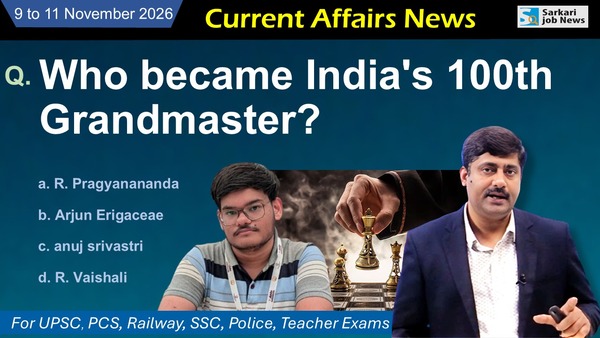
This is the current affairs 9 to 11 November 2026. Here are questions and answers of daily current affairs for better preparation of competitive exams for government jobs.
1. What is the name of India’s 100th Grandmaster?
a. R. Praggnanandhaa
b. Arjun Erigaisi
c. Anuj Srivastava
d. R. Vaishali
Answer: c. Anuj Srivastava
– Anuj Srivastava belongs to Katni, Madhya Pradesh.
– He achieved this feat by winning the 7th ASEAN+ Individual Open Chess Championship held in the Philippines.
– With this achievement, he became India’s 100th Grandmaster.
– He also became the first Grandmaster from Madhya Pradesh.
– He is 22 years old.
– He had received a job offer from an IT company in Germany, but Anuj Srivastava chose a career in chess instead of becoming a software professional.
What is a Grandmaster?
– Grandmaster (GM) is the highest title awarded to a chess player by the International Chess Federation (FIDE).
– Apart from becoming a World Champion, it is considered the highest position in the world of chess.
– Once a player achieves this title, it remains with them for their entire lifetime (unless it is revoked in cases of serious misconduct or cheating).
– A player must achieve a classical rating of at least 2500 points and complete 3 Grandmaster norms.
States with the Highest Number of Grandmasters in India
– Tamil Nadu is at the top, with 38 out of India’s 100 Grandmasters.
First Grandmaster
– In 1988, Viswanathan Anand became India’s first Grandmaster.
Recent Grandmasters
100th: Anuj Srivastava
99th: VS Rathanvel
98th: S. Ashwath
97th: Harshavardhan GB
96th: Ethan Vaz
95th: Aronyak Ghosh
————–
2. To which author and for which novel was the 2026 Booker Prize awarded?
a. Douglas Stuart for “John of John”
b. Marlon James for “The Disappears”
c. M. John Harrison for “The End of Everything”
d. Elizabeth Strout for “The Things We Never Say”
Answer: c. M. John Harrison for “The End of Everything”
– British author M. John Harrison was awarded the Booker Prize on 9 November 2026.
– At the age of 81, he became the oldest author to win the Booker Prize.
– Prize Money: £50,000.
AI-Related Concerns in the Book
– This novel portrays concerns about Artificial Intelligence through a dark satirical depiction of Britain after the end of the world.
– The novel features a mysterious artificial being (Artefact) that gradually begins to behave, speak and learn like humans.
– It imitates humans, and its intelligence continues to develop.
– Through this, questions are raised about AI, human consciousness, and the difference between humans and machines.
What is the Booker Prize?
– It is a major literary award given for a novel written in English and published in the United Kingdom or Ireland.
– It was first awarded in 1969.
– It is administered by the Booker Prize Foundation.
Booker Prize and International Booker Prize
– The Booker Prize and the International Booker Prize are two different awards.
– The Booker Prize is awarded for a novel written in the English language. It was established in 1969. (For example, Arundhati Roy received it for ‘The God of Small Things’).
– The International Booker Prize is awarded for a book originally written in another language and translated into English. It was established in 2005. (For example, Geetanjali Shree received it in 2022 for the English translation ‘Tomb of Sand’ of her Hindi novel ‘Ret Samadhi’).
– For both awards, the book must be published in the UK or Ireland.
– The winner of the International Booker Prize 2026 is Taiwanese writer Yang Shuang-zi.
—————
3. Which manuscripts were included in the ‘Asia-Pacific Regional Register’ of UNESCO’s ‘Memory of the World’ programme in 2026?
a. Mahabharata
b. Arthashastra
c. Rajatarangini
d. All of the above
Answer: d. All of the above (Mahabharata, Arthashastra, Rajatarangini) [The total number has now increased to 6.]
– On 6 November 2026, UNESCO included the manuscripts of three ancient Indian texts—Mahabharata, Arthashastra and Rajatarangini—in the Asia and Pacific Regional Register of its ‘Memory of the World’ programme.
– This decision was taken during the 11th session of UNESCO’s Memory of the World Asia-Pacific Regional Register held in Jakarta, Indonesia.
– With this, a total of 6 historical manuscripts/works have been included in this regional register.
Manuscripts/Works Included in UNESCO’s Memory of the World Asia-Pacific Regional Register
Manuscript/Work : Author/Related Person : Year
1) Mahabharata : Maharishi Ved Vyasa : 2026
2) Arthashastra : Kautilya / Chanakya : 2026
3) Rajatarangini : Kalhana : 2026
4) Ramcharitmanas : Goswami Tulsidas : 2024
5) Panchatantra : Vishnu Sharma : 2024
6) Sahṛdayāloka-Locana : A text on Indian poetics : 2024
Mahabharata
– The Mahabharata, composed by Maharishi Ved Vyasa, is considered the longest epic in the world.
– Its rare birch-bark manuscript, approximately 400 years old, is preserved at the Bhandarkar Oriental Research Institute (BORI) in Pune, Maharashtra.
– This manuscript is written in the Sharada Script.
– The Mahabharata describes subjects such as Dharma, Artha, Kama and Moksha, along with duty, Rajdharma, philosophy and human destiny.
Arthashastra
– The Arthashastra was composed approximately 2,000 years ago by Kautilya, who is also known as Chanakya and Vishnugupta.
– He was an adviser to the Mauryan emperor Chandragupta Maurya.
– This text provides a systematic account of governance, the economy, administration, diplomacy, law and military strategy.
– It describes the intelligence system, judicial procedures, rules of evidence and the system of punishment.
– The Mandala Theory and Shadgunya Policy are mentioned in relation to foreign policy.
– Sama, Dana, Danda and Bheda are described as the major methods of statecraft and diplomacy.
– Its original manuscript is preserved at the Oriental Research Institute in Mysuru, Karnataka, in the Grantha Script.
Rajatarangini
– Rajatarangini was composed in Sanskrit in the 12th century by Kashmiri historian Kalhana.
– It is an important historical text based on the history of Kashmir.
– It describes the dynasties of Kashmir, rulers, political events and socio-cultural conditions.
– This text is particularly important for its attempt to present historical events in chronological order.
– Its manuscript is written in the Sharada Script on old Kashmiri paper.
– This manuscript is preserved at the Oriental Research Library in Srinagar.
What is UNESCO’s Memory of the World Programme?
– UNESCO launched the Memory of the World (MoW) Programme in 1992.
– Its objective is to preserve the world’s important documentary heritage and make it accessible to the general public.
– Under this programme, rare manuscripts, historical documents, archives, library collections and other important documentary heritage are recognised.
– The programme aims to protect historical documents from the risk of being destroyed, damaged or forgotten.
– Inclusion in this register increases the global recognition of the concerned documents and promotes research, education and preservation.
– Along with the international register, regional registers are also maintained.
Memory of the World Asia-Pacific Regional Register (MOWCAP):
– It recognises important documentary heritage from the Asia-Pacific region.
– It was established in 1998.
– Its meetings are generally held every two years.
————–
4. Who is the author of the book ‘Belonging: A Journey of Love’?
a. Narendra Modi
b. Barack Obama
c. Angela Merkel
d. Sonia Gandhi
Answer: d. Sonia Gandhi
– Author: Sonia Gandhi
– Book: Belonging: A Journey of Love
– Publisher: HarperCollins
– Publication Date: 10 November 2026
– This is a memoir by Sonia Gandhi, describing her personal life, marriage to Rajiv Gandhi, political journey and experiences in India.
– Sonia Gandhi has described this memoir as a personal book and stated that it is not a political book.
————–
5. In which country did the parliament remove President Santiago Peña from office via impeachment, following a financial crisis triggered by the collapse of Ueno Bank?
a. Argentina
b. Paraguay
c. Uruguay
d. Chile
Answer: b. Paraguay
– On 7 November 2026, the Senate (Parliament) of Paraguay passed an impeachment motion against then-President Santiago Peña, removed him from office and ordered his house arrest.
– Following the banking crisis and widespread public opposition, President Peña had announced his resignation on 5 November. However, lawmakers did not accept his resignation and instead removed him through impeachment to strip him of legal immunity and hold him accountable before the court.
– Vice-President Pedro Alliana took charge as the interim President. Both Alliana and Peña belong to the country’s ruling Colorado Party.
Why Was President Peña Impeached in Paraguay?
– Before becoming President, Peña was a shareholder in the parent company of Ueno Bank.
– While holding the office of President, he allegedly used his political influence to deposit $350 million (approximately ₹2,900 crore) from the government treasury into Ueno Bank.
– This amount included public pension funds.
– The opposition and lawmakers directly accused him of putting public money at risk for personal benefit.
– Ueno Bank disregarded regulations and distributed huge loans without any collateral to its own owners, directors and shell companies associated with them.
– Even when the bank became financially hollow, the government and regulators remained silent.
– According to lawmakers, this was a “criminal network” that had the direct protection of President Peña.
– As a result, the bank collapsed on 3 November, and the accounts and pensions of 3 million citizens (half of the country’s population) were frozen, leading to violent protests on the streets.
Paraguay
– Geographical Location: It is a landlocked country located in the centre of South America. It shares its borders with Argentina, Brazil and Bolivia.
– Capital: Asunción
– Interim President: Pedro Alliana
– Former President: Santiago Peña
– Currency: Paraguayan Guarani
– Official Languages: Spanish and Guarani
– Population: Approximately 6.8 to 7.5 million
– Main Economy and Exports: Agriculture (soybeans), livestock (beef/meat) and hydroelectric power (through the Itaipu Dam).
————–
6. Between the Indian Navy and the navy of which other country was the bilateral maritime exercise ‘Naseem Al Bahr’ (Sea Breeze) conducted?
a. Oman
b. UAE
c. Qatar
d. Kuwait
Answer: a. Oman (Conducted in Muscat in November 2026)
– INS Surat participated in this exercise on behalf of India.
– After this exercise, a Coordinated Patrol (CORPAT) between the navies of both countries is also conducted.
————-
7. Where was the Malabar naval exercise between India, Japan, the USA and Australia held in 2026?
a. Guam, USA
b. Yokosuka, Japan
c. Visakhapatnam, India
d. Sydney, Australia
Answer: b. Yokosuka, Japan
– Duration of the Exercise: 5 to 12 November 2026
– Host Country: Japan
– Indian Navy Warship: INS Sahyadri
– The navies of India, Japan, the USA and Australia participated in this exercise.
– The objective of the exercise is to enhance coordination and tactical capabilities among the navies of all four countries.
– All four countries are members of the QUAD group.
————–
8. At which airbase did the Indian Air Force’s heavy-lift transport aircraft, the IL-76MD, successfully land at an altitude of over 13,600 feet—marking the highest-altitude landing for this type of aircraft?
a. Daulat Beg Oldie Airbase
b. Nyoma Airbase
c. Leh Airbase
d. Thoise Airbase
Answer: b. Nyoma Airbase
– The Russian-made heavy transport aircraft IL-76MD of the Indian Air Force (IAF) has successfully landed at an altitude of over 13,600 feet at Nyoma Airbase in eastern Ladakh.
– According to the Indian Air Force, this is the highest-altitude landing ever achieved by this aircraft anywhere in the world.
Key Facts Related to the Landing
– Aircraft: IL-76MD (Heavy-lift Transport Aircraft)
– Operator: Indian Air Force (IAF)
– Location: Nyoma Airbase, Eastern Ladakh
– Landing Altitude: Approximately 13,629 feet
– Special Achievement: The highest-altitude landing of an IL-76 aircraft anywhere in the world.
– Country of Origin: Russia (The aircraft was originally designed and manufactured in the Soviet Union).
Nyoma Airbase
– It is a strategically important airbase located in eastern Ladakh.
– It is situated approximately 25 kilometres from the Line of Actual Control (LAC).
– Its altitude above sea level is approximately 13,629 feet.
– It was made operational in November 2025.
– Fighter aircraft, helicopters and transport aircraft can operate from here.
– It is the fourth major Indian Air Force airbase in Ladakh.
About the IL-76 Aircraft
– The IL-76 is a heavy transport aircraft originally developed by the Soviet Union.
– It is used to transport troops, military equipment, vehicles and other heavy cargo.
– The Indian Air Force uses it to enhance its strategic airlift capabilities.
————–
9. When is Uttarakhand’s Foundation Day celebrated?
a. 9 February
b. 9 October
c. 9 November
d. 10 November
Answer: c. 9 November
Formation of Uttarakhand State
– Date of Formation: 9 November 2000
– Separated From: Uttar Pradesh
– Basis of State Formation: Uttar Pradesh Reorganisation Act, 2000
– India’s: 27th State
– Original Name: Uttaranchal
– Present Name: Uttarakhand (since 1 January 2007)
Uttarakhand
– Capital (Temporary): Dehradun
– Summer Capital: Gairsain (Bhararisain)
– High Court: Nainital
– Total Districts: 13
– Divisions: 2
– International Borders: China and Nepal
————–
10. When is National Legal Services Day celebrated?
a. 1 November
b. 4 November
c. 7 November
d. 9 November
Answer: d. 9 November
– Its objective is to spread legal awareness among people and provide free legal assistance and advice to the poor and weaker sections of society.
– The Supreme Court of India started observing this day annually in 1995.
————–
11. When is World Science Day for Peace and Development celebrated?
a. 7 November
b. 9 November
c. 10 November
d. 12 November
Answer: c. 10 November
Theme for 2026
– Common Ground Through Science Diplomacy
– Its objective is to highlight the important role of science in society and the need to involve people in discussions on emerging scientific issues.
– UNESCO declared this day in 2001.
————–
12. When is National Education Day celebrated?
a. 10 November
b. 11 November
c. 12 November
d. 13 November
Answer: b. 11 November
– National Education Day is celebrated every year on 11 November to mark the birth anniversary of Maulana Abul Kalam Azad, the first Education Minister of independent India.
– He was posthumously honoured with India’s highest civilian award, the Bharat Ratna, in 1992.
– The Ministry of Human Resource Development (Ministry of Education) announced this day on 11 September 2008.
————–
13. Which entity did the Supreme Court declare a ‘State’ under Article 12 of the Constitution?
a. National Council of Educational Research and Training (NCERT)
b. Board of Control for Cricket in India (BCCI)
c. National Book Trust (NBT)
d. Council of Scientific and Industrial Research (CSIR)
Answer: c. National Book Trust (NBT)
– A bench comprising Supreme Court Justices Prashant Kumar Mishra and Augustine George Masih delivered this verdict on 6 November 2026.
– The Court held that the Central Government exercises ‘deep and pervasive’ control over the formation, administration, functioning and finances of the NBT.
– As a result of being declared a ‘State’, the NBT will now be accountable for protecting Fundamental Rights under Part III of the Constitution.
– A petition can also be filed against it in court.
– The Court clarified that treating the NBT as a ‘State’ does not mean that it becomes a conventional government department.
– Its employees will not be considered civil servants, nor will they automatically receive the protection provided under Articles 309, 310 and 311 of the Constitution.
– The Court also stated that the NBT’s registration as a society and its generation of some income independently do not prevent it from falling within the scope of Article 12.
– The Court dismissed the appeal filed by the NBT against the 2012 Full Bench judgment of the Delhi High Court.
What is Article 12?
– Article 12 is included in Part III of the Constitution. It defines the term ‘State’ as follows:
– The Government and Parliament of India.
– The Government and Legislature of each State.
– All local authorities.
– Other authorities within the territory of India or under the control of the Government of India.
– The inclusion of ‘other authorities’ means that not only regular government departments but also other entities can come under the purview of constitutional review.
– Organisations over which the government exercises substantial control can fall within the definition of ‘State’ under Article 12.
Note – Once declared a ‘State’, any organisation becomes accountable for protecting Fundamental Rights under Part III of the Constitution.
Part III of the Indian Constitution (Articles 12 to 35) provides citizens with six Fundamental Rights:
1) Right to Equality (Articles 14 to 18)
2) Right to Freedom (Articles 19 to 22)
3) Right Against Exploitation (Articles 23 and 24)
4) Right to Freedom of Religion (Articles 25 to 28)
5) Cultural and Educational Rights (Articles 29 and 30)
6) Right to Constitutional Remedies (Article 32)
About NBT?
– The NBT is an autonomous organisation under the Ministry of Human Resource Development, Government of India.
– It was established in 1957.
– Its functions include publishing books, promoting book reading, promoting Indian books abroad, providing assistance to authors and publishers, and encouraging children’s literature.
PDF Download: Click here