
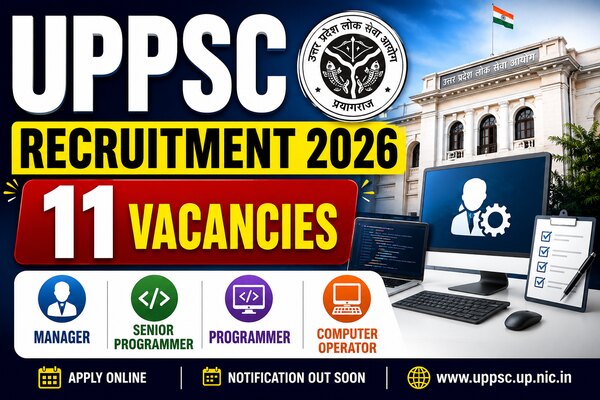
Uttar Pradesh Public service commission Recruitment 2026: Uttar Pradesh Public service commission (UPPSC) has recently announced a recruitment drive for the position of Manager (System) / Senior Programmer / Programmer Grade-2 / Computer Operator Grade-B.This recruitment is set to fill 11 posts.
Department: Uttar Pradesh Public service commission (UPPSC)
Posts: Manager (System) / Senior Programmer / Programmer Grade-2 / Computer Operator Grade-B.
Total posts: 11
Eligibility: Degree with Diploma in Computer Application / Bachelor’s degree / Post graduate
Age Limit: 21 to 40 Years
Last date: 03 sept 2026
Apply Fee: Rs. 25 to Rs. 225/-
Salary: Rs 20,200 to 1,42,400/-
Job Location: Uttar Pradesh
Apply Mode: Online
Note: – If you have any query regarding selection process then you must see the notification and read carefully.
UPPSC Vacancy Details:
Total Vacancy:
Name of post: Manager (System) / Senior Programmer / Programmer Grade-2 / Computer Operator Grade-B.
——
UPPSC Eligibility Criteria:
1. Manager(System) (Industrial development department): Degree in ComputerApplication.
2. Senior Programmer (Industrial development department): Degree with Diploma in Computer Application.
3. Programmer Grade-2 (Directorate of financial Planning and resources department):
(i) Bachelor’s degree from a University established by law in India or a qualification recognised by the Government as equivalent thereto.
(ii) Post graduate Diploma in Computer Science from a recognised Institute/ University; or ‘A’ level Certificate from the Department of Electronic.), Government of India.
(iii) Good knowledge of Software development like C/C- Fox Pro, RDVMS as Oracle/Ingress/Sybase, DB/Z etc. in DOS/ Unix/Windows environment.
(iv) Exposure to environment of any Networking Operative System.
(v) Complete knowledge of Office Automation Packages and Internet.
4. Computer Operator Grade-B (Uttar Pradesh Public Service Commission):
(i) Bachelordegree with diploma in Computer Science or Bachelor degree with O certificate from D.O.E.
(ii) Knowledge of Data Entry in Hindi and English on various softwares as M.S. Office/Lotus/Smart suit etc in D base/Unix/windows.
(iii) Knowledge of exposure of networking on Noval and window N.T. (iv) 25 and 40 words per minute speed of typewriting in Hindi and English.
—–
Age Limit: 21 to 40 Years
Reservation: The reservation for Scheduled Castes of U.P./ Scheduled Tribes of U.P / Other Backward Class candidates of U.P./ Economically Weaker Section candidates of U.P. shall be admissible in accordance with the provisions of relevant Govt. Rules. Similarly, reservation for horizontal categories as Dependents of Freedom Fighters of UP, Female candidates, Ex-Servicemen of U.P. and PH. of U.P. shall be admissible on settlement of vacancies 85 perrules. Reservation for PH. of U.P. shall be permissible for
the notified / identified Posts.
UPPSC Application fee: Rs. 25 to Rs. 225/-
Syllabus:
Syllabus for Manager (System):
Subject : Computer Application
1. Computer Fundamentals & Computer Organisation: Classification of computers, Elements of Computer Processing System, Hardware, Software, CPU, Peripherals, Storage Media, General organization of a digital computer, Data Representation, fixed and floating point decimal arithmetic, Bit slice microprocessor, Adders & its types, Generators & its types, multiplication and division circuits, an arithmetic unit, Instruction cycle, Instruction sequencing, formats and its interpretation, micro program concepts and control unit design. Semiconductor memory and memory organization, virtual memory, segments, pages, paged segments, cache memory and interleaved memory. Concepts of ॥0 organization, data transfer methods, programmed I/O, DMA, interrupt-based transfer, ॥0 channels, ॥0 processors, serial transmission and synchronization.
2. Data Structure & Algorithms: Algorithm Complexity, Data structure and its Types, Array, Representation and Analysis, Single and Multidimensional Arrays and its Application, Ordered List, Sparse Matrices and Vectors, Representation and Implementation of Singly lists, Two way Header list, Traversing and Searching of Linked List, Overflow and Underflow, Insertion and deletion to / from Linked Lists, Doubly linked list, Linked List in Array, Polynomial representation and addition, Garbage Collection and Compaction. Stacks, Queues, Array Representation and Implementation of tack, Operations on Stacks : Push & Pop, Array and Linked representation and implementation of Queues, Operations on Queue: Create, add, Delete, Full and Empty, Circular queue, De-queue and Priority Queue. Recursion, Principles of Recursion, Tower of Hanoi Problem, Simulating Recursion, Backtracking Recursive algorithms, tail Recursion, Removal of Recursion. Tree representation evaluation and Traversel, Binary tree representation, Algebraic Expressions, Complete Binary Tree, Extended Binary Tree, Array and Linked Representation of Binary trees, Threaded Binary trees, Traversing Threaded Binary trees, Huffman algorithm. Sequential search, Binary search, comparison and analysis, Hash Table, Hash Functions, Collision Resolution Strategies, Hash Table Implementation.
3. Programming languages: Concepts and Application of C, C++, Java, Python, Free and Open Source Software.
4. Database Management System: Data independence, Architecture for a Database system. Storage structures, Relational approach, Hierarchical approach, Network and Distributed Approach. Relations, Domains and attributes, Keys, Extensions and Intentions, Relational Algebra, Set operations, Relational operations, Relational calculus. Normal Forms, Functional Dependency, 1NF, 2NF, 3NF and BCNF. SQL, Query and Optimizer, Security, Concurrency and Recovery.
5. Operating Systems: Functions, Multiprogramming, Multiprocessing & Multitasking, Processes, Threads, Memory Management, Virtual memory, Paging, Fragmentation, Mutual exclusion, Critical regions. CPU scheduling, /0 scheduling, Scheduling algorithms, Deadlock avoidance & prevention; UNIX/LINUX: Structure & Commands, Interfacing, Editors & Compilers, LEX & YACC, File system, Systemcalls, Filters, Shell programming.
6. Data Communication and Computer Networks: Communication channels, Measure of information, Source coding techniques like Huffman code, Block Code & Cyclic Redundancy codes. Modulations and Demodulations, Networks structure and architecture, OSI Model, Topology, Transmission media, Switching, Multiplexing, ClientServer model, standards, FDDI, TCP/IP Model, Integrated services digital networks, Multipoint Protocol Layer Switching (MPLS). Physical Layer, Data Link Layer, Network Layer, Routing algorithms, Congestion control algorithms. Internetworking, IP addressing, Subnetting, IPv4. Transport Layer, Application layer, Compression Techniques, IPv6, DNS System. Security Concepts-Attacks, Services & Mechanisms, Cipher Principles and Cryptography.
7. Artificial Intelligence: Intelligent agents, Structure of agents and its ‘functions, Problem spaces and search, Heuristic Search techniques- Best first search, Problem reduction, Constraint satisfaction, Means Ends Analysis. Knowledge Representation: Approaches and issues in knowledge representation, Knowledge Based Agent, Propositional Logic, Predicate logic – Unification and Resolution.
8. Introduction to RMI (Remote Method Invocation): Client-server application using RMIL. Java Servlet, ServletAP], Life Cycle of a Servlet, Running Servlet, Debugging Servlets, Thread-safe Servlets, HTTP Redirects, Cookies, Java Server pages (JSP), HTML, URL, FTP, HTTP,PHPandASP.net.
9. System Security: Authentication, Service Electronic Mail Security, Web Security: Secure Socket Layer Security, Secure Electronic Transaction (SET). System Security: Intruders, Viruses, Firewall Design Principles. Internet: Basics, Various types of internet connections, ISP, Mail Services concepts, Voice and Video Conferencing, Web Browsers and Web Servers, VPN, Voice Over Internet Protocol (VOIP).
10. Software Engineering and MIS: Importance of Software and its characteristics, Software Development Life Cycle, Software Process. Software Requirement Specification, Water Fall Model, The Incremental Model, Prototyping, Spiral Model, Role of management in software development, Role of metrics and Measurement, Problem analysis, Requirement specification, Monitoring and Control, Software design principles, Abstraction, ohesiveness, Coupling, Software testing, Verification & validation, Software Project Management, Software Quality and Reliability, Concepts of MIS and ERP.
11. Advanced Computing: Basics Concepts of Mobile Computing, Cloud Computing,Grid Computing, Big Data, Internet of Things and Machine Learning.
Syllabus For Senior Programmar
Subject: Computer Application
1. Computer Fundamental and Computer Organization :
(a) Computer Fundamentals: Definition and Characteristics, Types, Components, Hardware, Software, Operating Systems and Utilities.
(b) Computer Organization: Number systems, Instruction Codes, Instruction Cycle, Addressing Modes, Data Transfer and Manipulation, Complex Instruction Set Computer (CISC)and Reduced Instruction set Computer (RISC).
2. Data Structure: Basics of Data Structures, Stack Operations, Array and Linked Representation of Stack, Stack Application, Queue Operations and their Array and Linked Representation, Basics of Search Trees.
3. DBMS: Basics of Data Base Management Systems, Data Models, ER Diagram, ExposuretoMSAccess, Oracle, MY SQL, SQL Server.
4. Programming Languages: Programming Concepts, Knowledge of C, C++, Java and Python programming and their Applications.
5. Network: Definition, Types (LAN, WAN, MAN) and Network Components, OSI, TCP/IP, Connection Oriented Network, Wireless Communication, Intranet, Internet (Services and Applications), Web Browsers and Email.
6. Web Technology: Fundamentals of Web Technology, Basic knowledge of HTML, XML, PHPand Java Script.
7. Software Engineering: The Evolving Role of Software, Changing Nature of Software, Software Development Life Cycle, Requirement Engineering Process, Knowledge of Testing Technique and Testing Tools, Debugging, Software Quality and Metrics.
8. Cyber Law and Security Policy: Cyber Crime, Forgery, Hacking, Software Privacy, Data Fraud, Phishing and Identity Theft, Web Security, Email Security, Social Media Security, ITAct.
9. Windows/Unix/Linux: Understanding Operating Systems, Its Features and applications, Working with Windows firewall, Windows firewall with Advanced Security, Password Security, Antivirus Security, Knowledge of Unix/Linux Commands.
10. Document Preparations: Working Knowledge of Office Suite.
Syllabus For Programmar Grade-2
Subject: Computer Application
1. Operating System
Fundamentals of Operating System: Basics of Operating System, Types, Functions and Services of Operating Systems, System Calls, Interface, Interrupts. Process: Process Management, Process Control Block, Process States, Threads, Scheduling, Spooling, Scheduling Algorithms and their Evaluation, Process Synchronization, Inter-process Communication, Concurrent Execution, Race Condition, Mutual Exclusion, Bounded Waiting, * Semaphores, Hardware Synchronization, Classical Problems of Synchronization (Readers-Writers, Dining Philosophers) Deadlock: Infroduction of Deadlocks, Deadlock Characteristics, Deadlock Prevention, Detection andAvoidance, Wait-for-Graph, Banker’s Algorithm, Safe Condition, Deadlock Recovery Memory Management: Basics of Memory Management, Static Allocation, Dynamic Allocation, Swapping, Compaction, Contiguous Vs. Non-Contiguous Allocation, Paging.
How to apply: Online
UPPCS Recruitment 2026 Important Dates:
Starting date for online application: 03 august 2026
Last date for online application: 03 sept 2026
Last date for payment of fee: 10 sept 2026
Click here for Recruitment Notification
Click here for Online Application
About: Uttar Pradesh Public Service Commission (UPPSC)
The Uttar Pradesh Public Service Commission (UPPSC) is the state-level public service commission responsible for conducting competitive examinations and recruitment for various posts and services under the Government of Uttar Pradesh. The Commission conducts examinations such as the Combined State/Upper Subordinate Services (PCS) Examination along with recruitment examinations for various departmental posts.