
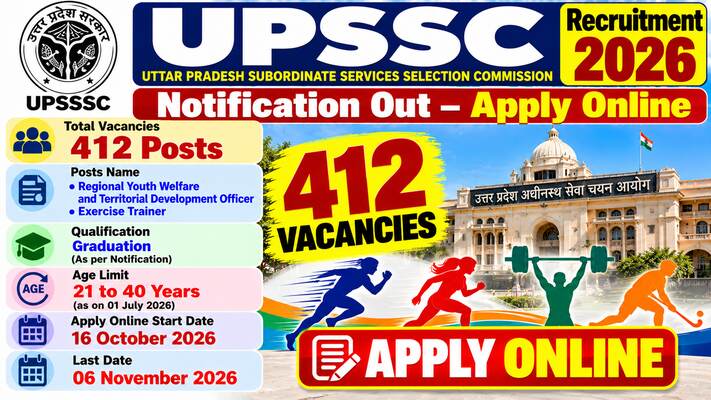
UPSSSC Recruitment 2026: The Uttar Pradesh Subordinate Services Selection Commission (UPSSSC), Lucknow, has announced recruitment for 412 posts of Regional Youth Welfare and Territorial Development Officer and Exercise Trainer under Advertisement No. 23-Examination/2026.
Department: Directorate General of Youth Welfare and Provincial Guards, Uttar Pradesh
Posts: Regional Youth Welfare and Territorial Development Officer and Exercise Trainer
Total posts: 412
Eligibility: Graduation; Exercise Trainer candidates must also possess the prescribed D.P.Ed./B.P.Ed. or equivalent qualification.
Age Limit: 21 to 40 years as on 01 July 2026, subject to applicable relaxation rules.
Last date: 06 November 2026
Apply Fee: ₹25 online application processing fee; category-wise conditions apply.
Salary: Pay Level-5 (₹29,200–₹92,300) and Level-6 (₹35,400–₹1,12,400), depending on the post.
Job Location: Uttar Pradesh
Apply Mode: Online
UPSSSC Vacancy Details:
Total Vacancy: 412 Posts
Name of posts:
1. Regional Youth Welfare and Territorial Development Officer (Special Selection): 142 Posts
2. Regional Youth Welfare and Territorial Development Officer (General Selection): 226 Posts
3. Exercise Trainer (Special Selection): 22 Posts
4. Exercise Trainer (General Selection): 22 Posts
Post-wise Salary:
Regional Youth Welfare and Territorial Development Officer:
Pay Level: Level-5
Pay Scale: ₹29,200–₹92,300
Exercise Trainer:
Pay Level: Level-6
Pay Scale: ₹35,400–₹1,12,400
Category-wise and Horizontal Reservation:
– The notification provides category-wise reservation for UR, SC, ST, OBC and EWS candidates.
– Horizontal reservation provisions apply to eligible dependents of freedom fighters, ex-servicemen, persons with disabilities, women and outstanding sportspersons, as prescribed.
– The detailed category-wise distribution is given in the official vacancy tables on pages 7–8 of the notification.
– The total vacancies and category-wise distribution may change according to applicable government reservation rules and departmental requirements.
UPSSSC Eligibility Criteria:
Educational Criteria:
1. Regional Youth Welfare and Territorial Development Officer:
– A Bachelor’s degree from a university established by law in India or an equivalent qualification recognized by the Government.
– Preferred qualifications, where applicable, include:
– B.P.Ed./D.P.Ed. from a recognized university or institution.
– Three years of service as a Block Commander, Halka Sardar or Dalpati in the organization.
– At least two years of service in the Territorial Army.
– National Cadet Corps (NCC) ‘B’ Certificate.
2. Exercise Trainer:
– A Bachelor’s degree from a university established by law in India or an equivalent qualification recognized by the Government.
– D.P.Ed./B.P.Ed. from a recognized university or institution, or an equivalent qualification recognized by the Government.
– B.P.E. or a Bachelor’s degree in Physical Education may be accepted as an equivalent qualification where applicable under the relevant government orders.
Preferred Qualifications for Exercise Trainer:
– A coaching diploma in the relevant discipline from Netaji Subhas National Institute of Sports (NIS), Patiala, Bengaluru, Kolkata, Lakshmibai National Institute of Physical Education, or another institution approved by the Government of India.
– M.P.Ed. from a recognized university or institution.
– At least two years of service in the Territorial Army.
– National Cadet Corps (NCC) ‘B’ Certificate.
Important Eligibility Conditions:
– Candidates must possess the prescribed essential qualifications by the last date of application.
– Candidates must have appeared in the Preliminary Eligibility Test (PET-2025) and must have been issued a PET-2025 scorecard by UPSSSC.
– Shortlisting for the Main Examination will be based on PET-2025 normalized scores.
– Candidates with zero or negative marks in the actual or normalized PET-2025 score will not be shortlisted for the Main Examination.
– Candidates provisionally marked as Under Investigation (UI) or Provisional in PET-2025 may be permitted to apply provisionally, subject to the Commission’s final decision.
– Candidates must select the relevant post or posts for which they possess the required qualifications.
– Preferred qualifications will be considered according to the applicable recruitment rules.
Age Limit:
Minimum Age: 21 Years
Maximum Age: 40 Years
Age calculated as on: 01 July 2026
Age Relaxation:
– SC/ST candidates: Relaxation as per applicable Uttar Pradesh Government rules.
– OBC candidates: Relaxation as per applicable Uttar Pradesh Government rules.
– Persons with Disabilities (PwD): Relaxation and reservation as per applicable rules.
– Ex-Servicemen: Relaxation and reservation as per applicable rules.
– State Government employees: Up to 5 years of age relaxation, subject to the prescribed conditions.
– Other eligible categories: Relaxation according to applicable government orders.
UPSSSC Application Fee:
– General/UR candidates: ₹25/-
– EWS candidates: ₹25/-
– OBC candidates: ₹25/-
– SC candidates: ₹25/-
– ST candidates: ₹25/-
Salary / Pay Scale:
Regional Youth Welfare and Territorial Development Officer:
Pay Level: Level-5
Pay Scale: ₹29,200–₹92,300
Exercise Trainer:
Pay Level: Level-6
Pay Scale: ₹35,400–₹1,12,400
The actual salary and admissible allowances will depend on the applicable pay rules and the post to which the candidate is appointed.
Selection Process:
1. Shortlisting based on PET-2025 normalized scores
2. Main Written Examination
3. Physical Measurement Test
4. Physical Eligibility Test
5. Preparation of Merit List based on written examination marks
6. Document Verification and other appointment formalities, as applicable
Important Selection Conditions:
– Only candidates shortlisted on the basis of PET-2025 normalized scores will be permitted to participate in the Main Examination.
– Candidates with zero or negative actual or normalized PET-2025 scores will not be shortlisted.
– The notification provides for shortlisting approximately 15 times the advertised vacancies category-wise, including candidates tied at the final cutoff normalized score.
– The written examination is the basis of selection.
– The Physical Measurement Test and Physical Eligibility Test are qualifying in nature.
– Candidates shortlisted on the basis of written examination marks must pass the prescribed physical tests.
– The merit list will be prepared based on written examination marks for candidates who qualify in the required physical tests.
– Candidates must fulfill all applicable educational, age, reservation and physical eligibility requirements.
Physical Measurement Test:
1. Regional Youth Welfare and Territorial Development Officer and Exercise Trainer:
Male Candidates:
Height:
– Scheduled Tribe candidates: Minimum 160 cm.
– Other candidates: Minimum 167.7 cm.
Chest:
– Scheduled Tribe candidates: 76.5 cm without expansion and 81.3 cm after expansion.
– Other candidates: 78.8 cm without expansion and 83.8 cm after expansion.
Female Candidates:
Height:
– Scheduled Tribe candidates: Minimum 147 cm.
– Other candidates: Minimum 152 cm.
The notification specifies the above minimum physical standards. Candidates should refer to the official notification for all applicable physical measurement conditions.
Physical Eligibility Test:
A. Regional Youth Welfare and Territorial Development Officer:
Male Candidates:
1. 200-Metre Race:
– 30 seconds: 10 marks
– 28 seconds: 15 marks
– 26 seconds: 20 marks
– 24 seconds: 25 marks
2. Long Jump:
– 3.50 metres: 10 marks
– 4.00 metres: 15 marks
– 4.50 metres: 20 marks
– 5.00 metres: 25 marks
3. High Jump:
– 1.05 metres: 10 marks
– 1.20 metres: 15 marks
– 1.35 metres: 20 marks
– 1.50 metres: 25 marks
4. Shot Put:
– 6.00 metres: 10 marks
– 7.00 metres: 15 marks
– 8.00 metres: 20 marks
– 9.00 metres: 25 marks
Female Candidates:
1. 200-Metre Race:
– 34 seconds: 10 marks
– 32 seconds: 15 marks
– 30 seconds: 20 marks
– 28 seconds: 25 marks
2. Long Jump:
– 3.00 metres: 10 marks
– 3.50 metres: 15 marks
– 4.00 metres: 20 marks
– 4.50 metres: 25 marks
3. High Jump:
– 1.20 metres: 10 marks
– 1.30 metres: 15 marks
– 1.35 metres: 20 marks
– 1.40 metres: 25 marks
4. Skipping Rope:
– 55 jumps: 10 marks
– 60 jumps: 15 marks
– 65 jumps: 20 marks
– 70 jumps: 25 marks
Qualifying Conditions:
– Candidates who obtain at least 45 marks across all four events will be considered successful.
– Candidates who participate in only three events and obtain 45 marks or more may also be considered successful.
– The Physical Measurement Test and Physical Eligibility Test are qualifying in nature.
B. Exercise Trainer:
Male Candidates:
1. Indian Exercise:
– Mallakhamb: 25 marks
– Asana: 25 marks
– Mugdar: 25 marks
– Candidates must obtain at least 50 marks across the three events.
2. Gymnastics:
– Parallel Bar: 25 marks
– Horizontal Bar: 25 marks
– Vaulting Horse: 25 marks
– Pommel Horse: 25 marks
– Floor Exercise: 25 marks
– Candidates must obtain at least 75 marks across the five events.
Female Candidates:
1. Indian Exercise:
– Mallakhamb Rope: 25 marks
– Asana: 25 marks
– Mugdar: 25 marks
– Candidates must obtain at least 40 marks across the three events.
2. Gymnastics:
– Parallel Bar: 25 marks
– Horizontal Bar: 25 marks
– Balancing Beam: 25 marks
– Uneven Bars: 25 marks
– Candidates must obtain at least 65 marks across the four events.
Important Note:
The Physical Eligibility Test is qualifying in nature. The written examination marks determine the merit list among candidates who qualify in the prescribed physical tests.
Exam Pattern:
Examination Name: Main Written Examination
Mode of Examination: Objective-Type Multiple Choice Questions
Total Questions: 100
Total Marks: 100
Total Duration: 2 Hours (120 Minutes)
Negative Marking: 1/4 mark for each wrong answer.
Subject-wise Exam Pattern:
Part-1: General Studies
1. History of India and Indian National Movement
Questions: 5
Marks: 5
2. Indian Polity and Indian Constitution
Questions: 10
Marks: 10
3. Geography of India and World
Questions: 5
Marks: 5
4. Indian Economy and Social Development
Questions: 5
Marks: 5
5. Knowledge Related to Road Safety
Questions: 5
Marks: 5
6. Current Events of National and International Importance
Questions: 5
Marks: 5
7. Sports in India
Questions: 5
Marks: 5
8. Human Anatomy
Questions: 5
Marks: 5
9. Environmental Ecology and Disaster Management
Questions: 10
Marks: 10
10. Data Interpretation
Questions: 10
Marks: 10
Part-2: Computer and Information Technology
Knowledge of Concepts of Computer and Information Technology and Contemporary Technological Development and Innovation:
Questions: 15
Marks: 15
Part-3: General Information Related to Uttar Pradesh
Questions: 20
Marks: 20
Total Questions: 100
Total Marks: 100
Duration: 120 Minutes
Important Exam Instructions:
– Each question carries one mark.
– A negative mark of 1/4 mark will be deducted for every incorrect answer.
– The examination will consist of one objective-type multiple-choice question paper.
– The Main Examination date will be announced separately by the Commission.
– Candidates must follow the instructions printed on the admit card and issued by UPSSSC.
Syllabus:
Part-1: General Studies
1. History of India and Indian National Movement:
– Social, cultural, economic and political aspects of Indian history.
– Indian freedom movement.
– Rise of nationalism and attainment of independence.
2. Indian Polity and Indian Constitution:
– Constitutional development in India.
– Indian Constitution.
– Indian political system and governance.
– Panchayati Raj and local self-government.
– Public policy, official issues and community development.
3. Geography of India and World:
– Physical, social and economic geography of India.
– Agriculture, horticulture, forestry and animal husbandry.
– Population and urbanization patterns.
– Smart cities and smart villages.
– General information about world geography.
4. Indian Economy and Social Development:
– Economic planning, objectives and achievements.
– Role of NITI Aayog.
– Sustainable Development Goals (SDGs).
– Government budget and financial system.
– Agriculture, industry, trade and commerce in India.
– Land reforms after independence.
– Globalization and liberalization.
– Changes in industrial policy and their impact.
– Infrastructure, including energy, ports, roads, airports and railways.
5. Knowledge Related to Road Safety:
– Concept of road safety and types of roads.
– Prescribed speed limits and effects of speed violations.
– Responsibilities of road construction agencies, education departments and medical departments.
– Lane driving, traffic indicators and traffic signals.
– Effects of overloading goods vehicles.
– Government measures to reduce road accidents.
– Provisions of the Motor Vehicles Act.
– Measures to reduce loss of life and property after road accidents.
– Duties of drivers and ordinary citizens in road accidents.
– Good Samaritan concept and rights.
– Supreme Court Committee on Road Safety.
6. Current Events of National and International Importance:
– Recent national and international events.
7. Sports in India:
– Rules and general information about athletics, judo, kabaddi, volleyball, badminton, wrestling, weightlifting, football, swimming, kho-kho and other sports.
– Efforts and achievements in promoting sports in India.
8. Human Anatomy:
– Cells, tissues, organs and organ systems.
– Bones, muscles, nerves and blood vessels.
– Basic structure and functions of the organs of taste, smell, hearing, sight and touch.
9. Environmental Ecology and Disaster Management:
– Environmental protection and ecosystems.
– Wildlife conservation and biodiversity.
– Environmental pollution and degradation.
– Environmental impact assessment and climate change.
– Disaster mitigation and management in India.
– Disaster Management Act, 2005.
– National Disaster Management Authority (NDMA).
– State Disaster Management Authority (SDMA).
– National Disaster Response Force (NDRF).
– State Disaster Response Force (SDRF).
– Agencies working in disaster management.
– Global efforts and achievements in disaster mitigation and management.
10. Data Interpretation:
– Interpretation and analysis of data.
– Statistical analysis.
– Graphs and diagrams.
– Drawing conclusions from statistical and graphical information.
Part-2: Computer and Information Technology
– History, introduction and applications of computers, information technology, the Internet and World Wide Web (WWW).
– Hardware and software.
– Input and output devices.
– Internet protocols and IP addresses.
– IT gadgets and their applications.
– Creation and use of email IDs.
– Operation of printers, tablets and mobile devices.
– Important elements of MS Word and MS Excel.
– Operating systems.
– Social networking and e-governance.
– Digital financial tools and applications.
– Future skills and cybersecurity.
– Contemporary technological developments and innovations.
– Artificial Intelligence, Big Data Processing, Deep Learning, Machine Learning and the Internet of Things.
– India’s achievements in these fields.
Part-3: General Information Related to Uttar Pradesh
– History of Uttar Pradesh.
– Culture, art and architecture.
– Festivals, folk dances, literature and regional languages.
– Heritage, social customs and tourism.
– Geography, environment and natural resources.
– Climate, soil, forests, wildlife, mines and minerals.
– Economy, agriculture, industry, business and employment.
– Polity and administration.
– Current affairs and achievements of Uttar Pradesh in various fields.
How to apply: Online
UPSSSC Recruitment 2026 Important Dates:
Date of Advertisement: 30 September 2026
Starting Date for Online Registration/Application: 16 October 2026
Last Date for Online Application: 06 November 2026
Last Date for Fee Payment and Application Submission: 06 November 2026
Last Date for Fee Reconciliation: Within the prescribed additional period, as stated in the notification.
Last Date for Application Correction: 13 November 2026
Click here for Official Notification
About: The Uttar Pradesh Subordinate Services Selection Commission (UPSSSC), Lucknow, conducts recruitment examinations for various Group C posts under the Government of Uttar Pradesh. Under Advertisement No. 23-Examination/2026, the Commission has invited online applications from eligible candidates for the Main Examination for 412 posts of Regional Youth Welfare and Territorial Development Officer and Exercise Trainer under the Directorate General of Youth Welfare and Provincial Guards, Uttar Pradesh.