This is the current affairs 7 to 11 August 2026. Here are questions and answers of daily current affairs for better preparation of competitive exams for government jobs.
1. According to the 16th National Assessment, what is the total number of Asiatic Lions recorded in India in the year 2025?
a. 891
b. 896
c. 791
d. 991
Answer: a. 891
– The government released the data on 10 August 2026 on the occasion of World Lion Day.
– In India, the Asiatic Lion species is mainly found in the Gir and Greater Gir areas of Gujarat.
– Its range has increased from approximately 30,000 square kilometres in 2020 to approximately 35,000 square kilometres.
– The 16th assessment of the Asiatic Lion population was conducted from 10 to 13 May 2025 in 11 districts of Gujarat.
– The direct beat verification method was used in this assessment.
– A total of 891 Asiatic Lions were recorded in the 2025 census.
– 674 lions were counted in 2020.
– Out of the 891 lions counted in 2025, 330 are adult females.
– This means that the number of Asiatic Lions increased by approximately 70.36%.
Census conducted for conservation
– Project Lion was launched on 15 August 2020 for the conservation of the Asiatic Lion.
– The project includes disease surveillance, veterinary support, habitat improvement and landscape management.
– These measures are related to the conservation of the species in Gir and Greater Gir.
Asiatic Lion
– It is a subspecies of lion scientifically known as Panthera leo persica.
– Its only natural wild population is found in India, mainly in the Saurashtra region of Gujarat.
– The species is listed as Endangered on the IUCN Red List.
—- Question for the Prelims Exam —-
Q. Consider the following statements regarding Asiatic Lions in India:
1) The only natural wild population of Asiatic Lions in India is found in the Saurashtra (Gir and Greater Gir) region of Gujarat.
2) According to the 16th National Assessment (2025), the total number of Asiatic Lions in India increased to 891, compared to 674 in 2020.
3) Project Lion was launched on 15 August 2020 for the conservation of Asiatic Lions.
Which of the above statements are correct?
(a) Only 1 and 2
(b) Only 2 and 3
(c) Only 1 and 3
(d) 1, 2 and 3
Answer: (d) 1, 2 and 3
Explanation:
– Statement 1 is correct: Asiatic Lions are naturally found only in Saurashtra (Gir and Greater Gir) in Gujarat.
– Statement 2 is correct: Compared to 674 lions in 2020, the number recorded in 2025 was 891 (including 330 adult females).
– Statement 3 is correct: Project Lion was announced on 15 August 2020, under which disease control, habitat improvement and landscape management are being carried out in the Gir region.
————–
2. When is World Lion Day celebrated?
a. 8 August
b. 10 August
c. 12 August
d. 15 August
Answer: b. 10 August
– Theme of 2026: “Safe Habitats, Thriving Wildlife: Coexisting for Lion Conservation”.
– This day was started in 2013 by Big Cat Rescue and other organizations.
– Objective: To promote awareness among people about lion conservation and their declining population and to encourage efforts to protect their natural habitats.
————–
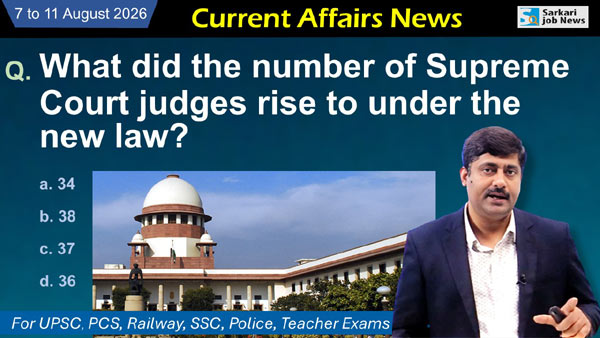
3. The Lok Sabha passed the Supreme Court Amendment Bill, 2026; under this, the number of judges was increased to how many?
a. 34
b. 38
c. 37
d. 36
Answer: b. 38
– Parliament has increased the total sanctioned strength of judges in the Supreme Court from 34 to 38.
– This Bill replaces the ordinance under which the sanctioned strength of judges in the Supreme Court had been increased from 34 to 38, including the Chief Justice of India (CJI).
Why did the government issue the ordinance?
– The Union Cabinet approved the proposal in May 2026, when Parliament was not in session.
– After this, the government issued an ordinance under Article 123 of the Constitution, through which the increase in the number of sanctioned seats came into effect immediately.
– This is the first increase in the number of judges since 2019, when Parliament increased the sanctioned strength from 31 to 34.
Why was this increase made?
– Union Law Minister Arjun Ram Meghwal said that the objective of increasing the sanctioned strength of judges in the Supreme Court is to enable the court to deal with its increasing workload and provide speedy justice.
– With more than approximately 92,000 cases pending in the apex court, additional judges were required for the speedy disposal of cases.
– As of 1 January 2026, 92,101 cases were pending in the Court.
– In 2025, the Court received 75,410 new cases, but despite functioning at full sanctioned capacity, it could dispose of only 65,615 cases.
– According to the government, the continuing gap between institutional capacity and case disposal made it necessary to increase the number of judges.
How will the additional judges help?
– The government says that this increase will help the Supreme Court hear more cases simultaneously, thereby improving the rate of case disposal.
– One argument in favour of appointing additional judges is that it will make it easier for the Chief Justice of India to constitute Constitution Benches on a regular basis.
When has the sanctioned strength of judges been increased?
– The Supreme Court started functioning in 1950 with eight judges, including the Chief Justice of India.
– Increased to 11 in 1956
– 14 in 1960
– 18 in 1978
– 26 in 1986
– 31 in 2009
– 34 in 2019, and
– Now, under the 2026 amendment, it has been increased to 38 (including the Chief Justice).
—- Question for the Prelims Exam —-
Q. Consider the following statements regarding the ‘Supreme Court (Number of Judges) Amendment Act, 2026’:
1) Under this Act, the total sanctioned strength of judges in the Supreme Court, including the CJI, has been increased to 38.
2) Under Article 124 of the Constitution, Parliament has the power to alter the number of judges of the Supreme Court by making a law.
Which of the above statements is/are correct?
(a) Only 1 and 2
(b) Only 2 and 3
(c) Only 1
(d) None of these
Answer: (a) Only 1 and 2
Explanation:
– Statement 1 is correct: Under the 2026 amendment, the total sanctioned strength of judges in the Supreme Court has been increased from 34 to 38 (1 CJI + 37 other judges).
– Statement 2 is correct: Under Article 124(1) of the Constitution, Parliament has the power to determine or modify the number of judges of the Supreme Court by making a law.
————-
4. Which private company’s rocket, ‘Vikram-1’, successfully completed India’s first private orbital launch from ISRO’s ‘Satish Dhawan Space Centre’?
a. Skyroot Aerospace
b. Agnikul Cosmos
c. Bellatrix Aerospace
d. Dhruva Space
Answer: a. Skyroot Aerospace
– On 18 July 2026, India’s first privately developed orbital rocket, ‘Vikram-1’, was successfully launched from the Satish Dhawan Space Centre located at Sriharikota.
– Name of the mission: This historic launch was part of ‘Mission Aagaman’.
– Major achievement for India: With this success, India became the third country in the world (after the United States and China) to acquire Private Orbital Launch Capability.
Features of the Vikram-1 Rocket:
– Manufacturing company: This rocket has been manufactured by Hyderabad-based private space startup Skyroot Aerospace.
– Naming: It has been named in honour of Dr. Vikram Sarabhai, the father of the Indian space programme.
– Structure: It is a seven-storey (approximately 22 metres high), multi-stage orbital launch vehicle.
– Payload capacity: It has the capacity to carry up to 350 kg of payload into Low Earth Orbit (LEO).
– Main function: Its primary objective is to place small satellites into low Earth orbit.
Vikram-S was also sent in 2022
– Vikram-S was a sub-orbital rocket. Its purpose was not to place a satellite into Earth’s orbit, but to reach the edge of space (~89.5 km altitude) and test Skyroot Aerospace’s technologies, avionics and engines.
What is an ‘Orbital Launch’?
– When a rocket carries a satellite or payload into space at such a high speed (approximately 28,000 km/hour or 7.8 km/second) and altitude that it does not fall back to Earth due to Earth’s gravity, but instead begins revolving around Earth in a permanent orbit, it is called an orbital launch.
Launch pad became active after 187 days
– With this successful launch on 18 July 2026, this launch pad of the Satish Dhawan Space Centre became active again after a long gap of 187 days.
– Previous launch (12 January 2026): Before this, the last launch from this spaceport was on 12 January 2026 as the PSLV-C62 mission. It carried the EOS-N1 Earth observation satellite, but the mission could not be completed successfully.
What did the Vikram-1 rocket carry?
– It successfully carried a total of 6 satellites/payloads into Low Earth Orbit (~450 km LEO).
—- Question for the Prelims Exam —-
Q. Consider the following statements regarding India’s first private orbital launch ‘Mission Aagaman’:
1) Under this mission, the rocket ‘Vikram-1’, manufactured by Hyderabad-based private startup ‘Skyroot Aerospace’, was successfully launched.
2) With this successful launch, India became the first country in the world to acquire Private Orbital Launch Capability.
3) ‘Vikram-1’ is a sub-orbital rocket whose main objective is only to reach the edge of space (~89.5 km) and test engines, and not to place satellites into orbit.
Which of the above statements is/are correct?
(a) Only 1
(b) Only 1 and 2
(c) Only 2 and 3
(d) 1, 2 and 3
Answer: (a) Only 1
Explanation:
– Statement 1 is correct: On 18 July 2026, the seven-storey ‘Vikram-1’ rocket developed by Skyroot Aerospace achieved success from the Satish Dhawan Space Centre under ‘Mission Aagaman’.
– Statement 2 is incorrect: India became the third country in the world (after the United States and China) to achieve this feat, not the first.
– Statement 3 is incorrect: ‘Vikram-1’ is an orbital launch vehicle that successfully placed 6 satellites into Low Earth Orbit (LEO). (The sub-orbital rocket was ‘Vikram-S’, which was sent in 2022 under ‘Mission Prarambh’ only for testing.)
————-
5. For how many years did the Union Cabinet approve the extension of the Pradhan Mantri Kisan Samman Nidhi (PM-KISAN) scheme?
a. One year
b. Two years
c. Five years
d. Four years
c. Five years (extended up to 2030-31)
– The Union Cabinet has approved the extension of the PM-KISAN scheme for five years from 2026-27 to 2030-31.
– Information and Broadcasting Minister Ashwini Vaishnaw said that the Cabinet approved an allocation of ₹3,15,614 crore for the extension.
This is the scheme
– Eligible farmer families will continue to receive ₹6,000 per year in three equal instalments (₹2,000 each).
– This money is sent directly to Aadhaar-linked bank accounts through Direct Benefit Transfer (DBT).
– So far, more than ₹4.47 lakh crore has been transferred to farmers’ accounts through 23 instalments of the scheme.
————-
6. In which country did more than 1,700 people die due to the Ebola virus outbreak?
a. Guinea
b. Gabon
c. Tanzania
d. DRC Congo
Answer: d. DRC Congo
– As of August 2026, 3,802 cases of Ebola had been recorded in Congo, including 1,707 deaths.
– This disease was declared an epidemic on 15 May 2026.
– The disease is caused by the Bundibugyo strain of the Ebola virus, for which no approved vaccine or treatment is currently available.
– 90% of the cases of this disease have been reported in Ituri Province of eastern Congo.
– Neighbouring Uganda had declared itself Ebola-free in mid-June after the country’s last patient was discharged from the hospital.
Disease spread in West Africa in 2014-2016
– During 2014-2016, Ebola spread in West African countries, mainly Guinea, Liberia and Sierra Leone.
– At that time, more than 28,000 cases and more than 11,000 deaths were recorded.
What is Ebola Virus Disease (EVD)?
– Nature: It is a severe infectious and fatal viral haemorrhagic fever (viral haemorrhagic fever).
– Origin: The Ebola virus was first identified in 1976 in Congo (then Zaire), near the Ebola River, after which it was named.
– Natural host: Fruit bats are considered the natural host of the Ebola virus.
– Transmission: It is transmitted through direct contact with infected animals (such as bats, chimpanzees and gorillas). Among humans, it is transmitted through direct contact with body fluids such as blood, vomit, saliva, sweat or semen. It is not airborne.
– Symptoms: Sudden fever, weakness, asthma, headache, sore throat, followed by vomiting, diarrhoea, rash, and internal and external bleeding.
Bundibugyo strain of the virus
– The current outbreak is caused by the extremely rare ‘Bundibugyo virus’ (BVD) strain of Ebola. Historically, this is only the third time this strain has been detected.
– No vaccine or treatment (no approved vaccine): Globally, vaccines (such as Merck and J&J vaccines) are available for the ‘Zaire strain’ of Ebola, but currently there is no approved vaccine or specific therapeutic drug for the Bundibugyo strain.
– High mortality rate: The mortality rate of this disease can range from 30% to 90%. At present, there are more than 300 diagnostic cases and more than 88 diagnostic workers’ deaths, including health workers.
DRC Congo
– National capital: Kinshasa
– President: Félix Tshisekedi
– Prime Minister: Judith Suminwa
– Population: 116 million
– Currency: CFA Franc
– Language: Swahili
– Neighbouring countries: Uganda, Rwanda, Burundi and Tanzania.
—- Question for the Prelims Exam —-
Q. Consider the following statements regarding the Ebola virus outbreak in eastern Congo and the deaths caused by it:
1) More than 1,700 deaths have been recorded due to the Ebola virus outbreak in eastern Congo.
2) The main cause of this epidemic is the ‘Bundibugyo strain’ of Ebola, for which there is currently no approved vaccine or treatment available.
3) The Ebola virus spreads only through the air (Airborne), which causes it to spread very rapidly.
Which of the above statements is/are correct?
(a) Only 1 and 2
(b) Only 2 and 3
(c) Only 1 and 3
(d) 1, 2 and 3
Answer: (a) Only 1 and 2
Explanation:
– Statement 1 is correct: More than 1,700 people have died due to this outbreak in Ituri Province of eastern Congo, making it an extremely serious epidemic.
– Statement 2 is correct: This outbreak is caused by the rare ‘Bundibugyo strain’, for which there is currently no approved vaccine available.
– Statement 3 is incorrect: Ebola does not spread through the air (non-airborne); it spreads through direct contact with the body fluids (blood, saliva, sweat, etc.) of an infected person/animal.
————–
7. Which Indian won the Korea Masters 2026 women’s singles title?
a. Ashmita Chaliha
b. Seed Han Qian Xi
c. Tanvi Sharma
d. Park Tae-sang
a. Ashmita Chaliha
– Indian badminton player Ashmita Chaliha defeated China’s seeded Han Qian Xi in the final match held on 9 August 2026.
– 26-year-old Ashmita, a resident of Assam, won her first BWF World Tour title.
– Meanwhile, India won its second consecutive BWF World Tour final title.
– Earlier, India’s Tanvi Sharma had won the Taipei Open.
————–
8. Who became the first Indian to win a medal in the high jump at the World Athletics U20 Championships?
a. Atul Solanki
b. Basant Kumar Meghwal
c. Ambrish Karthikeyan
d. Shahnawaz Khan
Answer: b. Basant Kumar Meghwal
– Basant Kumar Meghwal won the silver medal in the men’s high jump with a personal best jump of 2.21 metres.
– 19-year-old Basant Meghwal from Rajasthan achieved the victory at the championship held in Oregon, United States, on 8 August 2026.
—————
9. Which Union Territory’s police force was awarded the ‘President’s Police Colour’ in August 2026?
a. Ladakh
b. Puducherry
c. Jammu and Kashmir
d. Chandigarh
Answer: b. Puducherry
– The ‘President’s Colour’ is the highest honour given to the military unit or police force of a state or Union Territory.
– Puducherry is the first Union Territory to receive this honour.
– So far, the police forces of 18 states of India have received this honour.
– Union Home Minister Amit Shah presented this honour to the Puducherry Police.
– On 9 August 2026, the prestigious colour was handed over to the Junior Commissioned Officers (JCOs) of the police force at a ceremony held at the Puducherry Armed Police Ground in Gorimedu.
– President Droupadi Murmu had announced this honour on 8 May 2026.
—————
10. Which Indian physicist was jointly awarded the 2026 Dirac Medal?
a. Deepak Dhar
b. Bernard Derrida
c. Amit Agrawal
d. Prof. Surhud More
Answer: a. Deepak Dhar (jointly awarded with France’s Bernard Derrida, France’s Marc Mézard, and Israel’s Haim Sompolinsky)
– Physicist Deepak Dhar was given this honour for his outstanding contributions to statistical mechanics.
– This honour was jointly awarded to Deepak Dhar, French physicist Bernard Derrida, Professor of Theoretical Physics at Bocconi University Marc Mézard, and Visiting Professor at Harvard University Haim Sompolinsky.
– The award was given on 8 August 2026 by the Abdus Salam International Centre for Theoretical Physics (ICTP) in Trieste, Italy.
– Deepak Dhar, a resident of Pratapgarh, Uttar Pradesh, obtained his bachelor’s degree from Allahabad University in 1970.
– He completed his MSc degree from IIT Kanpur in 1972.
– He obtained his PhD from the California Institute of Technology in 1978.
– He worked as a teaching assistant to Richard Feynman at Caltech.
– He is known for his research on the sandpile model.
– The sandpile model is a famous mathematical method in physics.
His honours
– Boltzmann Medal (2022): He became the first Indian to receive this award.
– Padma Bhushan (2023)
– Shanti Swarup Bhatnagar Award (1991): In the field of science and technology.
Dirac Medal
– The Dirac Medal was established by ICTP in 1985.
– It is awarded every year on 8 August, the birth anniversary of theoretical physicist Paul Dirac.
– Paul Dirac was one of the founders of quantum mechanics.
– A prize of US$5,000 is awarded along with the medal.
– It is not awarded to former Nobel Prize winners, Fields Medal winners or Wolf Prize winners.
—————
11. With which country, alongside Saudi Arabia, did Pakistan sign the ‘Makkah Joint Defence Pact’, under which an attack on one country would be considered an attack on all of them?
a. Türkiye
b. Iran
c. UAE
d. India
Answer: a. Türkiye
– Pakistan, Saudi Arabia and Türkiye signed a defence pact on 7 August 2026 to increase security cooperation.
– It is being called the ‘Makkah Joint Defence Pact’.
– It was signed in Makkah by Saudi Crown Prince Mohammed bin Salman, Turkish President Recep Tayyip Erdoğan and Pakistan Prime Minister Shehbaz Sharif.
– The three countries will increase defence cooperation among themselves.
– With this agreement, Pakistan, Saudi Arabia and Türkiye have taken a step towards a ‘Muslim NATO’.
– This agreement is an attempt to increase security collectively among Muslim countries, similar to NATO.
– The three countries will provide military assistance to each other when required.
These are the rules of the pact
– If any one country is attacked, it will be considered an attack on all three countries.
– In the event of an external attack, all three countries will stand together for security.
– Military coordination and defence cooperation will be strengthened.
– The three countries will work towards increasing their capacity to respond jointly to threats.
– They will cooperate in dealing with terrorism and other security threats.
Why a new joint defence agreement?
– The need for a new military alliance has increased at a time when questions are being raised in other countries regarding US security policy.
– Saudi Arabia and, to some extent, Türkiye have long considered the United States an important security partner.
– However, amid increasing uncertainty over US foreign policy under President Donald Trump, several countries are looking for other options.
The three countries are facing challenges on different fronts
– The agreement was reached at a time when tensions between Israel and Iran in the Middle East have been continuously increasing.
– Pakistan has been involved in a border conflict with Afghanistan since February.
– In May 2025, there was also several days of firing between Pakistan and India.
– Meanwhile, Saudi Arabia has faced attacks from Iran and groups supported by Iran.
– Türkiye has also been fighting Kurdish armed groups inside and outside the country for a long time.
– Its tensions with Israel have also increased.
– In such a situation, the three countries have tried to bring their separate military strengths together to strengthen one another against any threat.
Here is the military strength of the three countries
– Pakistan has an army with extensive war experience, large quantities of weapons and nuclear weapons.
– Pakistan is the only Muslim-majority country that possesses nuclear weapons.
– Saudi Arabia has great economic strength, which can provide funding and other assistance for such military cooperation.
– Türkiye is an important member of NATO.
– It has modern drone technology and a strong defence industry.
—- Question for the Prelims Exam —-
Q. Consider the following statements regarding the ‘Makkah Joint Defence Pact’ signed between Pakistan, Saudi Arabia and Türkiye:
1) Under this agreement, in the event of an external attack on any one member country, it will be considered an attack on all three countries and they will provide joint military assistance.
2) This agreement was signed in Makkah between Saudi Crown Prince Mohammed bin Salman, Turkish President Recep Tayyip Erdoğan and Pakistan Prime Minister Shehbaz Sharif.
3) Under this agreement, special provisions have been made to strengthen the strategic defence partnership between India and Türkiye.
Which of the above statements are correct?
(a) Only 1 and 2
(b) Only 2 and 3
(c) Only 1 and 3
(d) 1, 2 and 3
Answer: (a) Only 1 and 2
Explanation:
– Statement 1 is correct: This pact adopts NATO’s principle of ‘collective defence’, according to which an attack on one country will be considered an attack on all three countries.
– Statement 2 is correct: This trilateral defence agreement was concluded on 7 August 2026 in Makkah between the top leaders of Saudi Arabia, Türkiye and Pakistan.
– Statement 3 is incorrect: This agreement was concluded only between Pakistan, Saudi Arabia and Türkiye. India is not part of this trilateral defence agreement.
—————
12. For which Northeastern state did the Central Government formally announce names for 27 locations based on their geographical characteristics?
a. Meghalaya
b. Arunachal Pradesh
c. Assam
d. Manipur
Answer: b. Arunachal Pradesh
– On 7 August 2026, the Central Government officially recorded 27 locations of Arunachal Pradesh and their geographical features on the official map.
– The purpose of including these names in official maps is to improve administration.
– This will bring uniformity to government records, improve coordination between different departments and make it easier to provide assistance during disasters.
– The main objective of the government is to establish the official identity of these areas and include them in India’s administrative records.
China has continued issuing names
– China has repeatedly issued lists of Chinese names for places in Arunachal Pradesh.
– It calls Arunachal Pradesh Zangnan.
– India has rejected these attempts by China.
These places were renamed
1. Longju border village
2. Maja border village
3. Bisa border village
4. Dzo La mountain pass
5. Riza La mountain pass
6. Pukur La mountain pass
7. Thag La mountain pass
8. Sambho Lake high-altitude glacial lake
9. Bara Kundun area/settlement
10. Chhota Kundun area/settlement
11. Dhan Bari area/settlement
12. Preetnagar area/settlement
13. Buddhmandir site/settlement
14. Jayrampur town/settlement
15. Teritnagar area/settlement
16. Ramnagar area/settlement
17. Jaswant Garh war memorial
18. Sagar area/settlement
19. Padma area/settlement
20. Jyotinagar area/settlement
21. Baisakhi area/settlement
22. Sher-e-Thapa Memorial 1962 war memorial
23. Chhota Ropuk area/settlement
24. Bara Ropuk area/settlement
25. Shivaji Nagar area/settlement
26. Sunpura area/settlement
27. Kamlang Nagar area/settlement
—————
13. Who became the first Indian to win the FISU World University Squash title?
a. Anahat Singh
b. Benedek Takács
c. Suraj Kumar Chand
d. Saurav Ghosal
Answer: c. Suraj Kumar Chand
– Suraj Kumar Chand won the gold medal in the men’s individual category of the squash championship.
– 25-year-old Suraj Chand from Mumbai defeated Hungary’s Benedek Takács in the final on 6 August 2026.
– The tournament was held in Mumbai from 3 to 9 August 2026.
– Players from more than 14 countries participated in it.
Achievements
– He had won a gold medal at the National School Games Squash Championship.
– He won bronze medals in the men’s singles and team events at the 2024 University Championship held in Johannesburg, South Africa.
– In April 2026, he won the HCL PSA Indian Tour competition held in Chennai without losing a single match.
– Due to his performance, he has been selected to participate in the men’s team and mixed doubles categories at the 2026 Asian Games to be held in Aichi-Nagoya, Japan.
FISU
– It is organized by the International University Sports Federation.
—————
14. Abelardo de la Espriella was sworn in as the 36th President of which country?
a. Peru
b. Panama
c. Brazil
d. Colombia
Answer: d. Colombia
– Right-wing leader Abelardo de la Espriella took the oath on 7 August 2026 in the city of Cali, outside Bogotá.
– José Manuel Restrepo took the oath as Vice President.
– In the election held on 21 June 2026, Abelardo replaced Gustavo Petro.
– He will remain in the position for four years.
—————
15. In which two states did the Central Government deploy the National Joint Outbreak Response Team (NJORT) to tackle the Chandipura virus (CHPV) outbreak?
a. Bihar
b. Rajasthan
c. Gujarat
d. Both b and c (Rajasthan and Gujarat)
Answer: d. Both b and c (Rajasthan and Gujarat)
– Chandipura virus (CHPV) appeared in Gujarat and Rajasthan in August 2026.
– The team includes experts from the National Centre for Disease Control (NCDC), Indian Council of Medical Research (ICMR) and the Department of Animal Husbandry.
– The Emergency Operations Centre of NCDC has also been activated.
– In Gujarat, 35 cases and 22 deaths of children have been recorded.
– Cases have also been reported from Dungarpur and Sirohi districts of Rajasthan.
– The team is working with the state governments to review epidemiological assessment, vector surveillance, laboratory coordination and clinical management of patients.
– Earlier, an outbreak of Chandipura virus occurred in Gujarat in 2024.
Impact of the disease
– This virus mainly affects children below 15 years of age.
– It spreads through the bite of sandflies or ticks.
– Chandipura virus is a member of the Rhabdoviridae family.
– Cases have been reported in the western, central and southern parts of the country, particularly during the monsoon.
—————
16. Which countries were affected by Typhoon Dolphin in August 2026, causing devastation?
a. Japan and China
b. Philippines and Taiwan
c. India and Bangladesh
d. Both a and b
Answer: d. Both a and b (Japan, China, Philippines and Taiwan)
– Typhoon Dolphin directly and indirectly affected several major countries in East and Southeast Asia.
– Typhoon Dolphin moved towards Japan on 8 August 2026 at a speed of approximately 200 km per hour. As a result, 260,000 people were ordered to leave their homes and move to safe locations.
– China – Most directly affected: It made landfall in Zhejiang Province on 9 August 2026, causing massive destruction. More than 1 million people were evacuated to safe locations, train services were cancelled and coastal infrastructure suffered heavy damage.
– Taiwan – Heavy rainfall and strong winds occurred in coastal areas, and a complete ban was imposed on maritime activities.
Indirect impact on India
– The extremely high intensity of this super typhoon in the Pacific Ocean pulled monsoonal moisture towards itself, causing monsoon rainfall to temporarily weaken in some parts of India during the second week of August.
Why do typhoons occur in Japan and China?
– Being located near the Equator.
– Due to the rotation of the Earth, the force that makes winds rotate (Coriolis effect) is very strong here.
– After storms form, they move with the flow of winds towards Japan, Taiwan, China, Korea and the Philippines.
– This is why these countries experience the highest number of storms.
– The biggest reason for the formation and strengthening of typhoons is warm seas.
– When the temperature of the sea surface increases, water rapidly turns into vapour and rises upward.
– This vapour acts as fuel for the storm, making both winds and rainfall extremely strong.
Typhoon?
– It is a tropical cyclone that comes with strong winds moving at a speed of 119 km/hour and heavy rainfall.
– It originates in the northwestern Pacific Ocean region. In simple words, it is a severe marine storm or cyclone.
– If it occurs over the North Atlantic, central North Pacific or eastern North Pacific oceans, we call it a hurricane.
– If it moves over the northwestern Pacific Ocean, we call it a typhoon.
—- Question for the Prelims Exam —-
Q. Consider the following statements regarding ‘Typhoon Dolphin’ and its impacts:
1) This super typhoon, which originated in the northwestern Pacific Ocean, severely affected countries such as China (Zhejiang Province), Japan, Taiwan and the Philippines.
2) The extreme intensity of Typhoon Dolphin pulled moisture towards the Pacific Ocean, indirectly and temporarily affecting monsoon rainfall in India in the middle of August 2026.
3) Tropical cyclones originating in the North Atlantic Ocean are called ‘typhoons’, while cyclones originating in the northwestern Pacific Ocean are called ‘hurricanes’.
Which of the above statements is/are correct?
(a) Only 1 and 2
(b) Only 2 and 3
(c) Only 1 and 3
(d) 1, 2 and 3
Answer: (a) Only 1 and 2
Explanation:
– Statement 1 is correct: Typhoon Dolphin caused heavy damage in major countries of East and Southeast Asia, including China (where more than 1 million people were evacuated to safe locations in Zhejiang), Japan, Taiwan and the Philippines.
– Statement 2 is correct: The formation of an intense cyclonic system in the Pacific Ocean attracted moisture from the monsoonal winds towards it, as a result of which some parts of India experienced a temporary slowdown (break-like situation) in monsoon rainfall during the second week of August.
– Statement 3 is incorrect: According to geographical nomenclature, cyclones occurring in the North-West Pacific are called ‘Typhoons’. Whereas cyclones occurring in the North Atlantic and eastern Pacific Ocean are called ‘Hurricanes’.
————–
17. When is World Wide Web (www) Day celebrated?
a. 31 July
b. 1 August
c. 2 August
d. 3 August
Answer: b. 1 August
– This day is observed to honour people’s ability to freely browse information using the web.
– This day is observed to honour and express gratitude to Tim Berners-Lee, the founder of the Internet.
– This date is considered the birth of the modern Internet.
– Tim Berners-Lee created the World Wide Web in 1989 at the CERN facility in Geneva, Switzerland, along with his colleagues as a means of connecting communication.
————–
18. When is World Breastfeeding Week 2026 observed?
a. 1 to 7 August
b. 2 to 8 August
c. 3 to 7 August
d. 4 to 9 August
Answer: a. 1 to 7 August
Theme for the year 2026
– Breastfeeding for a sustainable start in life: strengthen what works.
– This day is observed during the first week of August.
– This day is observed to raise awareness about the importance of breastfeeding for babies.
– The first World Breastfeeding Week was observed in 1992.
—————
19. When is Hiroshima Day celebrated?
a. 7 August
b. 6 August
c. 5 August
d. 4 August
Answer: b. 6 August
– The year was 1945. At that time, the Second World War was reaching a decisive stage, and the victory of the Allied Powers was almost certain.
– Germany had surrendered and only Japan was continuing to challenge the Allied Powers.
– In July 1945, US President Harry Truman, British Prime Minister Winston Churchill and Soviet Union leader Joseph Stalin met in Potsdam, a city in Germany, and decided that if Japan did not surrender unconditionally, strict measures would have to be taken against it.
– On 6 August 1945, the United States dropped an atomic bomb named “Little Boy” on the Japanese city of Hiroshima.
– Just three days later, a second atomic bomb was dropped on the Japanese city of Nagasaki, and both cities were devastated.
– More than two hundred thousand people lost their lives, and the lives of those who survived became worse than hell.
– The atomic bombs were used in the Second World War for the first and last time in the world.
– Every year on 6 August, Hiroshima Day is observed to promote peace and spread awareness about nuclear energy and the dangers of nuclear weapons.
—————
20. When is National Handloom Day celebrated?
a. 7 August
b. 6 August
c. 5 August
d. 4 August
Answer: a. 7 August
– The Indian handloom industry is one of the oldest and most vibrant cottage industries in the world, with 95% of the world’s handmade fabric coming from India.
– National Handloom Day on 7 August marks the launch of the Swadeshi Movement on 7 August 1905, celebrating its enduring legacy and important role in India’s freedom struggle.
PDF Download: Click here