This is the current affairs 18 & 19 March 2026. Here are questions and answers of daily current affairs for better preparation of competitive exams for government jobs.
1. According to the Hurun Global Rich List 2026, who is the world’s richest person?
a. Jeff Bezos
b. Elon Musk
c. Larry Page
d. Bernard Arnault
Answer: b. Elon Musk
– The Hurun Global Rich List is an annual ranking of the world’s richest individuals.
– It is released by the Hurun Research Institute and evaluates the wealth of billionaires.
2026 Report
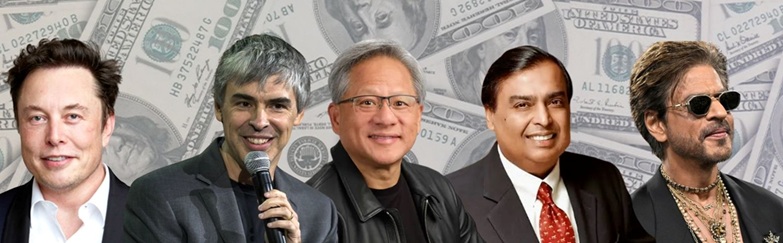
– Elon Musk remains the world’s richest person. His wealth is approximately $792 billion (≈ ₹72 lakh crore). This is his fifth time at the top in six years.
Top 10 richest individuals
– Elon Musk, SpaceX – Tesla ($792 billion)
– Jeff Bezos, Amazon ($300 billion)
– Larry Page, Alphabet (Google) ($270 billion)
– Larry Ellison, Oracle ($267 billion)
– Sergey Brin, Alphabet ($247 billion)
– Mark Zuckerberg, Meta Platforms ($234 billion)
– Bernard Arnault, LVMH ($178 billion)
– Warren Buffett, Berkshire Hathaway ($173 billion)
– Jensen Huang, Nvidia ($172 billion)
– Steve Ballmer, Microsoft ($159 billion)
Facts related to India
– India is among the top countries in terms of the number of billionaires.
– Mukesh Ambani remained the richest person in India.
—————-
2. The Central Government approved the establishment of quantum labs in 23 institutions by March 2026 under the National Quantum Mission (NQM). When was this mission launched?
a. 2020
b. 2021
c. 2023
d. 2024
Answer: c. 2023
– The Government of India approved the establishment of quantum labs in 23 academic institutions across the country in March 2026.
– This approval has been given under the National Quantum Mission (NQM).
– This decision is considered important for making India globally competitive in emerging quantum technologies.
– These labs aim to train students and researchers in advanced technologies like quantum computing, communication, and sensing.
– The government is also planning to establish such labs in 100 more institutions in the future.
About National Quantum Mission (NQM)
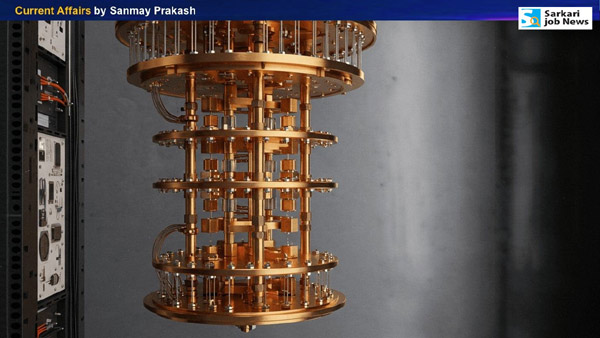
– It is a major initiative of the Government of India, launched in 2023.
– Total cost: approximately ₹6000 crore
– Duration: 2023–2031
– Objective: self-reliance in quantum technology, research and industry innovation, secure communication (Quantum Key Distribution)
– Quantum fabrication facilities (₹720 crore) are already being set up in IITs and IISc.
What is Quantum Technology?
– Quantum technology uses the unusual behavior of atoms and sub-atomic particles (like electrons and photons).
– While normal technology works on the rules of the “macro world,” quantum technology works on the “micro world.”
– Three main principles of Quantum Technology
– Superposition: A particle can exist in multiple states at the same time (0 and 1 simultaneously).
– Entanglement: Two particles become linked so that a change in one instantly affects the other.
– Quantum Tunneling: Particles can pass through barriers.
Benefits
– Much faster than today’s supercomputers
– Revolution in drug discovery, AI, weather, and space research
– Highly precise measurements (useful in GPS, defense, and medicine)
—————-
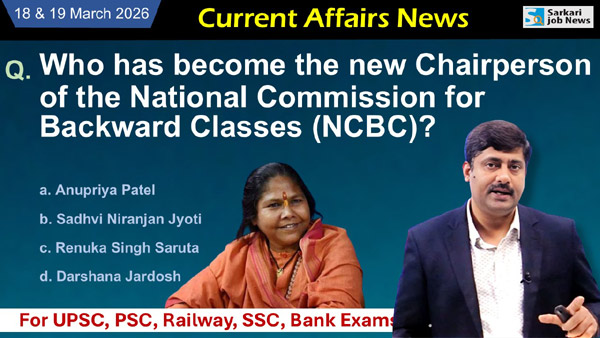
3. Whom did the President appoint as the new Chairperson of the National Commission for Backward Classes (NCBC)?
a. Anupriya Patel
b. Sadhvi Niranjan Jyoti
c. Renuka Singh Saruta
d. Darshana Jardosh
Answer: b. Sadhvi Niranjan Jyoti
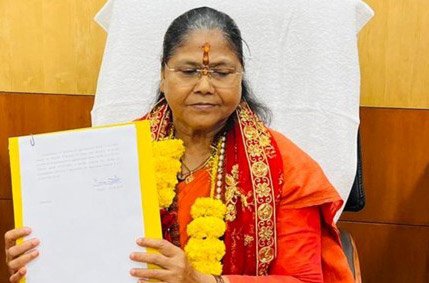
– On the recommendation of the Central Government, President Droupadi Murmu appointed Sadhvi Niranjan Jyoti as the Chairperson of NCBC.
– Her appointment was made on 18 March 2026.
– The post had been vacant since 2024; earlier Hansraj Gangaram Ahir was the chairman.
– This commission is a constitutional body under Article 338B.
– The Chairperson is appointed by the President.
– Sadhvi Niranjan Jyoti is a former Union Minister and BJP leader.
Origin of the Commission
– The issue of OBCs gained prominence with the Mandal Commission (1979).
– It recommended 27% reservation for OBCs.
– In 1990, the V.P. Singh government implemented the recommendation.
– A need was felt for a body to manage the OBC list and related disputes.
– Thus, NCBC was established in 1993 as a statutory body.
NCBC (National Commission for Backward Classes)
– Established: 1993 (NCBC Act, 1993)
– Constitutional status: 102nd Constitutional Amendment, 2018
– Article: 338B
– Ministry: Ministry of Social Justice and Empowerment
– Structure: Chairperson, Vice-Chairperson, and three members (appointed by the President)
Functions
– Advice on inclusion/exclusion in the OBC list
– Monitor constitutional safeguards
– Investigate complaints
– Provide policy recommendations
– Report on socio-economic development
Powers
– Powers similar to a civil court during investigations
– Advisory role only; government is not bound to accept its recommendations
————–
4. What has the Government of India changed the base year of the Merchandise Trade Index (MTI) to from 2012-13?
a. 2018-19
b. 2020-21
c. 2021-22
d. 2022-23
Answer: d. 2022-23
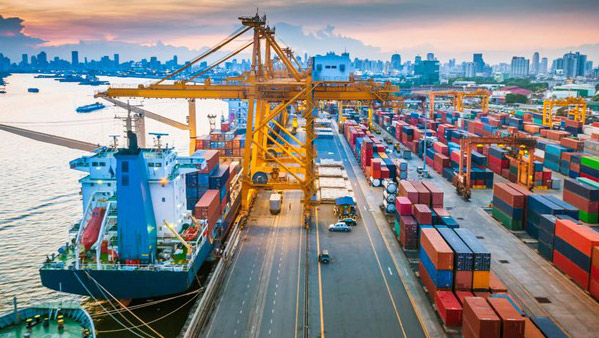
– The Government of India has changed the base year of MTI from 2012-13 to 2022-23.
What is Merchandise Trade Index?
– It refers to trade in physical goods (imports and exports), excluding services.
– It measures changes in price (unit value) and quantity of exports and imports.
– Prepared by DGCI&S under the Ministry of Commerce.
– Helps understand the external sector of the economy.
Meaning of Base Year Change
– Base year = reference year (taken as 100)
– Now 2022-23 = 100
– Earlier base year (2012-13) had become outdated
Reasons for Change
– Structural changes in the economy
– Emergence of new products
– Changes in global trade patterns
Improvements
– Updated commodity basket
– Revised weights
– Improved methodology
– Different indices: export/import unit value index, quantity index, terms of trade
Importance
– Used in GDP calculation
– Helps RBI in Balance of Payments analysis
– Assists policymaking
—————-
5. What is the new base year for the IIP (Index of Industrial Production) in India?
a. 2011–12
b. 2012–13
c. 2020–21
d. 2022–23
Answer: d. 2022–23
– The Government of India has changed the base year of IIP from 2012-13 to 2022-23.
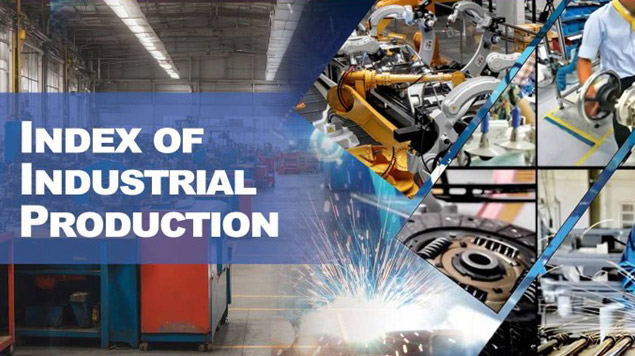
What is IIP?
– It measures industrial output in the country.
– Released by MOSPI.
Main sectors
– Mining
– Manufacturing (highest weight)
– Electricity
Reason for change
– Inclusion of new industries
– Structural changes in production
– More accurate data
Note
– Industrial growth slowed to 4.8% in January 2026, down from 8% in December 2025.
—————
6. When is National Vaccination Day celebrated?
a. 17 March
b. 16 March
c. 15 March
d. 14 March
Answer: b. 16 March
– It is celebrated to spread awareness about vaccination.
– First observed on 16 March 1995.
– India launched the Pulse Polio Programme in 1995 and administered the first dose of oral polio vaccine.
—————-
7. When is the Global Recycling Day celebrated?
a. 16 March
b. 17 March
c. 18 March
d. 19 March
Answer: c. 18 March
Theme 2026
– “Don’t Think Waste – Think Opportunity”
What is Recycling?
– The process of converting used materials into reusable or eco-friendly products.
– It helps reduce landfill waste.
Three main steps
– Collection of waste
– Processing into new products
– Purchasing recycled products
—————-
8. The atomic clock on which satellite of India’s navigation system failed, causing the indigenous GPS to face a crisis? (IRNSS-1F)
a. GPS
b. GLONASS
c. NavIC
d. Galileo
Answer: c. NavIC
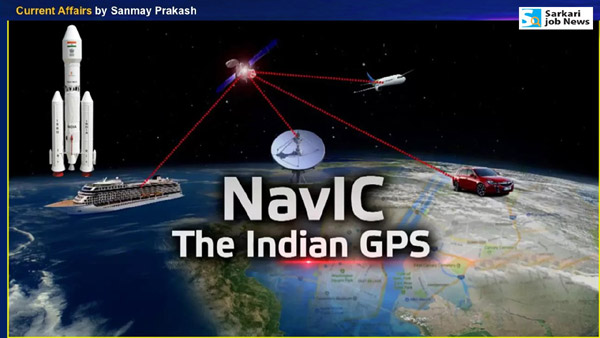
– India’s indigenous navigation system NavIC is facing a technical issue.
– On 13 March 2026, the atomic clock of IRNSS-1F failed, affecting its positioning capability.
– It can still provide limited one-way messaging services.
About NavIC
– Official name: IRNSS
– Regional navigation system covering India and ~1500 km around it
– Provides accuracy of about 10 meters
Origin
– Idea emerged after the 1999 Kargil War
– Approved in 2006
– Operational since 2016
Atomic Clock
– Measures time using atomic vibrations
– Highly precise and essential for navigation
– Even small errors can cause large location inaccuracies
Issues
– Repeated failures of atomic clocks
– Aging satellites
—————-
9. Which strait did Trump appeal to allied nations—as well as China—to send warships to help reopen, a request that was rejected by most countries?
a. Strait of Malacca
b. Strait of Gibraltar
c. Strait of Hormuz
d. Bab-el-Mandeb
Answer: c. Strait of Hormuz
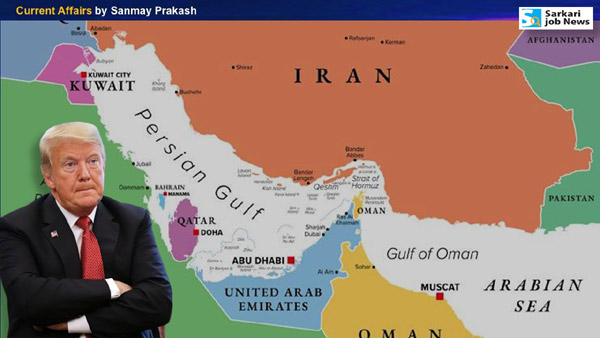
About Strait of Hormuz
– Connects the Persian Gulf with the Gulf of Oman
– Width: ~33 km (shipping lane ~3 km per direction)
– About 20–25% of global oil trade passes through it
Why assistance was sought
– Disruption during the US-Iran conflict in 2026
– Impact on global energy supply
Why countries refused
– Risk of escalation
– National interest concerns
—————-
10. With what percentage contribution to global coconut production is India the world’s largest producer of coconuts?
a. 30.37%
b. 25.45%
c. 20.68%
d. 15.85%
Answer: a. 30.37%
– India contributes 30.37% to global coconut production.
Facts
– Global coconut cultivation: ~12,390 thousand hectares
– India’s share: ~2,165.20 thousand hectares
– Annual production: ~21,373.62 million coconuts
– Productivity: ~9,871 coconuts per hectare
– Around 30 million people depend on coconut farming
Coconut Development Scheme
– Announced in Budget 2026-27
– Focus on replacing old trees and improving productivity
—————
11. What was the retail inflation rate in India in February 2026?
a. 1.25%
b. 1.33%
c. 3.2%
d. 2.75%
Answer: c. 3.2%
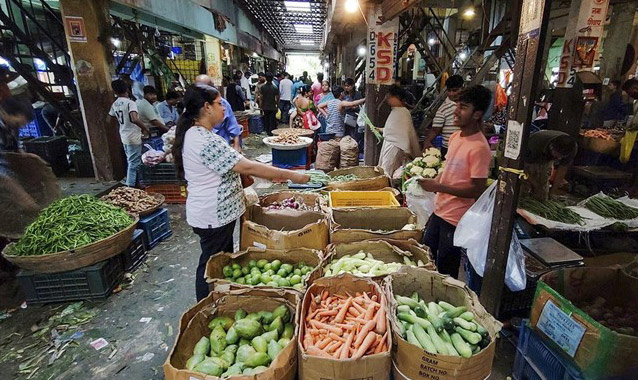
– Retail inflation (CPI-based) rose to 3.2% in February 2026.
– It is a 10-month high.
Reasons
– Rise in food prices
– Increase in tobacco prices
Reported by
– NSO under MOSPI
Inflation target
– RBI target: 4% ± 2%
—————-
12. What was the wholesale inflation rate in February 2026?
a. 0.83%
b. 1.81%
c. 2.13%
d. 2.21%
Answer: c. 2.13%
– WPI-based inflation was 2.13% in February 2026 (11-month high).
Reasons
– Rise in crude oil prices
– Increase in non-food and food items
Reported by
– DPIIT under Ministry of Commerce and Industry
What is WPI?
– Measures prices at the wholesale level (business-to-business transactions).
PDF Download: Click here