
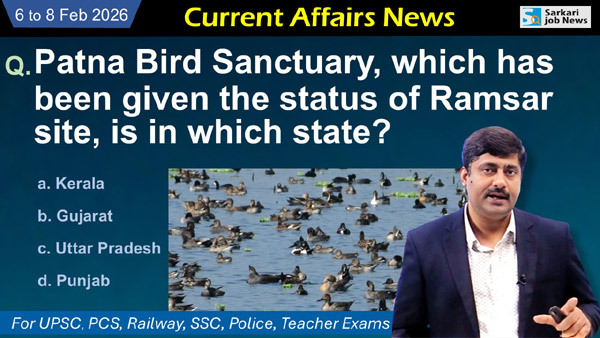
This is the current affairs of 6 to 8 February 2026. Here are questions and answers of daily current affairs for better preparation of competitive exams for government jobs.
PDF Download: Click here
1. In which state is ‘Chari-Dhand’, which has been given the status of a Ramsar site, located?
a. Uttarakhand
b. Punjab
c. Uttar Pradesh
d. Gujarat
Answer: d. Gujarat
– Chari-Dhand is located in the Banni grasslands of Kutch district in Gujarat.
– It is a seasonal desert wetland spread over 227 square kilometers.
– After the monsoon (from November to March), it becomes a haven for thousands of migratory birds, especially flamingos.
– This area is famous for its biodiversity.
– In the local Kutchi language, ‘Chari’ means ‘saline’ or salt-affected, and ‘Dhand’ means ‘shallow wetland’.
– More than 370 species of birds are found here.
– Apart from birds, wildlife such as chinkara, wolf, caracal, desert cat, and fox are also seen here.
———————-
2. In which state is Patna Bird Sanctuary located, which got the status of a Ramsar site in January 2026?
a. Bihar
b. Gujarat
c. Uttar Pradesh
d. Punjab
Answer: c. Uttar Pradesh
– Patna Bird Sanctuary is located in Jalesar tehsil of Etah district in Uttar Pradesh.
– Prime Minister Narendra Modi congratulated the local people and all citizens involved in wetland conservation on this achievement.
– It is the 11th Ramsar wetland of Uttar Pradesh.
– The announcement was made by Union Minister Bhupender Yadav.
Thousands of migratory birds arrive
– Patna Bird Sanctuary is spread over about 108.86 hectares.
– Thousands of migratory birds visit here.
– It is one of the richest small wetlands of Uttar Pradesh.
– So far, 178 species of birds have been recorded here.
– Out of 42 species of the Indian subcontinent, 18 species are regularly seen here.
– Every year, this area becomes a seasonal habitat for more than 50,000 birds, making it one of the major bird conservation centers of North India.
– More than 44 rare species of birds are found here.
– In winter, when the surrounding fields get waterlogged, this lake develops into a ‘Sarus Kemp’.
252 plant species as well
– This wetland includes not only birds but also plant species.
– Surveys have recorded 252 plant species from 71 plant families here, including 24 aquatic plants.
– In addition, ecological richness in the form of wildlife such as nilgai, jackal, mongoose, monitor lizard, wild cat, and porcupine is also found here.
– An ancient Shiva temple, about 600 years old from the Mahabharata period, is also located in this Patna Bird Sanctuary.
What is called a wetland?
– It is a type of moist land (wetland) where water accumulates during rainfall, and a large number of bird species are found in this area.
– In recent years, many sites have been included as Ramsar sites, and UNESCO provides assistance for their conservation.
Why are they called Ramsar sites?
– Ramsar is a city in Iran.
– On 2 February 1971, countries of the world signed the Ramsar Convention on Wetlands there.
– Therefore, it is called the Ramsar Convention. Some people also call this convention the Wetland Convention.
– It came into force in 1975.
– The formal name of this convention is: Convention on Wetlands of International Importance, especially as Waterfowl Habitat.
– It is an intergovernmental treaty that provides guidance on the conservation and wise use of wetlands.
– India signed this convention in 1982.
– In India, the Ministry of Environment, Forest and Climate Change has been declared the nodal ministry for matters related to wetland conservation.
India’s 98 Ramsar sites (as of February 10, 2026)
1. Asthamudi Wetland, Kerala
2. Beas Conservation Reserve, Punjab
3. Bhitarkanika Mangroves, Odisha
4. Bhoj Wetlands, Madhya Pradesh
5. Chandertal Wetland, Himachal Pradesh
6. Chilika Lake, Odisha
7. Deepor Beel, Assam
8. East Kolkata Wetlands, West Bengal
9. Harike Lake, Punjab
10. Hokera Wetland, Jammu and Kashmir
11. Kanjli Lake, Punjab
12. Keoladeo Ghana NP, Rajasthan
13. Keshopur-Miani Community Reserve, Punjab
14. Kolleru Lake, Andhra Pradesh
15. Loktak Lake, Manipur
16. Nalsarovar Bird Sanctuary, Gujarat
17. Nandur Madmaheshwar, Maharashtra
18. Nangal Wildlife Sanctuary, Punjab
19. Nawabganj Bird Sanctuary, Uttar Pradesh
20. Parvati Agra Bird Sanctuary, Uttar Pradesh
21. Point Calimere Wildlife and Bird Sanctuary, Tamil Nadu
22. Pong Dam Lake, Himachal Pradesh
23. Renuka Wetland, Himachal Pradesh
24. Ropar Lake, Punjab
25. Rudrasagar Lake, Tripura
26. Saman Bird Sanctuary, Uttar Pradesh
27. Samaspur Bird Sanctuary, Uttar Pradesh
28. Sambhar Lake, Rajasthan
29. Sandi Bird Sanctuary, Uttar Pradesh
30. Sarasai Nawar, Uttar Pradesh
31. Sasthamkotta Lake, Kerala
32. Sundarban Wetland, West Bengal
33. Surinsar-Mansar Lakes, Jammu and Kashmir
34. Tsomoriri Lake, Jammu and Kashmir
35. Upper Ganga River, Uttar Pradesh
36. Vembanad Kol Wetland, Kerala
37. Wular Lake, Jammu and Kashmir
38. Asan Conservation Reserve, Uttarakhand
39. Kabartal (Kanwar Lake), Bihar
40. Keetham Lake (Sur Sarovar), Uttar Pradesh (Agra)
41. Lonar Lake, Maharashtra
42. Startsapuk Tso and Tso Kar Lakes, Ladakh
43. Sultanpur National Park, Haryana
44. Bhidawas Wildlife Sanctuary, Haryana
45. Thol Lake Wildlife Sanctuary, Gujarat
46. Wadhwana Wetland Area, Gujarat
47. Haiderpur Wetland, Uttar Pradesh
48. Khijadiya Bird Sanctuary, Gujarat
49. Bakhira Wildlife Sanctuary, Uttar Pradesh
50. Karikili Bird Sanctuary, Tamil Nadu
51. Pallikaranai Marsh Reserve Forest, Tamil Nadu
52. Pichavaram Mangroves, Tamil Nadu
53. Pala Wetland, Mizoram
54. Sakhya Sagar Wetland, Madhya Pradesh
55. Koonthankulam Bird Sanctuary, Tamil Nadu
56. Satkosia Gorge, Odisha
57. Nanda Lake, Goa
58. Gulf of Mannar Marine Biosphere Reserve, Tamil Nadu
59. Ranganathittu Bird Sanctuary, Karnataka
60. Vembannur Wetland Complex, Tamil Nadu
61. Vellode Bird Sanctuary, Tamil Nadu
62. Sirpur Wetland, Madhya Pradesh
63. Vedanthangal Bird Sanctuary, Tamil Nadu
64. Udayamarthandapuram Bird Sanctuary, Tamil Nadu
65. Tampara Lake, Odisha
66. Hirakud Reservoir, Odisha
67. Anshupa Lake, Odisha
68. Yashwant Sagar, Madhya Pradesh
69. Chitrangudi Bird Sanctuary, Tamil Nadu
70. Suchindram Therur Wetland Complex, Tamil Nadu
71. Vaduvoor Bird Sanctuary, Tamil Nadu
72. Kanjirkulam Bird Sanctuary, Tamil Nadu
73. Thane Creek, Maharashtra
74. Haigam Wetland Conservation Reserve, Jammu and Kashmir
75. Shalbuga Wetland Conservation Reserve, Jammu and Kashmir
76. Ankasamudra Bird Conservation Reserve, Karnataka
77. Aghanashini Sanctuary, Karnataka
78. Magadi Kere Conservation Reserve, Karnataka
79. Karaivetti Bird Sanctuary, Tamil Nadu
80. Longwood Shola Reserve Forest, Tamil Nadu
81. Nagi Bird Sanctuary, Bihar
82. Nakati Bird Sanctuary, Bihar
83. Nanjarayan Bird Sanctuary, Tamil Nadu
84. Kazuveli Bird Sanctuary, Tamil Nadu
85. Tawa Reservoir, Madhya Pradesh
86. Sakkarakottai Bird Sanctuary, Tamil Nadu
87. Theerthangal Bird Sanctuary, Tamil Nadu
88. Khecheopalri Wetland, Sikkim
89. Udhwa Lake, Jharkhand
90. Menar Wetland Complex, Rajasthan (Udaipur)
91. Khichan Wetland, Rajasthan (Jodhpur)
92. Gokul Reservoir, Bihar (Buxar)
93. Udaipur Lake, Bihar (West Champaran)
94. Gogabil Lake, Bihar (Katihar)
95. Kopra Reservoir, Chhattisgarh (Bilaspur)
96. Siliserh Lake, Rajasthan (Alwar)
97. Patna Bird Sanctuary, Uttar Pradesh (Etah)
98. Chari-Dhand, Gujarat (Kutch)
——————-
3. Who was the winning team of the Women’s Premier League (WPL) 2026?
a. Royal Challengers Bengaluru (RCB)
b. Delhi Capitals (DC)
c. Gujarat Giants (GG)
d. Mumbai Indians (MI)
Answer: a. Royal Challengers Bengaluru (RCB) {defeated Delhi Capitals}
– WPL 2026 began on 9 January 2026.
– RCB won the title by defeating Delhi Capitals.
– In the final match held on 5 February 2026 at the BCA Stadium in Vadodara, Gujarat, RCB won by 6 wickets.
– RCB won the WPL trophy for the second time. Earlier, RCB had won this tournament in 2024.
– Delhi Capitals were captained by Jemimah Rodrigues.
– RCB was captained by Smriti Mandhana.
– The winning team was awarded a prize money of ₹6 crore.
– The runner-up team received ₹3 crore.
WPL 2026 Awards
– Player of the Tournament: Sophie Devine (GG)
– Most Valuable Player: Sophie Devine (GG)
– Player of the Match (Final): Smriti Mandhana (RCB)
– Orange Cap (most runs): Smriti Mandhana
– Purple Cap (most wickets): Sophie Devine
– Most Sixes of the Season: Harmanpreet Kaur (MI)
– Emerging Player of the Season: Nandini Sharma (DC)
– IQ of the Match: Georgia Voll
– Super Striker of the Season: Grace Harris (RCB)
– Active Catch of the Match: Richa Ghosh (RCB)
– Green Dot Balls of the Season: Lauren Bell (RCB)
– Catch of the Season: Lucy Hamilton (DC), prize money – ₹5 lakh
——————–
4. Who won the Orange Cap (most runs) in the Women’s Premier League (WPL) 2026?
a. Ellyse Perry
b. Smriti Mandhana
c. Richa Ghosh
d. Renuka Singh
Answer: b. Smriti Mandhana
– Smriti Mandhana is the captain of Royal Challengers Bengaluru (RCB).
– She scored 377 runs in nine matches.
– She scored these runs at an average of 53.85 and a strike rate of 153.25.
– After her, Mumbai captain Harmanpreet Kaur was second with 342 runs.
– Smriti Mandhana received a prize of ₹5 lakh.
– Smriti Mandhana is the first Indian player to win the Orange Cap in this league.
———————
5. Who won the Purple Cap (most wickets) in the Women’s Premier League (WPL) 2026?
a. Lauren Bell
b. Sayali Satghare
c. Sophie Devine
d. Nandini Sharma
Answer: c. Sophie Devine
– Sophie Devine is a player of Gujarat Giants (GG).
– She is a New Zealand all-rounder and the captain of the national women’s cricket team.
– She took 17 wickets in nine matches of WPL 2026.
—————
6. Who was the winning team of the Under-19 World Cup 2026?
a. New Zealand
b. Australia
c. England
d. India
Answer: d. India
– India won the Under-19 World Cup for the sixth time.
– The team won the final match played on 6 February 2026 at Harare Sports Club, Zimbabwe, by defeating England by 100 runs.
– In the final match, Vaibhav Suryavanshi played a century innings of 175 runs off 80 balls.
– In this innings, he hit 15 fours and 15 sixes.
– With this, he became the first player in the world to score 150 runs in an Under-19 World Cup final.
– On the back of this innings, India managed to set a target of 412 runs.
– The England team was all out for 311 runs in 40.2 overs.
– BCCI Secretary Devajit Saikia announced a prize money of ₹7.5 crore for the Indian team that won the Under-19 World Cup.
India won the title in these years
– India has won this title a maximum of 6 times (2000, 2008, 2012, 2018, 2022, 2026).
Player of the Tournament: Vaibhav Suryavanshi
India’s World Champions
– Ayush Mhatre (Captain), Aaron George, Vaibhav Suryavanshi, Vihan Malhotra, Abhigyan Kundu (Wicketkeeper), Vedant Trivedi, R. S. Ambrish, Kanishk Chauhan, Khilan Patel, Henil Patel, Deepesh Devendran, Harvansh Pangaliya, Mohammad Inan, Udhav Mohan, and Kishan Singh.
———————-
7. Who is the first player in the world to score 150 runs in the Under-19 World Cup 2026 final match?
a. Ayush Mhatre
b. Aaron George
c. Vaibhav Suryavanshi
d. Vihan Malhotra
Answer: c. Vaibhav Suryavanshi
– In the final match, Vaibhav Suryavanshi played a century innings of 175 runs off 80 balls.
– In this innings, he hit 15 fours and 15 sixes.
– With this, he became the first player in the world to score 150 runs in an Under-19 World Cup final match.
————–
8. Which country cancelled the Special Economic Zone (SEZ) land allotment given to India in Chittagong and gave this land to China to build a drone factory?
a. Japan
b. Bangladesh
c. Sri Lanka
d. Nepal
Answer: b. Bangladesh
– The Chittagong plant is 100 km away from the Indian border.
– Spread over about 850 acres, production on this land will begin by the end of 2026.
– China has also agreed to transfer drone technology.
– Medium-range and vertical-lift drones will be manufactured here.
– Bangladesh will become the third country in South Asia after India and Pakistan to manufacture drones.
– On the other hand, in 2025 China also signed a deal to supply 20 J-10CE fighter jets to Bangladesh.
– China has also given Bangladesh significant leeway in payment.
– The decision to cancel the land allotment to India was taken in the governing board meeting of BEZA, chaired by Chief Adviser Muhammad Yunus.
– In January 2026, BEZA Executive Chairman Chowdhury Ashik Mahmood bin Harun announced that the vacant land allotted in Mirsarai will now be developed as a Defence Economic Zone.
Reasons for cancellation of the project
– Only 1% of the fund was utilized and there was little interest among Indian contractors.
– After the removal of Sheikh Hasina’s government in 2024, the interim government of Muhammad Yunus officially cancelled this project by October 2025.
– Bangladesh now wants to increase its defence capability.
– It is promoting local production of weapons and military equipment.
– Bangladesh wants to increase exports in the international market.
In 2015, India was given land under an agreement
– An agreement was signed between India and Bangladesh in 2015.
– During Prime Minister Modi’s visit to Dhaka, a decision was taken in the joint declaration with Sheikh Hasina to establish an Indian Economic Zone (IEZ) for Indian investors.
– This was under a Government-to-Government (G2G) framework, in which Indian investors would be given priority.
– Funding was to be provided through India’s Line of Credit (LoC).
– For this, about 850 acres of land were allotted in Mirsarai, Chittagong.
– Another smaller economic zone at Mongla was also proposed.
– Its objective was to increase bilateral trade, attract Indian investment, generate employment, and provide special facilities to Indian companies in Bangladesh.
– In 2019, an MoU was signed between BEZA and Adani Ports and SEZ.
– India had provided support through a $115 million Line of Credit (LoC).
Benefits of SEZs for India
1. Special facilities for Indian companies.
2. Boosting Indian exports: Under India’s LoC conditions, 85% of goods and services must be procured from Indian sources, providing a larger market for Indian exporters.
3. Strengthening regional trade and supply chains: Indian SEZs in Bangladesh boost bilateral trade, which is already a major export market for India.
4. Employment generation: Indian investments in SEZs create thousands of jobs and facilitate technology transfer and skill development.
5. Strategic benefits: Increasing Indian presence in Bangladesh strengthens regional influence, especially in balancing the presence of SEZs in China and other countries.
20,000 crore jet deal from China
– The Bangladesh government approved the purchase of China’s J-10CE multirole fighter jets in October 2025.
– 20 aircraft will be delivered by 2027.
– The total cost will be $2.2 billion (approximately ₹20,000 crore), including training and spare parts.
– Payback will be made over 10 years.
—————-
9. How many Gallantry Awards 2026 were announced in the year 2026?
a. 70
b. 60
c. 50
d. 40
Answer: a. 70
– On the eve of the 77th Republic Day, the names of the gallantry award recipients were announced. Of these, six awards will be given posthumously.
– These include one Ashok Chakra, three Kirti Chakras, and 13 Shaurya Chakras (including one posthumous).
Distinguished Service Awards
– 19 Param Vishisht Seva Medals
– 4 Uttam Yudh Seva Medals
– 35 Ati Vishisht Seva Medals
– 7 Yudh Seva Medals
– Sena Medal (Distinguished) twice, 43 Sena Medals (Distinguished), and 85 Vishisht Seva Medals.
India’s highest gallantry awards: wartime and peacetime
– Highest wartime gallantry awards: Param Vir Chakra, Maha Vir Chakra, Vir Chakra
– Highest peacetime gallantry awards: Ashok Chakra, Kirti Chakra, Shaurya Chakra
– Other gallantry awards: Sena Medal, Nao Sena Medal, Vayu Sena Medal
————-
10. Who was honoured by the President with India’s highest peacetime gallantry award, the “Ashok Chakra,” in the year 2026?
a. Balakrishnan Nair
b. Shubhanshu Shukla
c. Colonel Sofia Qureshi
d. Major Arshdeep Singh
Answer: b. Shubhanshu Shukla
– The Ashok Chakra is India’s highest peacetime gallantry award, given for exceptional bravery or sacrifice.
Why Shubhanshu Shukla?
– Shubhanshu Shukla went to the International Space Station (ISS) under the Axiom-4 mission in June 2025.
– Shubhanshu became the second Indian to travel to space and the first Indian to set foot on the ISS.
– His 18-day space journey was the first spaceflight by an Indian after 41 years.
– Earlier, in 1984, Rakesh Sharma had undertaken a space journey aboard the Russian Soyuz spacecraft.
– Shubhanshu is an experienced fighter pilot of the Indian Air Force.
– He has more than 2,000 hours of flying experience.
– He has flown several aircraft such as the Su-30 MKI, MiG-21, MiG-29, Jaguar, Hawk, Dornier, and AN-32.
———————-
11. Who was honored by the President with India’s second peacetime gallantry award, the “Kirti Chakra,” in the year 2026?
a. Major Arshdeep Singh
b. Naib Subedar Doleswar Subba
c. Group Captain Prashant Balakrishnan Nair
d. All of the above
Answer: d. All of the above
– The Kirti Chakra is India’s second-highest peacetime gallantry award, given to both military personnel and civilians for exceptional bravery, courageous action, or self-sacrifice away from the battlefield.
Major Arshdeep Singh
– Major Arshdeep Singh of the 1st Assam Rifles was awarded the Kirti Chakra for leading a special patrol team on the India–Myanmar border on 14 May 2025.
– Despite heavy enemy fire, he neutralized several armed terrorists, including one equipped with an RPG launcher.
– Through exceptional leadership, bravery, and determination, he ensured zero casualties among his soldiers.
Naib Subedar Doleswar Subba
– Naib Subedar Doleswar Subba of the 2nd Battalion of the Parachute Regiment (Special Forces) was awarded the Kirti Chakra for extraordinary gallantry and courage displayed during an anti-terrorist operation conducted in the forests of Kishtwar on 11 April 2025.
Group Captain Prashant Balakrishnan Nair
– He is an experienced fighter test pilot of the Indian Air Force (IAF) and has been selected as an astronaut for ISRO’s Gaganyaan mission.
– Nair has completed more than 3,000 flying hours.
– He was also a backup crew member for the Axiom-4 mission.
These brave personnel were awarded the “Shaurya Chakra”
– Lieutenant Colonel Ghatage Aditya Shrikumar, 21st Battalion, Parachute Regiment (Special Forces)
– Major Anshul Baltu, 32nd Assam Rifles
– Major Shivkant Yadav, 5th Battalion, Parachute Regiment (Special Forces)
– Major Vivek, 42nd Rashtriya Rifles
– Major Leishangthem Deepak Singh, 11th Battalion, Parachute Regiment (Special Forces)
– Captain Yogendra Singh Thakur, 6th Battalion, Parachute Regiment (Special Forces)
– Subedar P. H. Moses, 1st Assam Rifles
– Lance Dafadar Baldev Chand, 4th Rashtriya Rifles
– Rifleman Manglem Sang Vaiphei, 3rd Assam Rifles
– Rifleman Dhurba Jyoti Dutta, 33rd Assam Rifles
– Lieutenant Commander Dilna K, Indian Navy
– Lieutenant Commander Roopa A, Indian Navy
– Assistant Commandant Vipin Wilson
Uttam Yudh Seva Medal
– Lieutenant General Dhiraj Seth, Southern Army Commander
Param Vishisht Seva Medal
– Chief Air Marshal Ashutosh Dixit
– Vice Admiral Krishna Swaminathan, Western Naval Commander
– Lieutenant General Sumer Ivan D’Cunha, Director General of Army Air Defence
– Vice Admiral Atul Anand, Additional Secretary, Department of Military Affairs
Vishisht Seva Medal
– Colonel Sofia Qureshi
—————-
12. When is Indian Coast Guard Day celebrated?
a. 1 February
b. 2 February
c. 3 February
d. 4 February
Answer: a. 1 February
– On this day, the Indian Coast Guard was established in 1977 through the Coast Guard Act passed by the Parliament of India.
– This year, the 49th Indian Coast Guard Raising Day was celebrated.
– The Indian Coast Guard protects India’s maritime boundaries of approximately 7,500 kilometers.
– It also assists in relief and rescue operations.
Indian Coast Guard
Established: 1 February 1977
Headquarters: New Delhi
Director General: Paramesh Shivamani
Motto: Vayam Rakshamah (We Protect)
——————
13. When is World Wetlands Day celebrated?
a. 1 February
b. 2 February
c. 3 February
d. 4 February
Answer: b. 2 February
Theme for 2026
– Wetlands and Traditional Knowledge: Celebrating Cultural Heritage
– On this day in 1971, the Ramsar Convention on Wetlands was adopted in the city of Ramsar, Iran.
– Its objective is to raise awareness among people about the importance of wetlands.
– It has been observed since 1997.
—————–
14. The Governor of Assam awarded the 22nd Upendra Nath Brahma “Soldier of Humanity” Award to the Queen of which country?
a. Jamaica
b. Bhutan
c. Saint Vincent
d. United Kingdom (UK)
Answer: b. Bhutan
– On 3 February 2026, the Governor of Assam, Lakshman Prasad Acharya, presented this award to Her Majesty Queen Mother Gyalyum Ashi Dorji Wangmo Wangchuck of Bhutan.
– It was awarded at a special ceremony held at Bodoland University in Kokrajhar, Assam.
– The award was given by the Upendra Nath Brahma Trust (UNBT) in recognition of the Queen Mother’s “lifelong and exceptional contribution to humanitarian service, social development, and inclusive development.”
– Internationally honored for her leadership in the field of social welfare, the Queen Mother is the founder-chairperson of the Tarayana Foundation.
– Through this foundation, she has led extensive rural development initiatives in remote areas of Bhutan.
– The foundation’s work focuses on poverty alleviation, women empowerment, education, healthcare, and preservation of cultural heritage.
– The award includes a citation, a statue of Upendra Nath Brahma—revered as Bodofa, the guardian of the Bodo ethnic community—along with traditional Bodo artifacts such as a Serja (a musical instrument), Aronai (a decorative scarf), and Dokhona (women’s attire), and a cash prize of ₹2 lakh.
(Bhutan)
Capital: Thimphu
Prime Minister: Dr. Lotay Tshering
Population: 7.9 lakh (2022)
Language: Dzongkha
Currency: Ngultrum
Neighbouring countries: India and China.
PDF Download: Click here