
This is the current affairs of 3 & 4 October 2025. Here are questions and answers of daily current affairs for better preparation of competitive exams for government jobs.
PDF Download: Click here
1. On the centenary year of the UPSC, Chairman released a new logo, in which a garland of leaves of which tree has been made?
a. Peepal
b. Neem
c. Mango
d. Banyan
Answer: d. Banyan (Chairman Dr. Ajay Kumar released the new Logo)
– The UPSC was established on 1 October 1926 under the recommendations of the Lee Commission and the provisions of the Government of India Act, 1919.
– Since then, the Commission has been considered the backbone of the country’s merit-based civil service system.
– The Union Public Service Commission (UPSC) began its centenary year on 1 October 2025.
– On this occasion, Chairman Dr. Ajay Kumar released the Commission’s new emblem (Logo).
What’s special in the new Logo?
– At the center of the new logo is the National Emblem, which represents service to the nation and authority.
– Around it is a wreath of Banyan leaves, symbolizing knowledge and patience.
– At the bottom, on a strip, the words “Sang Lok Seva” are inscribed, highlighting the Commission’s responsibility and commitment to duty.
A special centenary logo was also unveiled
– The Commission also presented a special centenary logo.
– The wave-shaped design in it represents the Commission’s hundred-year-long progressive, resilient, and adaptive journey.
– In this logo, the UPSC emblem is placed within the last ‘0’ of ‘100’, symbolizing its central role in India’s administrative journey.
New Initiative Launched
– As part of the centenary year programs, UPSC has also launched a special initiative titled ‘My UPSC Interview: From Dream to Reality’. This portal is available at innovateindia.mygov.in/upsc/. Under this initiative, retired and serving civil servants have been invited to share their UPSC interview experiences.
– The last date for accepting entries is 31 December 2025.
– The selected experiences will be compiled and published during the centenary year 2026.
—————
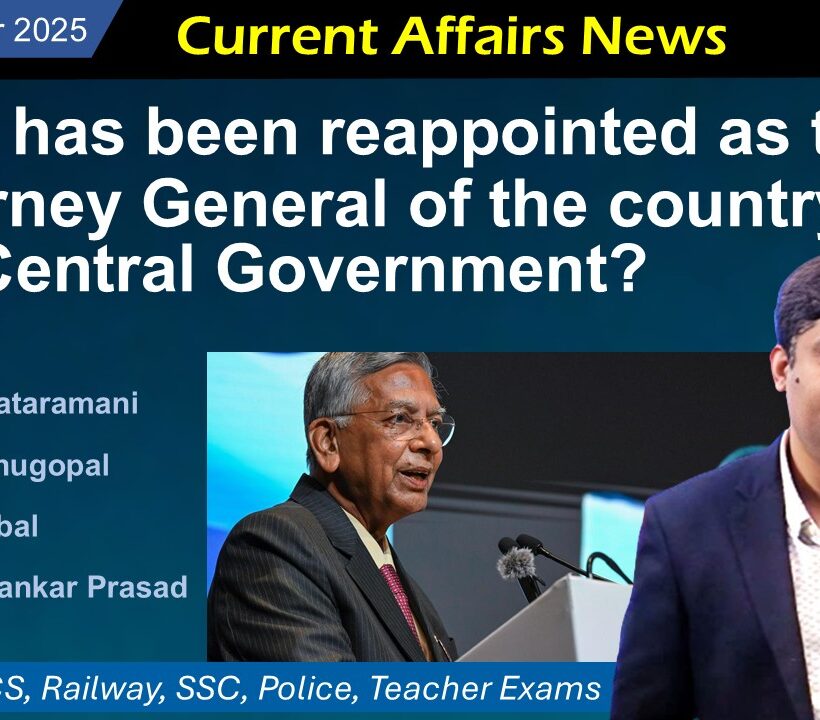
2. Who has been reappointed as the Attorney General of the country by the Central Government?
a. R. Venkataramani
b. R.K. Venugopal
c. Kapil Sibal
d. Ravi Shankar Prasad
Answer: a. R. Venkataramani
– The Central Government has reappointed Venkataramani as the Attorney General of India for the next two years starting from 1 October 2025.
– His tenure ended on 30 September 2025, but R. Venkataramani has been reappointed to the post of Attorney General.
– He had replaced K.K. Venugopal on 1 October 2022.
About R. Venkataramani
– R. Venkataramani is a Senior Advocate.
– He became the 16th Attorney General of India.
– He hails from Tamil Nadu.
– He became a lawyer in 1977.
– He started practicing in the Supreme Court in 1979.
– In 2010, he was appointed as a member of the Law Commission.
– In 2013, he was again appointed as a member for another term.
– On 30 September 2022, he became the 16th Attorney General of the country.
– Now, from 1 October 2025, he has been reappointed.
Attorney General
– According to Article 76 of the Indian Constitution, the Attorney General (AG) of India is the highest law officer in the country.
– The Attorney General is the chief legal advisor to the Government of India and advises the Central Government on legal matters.
– He represents the Government of India in the Supreme Court and High Courts.
– The Attorney General also has the right to participate in and speak in the proceedings of both Houses of Parliament.
– However, he does not have the right to vote in the House.
– He enjoys all the privileges and immunities that a Member of Parliament has.
How is the Attorney General appointed?
– The Attorney General is a constitutional post.
– The appointment is made by the President on the recommendation of the Central Government.
– He holds office for a fixed term or during the pleasure of the President.
– The Attorney General of India can be removed by the President at any time.
– For appointment, it is necessary that the person must be a citizen of India.
– He must have completed either 10 years as a Judge of a High Court of any Indian state or 10 years as an Advocate in a High Court.
– He may also be a distinguished jurist in the opinion of the President.
– He is the chief legal advisor to the Central Government.
————–
3. Famous Gandhian GG Parikh passed away on 2 October 2025 at the age of 101, what was he among these?
a. Freedom Fighter
b. Supporter of Democratic Socialism
c. Leader of Labour Movements
d. All of the above
Answer: d. All of the above (Freedom Fighter, Supporter of Democratic Socialism, Leader of Labour Movements)
– Born on 30 December 1924 in Rajkot, he participated in the Quit India Movement in 1942 during his youth. During that time, the British government imprisoned him for 10 months.
– It was there that he met Acharya Narendra Deva. His interactions with him provided a strong ideological foundation.
– He dedicated his entire life to strengthening the labor movement and engaging the youth in spreading socialist democratic values at the grassroots level.
– He was a believer in democratic socialism, associated with Seva Dal, and was friends with prominent leaders like George Fernandes, Madhu Dandavate, Mrinal Gore, Pramila Dandavate, Kamal Morarka, and industrialist Rahul Bajaj.
– He founded the Yusuf Meher Ali Centre 65 years ago.
– Throughout his life, he remained actively involved in opposing the growing communalism in the country, and injustice against Muslims, Dalits, and women.
—————
4. RBI did not change the repo rate in the bi-monthly monetary policy review (August 2025), what is this repo rate?
a. 5.5%
b. 5.8%
c. 6.2%
d. 6.5%
Answer: a. 5.5%
– The meeting of the Reserve Bank of India’s Monetary Policy Committee (MPC) was held on 1 October 2025.
– In this meeting, it was decided to keep the policy repo rate unchanged at 5.5%.
– The RBI stated that since inflation is under control, no change has been made in the repo rate.
What is Repo Rate (Repurchase Rate or Repo Rate)?
– In simple terms, banks give us loans, and we have to pay interest on those loans.
– Similarly, banks also need large amounts of money for their day-to-day operations, so they borrow from the Reserve Bank of India (RBI).
– The rate of interest charged by the RBI on this loan is called the Repo Rate.
How does Repo Rate affect the common man?
– The RBI has a powerful tool to fight inflation in the form of the repo rate.
– When inflation is very high, the RBI increases the repo rate to reduce the money flow in the economy.
– When banks get loans at a lower interest rate (i.e., repo rate is reduced), they can also provide cheaper loans to their customers.
– And if the Reserve Bank increases the repo rate, borrowing becomes costly for banks, and in turn, they make loans expensive for their customers.
Reverse Repo Rate
– It is the opposite of the repo rate.
– When banks have surplus funds after their day-to-day operations, they deposit that money with the Reserve Bank.
– The RBI pays them interest on this amount.
– The rate at which the Reserve Bank pays interest on this money is called the Reverse Repo Rate.
Ex-officio Chairman of the Monetary Policy Committee – Governor of the Reserve Bank of India, Sanjay Malhotra
—————-

5. The high-level committee of the Home Ministry approved disaster mitigation, rehabilitation and reconstruction projects worth ₹4,645.60 crore for how many states?
a. Assam, Kerala, Madhya Pradesh, Odisha, Rajasthan
b. Uttar Pradesh, Bihar, Chhattisgarh, Andhra Pradesh
c. Punjab, Haryana, Himachal Pradesh, Gujarat
d. Both a and b
Answer: d. Both a and b (Assam, Kerala, Madhya Pradesh, Odisha, Rajasthan, Uttar Pradesh, Bihar, Chhattisgarh, Andhra Pradesh)
– The High-Level Committee (HLC) constituted under the leadership of the Ministry of Home Affairs approved disaster mitigation, rehabilitation, and reconstruction projects for nine states on 1 October 2025.
– The total amount is ₹4,645.60 crore, which will be funded from the National Disaster Mitigation Fund (NDMF).
– These states include Assam, Kerala, Madhya Pradesh, Odisha, Rajasthan, Uttar Pradesh, Bihar, Chhattisgarh, and Andhra Pradesh.
-The committee was chaired by Union Home Minister Amit Shah.
– The committee also included Finance Minister Nirmala Sitharaman, Agriculture Minister Shivraj Singh Chouhan, and the Vice-Chairperson of NITI Aayog.
– This initiative aims to strengthen Prime Minister Narendra Modi’s vision of a “Disaster Resilient India.”
Details of Major Projects
– The projects are focused on tackling disasters such as floods, landslides, droughts, forest fires, etc. Some of the major projects are as follows:
1) Revival and Restoration of Wetlands in Assam
– Amount: ₹692.05 crore (Central share ₹519.04 crore – 75%, State share ₹173.01 crore – 25%)
– Details: 24 wetlands across 9 districts of the Brahmaputra river system will be restored. This will increase flood storage capacity, protect the aquatic environment, and promote economic development through fisheries.
2) Urban Flood Risk Management Programme (UFRMP) Phase-2
– Amount: ₹2,444.42 crore (Central share 90%, State share 10%)
– Coverage: 11 cities – Bhopal, Bhubaneswar, Guwahati, Jaipur, Kanpur, Patna, Raipur, Trivandrum, Visakhapatnam, Indore, Lucknow
– Details: These cities have been selected based on criteria like population and flood vulnerability. The programme includes structural measures (e.g., dams) and non-structural measures (e.g., warning systems).
– Special: For Guwahati, ₹200 crore is allocated for flood mitigation (Central share ₹180 crore).
3) Rehabilitation and Reconstruction Projects:
– Assam: ₹1,270.788 crore for the 2022 floods/landslides.
– Kerala: ₹260.56 crore for the 2022 floods and 2024 Wayanad landslides.
Other States (Previous Approvals):
– Sikkim: ₹555.27 crore for the 2023 GLOF (Glacial Lake Outburst Flood); approved on 28 March 2025. This funding, from the National Disaster Response Fund (NDRF), is for the Teesta III dam and related rehabilitation works.
– National GLOF Risk Mitigation Project (NGRMP): ₹150 crore approved on 4 February 2025. This project will be implemented in four Himalayan states – Himachal Pradesh, Uttarakhand, Sikkim, and Arunachal Pradesh – covering monitoring, early warning systems, and mitigation measures for 190 high-risk lakes.
– Uttarakhand: ₹1,658.17 crore for Joshimath landslide; approved on 30 November 2023. This rehabilitation and reconstruction plan will be implemented over three years.
– Himachal Pradesh: ₹2,006.40 crore for 2023 floods/landslides; approved on 18 June 2025. This is central assistance for the rehabilitation plan following the 2023 floods, landslides, and cloudburst events. (Note: An additional ₹633.73 crore had already been approved in December 2023.)
—————
6. Who was honoured with the Dr. MS Swaminathan Environment Conservation Award 2025?
a. Sahaj Samruddha (N. Devkumar) and Veerappan
b. Rakesh Verma, Ajay Sharma
c. Ajay Rastogi, Vijay Das
d. C.K. Ranganathan
Answer: a. Sahaj Samruddha (N. Devkumar) and Veerappan
– This award was presented in September 2025 during the 100th birth anniversary celebrations of M.S. Swaminathan.
– It was the 31st edition of the award.
Award Winners
– The first award was given to Sahaj Samruddha (N. Devkumar) from Mysuru, a people’s movement dedicated to preserving India’s traditional agricultural practices and indigenous crop varieties. Sahaj Samruddha, as an organization, plays a significant role in conserving traditional varieties of rice and millet.
– The second award was given to 60-year-old Veerappan, a fisher from Irular village in Kalagnar Nagar. He was honored for his contributions to environmental conservation. He explained how his team promoted mud crabs living in wetlands and now trains college students in crab and fish farming.
Dr. M.S. Swaminathan Environmental Protection Award
– This award is given to an individual, company, or NGO that has contributed, directly or indirectly, to environmental protection and awareness.
– The initiative is supported by CavinKare Private Limited.
About M.S. Swaminathan
– The full name of India’s great agricultural scientist M.S. Swaminathan is Mankombu Sambasivan Swaminathan.
– Swaminathan was a global leader of the Green Revolution.
– He introduced and further developed high-yielding varieties of wheat and rice.
– He received the Shanti Swarup Bhatnagar Award, Ramon Magsaysay Award, and Albert Einstein World Science Award.
– In February 2024, the Central Government announced the Bharat Ratna award for him.
—————
7. When is the International Day of Older Persons celebrated?
a. 1 October
b. 2 October
c. 3 October
d. 4 October
Answer: a. 1 October
Theme for 2025:
– Older Persons Driving Local and Global Action: Our Aspirations, Our Well-Being and Our Rights
– It was declared by the United Nations General Assembly (UNGA) on 14 December 1990.
– First observance: Celebrated for the first time in 1991.
Objectives:
– To protect the rights, welfare, and dignity of older persons.
– To recognize their contributions to society.
– To raise awareness about issues related to the growing elderly population, such as health, economic security, and social inclusion.
Government Policy on Older Persons:
– The government has formulated the National Policy on Older Persons for their welfare.
– The Senior Citizens Act, 2007 has also been implemented, providing legal guarantees for the care and rights of older persons.
—————
8. What is India’s rank in the world in generating e-waste, with an estimated 2.2 million tonnes of e-waste generated in 2025?
a. First
b. Second
c. Third
d. Fourth
Answer: c. Third (After the USA and China, India ranks third)
– Along with India’s rapid digital revolution, there has been an unprecedented increase in electronic waste (e-waste).
– This has become a serious challenge for the environment, health, and the economy.
E-waste Generation by Top 3 Countries
– According to The Hindu newspaper, in 2025, India generated approximately 2.2 million metric tons (22 lakh tons) of e-waste.
– This ranks third after China (approximately 5.3 million tons) and USA (approximately 3.2 million tons).
– E-waste generation in India has increased by 151% from 2017-18 to 2023-24.
Current Challenges in E-waste Management
– The majority of e-waste (over 60%) comes from 65 major cities, such as Seelampur in Delhi, Mustafabad, Muradabad in Uttar Pradesh, and Bhiwandi in Maharashtra.
– The biggest problem is the dominance of the informal sector (95%) in e-waste management, where scrap dealers, kabadiwalas, and slum-based workshops process waste using unsafe methods.
– Only 10% of e-waste reaches formal recycling, although the capacity of 322 registered units exceeds 2.2 million tons.
– Informal practices such as manual dismantling, open burning, acid leaching, and insensitive dumping release over 1,000 toxic substances, including lead, cadmium, mercury, chromium, dioxins, and brominated flame retardants.
– The economic loss exceeds $10 billion annually, including water pollution (from cyanide and sulfuric acid), air pollution (from lead smoke, coal burning, and plastic incineration), and soil contamination.
– The social loss is over $20 billion, and valuable metals (like gold and copper) worth over ₹80,000 crore are lost.
Health Risks: A Hidden Crisis
– Health hazards associated with e-waste particularly affect informal workers (mainly women and children) and surrounding communities.
– Respiratory diseases such as chronic bronchitis, asthma, and persistent cough are found in 76–80% of informal workers.
– Neurotoxins (lead, mercury, cadmium) impair brain development, leading to reduced IQ, attention deficits, and behavioral disorders in children.
– Skin and eye disorders, such as rashes, chemical burns, and dermatitis, affect up to 100% of workers.
– Genetic damage, epigenetic changes, and oxidative stress weaken the immune system, which, combined with pre-existing vulnerabilities like poverty, malnutrition, and unsafe housing, creates a “syndemic” (co-occurring epidemic).
Law/Regulations
– The E-Waste (Management) Rules 2022 should implement a floor price for EPR (Extended Producer Responsibility) certificates, ensuring fair returns for registered recyclers and preventing hazardous informal practices.
– Formalize the informal sector: Provide skill certification, PPE, and health facilities.
– Strengthen enforcement (vigilance): Implement digital tracking, environmental audits, and medical monitoring (health camps, long-term studies).
—–
UPSC and State PCS Prelims Level Question
Q: E-waste generation in India increased by 151% from 2017-18 to 2023-24. Which of the following factors are most relevant for this increase?
Options:
A. Increasing consumption of digital devices and smartphones
B. Decline in industrial production
C. Dominance of the informal waste collection system
D. Effective implementation of e-waste management rules
Answer: A
Brief Explanation: The main reason for the rise in e-waste generation is the digital revolution and the increasing use of smartphones, computers, and other electronic devices. The informal waste system affects management, not production.
—–
UPSC and State PCS Mains Level Question
GS Paper 3: Environment/Economy
Q: Analyze the environmental and health risks arising from the dominance of the informal sector in e-waste management in India. Also, suggest potential policy measures to strengthen the formal sector.
Answer / Explanation:
In 2025, India’s e-waste generation is estimated at approximately 2.2 million tons. About 95% of e-waste is recycled in the informal sector, which poses serious economic, social, and health challenges.
– Environmental, Economic, and Social/Health Risks from Informal E-Waste Recycling:
– Environmental Risks: Informal recycling releases toxic substances such as lead, cadmium, mercury, chromium, and dioxins, which pollute water, air, and soil.
– Economic Losses: Valuable metals like gold and copper are lost, resulting in annual economic losses exceeding $10 billion.
Social and Health Risks:
– Workers suffer from respiratory diseases (chronic bronchitis, asthma).
– Exposure to neurotoxins affects IQ and behavior in children.
– Skin and eye disorders are common among workers.
– Weak immune systems, combined with poverty, malnutrition, and unsafe living conditions, create a ‘syndemic’ situation.
Policy Measures:
– Implement a floor price for EPR certificates to ensure fair returns for formal recyclers and discourage hazardous informal practices.
– Support informal workers by providing skill certification, PPE, and health facilities.
– Strengthen enforcement through digital tracking and environmental audits to monitor compliance and safe e-waste management.
—————
9. When is International Coffee Day celebrated?
a. 1 October
b. 2 October
c. 3 October
d. 4 October
Answer: a. 1 October
Theme for 2025:
– Embrace Collaboration for Collective Action – More Than Ever
Key Message of the Theme:
– In the coffee industry, farmers, consumers, organizations, and governments must work together.
– Such collaboration will make coffee production sustainable.
– It will also ensure fair trade practices.
– The initiative was launched by the International Coffee Organization in 2015.
—————-
10. International Day of Non-Violence is celebrated on the birth anniversary of which great man?
a. Sardar Vallabhbhai Patel
b. Nelson Mandela
c. Mahatma Gandhi
d. Albert Einstein
Answer: c. Mahatma Gandhi (2 October)
– This day was declared by the United Nations in 2007.
– The birthday of Father of the Nation, Mahatma Gandhi, is celebrated on 2 October.
– He was born on 2 October 1869 in Porbandar, Gujarat.
– He passed away on 30 January 1948, when India’s first terrorist Nathuram Godse shot him.
– His memorial is at Raj Ghat, Delhi.
– Mahatma Gandhi is an icon not only for India but for people around the world.
Government Initiative Based on Gandhian Philosophy
Swachh Bharat Mission
– Launched on Gandhi Jayanti, 2 October 2014.
– Gandhian Philosophy: “Sanitation is next to godliness.”
– On 2 October 2019 (Gandhi’s 150th birth anniversary), India was declared Open Defecation Free (ODF).
– 5,66,068 ODF+ villages achieved (as of 13 August 2025).
– Over 12 crore toilets constructed.
– Saved 3 lakh children under 5 years of age (according to WHO data).
Self-Help Groups (SHGs)
– Implemented under Deendayal Antyodaya Yojana – National Rural Livelihood Mission (DAY-NRLM).
– Gandhian Philosophy: Cooperative economics and grassroots empowerment.
– Cumulative loans of ₹11,10,945.88 crore were distributed to women SHGs.
– 10.05 crore women organized into 90.90 lakh SHGs (as of June 2025).
– The goal of organizing 10 crore rural households has been achieved.
Ownership Scheme
– Launched on National Panchayati Raj Day, 2020.
– Gandhian Philosophy: Village self-reliance and Panchayati Raj.
– 65 lakh property cards distributed.
– Covered over 50,000 villages.
– Drone surveys completed in 3.2 lakh villages.
Khadi and Village Industries
– Promoted through KVIC (Khadi and Village Industries Commission).
– Gandhian Philosophy: Swadeshi ideology and village-based production.
PM Tribal Advanced Village Campaign (PM JUGA / DAJGUAA)
– Launched on 2 October 2024 by PM Modi from Hazaribagh, Jharkhand.
– Gandhian Philosophy: Empowerment of tribal communities for national development.
– Financial Outlay: ₹79,156 crore (Central share ₹56,333 crore).
– Benefits over 5 crore tribal citizens.
– Covers 63,000 villages in 549 districts (~71% of the country).
– Implemented through 17 related ministries.
Mahatma Gandhi National Rural Employment Guarantee Act (MGNREGA)
– Gandhian Philosophy: Right to dignified work and inclusive rural development.
About Lal Bahadur Shastri
– Lal Bahadur Shastri was born on October 2, 1904, in Mughalsarai, a small railway town seven miles from Varanasi, Uttar Pradesh. His father was a school teacher.
– Lal Bahadur Shastri was the former Prime Minister of India and the originator of the immortal slogan “Jai Jawan, Jai Kisan.”
—————-
11. When is World Animal Protection Day celebrated?
a. 1 October
b. 2 October
c. 3 October
d. 4 October
Answer: d. 4 October
Theme for 2025:
“Save Animals, Save the Planet!”
– This day reminds us that the Earth belongs not only to humans but also to animals, and their protection is our responsibility.
– objective is to raise awareness about animal rights, their conservation, and welfare.
—————
12. United Nations Peacekeeping Contributor Countries Summit
– The Indian Army will host the UNTCC Chiefs Conclave in New Delhi from 14–16 October 2025.
– Over 30 countries will participate, discussing indigenous technology and peacekeeping missions.
——-
PDF Download: Click here