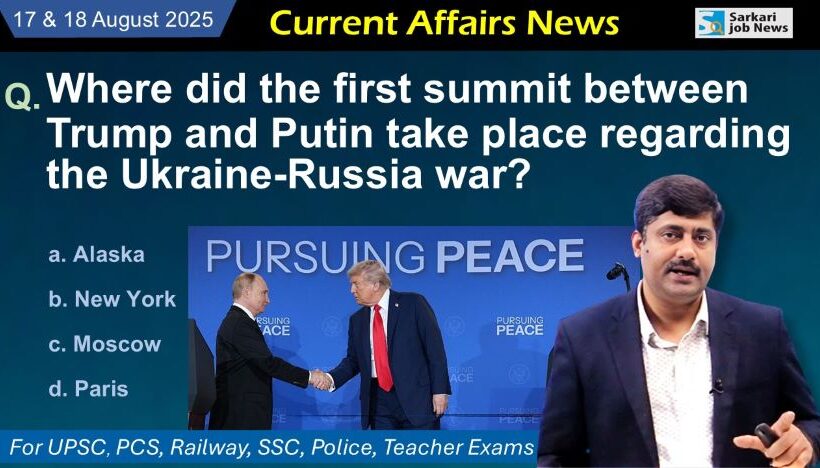
This is the current affairs of 17 & 18 August 2025. Here are questions and answers of daily current affairs for better preparation of competitive exams for government jobs.
PDF Download: Click here
1. Who has been nominated by the National Democratic Alliance (NDA) as its candidate for the post of Vice President?
a. JP Nadda
b. CP Radhakrishnan
c. RK Ramaswamy
d. Radhika Banerjee
Answer: b. CP Radhakrishnan
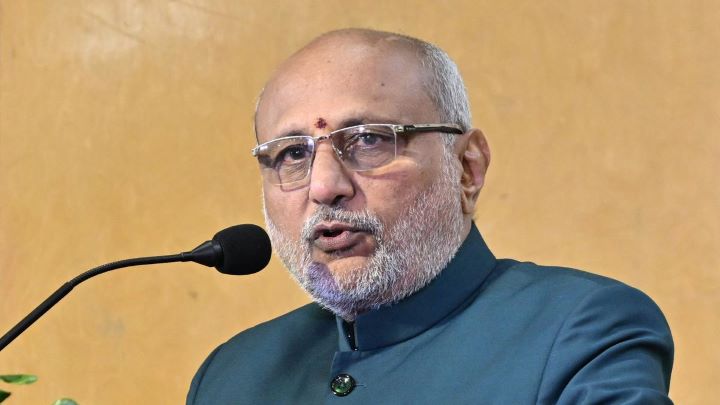
– NDA has nominated CP Radhakrishnan as the Vice Presidential candidate.
– BJP President JP Nadda announced his name in a press conference.
About CP Radhakrishnan
– He is originally from Tamil Nadu.
– He was born on 20 October 1957 in Tiruppur, Tamil Nadu.
– He has studied BBA (Business Administration).
– He began as a volunteer of RSS.
– He was elected MP from Coimbatore in 1998 and 1999.
– He served as Tamil Nadu BJP President from 2004 to 2007.
– In 2023, he became the Governor of Jharkhand. (Additional charge – Governor of Telangana and Lieutenant Governor of Puducherry)
– In 2024, he became the Governor of Maharashtra.
Constitutional Provisions Related to the Vice President
– Article 63: There shall be a Vice President of India.
– Article 64: The Vice President shall be the Chairman of the Rajya Sabha.
– Article 65: In case of vacancy, absence or inability of the President, the Vice President shall act as the Acting President.
– Article 66: Election of the Vice President and related provisions.
– Article 67: Term of the Vice President – 5 years (or until the successor to the President takes over).
– Article 68: Procedure for filling vacancy in the office of the Vice President.
– Article 71: Election disputes shall be decided by the Supreme Court.
Vice Presidential Election Process
1) Electoral College
– The Vice President is elected by the members of both Houses of Parliament (Lok Sabha + Rajya Sabha, including both elected and nominated members).
– State Legislative Assemblies have no role in this election (unlike the Presidential election).
2) Voting Method
– The election is held through the Single Transferable Vote System (STV) based on Proportional Representation.
– Voting is conducted by a secret ballot.
3) Qualifications: To become the Vice President, a person must –
– Be a citizen of India.
– Be at least 35 years of age.
– Be eligible to be a member of the Rajya Sabha.
– Not hold any office of profit.
4) Nomination
– A candidate for the Vice President must have at least 20 MPs as proposers and 20 MPs as seconders.
– A specified security deposit must be submitted.
5) Election Authority
– The Election Commission of India conducts the election for the Vice President.
Term and Removal from Office
– The term of the Vice President is 5 years, but they can be re-elected.
– After the term ends, they continue to hold office until their successor assumes charge.
Removal from Office
– The Constitution provides a procedure for removal of the Vice President.
– A resolution to remove the Vice President can be introduced only in the Rajya Sabha, and must be passed by an effective majority (i.e., a majority of the total membership of the House, excluding vacancies).
– After that, the Lok Sabha must approve the resolution by a simple majority.
———-
2. Where did the first meeting take place between US President Donald Trump and Russian President Vladimir Putin in the wake of the Ukraine-Russia war?
a. Alaska, USA
b. New York, USA
c. Moscow, Russia
d. Paris, France
Answer: a. Alaska, USA (Alaska Summit was held on 15-16 August 2025 in Anchorage)
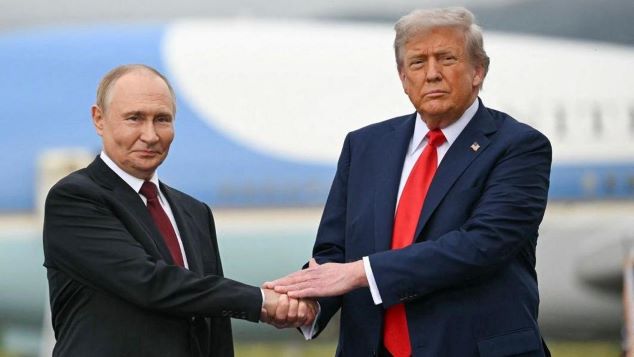
Alaska Summit: Efforts to End the Ukraine-Russia War
– The Alaska Summit was held on 15–16 August 2025 between US President Donald Trump and Russian President Vladimir Putin in Anchorage, Alaska.
– Its main objective was to discuss a ceasefire and a peace agreement to end the Ukraine-Russia war.
– This was the first high-level meeting between the US and Russia since the war began in 2022. Although no concrete agreement was reached, Trump called it “productive.”
– According to reports, Putin made it clear during the summit that he will not withdraw from the Ukrainian territories that Russia has captured. He stated that Ukraine must relinquish these regions to Russia.
– This event is significant in international relations, as it affects conflict resolution, territorial boundaries, and the global balance of power.
Relevance for the UPSC Exam
– From the UPSC exam perspective, this topic is relevant for GS Paper 2 (International Relations) and GS Paper 3 (Security and Economic Impact), where the focus lies on multilateral diplomacy, regional disputes, and India’s foreign policy.
Ukraine–Russia War
– The Ukraine-Russia war began in February 2022 with Russia’s invasion of Ukraine.
– Russia has claimed control over Crimea (occupied since 2014), Donetsk, Luhansk, Kherson, and Zaporizhzhia regions.
– The war has resulted in millions of deaths, displacement, and a global energy and food crisis.
– Trump had promised during his election campaign that he would end the war within 24 hours, and the Alaska Summit was part of that effort.
Trump’s Efforts:
– Trump called the summit “very useful” and held a 3-hour meeting with Putin.
– Initially, he emphasized a ceasefire, but after meeting Putin, he shifted toward a “direct peace agreement” that included territorial settlements.
– A plan by Trump’s advisor Steve Witkoff included Ukraine giving up Donetsk and Luhansk.
– Trump, in an interview on Fox News, appealed to Zelensky to “make a deal,” stating that “Russia is a major power.”
– Trump mentioned the idea of a “territorial swap”, but no concrete agreement was reached.
– Critics say this approach puts pressure on Ukraine under the “America First” policy, while supporters view it as a practical step toward ending the war.
Putin’s Stance:
– Putin also called the summit “very useful” and praised Trump’s peace efforts.
– He opposes a ceasefire, considering it a chance for Ukraine to re-militarize. Instead, he demands a full peace agreement, which includes:
– Ukraine withdrawing troops from Donbas (Donetsk–Luhansk), Crimea, Kherson, and Zaporizhzhia.
– Ukraine becoming a neutral, non-nuclear, and NATO-free country.
– Ensuring rights for Russian-speaking citizens.
– Lifting of Western sanctions.
– Putin’s approach is “maximalist”, aiming for Ukraine’s surrender.
– After the summit, Russia intensified its attacks, indicating Putin’s strategic posture.
European Leaders’ Thinking:
– Reactions are mixed: Many consider it a diplomatic victory for Putin. European leaders are concerned that Trump may force Ukraine to cede territory, comparing it to the “Munich Agreement.”
– French President Emmanuel Macron said that Russia wants Ukraine’s surrender, not peace. German media described it as a Ukrainian defeat.
– EU leaders met in Brussels and emphasized transatlantic unity, Ukraine’s EU membership, and security guarantees. They oppose any “decision without Ukraine” and seek to strengthen NATO’s role.
– Estonian MP Marko Mihkelson warned that this could establish the doctrine of “Might Trumps Right”, endangering the security of Baltic states.
Other Global Dimensions:
– Ukraine’s Perspective: President Zelensky stated that Russia’s refusal complicates the war.
– Ukraine considers territorial concessions unconstitutional and continues to seek EU and NATO membership.
– Global Impact: The summit brought Russia back onto the global stage, but no ceasefire was achieved. It could set a dangerous precedent for regions like Taiwan and the Philippines.
Impact on India
– India welcomed the summit, reiterating PM Modi’s statement: “This is not an era of war.” India’s approach reflects its strategic autonomy:
– Economic Impact: The war has led to rising energy prices, affecting India’s inflation. Cheap oil imports from Russia increased (over 40% in 2024), but Trump’s 50% tariff threat could impact India.
– Security and Defence: India is dependent on Russia (e.g., S-400, Su-30), but the war has disrupted supplies. India maintains balance with the West via alliances like QUAD and I2U2.
– Diplomatic Impact: India attempted to mediate (e.g., Modi’s visit to Russia), but has not become a formal mediator.
– If the war continues longer, it may impact global food security, affecting India’s food exports.
———-
3. Shubhanshu Shukla returned to India after space travel
Astronaut Shubhanshu Shukla Returns to India
– Astronaut Shubhanshu Shukla returned to India from the US on 17 August 2025.
– He is originally from Lucknow and is an Air Force pilot.
– Under the Axiom Mission-4, Shubhanshu Shukla along with three other astronauts departed for the International Space Station (ISS) on 25 June.
– They reached the ISS on 26 June at 4:01 PM IST.
– After spending 20 days in space and 18 days on the ISS, they returned to Earth on 15 July, landing off the coast of California, USA.
– He conducted various types of research on the ISS.
– Shubhanshu Shukla is the first Indian to go to the ISS.
– He is the second Indian to go into space. The first was Rakesh Sharma, who traveled to space 41 years ago in 1984 aboard a Soviet spacecraft.
Discussion on Shubhanshu Shukla in Lok Sabha
– On 18 August 2025, the Lok Sabha held a special discussion on Shubhanshu Shukla’s successful space mission.
– The topic of the debate was:
“India’s First Astronaut on the International Space Station (ISS) – The Role of the Space Program in Developed India 2047.”
Reached the ISS After 6 Years of Training
– Shubhanshu Shukla is a pilot in the Indian Air Force.
– He was selected as an astronaut for the Gaganyaan Mission in 2019.
– From 2019 to 2021, he completed basic astronaut training at Russia’s Yuri Gagarin Cosmonaut Training Center.
– In 2022, he continued training at the Astronaut Training Facility Center in Bengaluru, India.
– In 2025, he completed training with SpaceX in the US.
– SpaceX took him to the ISS under the Axiom-4 mission.
Experience to Help in Gaganyaan Mission
– Shubhanshu’s experience will contribute significantly to India’s Gaganyaan Mission.
– Gaganyaan is India’s first human spaceflight mission.
– The mission aims to send Indian astronauts into low Earth orbit and return them safely.
– It is expected to launch in 2027.
– In India, astronauts are called Gagannauts, while in Russia they are called Cosmonauts, and in China, Taikonauts.
———-
4. Which aquanaut created an Indian record by diving to a depth of 5002 meters in the North Atlantic Ocean?
a. Gota Singh
b. Jatinder Pal Singh
c. Raju Ramesh
d. None of these
Answer: b. Jatinder Pal Singh (Jatinder Pal Singh reached a depth of 5002 meters on 6 August and Raju Ramesh reached a depth of 4,025 meters on 5 August through the French submarine ‘Nautile’)
– About a month after Shubhanshu Shukla reached the International Space Station, two Indian aquanauts set a record for diving to the greatest ocean depths.
– On 6 August, Jatinder Pal Singh reached a depth of 5,002 meters, and on 5 August, Raju Ramesh went 4,025 meters deep using the French submersible ‘Nautile’.
– Both dives took place in the North Atlantic Ocean using the submarine.
– It was a joint mission with France.
About Aquanauts
– People who dive deep into the ocean are called aquanauts.
– Raju Ramesh is a scientist at the National Institute of Ocean Technology (NIOT).
– Jatinder Pal Singh is a retired Commander from the Indian Navy.
Samudrayaan ‘Matsya 6000’
– This mission is part of India’s preparations for its indigenous deep-sea mission ‘Matsya 6000’.
– India’s home-grown ‘Matsya 6000’ submersible is expected to be launched in 2027. It will go as deep as 6,000 meters underwater.
– India is the sixth country to build a manned submersible, after the USA, Russia, Japan, France, and China.
Features of ‘Matsya 6000’
– The ‘Matsya 6000’ submersible can operate continuously for 12–16 hours.
– It will have an oxygen supply for up to 96 hours.
– It has a diameter of 2.1 meters and can carry three people.
– Made of 80mm titanium alloy.
– It can withstand pressure 600 times greater than at sea level (i.e., 600 bar of pressure) at a depth of 6,000 meters.
What is a Submersible? How is it Different from a Submarine?
– Both submarines and submersibles operate underwater, but their design, function, and purpose differ.
– A submarine is a type of watercraft that can operate both on the surface and underwater.
– It runs on electric or diesel engines. Submarines are usually larger in size and can carry many people.
– They are mainly used for reconnaissance, surveillance, and military purposes.
———-
5. In which district of Jammu and Kashmir, more than 60 people died and hundreds were injured due to cloudburst in August 2025?
a. Jammu
b. Kishtwar
c. Reasi
d. Rajouri
Answer: b. Kishtwar
Cloudbursts in Jammu & Kashmir and Himachal Pradesh
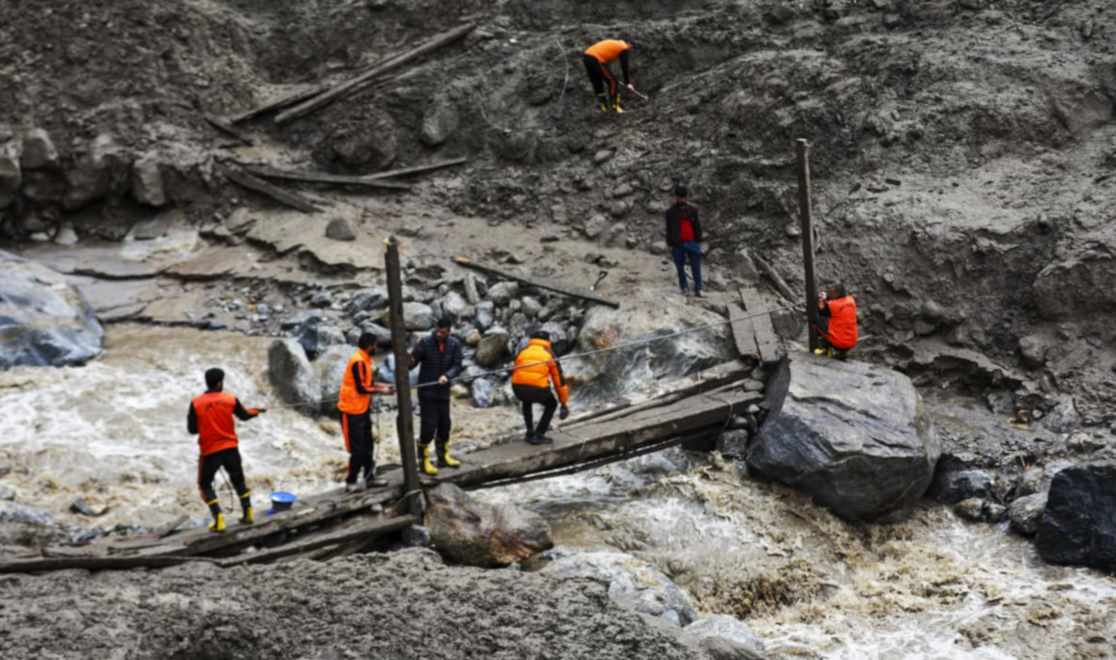
– Between August 15 and 17, multiple cloudburst incidents occurred in various regions of Jammu & Kashmir.
– The most devastating incident happened in Chasoti village of Kishtwar district.
– Over 60 people died due to floods and debris caused by the cloudburst.
– Later, in Kathua district, three cloudbursts occurred in border-adjacent areas, leading to more casualties.
– Meanwhile, in Himachal Pradesh, a cloudburst struck Takoli in Kullu on August 18, 2025.
– Flash floods also hit Panarsa and Naghwai areas of Kullu, leaving debris scattered across the region and causing heavy damage in parts of Kullu and Mandi districts.
Machail Yatra Suspended
– The cloudburst in Chasoti (Kishtwar district) triggered sudden floods while a large number of pilgrims had gathered for the annual Machail Mata temple pilgrimage.
– The yatra had begun on 25 July and was scheduled to end on 5 September.
– The 8.5 km trek to the 9,500-foot high temple starts from Chasoti village, which is about 90 km from Kishtwar town.
What is a Cloudburst?
– A cloudburst refers to an event where extremely heavy rainfall occurs over a small area in a very short time.
– It doesn’t literally mean that a cloud bursts. However, the rainfall is so intense and sudden that it feels like a giant water-filled polythene bag has burst in the sky—hence the term “cloudburst.”
– Not all heavy rainfall qualifies as a cloudburst.
– According to the specific definition:
– Rainfall of 10 cm or more within one hour over an area of about 10 km x 10 km is classified as a cloudburst.
– Similarly, 5 cm rainfall in half an hour over the same area also qualifies.
– That means, if 100 liters or more of rainwater falls over an area of just 1 square meter in less than an hour, it is considered a cloudburst in that region.
Why Does Cloudburst Occur?
– Essentially, clouds are vapour masses formed above the sea due to the heat of the sun, which travel with moist winds from the sea towards the land. When these dense clouds and moist winds reach the land, we say the monsoon has arrived.
– Just like water droplets form on the surface of a cold glass or jug from a refrigerator, similarly, when clouds are in the cold upper atmosphere, they begin to turn into droplets. When these droplets become heavy and fall to the earth, it is called rainfall.
– Monsoon clouds collide with the Himalayas and accumulate heavily, and at some point, these clouds burst like a water-filled bag, causing very rapid and heavy rainfall over a small area.
How Common is Cloudburst?
– Cloudburst is not an unusual event, especially during the monsoon months.
– These events mostly occur in Himalayan states where local topography, wind systems, and temperature differences between lower and upper atmosphere promote such phenomena.
———-
6. When is World Humanitarian Day celebrated?
a. 18 August
b. 19 August
c. 20 August
d. 21 August
Answer: b. 19 August
– This day has been declared by the United Nations.
– In fact, on 19 August 2003, there was a devastating bomb attack on the Canal Hotel in Baghdad, Iraq.
– In that attack, 22 humanitarian workers lost their lives, including Sergio Vieira de Mello, the UN Special Representative for Iraq.
– After this, the day was declared as World Humanitarian Day.
———-
7. Who won the election for the General Secretary of the Constitution Club of India (CCI)?
a. Sanjeev Balyan
b. Rajiv Pratap Rudy
c. Amit Shah
d. VK Singh
Answer: b. Rajiv Pratap Rudy
– Rajeev Pratap Rudy has once again become the General Secretary of the Constitution Club of India (CCI).
– During the elections held in August 2025, there was a contest between BJP’s Rajeev Pratap Rudy and Sanjeev Balyan.
– According to the results, Rajeev Pratap Rudy won with 392 votes, while Sanjeev Balyan got 290 votes. Rudy defeated his rival Balyan by 102 votes.
Other Office Bearers
– Secretary (Culture): Rajya Sabha MP Tiruchi Siva
– Secretary (Sports): Rajeev Shukla
– Treasurer: A. P. Jitender Reddy (Telangana); currently Special Representative of Telangana Government in Delhi
What is the Constitution Club of India (CCI)?
– The Constitution Club of India (CCI) is a prestigious institution located near the Parliament House.
– Established: The Constitution Club was established in 1947.
– Purpose: To provide a place for MPs where they can rise above political and ideological differences to engage in mutual dialogue, relax, and participate in socio-cultural activities.
– Location: It is situated on Rafi Marg, New Delhi, near the Parliament House.
– Membership: Members of Parliament (Lok Sabha and Rajya Sabha) are permanent members. Former MPs can also take membership. Some distinguished individuals are given special membership.
– Facilities: Restaurant, gym, swimming pool, library, meeting halls, and auditorium. Various conferences, seminars, cultural programs, book launches, and social events are regularly held here.
– Importance: It is not only a place for recreation but also a platform for democratic discourse and dialogue. MPs can discuss serious political issues in a comfortable environment.
———-
8. SLINEX-2025 war exercise took place between the navies of India and which country in August 2025?
a. Japan
b. Sri Lanka
c. Australia
d. Bangladesh
Answer: b. Sri Lanka
– SLINEX: Sri Lanka–India Naval Exercise
– Duration: 14 to 18 August 2025
– Edition: 12th
– Venue: Colombo, Sri Lanka
– Indian Warships Participated: INS Rana (Guided Missile Destroyer) and INS Jyoti (Fleet Tanker)
Sri Lanka
– President: Anura Kumara Dissanayake
– Prime Minister: Harini Amarasuriya
– Capital: Sri Jayawardenepura Kotte (Legislative) and Colombo (Executive and Judicial)
– Currency: Sri Lankan Rupee
– Official Languages: Sinhala and Tamil
———-
9. When was the seventh death anniversary of former Prime Minister Atal Bihari Vajpayee celebrated?
a. 6 August, 2025
b. 16 August, 2025
c. 26 August, 2025
d. 8 August, 2025
Answer: b. 16 August, 2025
– Poet, writer, speaker, and politician, Vajpayee served as India’s Prime Minister three times and was the first non-Congress leader to complete a full term.
– Atal Bihari Vajpayee was born on 25 December 1924 in Gwalior, Madhya Pradesh. Later, he grew up in Baah near Agra.
– He served as Prime Minister for 13 days in 1996, for 13 months from 1998 to 1999, and then completed a full term from 1999 to 2004.
———-
10. When is ‘Partition Horrors Remembrance Day’ celebrated?
a. 15 August
b. 14 August
c. 13 August
d. 12 August
Answer: b. 14 August
– This day was first declared in 2021 by Prime Minister Narendra Modi.
– The day is observed to remember the victims and sufferings of people during the India-Pakistan partition.
PDF Download: Click here