
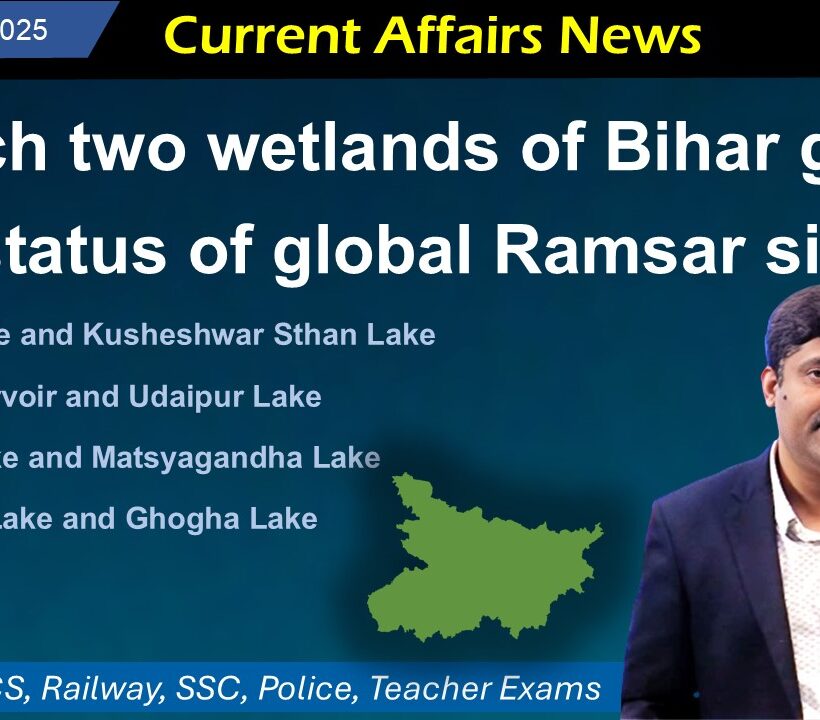
This is the current affairs of 9 October 2025. Here are questions and answers of daily current affairs for better preparation of competitive exams for government jobs.
PDF Download: Click here
1. When was Wildlife Week 2025 celebrated?
a. October 2-8
b. October 3-9
c. October 4-10
d. October 5-15
Answer: a. October 2-8
Theme for 2025
– Theme 2025: Seva Parv – Focusing on service and responsibility towards nature
– Theme 2025: Seva Parv – Focusing on service and responsibility towards nature
– The Union Ministry of Environment, Forest and Climate Change organized Wildlife Week from October 2-8, 2025.
—————
2. Which five national projects were launched by the Central Government during Wildlife Week 2025?
a. Project Dolphin (Phase II), Project Sloth Bear, Project Gharial
b. Centre of Excellence for Human-Wildlife Conflict (CoE-HWC), Tiger Initiatives outside Tiger Reserves
c. Project Peacock, Project Chital, Project Tiger, Project Bear, Project Forest
d. Both a and b
Answer: d. Both a and b (1. Project Dolphin (Phase II), 2. Project Sloth Bear, 3. Project Gharial, 4. Centre of Excellence for Human-Wildlife Conflict (CoE-HWC), 5. Tiger Initiatives outside Tiger Reserves)
1) Project Dolphin (Phase-II): Expansion of monitoring and protection of river and marine dolphins, habitat improvement, reduction of underwater noise, fishing threats, and pollution.
2) Project Sloth Bear: A national implementation framework to prevent habitat loss, conflict zones, and poaching that affect the population of sloth bears.
3) Project Gharial: Focus on river ecosystem restoration, nesting site rehabilitation, and breeding programs. It will work on structured plans for the conservation of the critically endangered gharial.
4) Centre of Excellence for Human-Wildlife Conflict Management (CoE-HWC) at SACON: Establishment of a dedicated national center to support policy, research, and field-based mitigation of human-wildlife conflicts in India, along with the release of an information booklet.
5) Campaign for Tigers Outside Tiger Reserves: Aims to resolve conflicts outside protected areas using a landscape approach, technological interventions, capacity building, and community support.
Four population estimation and monitoring initiatives were also launched.
1) Second cycle of population estimation of river dolphins and other cetaceans, with brochures and field guides developed.
2) All India Tiger Estimation Cycle 6: Field guides developed in eight regional languages.
3) Action plan for the second cycle of snow leopard population estimation.
4) Progress report on population estimation of the Great Indian Bustard and Lesser Florican.
—————-
3. The Union Cabinet decided to celebrate nationwide celebrations to mark the completion of how many years of the national anthem “Vande Mataram”?
a. 100 years
b. 125 years
c. 150 years
d. 160 years
Answer: c. 150 years
– The Union Cabinet has announced a year-long celebration to commemorate the 150th anniversary of India’s national song, Vande Mataram.
– The government says this will be done to honor its historical and cultural significance in the country’s freedom struggle.
– The Union Cabinet took this decision on October 1, 2025.
About the National Anthem
– The song Vande Mataram was composed in Sanskrit by Bankim Chandra Chatterjee in 1875 and is included in his novel Anandamath (1882).
– Dr. Rajendra Prasad officially declared it the national anthem in the Constituent Assembly on January 24, 1950, stating that it would have equal status with the national anthem, Jana Gana Mana.
– The Indian Constitution, under Article 51A(a), requires citizens to respect the Constitution, its ideals, institutions, the national flag, and the national anthem, but does not mention the national anthem.
—
What is the original language of India’s national song ‘Vande Mataram’?
a. Bengali
b. Sanskrit
c. Hindi
d. Tamil
Answer: b. Sanskrit (The original language of India’s national song ‘Vande Mataram’ was Sanskrit, but it was written in Bengali script.)
—————-
4. Which district of Arunachal Pradesh has the state’s first commercial coal mine, which was inaugurated by Union Coal and Mines Minister G. Kishan Reddy?
a. Dibang Valley
b. Changlang
c. Anjaw
d. Kamle
Answer: b. Changlang
– Union Coal and Mines Minister Shri G. Kishan Reddy inaugurated this mine on October 6, 2025, along with Arunachal Pradesh Chief Minister Pema Khandu.
– This is the state’s first commercial coal mine.
– Name: Namchik Namphuk Coal Mine
– The Namchik Namphuk Coal Mine has a coal reserve of 15 million tonnes and became operational today.
It will accelerate the development of which region?
– The Namchik-Namphuk coal mine will play an important role in accelerating the development of the Northeastern region and will also strengthen India’s journey towards Aatmanirbhar Bharat (Self-Reliant India).
– It will not only promote local employment and industrial development, but also enhance the region’s contribution to the nation’s energy security and self-reliance.
– According to some reports, the Namchik-Namphuk coal block is expected to generate an annual revenue of ₹100 crore.
Arunachal Pradesh
– Chief Minister: Pema Khandu
– Capital: Itanagar
– Governor: Lieutenant General Kaivalya Trivikram Parnayak
—————
5. Name the second Anti-Submarine Warfare (ASW-SWC) ship to be inducted into the Indian Navy, which is an Arnala-class ship?
a. INS Androth
b. INS Ajay
c. INS Anjadip
d. INS Vikrant
Answer: a. INS Androth
– INS Androth is the second ship of the Arnala class of anti-submarine warfare shallow water craft (ASW SWC) of the Indian Navy.
– The ship was commissioned on 6 October 2025.
– The ceremony was presided over by Vice Admiral Rajesh Pendharkar, Flag Officer Commanding-in-Chief, Eastern Naval Command.
– This is the second anti-submarine warfare ship (ASW-SWC) to be inducted into the Indian Navy.
– INS Androth was recently commissioned. Earlier warships like Arnala, Nistar, Udaygiri and Nilgiri have also been inducted into the Navy.
– All these ships demonstrate that the Navy is being strengthened and modernized with new and different platforms.
About INS Androth
– Name: INS Androth
– Named after: Androth Island
– Class: Arnala class
– Owner: Indian Navy
– Operator: Indian Navy
– Builder: Garden Reach Shipbuilders and Engineers (GRSE), Kolkata
– Cost: Approximately ₹789 crore
– Launch: 6 October 2025
– Speed: 25 knots (46 km/h; 29 mph)
—————

6. When is World Cotton Day (WCD) celebrated?
a. October 6
b. October 7
c. October 8
d. October 10
Answer: b. October 7
Theme for the year 2025
– Cotton 2040: Technology, Climate and Competitiveness
– This day was declared by the United Nations General Assembly in 2021.
– India is the world’s second-largest cotton producer and consumer, and plays a major role in the global economy.
– The top five cotton-producing countries are China, India, the United States, Brazil, and Pakistan, which together account for more than three-quarters of global production.
– The cotton we come into contact with every day is a source of livelihood for millions of small farmers and laborers, including women and their families, and contributes significantly to the economies of many developing countries.
—————
7. Which two wetlands of Bihar got the status of global Ramsar site in September 2025?
a. Gogabill Lake and Kusheshwar Sthan Lake
b. Gokul Reservoir and Udaipur Lake
c. Anupam Lake and Matsyagandha Lake
d. Kharagpur Lake and Ghogha Lake
Answer: b. Gokul Reservoir and Udaipur Lake (Gokula is in Buxar and Udaipur Lake is in West Champaran. There are already two other Ramsar sites here: Kabartal (Kanwar Lake), Nagi Bird Sanctuary, and Nakati Bird Sanctuary. The total number will increase to five by October 2025.)
– India has added two new wetlands from Bihar—the Gokul Reservoir in Buxar and the Udaipur Lake in West Champaran—to the global list of Ramsar Convention sites of international importance.
– With the addition of these sites, the number of Ramsar sites in India now stands at 93, covering an area of 13,60,719 hectares.
– It retains its top position in Asia and ranks third globally, with the UK (176) and Mexico (144) at first and second.।
What is a wetland?
– A wetland is a place where water accumulates during the rainy season. A large number of bird species are also found in this area.
– Over the years, many sites have been included in the Ramsar list, and UNESCO provides assistance in their conservation.
Why is it called a Ramsar site?
– Ramsar is a city in Iran.
– It was here on February 2, 1971, that the countries of the world signed the Ramsar Convention on Wetlands.
– That is why it is called the Ramsar Convention. Some people also call this treaty the Wetland Convention.
– It came into force in 1975.
– The formal name of this treaty is – Convention on Wetlands of International Importance, especially as Waterfowl Habitat.
– It is an intergovernmental treaty that provides guidance regarding the conservation and wise use of wetlands.
– India signed this treaty in 1982.
– The Union Ministry of Environment, Forest and Climate Change is the nodal ministry for wetland conservation in India.
India’s 93 Ramsar sites (as of October 10, 2025)
1. Asthamudi Wetland, Kerala
2. Beas Conservation Reserve, Punjab
3. Bhitarkanika Mangroves, Odisha
4. Bhoj Wetlands, Madhya Pradesh
5. Chandertal Wetland, Himachal Pradesh
6. Chilika Lake, Odisha
7. Deepor Beel, Assam
8. East Kolkata Wetlands, West Bengal
9. Harike Lake, Punjab
10. Hokera Wetland, Jammu and Kashmir
11. Kanjli Lake, Punjab
12. Keoladeo Ghana NP, Rajasthan
13. Keshopur-Miani Community Reserve, Punjab
14. Kolleru Lake, Andhra Pradesh
15. Loktak Lake, Manipur
16. Nalsarovar Bird Sanctuary, Gujarat
17. Nandur Madmaheshwar, Maharashtra
18. Nangal Wildlife Sanctuary, Punjab
19. Nawabganj Bird Sanctuary, Uttar Pradesh
20. Parvati Agra Bird Sanctuary Sanctuary, Uttar Pradesh
21. Point Calimere Wildlife and Bird Sanctuary, Tamil Nadu
22. Pong Dam Lake, Himachal Pradesh
23. Renuka Wetland, Himachal Pradesh
24. Ropar Lake, Punjab
25. Rudrasagar Lake, Tripura
26. Saman Bird Sanctuary, Uttar Pradesh
27. Samaspur Bird Sanctuary, Uttar Pradesh
28. Sambhar Lake, Rajasthan
29. Sandi Bird Sanctuary, Uttar Pradesh
30. Sarasai Nawar, Uttar Pradesh
31. Sasthamkotta Lake, Kerala
32. Sundarban Wetland, West Bengal
33. Surinsar-Mansar Lakes, Jammu and Kashmir
34. Tsomoriri Lake, Jammu and Kashmir
35. Upper Ganga River, Uttar Pradesh
36. Vembanad Kol Wetland, Kerala
37. Wular Lake, Jammu and Kashmir
38. Asan Conservation Reserve, Uttarakhand
39. Kabartal (Kanwar Lake), Bihar
40. Keetham Lake (Sursarovar), Uttar Pradesh (Agra)
41. Lonar Lake, Maharashtra
42. Startsapuk Tso and Tso Kar Lakes, Ladakh
43. Sultanpur National Park, Haryana
44. Bhidawas Wildlife Sanctuary, Haryana
45. Thol Lake Wildlife Sanctuary, Gujarat
46. Wadhwana Wetland Area, Gujarat
47. Haiderpur Wetland, Uttar Pradesh
48. Khijadiya Bird Sanctuary, Gujarat
49. Bakhira Wildlife Sanctuary, Uttar Pradesh
50. Karikili Bird Sanctuary, Tamil Nadu
51. Pallikaranai Marsh Reserve Forest, Tamil Nadu
52. Pichavaram Mangroves, Tamil Nadu
53. Pala Wetland, Mizoram
54. Sakhya Sagar Wetland, Madhya Pradesh
55. Koonthankulam Bird Sanctuary, Tamil Nadu
56. Satkosia Gorge, Odisha
57. Nanda Lake, Goa
58. Gulf of Mannar Marine Biosphere Reserve, Tamil Nadu
59. Ranganathittu Bird Sanctuary, Karnataka
60. Vembannur Wetland Complex, Tamil Nadu
61. Vellode Bird Sanctuary, Tamil Nadu
62. Sirpur Wetland, Madhya Pradesh State
63. Vedanthangal Bird Sanctuary, Tamil Nadu
64. Udayamarthandapuram Bird Sanctuary, Tamil Nadu
65.Tampara Lake, Odisha
66. Hirakud Reservoir, Odisha
67. Anshupa Lake, Odisha
68. Yashwant Sagar, Madhya Pradesh
69. Chitrangudi Bird Sanctuary, Tamil Nadu
70. Suchindram Theroor Wetland Complex, Tamil Nadu
71. Vaduvur Bird Sanctuary, Tamil Nadu
72. Kanjirkulam Bird Sanctuary, Tamil Nadu
73. Thane Creek, Maharashtra
74. Haigam Wetland Conservation Reserve, Jammu and Kashmir
75. Shalbug Wetland Conservation Reserve, Jammu and Kashmir
76. Ankasamudra Bird Conservation Reserve, Karnataka
77. Aghanashini Sanctuary, Karnataka
78. Magadi Kere Conservation Reserve, Karnataka
79. Karaivetti Bird Sanctuary, Tamil Nadu
80. Longwood Shola Reserve Forest, Tamil Nadu
81. Nagi Bird Sanctuary, Bihar
82. Nakati Bird Sanctuary, Bihar
83. Nanjarayan Bird Sanctuary, Tamil Nadu
84. Kazhuveli Bird Sanctuary, Tamil Nadu
85. Tawa Reservoir, Madhya Pradesh
86. Sakkarakottai Bird Sanctuary, Tamil Nadu
87. Theerthangal Bird Sanctuary, Tamil Nadu
88. Khecheopalri Wetland, Sikkim
89. Udhwa Lake, Jharkhand
90. Menar Wetland Complex, Rajasthan (Udaipur)
91. Khichan Wetland, Rajasthan (Jodhpur)
92. Gokul Reservoir, Bihar (Buxar)
93. Udaipur Lake, Bihar (West Champaran)
—————-
8. In which state is Gokul Reservoir located, which has been given the status of Ramsar site?
a. Uttar Pradesh
b. Madhya Pradesh
c. Rajasthan
d. Bihar
Answer: d. Bihar
– Gokul Reservoir was added to the Ramsar list of sites in September 2025.
– Oxbow lake located on the southern bank of the Ganges River. (A U-shaped lake or pond formed when a meander is cut off from the main channel, leaving the bent portion of the river as a separate body of water. These lakes are the result of river development and erosion, often found in floodplains.)
– Ecological role: Acts as a natural flood barrier for nearby villages and provides habitat for over 50 bird species.
– Community connectivity: Provides livelihoods through fishing, agriculture, and irrigation.
– Local tradition: Villagers clean the catchment area every year during a festival.
—————-
9. Udaipur Lake, which has been declared a Ramsar site, is located in which district of Bihar?
a. Patna
b. Ara
c. Muzaffarpur
d. West Champaran
Answer: d. West Champaran
– This lake received Ramsar status in September 2025.
About Udaipur Lake, West Champaran
– It is an oxbow lake surrounding the village. (A U-shaped lake or pond formed when a meander is cut off from the main stream by a wide river channel, leaving the bend as a separate body of water. These lakes are the result of river development and erosion, often found in floodplains.)
– Biodiversity: 280 plant species are found here, including Alysicarpus roxburghianus (endemic to India).
– It is an important wintering habitat for 35 migratory bird species, including the endangered Common Pochard.
—————-
10. In which district and state did the Menar Wetland Complex get the status of Ramsar site?
a. Udaipur, Rajasthan
b. Jodhpur, Rajasthan
c. Kollam, Kerala
d. Agra, Uttar Pradesh
Answer: a. Udaipur, Rajasthan
– It received Ramsar status on World Environment Day (June 5, 2025).
– Complex means a group of several ponds or lakes.
About the Menar Wetland Complex
– This site is a rain-fed freshwater wetland complex, consisting of three major ponds: the Brahma Talab, the Dhandh Talab, and the Kheda Talab, and the adjoining agricultural land.
– Location: Located near Menar village in Udaipur district.
– Key Features: The flooding of agricultural land during the monsoon season makes the area an ideal habitat for birds. Over 100 waterbirds are found here, including 67 migratory species. The critically endangered vulture species, the White-rumped Vulture (Gyps bengalensis) and the Long-billed Vulture (Gyps indicus), are also seen here. Over 70 plant species are found here, including a large colony of Indian Flying Foxes (Pteropus giganteus) in the mango trees surrounding the Brahma Talab.
– Community Contribution: This site is an important example of community conservation in Rajasthan. The locals themselves protect the wildlife by prohibiting activities like hunting and fishing. This has made the area a safe haven for birds.
—————
11. In which district and state did Khichan Wetland get the status of Ramsar site?
a. Udaipur, Rajasthan
b. Jodhpur, Rajasthan
c. Kollam, Kerala
d. Agra, Uttar Pradesh
Answer: b. Jodhpur, Rajasthan
– This lake was designated a Ramsar site on World Environment Day (June 5, 2025).
– Introduction: Located in the northern Thar Desert, the Kheechan Wetland comprises two water bodies, the Ratri River and the Vijay Sagar Pond, riparian habitats, and shrublands.
– Location: In the Phalodi area of Jodhpur district.
– Key Features: This desert ecosystem is an important habitat for drought-resistant plant species that provide habitat for over 150 bird species.
The site is particularly known for its large winter flocks of migratory Demoiselle Cranes (Anthropoides virgo), numbering over 22,000 annually.
– Local efforts: Local people work to protect the Demoiselle Cranes by reducing deaths from collisions with power lines and stray dog attacks, which are threats to the cranes’ survival. The site is extremely popular with birdwatchers, scientists, students, and tourists.
—————-
12. When is Air Force Day celebrated?
a. October 5th
b. October 6th
c. October 7th
d. October 8th
Answer: d. October 8th
Why is the day celebrated on October 8?
– The Air Force was established on October 8, 1932.
– At that time, it was known as the Royal Indian Air Force (RIAF).
– The first squadron of the Air Force was formed on April 1, 1933, the year after its establishment.
– The Indian Air Force also played an important role during World War II.
– Before the country’s independence, the Air Force functioned under the Army.
– After independence, the word “Royal” was removed from the Air Force’s name, making it simply “Indian Air Force.”
– In independent India, Sir Thomas W. Elmhurst was appointed the first Chief of the Indian Air Force, Air Marshal.
Motto from the Gita
– The motto of the Indian Air Force is ‘Nabha: Sprisham Deeptam’ (Touch the Sky with Pride)
– It is taken from Chapter 11 of the Gita.
– It is an excerpt from the sermon given by Lord Shri Krishna to Arjuna in the battle of Kurukshetra during the Mahabharata War.
Air Chief Marshal: Amarpreet Singh
—————
13. The Cabinet Committee on Economic Affairs (CCEA) approved four railway projects worth ₹24,634 crore.
Total Investment: ₹24,634 crore
Network Expansion: 894 route km
Additional Freight Capacity: 78 million tonnes per year
Project, Length (km), State
1) Wardha – Bhusawal 3rd and 4th Line, 314, Maharashtra
2) Vadodara – Ratlam 3rd and 4th Line, 259, Gujarat and Madhya Pradesh
3) Gondia – Dongargarh 4th Line, 84, Maharashtra and Chhattisgarh
4) Itarsi – Bhopal – Bina 4th Line, 237, Madhya Pradesh
– These projects will play a vital role in the transportation of industrial goods such as coal, cement, containers, fly ash, food grains, and steel.
– The new lines are expected to increase Indian Railways’ annual freight capacity from 1.61 billion tonnes (FY 2024–25) to 2 billion tonnes.
In addition, these routes will connect several major tourist destinations, such as:
– Sanchi – UNESCO World Heritage Site
– Satpura Tiger Reserve
– Bhimbetka Rock Shelters
– Hazara Falls
– Navegaon National Park
—————-
PDF Download: Click here