
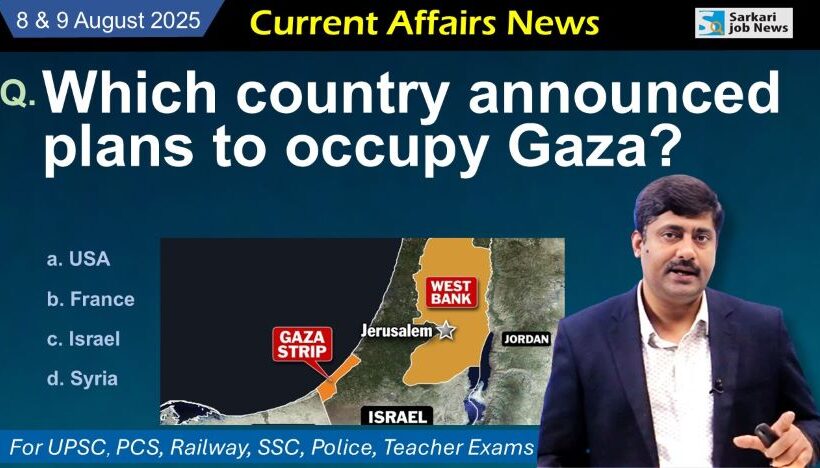
This is the current affairs of 8 & 9 August 2025. Here are questions and answers of daily current affairs for better preparation of competitive exams for government jobs.
PDF Download: Click here
1. In which hill station did the Supreme Court ban ‘hand rickshaws’?
a. Mussoorie
b. Matheran
c. Gangtok
d. Srisailam
Answer: b. Matheran (Maharashtra)
—–
In which state’s hill station ‘Matheran’, the Supreme Court called the practice of ‘hand rickshaw’ inhuman and ordered to stop it and replace it with e-rickshaw?
a. Bihar
b. Maharashtra
c. West Bengal
d. Uttar Pradesh
Answer: b. Maharashtra
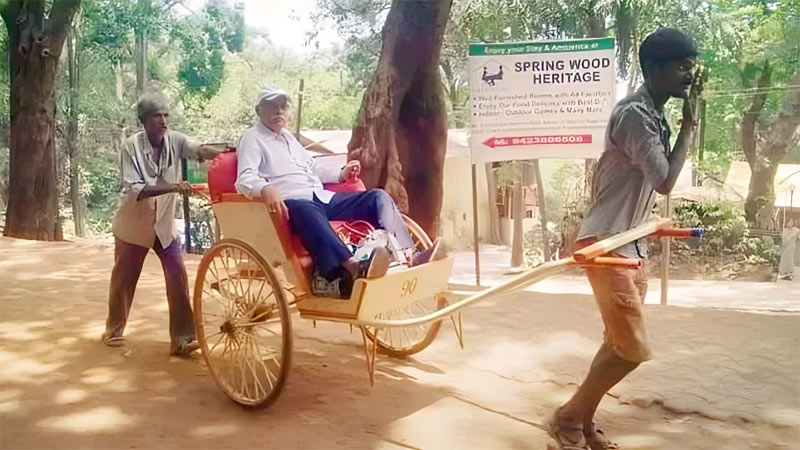
– Supreme Court’s Decision Came on August 6, 2025
About the Hill Station ‘Matheran’
– State: Maharashtra
– District: Raigad
– Altitude: 800 meters (2600 feet) above sea level
– Matheran is one of the smallest hill stations in India. It is located approximately 90 km from Mumbai and 120 km from Pune.
– In Marathi, the name ‘Matheran’ means “Forest on the forehead of the mountains.”
– Environmental Sensitivity: It is declared an environmentally sensitive area by the Ministry of Environment, Forest and Climate Change, Government of India.
– Special Feature: It is a partially automobile-free hill station.
Why Were Hand-Pulled Rickshaws Still Running in Matheran?
– Due to its status as an environmentally sensitive area, petrol and diesel vehicles are banned in Matheran.
– As a result, hand-pulled rickshaws were used as a mode of transport for tourists and locals. In addition, there are over 400 horses used to assist tourists.
– In light of previous Supreme Court directives, a few e-rickshaws have also been introduced.
– In February 2025, the Supreme Court directed the Maharashtra government to frame an e-rickshaw policy within six months.
– In August 2025, the court imposed an immediate ban on hand-pulled rickshaws.
What Did the Supreme Court Say?
– In its verdict, the Chief Justice of the Supreme Court said:
“It is unfortunate that hand-pulled rickshaws continue even after 78 years of independence, 75 years of the Constitution, and 45 years of this historic judgment.”
– The bench comprising Chief Justice B.R. Gavai, Justice K. Vinod Chandran, and Justice N.V. Anjaria stated:
“No person pulls another by choice. They do so because they have no other means of livelihood. But this practice is against human dignity. Continuing it would be an insult to the constitutional promise of social and economic justice.”
Reference to a 1980 Judgment
– The Court referenced the historic 1980 judgment “Azad Rickshaw Pullers Association vs Punjab.”
– That judgment included several directives to ensure a dignified life for rickshaw pullers.
– The Chief Justice reiterated: “It is unfortunate that hand-pulled rickshaws continue even after 78 years of independence, 75 years of the Constitution, and 45 years of this historic judgment.”
Origin of Hand-Pulled Rickshaws in Japan
– Hand-pulled rickshaws originated in 1869 in Japan, where three entrepreneurs — Suzuki Tokujirō, Izumi Yosuke, and Takayama Kosuke — invented the concept.
– The idea quickly spread to other Asian countries like China and India, where rickshaws became a popular mode of transport.
– In India, hand-pulled rickshaws were first seen in Shimla in the late 19th century.
– During the 20th century, they were gradually replaced by cycle rickshaws, auto-rickshaws, and eventually electric rickshaws.
The Practice in Kolkata
– Hand-pulled rickshaws were a part of Kolkata’s identity for over 125 years. They were banned about a decade ago.
– The tradition started in the late 19th century when Chinese traders introduced them primarily for transporting goods.
– Before and shortly after independence, they were seen as a symbol of pride and social status.
– The wealthy used palanquins, while the middle and upper-middle classes relied on hand-pulled rickshaws for transportation.
– During the 1971 Bangladesh Liberation War, they became the primary livelihood for refugees crossing the border.
– Eventually, the state government banned them, labeling the practice as inhumane.
—————
2. Amid the tariff dispute, which minister postponed his August 2025 visit to the US, where a ten-year defense partnership framework was to be signed between the two countries?
a. Prime Minister
b. Defence Minister
c. Foreign Minister
d. Home Minister
Answer: b. Defence Minister (Rajnath Singh)
– Defense Minister Rajnath Singh’s visit to the United States, which was scheduled for the last week of August 2025, has been postponed due to the ongoing tariff dispute.
– However, government sources in India have told the media that the trip has been postponed, not canceled, as was previously reported, and it is likely to take place in the next few months.
– Just before this, the international news agency Reuters reported, citing sources, that due to the tariff dispute, India has suspended defense deals with the U.S.
– Indian government sources have denied this claim in the media, stating that no defense agreements or purchases have been canceled, and that these will proceed in the future.
– Meanwhile, Indian Prime Minister Narendra Modi held a telephone conversation with Russian President Vladimir Putin.
– The two leaders engaged in detailed discussions regarding the bilateral agenda and developments in Ukraine, at a time when Trump was pressuring India over its oil imports from Russia.
About the 10-Year Defense Partnership Framework (Next 10-Year U.S.-India Defense Framework)
Background of the Agreement
– In February 2025, Prime Minister Modi and President Trump issued a joint statement, announcing plans to sign a 10-year defense partnership framework.
– On July 1, 2025, Defense Minister Rajnath Singh and U.S. Secretary of Defense Pete Hegseth held a phone meeting and agreed to sign the defense cooperation framework on time for the next 10 years.
– However, the tariff dispute escalated, with the U.S. increasing tariffs on Indian goods by up to 50%.
– Amid this dispute, Rajnath Singh’s visit to the U.S. was postponed.
Objectives of the 10-Year Defense Partnership Framework
– To enhance cooperation in all sectors, including Army, Navy, Air Force, Cybersecurity, and Space.
– To accelerate co-production, such as manufacturing GE F404 and F414 engines in India, and systems like Javelin missiles and Stryker vehicles.
– To strengthen interoperability (tactical coordination), logistics partnerships, strategic supply chains, and joint exercises.
– To promote defense technology innovation and industrial cooperation through platforms like INDUS-X (India–U.S. Defense Acceleration Ecosystem).
Key Objectives
– Javelin Missiles, Stryker Vehicles, P-8I Aircraft, F404/F414 Engines, INDUS-X procurement
What is the Importance of this Proposed Agreement?
Balancing China’s Influence
– This framework is crucial to balance China’s increasing military influence in the Indo-Pacific region.
– The U.S. wants India to play the role of a Security Provider in the region.
– For India, this is a dual strategy: reducing pressure from the border dispute with China and strengthening its naval presence in the Indian Ocean.
Transfer of Defense Technology
– Through co-production and co-development, India will gain access to advanced technology and enhance its defense manufacturing capabilities.
– Examples:
GE F-414 Engines → For indigenous fighter jets
Javelin ATGM → To enhance anti-tank capabilities
Stryker Armored Vehicle → For mobile combat capability
Impact on Defense Exports
– By leveraging the U.S.-India partnership, India can increase its defense exports to Southeast Asia, Africa, and the Middle East markets.
– Through this partnership, the ‘Make in India’ defense equipment can be certified to international standards with the cooperation of the U.S.
Interoperability and Joint Operations
– There will be an increase in communication, logistics, and operation protocols between the two countries’ armed forces.
– Joint training exercises such as the Malabar Naval Exercise, War Games, and Tiger Triumph will be conducted at even more advanced levels.
Challenges and Cautions
Defense Relations with Russia
– India is still purchasing S-400 systems and other weapons from Russia, so caution will be exercised in the technology transfer process with the U.S.
Technology Control Laws (ITAR)
– The U.S. has strict regulations on the transfer of weapon technology, which means a fully open transfer of defense technology may not be possible.
Competitive Pressure on Domestic Defense Industry
– The influx of foreign technology will require rapid upgrades by Indian private and public defense companies to stay competitive.
Potential Long-Term Impact
Geopolitics
– India’s strategic position against China will be strengthened.
Defense Production
– India could emerge among the top 5 defense producers globally.
Maritime Security
– U.S.-India naval patrols and surveillance in the Indian Ocean will increase.
Technology
– Progress in the development of drones, AI-based warfare systems, and hypersonic weapons will be seen.
Diplomacy
– India’s role in Quad (Quadrilateral Security Dialogue) and the Indo-Pacific strategy will become more central.
—————
3. In which country will PM Modi visit to attend the Shanghai Cooperation Organisation (SCO) Summit on 31 August and 1 September?
a. China
b. Russia
c. Iran
d. Pakistan
Answer: a. China
– Prime Minister Modi’s upcoming visit to China will be his first since the 2020 Galwan Valley military clash between India and China.
– He had previously visited China in 2018, and this will be his sixth visit to the country as Prime Minister.
– This makes it the most visits by any Indian PM to China in 70 years.
– In October 2024, Modi met with Chinese President Xi Jinping during the BRICS summit in Kazan.
– This trip to China, as part of the SCO summit, comes amid growing pressure from U.S. President Donald Trump over tough tariffs and increasing demands on India to curb oil imports from Russia.
– It is expected that, under these circumstances, improvement in India-China relations could serve as a balancing factor for the United States.
Defense Minister’s Refusal to Sign Joint Statement
– In June 2025, Defense Minister Rajnath Singh refused to sign a joint statement at the SCO meeting of defense ministers.
– The reason was the absence of any mention of the terrorist attack in Pahalgam on April 22, which resulted in the deaths of 26 people.
– Instead, the statement mentioned Balochistan, implying an indirect accusation against India of inciting unrest in the region.
– However, China recently issued a strong statement against terrorism, after the U.S. declared the Pakistan-based Lashkar-e-Taiba affiliate group, The Resistance Front, as a foreign terrorist organization for its involvement in the Pahalgam attack.
– At the SCO Summit, discussions are expected to cover trade, terrorism, and regional security with all ten member nations participating.
Last Month, S. Jaishankar Visited China
– In July 2025, Foreign Minister S. Jaishankar visited China, where he met with President Xi Jinping and Foreign Minister Wang Yi.
– Jaishankar raised several key issues, including:
-Water resource data sharing
-Trade restrictions
-Reducing tensions at the LAC (Line of Actual Control)
-Taking a strong stance against terrorism and extremism.
– According to media reports, this meeting set the roadmap for Modi’s visit to China.
Xi Jinping’s Last Visit to India in 2019
– Xi Jinping last visited India in 2019, where he met Prime Minister Modi in Mahabalipuram, Tamil Nadu.
– This visit was a significant step toward strengthening India-China relations and managing their mutual differences.
– Both leaders agreed on maintaining peace and stability along the border.
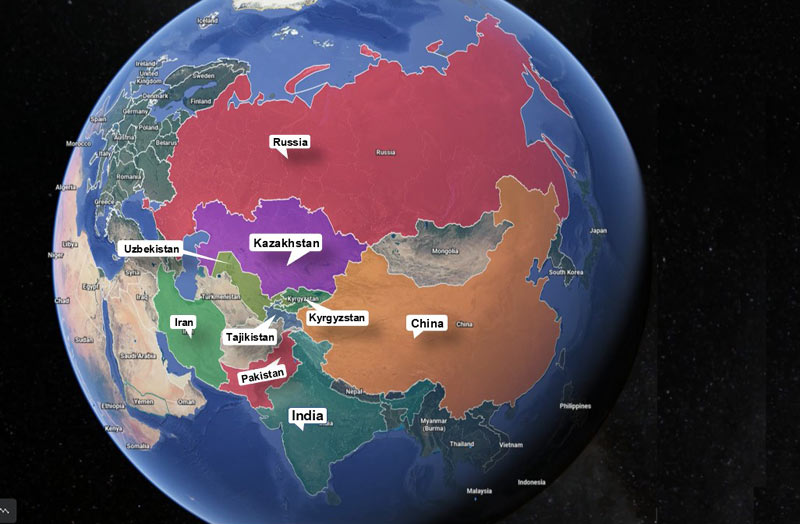
Shanghai Cooperation Organization (SCO)
– SCO is a regional international organization.
– It is a Eurasian political, economic, international security, and defense organization established by China and Russia.
– It is an expansion of the Shanghai Five, which was formed in 1996 between the People’s Republic of China, Kazakhstan, Kyrgyzstan, Russia, and Tajikistan.
– Currently, there are 10 member countries in the SCO.
– The SCO has emerged as a significant economic and security bloc and one of the largest inter-regional international organizations.
Member Countries
– China
– Russia
– Kazakhstan
– Kyrgyzstan
– Tajikistan
– Uzbekistan
– India
– Pakistan
– Iran
– Belarus
—————
4. Prime Minister Narendra Modi inaugurated a part of the Common Central Secretariat Building on August 6, 2025, what is its name?
a. Karya Bhawan-3
b. Rashtra Bhawan-2
c. Kartavya Bhawan-3
d. Path Bhawan
Answer: c. Kartavya Bhawan-3
– Duty Bhavan is the first of the ten Common Central Secretariat buildings being built for the bureaucracy.
– The purpose of this project is to bring ministries and departments under one roof for efficiency.
– The first building to be inaugurated, Duty Bhavan-03, will house the Ministry of Home Affairs, Ministry of External Affairs, Ministry of Rural Development, MSME, DoPT, Ministry of Petroleum and Natural Gas, and the Office of the Principal Scientific Adviser.
– The Ministry of Housing and Urban Affairs has planned the construction of ten buildings as part of the government’s Central Vista Redevelopment Project under the Common Central Secretariat (CCS).
– Duty Bhavan-03 has a plinth area of 1.5 lakh square meters and a basement area of 40,000 square meters. Its parking can accommodate 600 cars.
– The Ministry of Housing and Urban Affairs has said that Duty Bhavan-03 will have a crèche, a yoga room, a medical room, a café, a kitchen, and a multipurpose hall.
– It will have 24 main conference rooms, each with a seating capacity of 45 people.
– There are 26 small conference rooms, each with a seating capacity of 25 people, 67 meeting rooms, and 27 lifts.
Why the Need
– According to the government, many major ministries are working in old buildings built between the 1950s and 1970s, such as Shastri Bhavan, Agriculture Bhavan, Industry Bhavan, and Construction Bhavan, which are now “structurally outdated.”
—————
5. The Defense Acquisition Council (DAC) approved several procurement proposals worth how many crores in August 2025 to strengthen the country’s military preparedness?
a. Rs 60,000 crore
b. Rs 57,000 crore
c. Rs 66,000 crore
d. Rs 67,000 crore
Answer: d. Rs 67,000 crore
– Under the chairmanship of Defence Minister Rajnath Singh, the DAC (Defence Acquisition Council) has approved measures to enhance the capabilities of the Army, Air Force, and Navy.
– For the Army, approval has been given for the procurement of a thermal imager-based driver night sight for BMP (Boyevaya Mashina Pekhoty).
– This will enhance the night-time driving capability of the BMP.
– The purchase of mountain radar and the upgrade of the ‘Akash/Spider’ weapon system have also been approved.
– The deployment of mountain radar will improve air surveillance capabilities along the borders in hilly areas.
– Additionally, linking the Spider system with the Integrated Air Command and Control System will enhance the Air Force’s capabilities.
– For the Navy, approval has been granted for the procurement of compact autonomous surface craft, BrahMos fire control systems, and launchers, as well as the Barak-1 point defence missile system.
– The acquisition of compact autonomous surface craft will provide the Navy with the ability to detect threats in anti-submarine warfare operations.
– The purchase of Medium Altitude Long Endurance (MALE) Remotely Piloted Aircraft (RPA) for all three services has been approved.
– The proposed MALE RPAs will be able to carry multiple payloads and weapons.
– Additionally, the DAC has approved the AON for maintenance of the C-17 and C-130J fleets and the annual maintenance contract for the S-400 long-range air defence missile system.
————–
6. Which country announced plans to capture Gaza city?
a. USA
b. France
c. Israel
d. Syria
Answer: c. Israel
– The office of Israeli Prime Minister Benjamin Netanyahu has announced that the Israeli security cabinet has approved plans to seize the city of Gaza.
– This decision, taken on August 8, 2025, represents another escalation in the 22-month military campaign launched by Israel in response to the Hamas attack on October 7, 2023.
– Despite international concerns, domestic opposition, and the already severe humanitarian crisis in the region, this step has been taken.
UN has
– Meanwhile, the United Nations Human Rights Chief Volker Turk on Friday, August 8, 2025, urged the Israeli government to immediately halt its plan for full military occupation of the Gaza Strip.
– He warned that this plan would lead to widespread displacement, more killings, unbearable suffering, and an increase in atrocities.
– Turk described the plan as being against the International Court of Justice (ICJ) ruling, which called for Israel to end its occupation policy as soon as possible and implement a two-state solution.
Humanitarian Impact
– Gaza has already experienced widespread destruction due to the war, with over 61,000 Palestinians having died, and nearly 75% of the population displaced.
– A large-scale military operation in Gaza city could result in the displacement of thousands more and disrupt food distribution, deepening the hunger crisis.
Hostage Situation
– On October 7, 2023, Hamas took 251 hostages, of whom 50 are still in Gaza, and Israel believes that approximately 20 of them are alive.
– The families of the hostages have opposed this plan, as they believe that the military escalation could put their loved ones’ lives in danger.
Israel – Hamas War
– In the attack led by Hamas on October 7, 2023, nearly 1,200 Israelis were killed, and 251 people were taken hostage, after which Israel launched a large-scale military operation in Gaza.
– According to the Gaza Health Ministry, more than 61,000 Palestinians have been killed in this war, although this number does not differentiate between civilians and fighters.
– The United Nations and independent experts have deemed these figures to be credible.
Israel
– Capital: Jerusalem (limited international recognition)
– President: Isaac Herzog
– Prime Minister: Benjamin Netanyahu
– Currency: New Shekel
– Population: Approximately 10 million
– Neighboring countries: Lebanon, Syria, Jordan, Egypt, Palestine
Palestine
– Divided into two parts: West Bank and Gaza Strip
– Declared Capital: Jerusalem (East Jerusalem, limited international recognition)
– Administrative Center: Ramallah
– Currency: Israeli New Shekel, Jordanian Dinar, Egyptian Pound
– Population: Approximately 5.477 million
– Neighboring countries: Israel, Jordan, Egypt
– President: Mahmoud Abbas
– Prime Minister: Mohammad Mustafa
– Hamas controls the Gaza Strip, while the Palestinian Authority (led by Fatah) has partial governance over the West Bank.
—————
7. Rahul Gandhi alleges vote theft, presents evidence in press conference
Opposition Leader and Congress Leader Rahul Gandhi’s Press Conference Claim
– On August 7, 2025, in a press conference in New Delhi, Rahul Gandhi, the Leader of Opposition in Lok Sabha and Congress leader, claimed that there was widespread voter fraud in the 2024 Lok Sabha elections and recent other elections.
– He referred to it as “vote theft” and stated that it poses a threat to Indian democracy.
– According to him, this fraud primarily occurred through manipulation of voter lists, which included duplicate voters, fake addresses, and the illegal addition of new voters.
– He accused the Election Commission of India (ECI) and the Bharatiya Janata Party (BJP) of “vote theft” in the 2024 Lok Sabha elections and other recent elections.
– These allegations have sparked a major controversy in Indian politics, highlighting important issues like democracy, the fairness of the electoral process, and the credibility of constitutional institutions.
What Did the Election Commission Say?
– The Election Commission has told Congress MP Rahul Gandhi that if he believes his claims of vote theft are correct, he should sign an affidavit confirming his statement. If he does not trust his claims, he should apologize to the nation.
Main Allegations of Vote Theft – In his press conference, Rahul Gandhi emphasized the following points:
– Duplicate and Fake Voters: He cited the example of Mahadevapura assembly constituency in Bengaluru Central Lok Sabha seat, claiming that more than 1,00,250 fake votes were found. This included 11,965 duplicate voters, 40,009 voters with incorrect addresses, 10,452 voters registered at the same address, and 4,132 voters with unclear photos.
– Role of Election Commission: Gandhi alleged that the Election Commission played a significant role in this fraud and failed to provide machine-readable data of the voter list and CCTV footage due to a lack of transparency.
– Targeting BJP: He claimed that the fraud was carried out to benefit the BJP, as other parties face the anti-incumbency wave, but the BJP seems unaffected by it.
– Fraud in Karnataka and Maharashtra: Gandhi mentioned that Congress should have won 16 seats in Karnataka, but due to fraud, it only won 9 seats. He also claimed that millions of voters in Maharashtra were added to the list in a suspicious manner.
– Claim of Evidence: Rahul Gandhi stated that his team had investigated the matter for 6 months and had 100% solid evidence, which would be made public soon.
– Uttar Pradesh Case: Rahul Gandhi claimed that a person, Aditya Srivastava, was listed as a voter in Karnataka, Maharashtra, and Lucknow. However, the Chief Electoral Officer of UP dismissed it, stating that the person was only registered in Mahadevapura, Karnataka.
BJP’s Response:
– BJP leaders like Keshav Prasad Maurya and Bhupender Yadav called the allegations a desperate attempt by Congress and an attack on democracy.
Democracy and Constitutional Institutions:
– This issue raises questions about the foundation of Indian democracy, namely the “one person, one vote” principle.
– It is crucial to discuss the autonomy and impartiality of the Election Commission, as it is a constitutional body (Article 324). For UPSC, this is part of governance and the constitutional framework.
—————
8. When is Quit India Movement Day celebrated?
a. 6 August
b. 7 August
c. 8 August
d. 9 August
Answer: c. 8 August
– In the year 2024, it will be the 82nd anniversary of this significant movement.
– Mahatma Gandhi had launched the Quit India Movement against the British on August 8, 1942, during the session of the All India Congress Committee in Mumbai.
– In his Quit India speech, he gave the slogan “Do or Die”.
– This day is also known as the August Movement or August Revolution.
————–
9. When is World Nagasaki Day?
a. 12th August
b. 11th August
c. 10th August
d. 9th August
Answer: d. 9th August
– On August 9, 1945, the United States dropped a 6.4 kg plutonium-239 bomb named ‘Fat Man’ on the port city of Nagasaki in southern Japan at 11:01 AM.
– Earlier, on August 6, 1945, the United States had dropped a uranium bomb named ‘Little Boy’ on the city of Hiroshima in Japan.
– The explosion was so powerful that the windows of houses located 8 kilometers away shattered.
– Approximately 140,000 people were killed in the blast.
– When the plutonium atomic bomb was dropped on Nagasaki, it exploded 43 seconds after being dropped at a height of 1,540 feet above the ground.
– The explosion had the power equivalent to 21 kilotons of TNT.
– It generated a temperature of 3,900 degrees Celsius.
– The wind speed reached up to 1,005 km per hour.
– The immediate death toll was estimated to be between 40,000 to 75,000.
– By the end of 1945, this number had reached up to 80,000.
—————
10. When is the International Day of the World’s Indigenous Peoples observed?
a. 6 August
b. 7 August
c. 8 August
d. 9 August
Answer: d. 9 August
– To encourage the spread of the United Nations’ message on the protection and promotion of the rights of indigenous peoples worldwide, International Day of the World’s Indigenous Peoples is celebrated every year on August 9.
PDF Download: Click here