This is the current affairs of 5 – 8 July 2025. Here are questions and answers of daily current affairs for better preparation of competitive exams for government jobs.
PDF Download: Click here
1. Who will hold the presidency of BRICS in the year 2026?
a. India
b. China
c. Russia
d. Egypt
Answer: a. India
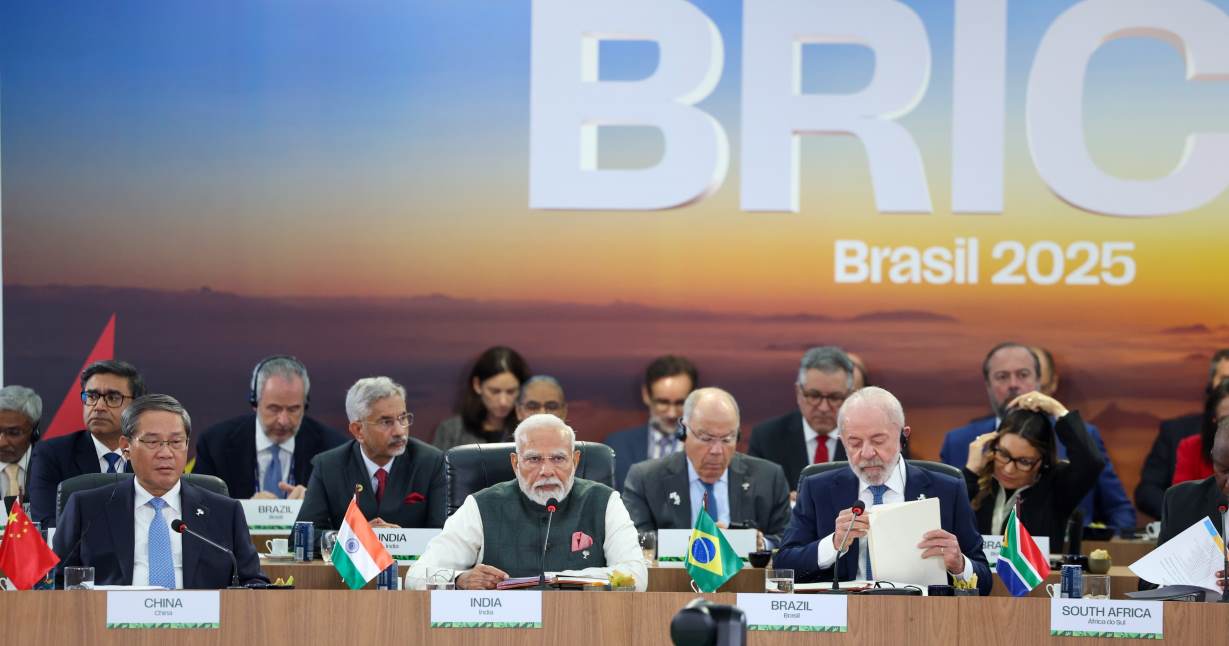
– India will assume the BRICS presidency in 2026, and the 18th BRICS Summit will be held in India.
– Prime Minister Narendra Modi said at the 17th BRICS Summit that under India’s BRICS presidency next year, the forum will adopt a “people-centric approach and a spirit of putting humanity first.”
– He stated that under its presidency, India will continue to work together on all key issues.
– He said, “Under India’s BRICS presidency next year, we will continue to work together on all major issues. Our aim will be to redefine BRICS as a platform for building resilience and innovation for cooperation and stability.”
– “Just as we brought inclusivity to our G20 presidency and placed the concerns of the Global South at the forefront of the agenda, similarly, during our BRICS presidency, we will advance this forum with a people-centric approach and a spirit of ‘humanity first’.”
—————-
2. What was the theme of the 17th BRICS Summit held in Brazil?
a. Strengthening global South cooperation for more inclusive and sustainable governance
b. Peace and trustful world
c. Sustainable environment and clean world
d. None of these
Answer: a. Strengthening global South cooperation for more inclusive and sustainable governance
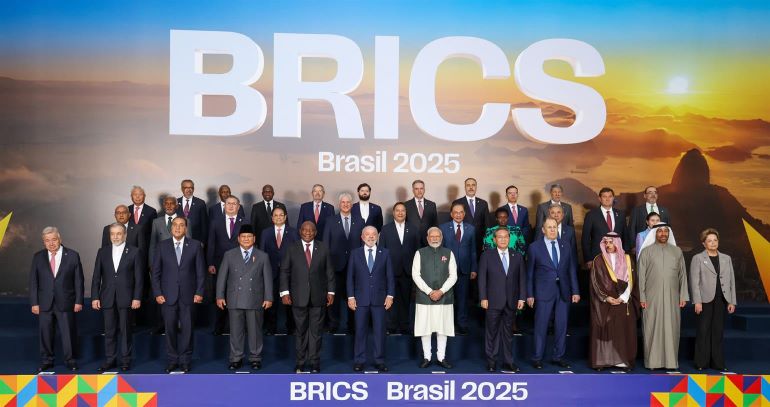
Theme of 2025:
– Strengthening Global South Cooperation for a More Inclusive and Sustainable Governance
BRICS Summit:
– Which Summit: 17th BRICS Summit
– When: July 6–7, 2025
– Where: Rio de Janeiro
Key Announcements:
– BRICS Leaders’ Framework Declaration on Climate Finance
– Statement on Global Governance of Artificial Intelligence (AI)
– Launch of BRICS Partnership for the Elimination of Socially Determined Diseases
India’s Strategic Gains from BRICS 2025:
– At the 17th BRICS Summit, India emerged as a leading voice in shaping the BRICS agenda and advancing key issues such as de-dollarization, climate finance, digital governance, and global institutional reforms.
– Discussions were held on BRICS wage and national currency settlement frameworks; however, the possibility of a common BRICS currency was ruled out.
– To boost private investment in infrastructure, climate, and sustainable development, the New Development Bank (NDB) launched the BRICS Multilateral Guarantee (BMG) mechanism.
U.S. Opposition to BRICS:
– BRICS as a Rising Power Bloc: With the addition of new members, BRICS now represents 45% of the global population and contributes 35% to global GDP.
– Concerns over BRICS Currency Alternatives: Despite early speculation, BRICS clarified that its goal is not to replace the U.S. dollar but to offer viable alternative settlement systems aimed at improving market efficiency and ensuring inclusive globalization.
– Trump’s Tariff Threats: Former President Donald Trump warned that any country supporting BRICS’ “anti-America policies” would face a 10% tariff, and if BRICS countries tried to reduce the use of the dollar in international trade, a 100% tariff would be imposed.
Note – Chinese President Xi Jinping and Russian President Vladimir Putin did not attend the 17th BRICS Summit.
Brazil:
– Capital: Brasília
– President: Luiz Inácio Lula da Silva
– Currency: Real
– Official & National Language: Portuguese
– Population: 212.5 million
– Neighboring Countries: French Guiana, Suriname, Guyana, Venezuela, Colombia, Peru, Bolivia, Paraguay, Argentina, Uruguay
BRICS:
– Headquarters: Shanghai, China
– Established: 2009
– It is a group of 10 major emerging economies.
– This group represents 41% of the world’s population.
– BRICS countries contribute to approximately 26% of global GDP.
– India has chaired the BRICS Summit three times so far — in 2012, 2016, and 2021.
BRICS Member Countries and Year of Joining:
– Brazil – 2006
– Russia – 2006
– India – 2006
– China – 2006
– South Africa – 2011
– Iran – 2024
– Egypt – 2024
– Ethiopia – 2024
– United Arab Emirates (UAE) – 2024
– Indonesia – 2025
10 Partner Countries:
– Belarus
– Bolivia
– Kazakhstan
– Cuba
– Nigeria
– Malaysia
– Thailand
– Vietnam
– Uganda
– Uzbekistan
—————–
3. Which two countries became members of the New Development Bank (NDB) / BRICS Development Bank just before the 17th BRICS Summit?
a. USA and Britain
b. France and Sri Lanka
c. Colombia and Uzbekistan
d. Pakistan and Myanmar
Answer: c. Colombia and Uzbekistan
– Just before the 17th BRICS Summit, Colombia and Uzbekistan joined the New Development Bank (NDB).
– After this, the total number of NDB member countries has increased to 12.
What is the New Development Bank?
– The NDB was established in 2015 by the original five BRICS countries — Brazil, Russia, India, China, and South Africa.
– It is a multilateral development bank whose objective is to mobilize resources for infrastructure and sustainable development projects in BRICS and other EMDCs (Emerging Markets and Developing Countries).
– President: Dilma Rousseff
– Headquarters: Shanghai, China
Total 12 Members of NDB:
– Founding Members: Brazil, Russia, India, China, and South Africa
– Members: Bangladesh, United Arab Emirates, Uruguay, Egypt, Algeria, Colombia, and Uzbekistan

—————
4. In which country will the 30th United Nations Climate Change Conference (COP30) be held in November 2025?
a. Toronto, Canada
b. Belém, Brazil
c. Colombo, India
d. Delhi, India
Answer: b. Belém, Brazil
– The previous conference was held in Baku (Azerbaijan) in November 2024.
What is UNFCCC?
– UNFCCC is an international treaty adopted in 1992 during the Earth Summit (Rio Conference).
– Under this treaty, a conference is held every year, which is called the COP (Conference of the Parties).
– Its objective is — to stabilize the emissions of human-induced greenhouse gases so as to prevent “dangerous” human interference with the climate system.
– In every COP conference, 190+ countries from around the world participate and develop global Paris Climate Agreements, targets, and action plans to tackle climate change.
—————
5. For which year, India has claimed its candidature for the 33rd UN Climate Change Conference (COP33), which was welcomed at the BRICS Summit?
a. 2026
b. 2027
c. 2028
d. 2029
Answer: c. 2028
United Nations Climate Change Conference: An Introduction
What is UNFCCC?
– The UNFCCC (United Nations Framework Convention on Climate Change) is an international treaty adopted in 1992 during the Earth Summit (Rio Conference).
– Under this treaty, an annual conference is held, known as the COP (Conference of the Parties).
– Its objective is to stabilize the emissions of human-induced greenhouse gases in order to prevent “dangerous” human interference with the climate system.
– Each COP conference sees participation from 190+ countries worldwide, who come together to draft global Paris Climate Agreements, targets, and action plans to address climate change.
What is the Paris Climate Agreement?
– The Paris Agreement is a legally binding international treaty on climate change.
– It was adopted by 196 countries on 12 December 2015 at the United Nations Climate Change Conference (COP21) in Paris, France.
– World leaders pledged to make efforts to limit global temperature rise to no more than 1.5°C.
– For the first time, almost all nations agreed to reduce greenhouse gas emissions, which are the primary cause of global warming.
– The agreement came into force on 4 November 2016.
Key Commitments Under the Agreement:
– To keep the increase in global temperature well below 2.0°C above pre-industrial levels, and to pursue efforts to limit it to 1.5°C.
– To limit greenhouse gas emissions caused by human activities to levels that can be naturally absorbed by trees, soil, and oceans — known as achieving net zero emissions between 2050 and 2100.
– Each country is required to set its own emission reduction targets, and these must be reviewed every five years to raise ambition.
– Wealthier nations will support poorer countries by providing financial assistance to help them adapt to climate change and adopt renewable energy — a commitment known as climate finance.
– In recent years, world leaders have increasingly emphasized the need to limit global warming to 1.5°C by the end of this century.
Why is it important to limit global temperature rise to 1.5 degrees Celsius?
– Scientists say that every 0.1 degree Celsius increase in temperature brings greater risks to the planet — such as longer heatwaves, more intense storms, and wildfires.
– The 1.5 degrees Celsius target was agreed upon because there is strong evidence that as the world approaches 2 degrees Celsius, the impacts will become even more severe. Some changes may become irreversible.
– In extremely hot days, the mid-latitude regions (areas outside the poles and tropics) will experience on average 4 degrees Celsius more heat at 2 degrees rise, compared to 3 degrees Celsius more heat at 1.5 degrees rise.
– Sea level rise will be 0.1 meters higher at 2 degrees Celsius, putting over 10 million people at increased risk of frequent flooding.
Did BRICS countries welcome India’s candidacy?
– The leaders of BRICS countries welcomed India’s candidacy to host the 33rd Conference of the Parties (COP33) under the UNFCCC in 2028.
– In a joint declaration at the 17th BRICS Summit, BRICS countries also expressed their commitment to remain united in achieving the goals and objectives of the Paris Agreement.
India’s Role
– India is an active member of the UNFCCC.
– India has set targets to reduce its emission intensity, increase green energy production, and expand forest cover by 2030 through its Nationally Determined Contributions (NDCs).
– India has also taken the lead in initiatives like the International Solar Alliance (ISA).
– Under the Paris Climate Agreement, India has set a goal to achieve net zero emissions by 2070.
—————
6. Who became the first country in the world to officially recognise the Taliban government in Afghanistan?
a. Russia
b. Ukraine
c. America
d. Pakistan
Answer: a. Russia
– The Taliban government in Afghanistan has received official recognition.
– On 3rd July 2025, a meeting was held in Kabul between Russia’s ambassador Dmitry Zhirnov and the Taliban’s foreign minister Amir Khan Muttaqi.
– The Russian Ministry of Foreign Affairs stated that recognizing the Islamic Emirate government will rapidly increase bilateral cooperation between the two countries.
– Several countries, including the United States and India, have not yet recognized the Taliban as the government of Afghanistan.
– Afghanistan has continuously been demanding recognition from the international community.
Taliban’s rule since 2021
– On 15th August 2021, after the United States and NATO left Afghanistan, the Taliban took control of the country.
– At that time, the Taliban said they would run a liberal government in Afghanistan.
However, they later imposed strict Sharia laws.
– Many countries had been maintaining relations with the Taliban government as a policy, but none had given official recognition until now.
Western Countries Isolated the Taliban
– Due to the Taliban’s strict discriminatory policies against women, Western countries had diplomatically isolated the Taliban.
– Experts say that China is also considering recognizing Afghanistan.
Formation of the Taliban and Clash with Russia
– The Taliban was formed in 1994 in the city of Kandahar, Afghanistan.
– This organization was among the factions involved in the civil war for power in Afghanistan after the Soviet army withdrew in 1989.
– Actually, Soviet troops had intervened in Afghanistan in 1979.
– After this, in 1989, Russia had to withdraw its army.
– During this period, Afghanistan and Russia remained entangled in bilateral relations.
– Most members of the Taliban were the same Mujahideen who, with the help of the United States, fought the Soviet Union for nine years, forcing it to retreat.
– Due to this cooperation, the Taliban initially received support from the United States.
– However, after the Al-Qaeda attacks on the World Trade Center, the US deployed troops in Afghanistan against Al-Qaeda and the Taliban. Eventually, on 15 August 2021, the US also had to leave Afghanistan.
– Meanwhile, in April 2025, after 20 years, Russia removed the Taliban from its list of terrorist organizations.
– Along with this, Russia has been working to strengthen economic relations with the Taliban.
What will be India’s policy?
– Russia needs security cooperation from the Taliban due to the terrorist organization ISKP (Islamic State – Khorasan Province).
– This group carried out a terrorist attack in Russia in 2024, killing 130 people.
– As far as India is concerned, its policy on Afghanistan is not determined by what a third country does in this regard.
– India has maintained close engagement with both Russia and Afghanistan.
– On 15 May 2025, External Affairs Minister S. Jaishankar spoke on the phone with Afghanistan’s acting Foreign Minister Amir Khan Muttaqi.
– This was the first conversation by the foreign minister.
– In January, Foreign Secretary Vikram Misri had met with Muttaqi in Dubai.
– After the Pahalgam attack, a delegation had also visited Kabul.
What does official recognition mean?
– When one country gives official recognition to another, it acknowledges it as a sovereign nation.
– This means that country has its own government, its own borders, and can establish relations with other countries worldwide.
– This recognition is based on international laws such as the Montevideo Convention of 1933.
– There are four conditions for recognition: a permanent population, defined territory, a government, and the capacity to enter into relations with other states.
– Recognition grants a country legitimacy, a place in international organizations, and the opportunity to conduct trade and diplomatic relations with other countries.
—————-
7. Who became the first woman president in the South American country ‘Suriname’?
a. Jennifer Geerlings-Simons
b. Ruth Wijdenbosch
c. Elizabeth Samson
d. Marijke Jwalapersad
Answer: a. Jennifer Geerlings-Simons
– Suriname’s parliament elected her as president on 6 July 2025.
– 71-year-old Jennifer Geerlings-Simons will take oath on 16 July.
– She is associated with the National Democratic Party.
– Suriname’s National Assembly elects the president with a two-thirds majority.
– Jennifer won the election unopposed.
– Jennifer said her first priority will be to improve the country’s economic condition.
Santokhi’s tenure was marred by corruption
– Former President Chan Santokhi’s five-year tenure was filled with corruption cases.
– He was forced to seek help from the International Monetary Fund (IMF) to bring the economy back on track.
– As a result, the country’s public debt was extensively restructured, and government subsidies were cut.
– This improved the economic situation somewhat, but common people faced many hardships, and there were several violent protests.
– Capital: Paramaribo
– Population: 629,000 (2023)
– Language: Dutch
– Currency: Surinamese Dollar
– Neighboring countries: Guyana, Brazil
—————-
8. Who became the first Indian actress to be chosen for the 2026 Hollywood Walk of Fame honour?
a. Deepika Padukone
b. Aishwarya Roy
c. Anushka Sharma
d. Alia Bhatt
Answer: a. Deepika Padukone
– The official organization managing the Hollywood Walk of Fame, Hollywood Chamber of Commerce, shared this news on Instagram on 2 July 2025.
– The Hollywood Walk of Fame is a famous tourist location in California.
– Every year, a large number of people visit this popular tourist spot.
– So far, 2813 actors, directors, singers, and filmmakers have been honored here.
An actor of Indian origin has already been honored
– Before Deepika, actor Sabu Dastagir, of Indian origin, was honored with this recognition.
– Sabu received his star in 1960, by which time he had already become a U.S. citizen.
Deepika’s global impact
– Deepika made her Hollywood debut in 2017 with XXX: Return of Xander Cage.
– In 2018, Time magazine included her in the list of the 100 most powerful people in the world.
– Deepika has also received the TIME100 Award.
– She was the first Indian to unveil the FIFA World Cup final trophy in Qatar.
—————-
9. When is International Plastic Bag Free Day observed?
a. 2 July
b. 3 July
c. 4 July
d. 30 June
Answer: b. 3 July
– The purpose of this day is to raise awareness about the issues of plastic pollution and its harmful impact on the natural environment.
– Plastic causes significant damage to the environment.
– It can take 100 to 500 years for a plastic bag to decompose in waste.
—————-
10. The Union Cabinet approved the National Sports Policy (NSP) 2025, it replaced which policy?
a. National Education Policy 2020
b. National Sports Policy 2001
c. National Sports Policy 1984
d. Fit India Policy 2021
Answer: b. National Sports Policy 2001
– The Union Cabinet approved the National Sports Policy (NSP) 2025 in July 2025.
National Sports Policies So Far and Their Objectives
1. National Sports Policy 1984: The first formal policy, promoting sports infrastructure, talent identification, and coaching.
2. National Sports Policy 2001: Focus on sports development in rural areas, participation of women and differently-abled persons, and talent nurturing.
3. National Sports Policy 2025: Inclusive sports ecosystem, global competitiveness, economic growth, and public participation.
Timeline and Major Preparations
– Hosting the 2036 Olympics: A key part of the government’s strategy.
– Goal to become a Top-5 sporting nation by 2047.
Key Pillars of National Sports Policy 2025 (NSP 2025)
1. Excellence on the Global Stage: This pillar focuses on empowering sports from the grassroots to the highest levels. It includes early talent identification, development of competitive leagues and infrastructure, and establishing world-class training and coaching systems.
2. Sports for Economic Growth: This pillar promotes sports tourism, startups, and private investments, aiming to strengthen India’s role in the global sports economy.
3. Sports for Social Development: The policy emphasizes promoting social inclusion through sports — encouraging participation from marginalized groups, reviving traditional and local sports, enhancing engagement of the Indian diaspora, and fostering voluntary services.
4. Sports as a People’s Movement: To make sports a national movement, the policy aims to boost public participation and fitness culture through campaigns, launch fitness indices for institutions, and improve access to sports facilities across the country.
5. Integration with Education (NEP 2020): Aligned with the National Education Policy 2020, this pillar targets integrating sports into school curricula and training teachers to develop interest in sports at the foundational level.
Strategic Framework
– Governance: The aim of NSP 2025 is to establish a legal and regulatory framework that ensures transparency and accountability in sports administration.
– Private Sector Participation: To encourage private investment through Public-Private Partnerships (PPP), Corporate Social Responsibility (CSR), and innovation-driven financing initiatives.
– Technology and Innovation: Utilize Artificial Intelligence (AI), data analytics, and emerging technologies for performance monitoring and program delivery.
– Monitoring and Evaluation: Set up a national monitoring framework with Key Performance Indicators (KPIs) and time-bound targets for regular progress review.
– Model Policy for States: This policy will serve as a guideline for states and union territories to formulate or update their sports policies in alignment with national objectives.
—————
11. When is World Zoonoses Day observed?
a. 08 July
b. 07 July
c. 06 July
d. 05 July
Answer: c. 06 July
Zoonotic diseases are infectious diseases that spread from animals to humans, such as:
– Rabies
– Anthrax
– Brucellosis
– Avian Flu
– Swine Flu
– Coronavirus (COVID-19) (possible zoonotic origin)
History of World Zoonoses Day
– On 6 July 1885, Louis Pasteur created the first successful vaccine against rabies by experimenting on a boy.
– World Zoonoses Day is celebrated in memory of that historical event.
Preventive measures
– Keeping a safe distance from domestic and non-domesticated animals
– Regular vaccination of animals
– Consume meat and milk after cooking it thoroughly
– Maintain hygiene in animal husbandry
– Get timely vaccination for diseases like rabies
—————
12. When is Global Forgiveness Day observed?
a. 5 July
b. 6 July
c. 7 July
d. 8 July
Answer: c. 7 July
– Global Forgiveness Day gives people a chance to heal their relationships.
– Forgiveness is essential, especially for our mental health and peace.
—————
13. Name the new Chief Executive Officer (CEO) of International Cricket Council (ICC)?
a. Rajiv Gupta
b. Ajay Kumar
c. Ramesh Awasthi
d. Sanjog Gupta
Answer: d. Sanjog Gupta
– The International Cricket Council (ICC) appointed Sanjog Gupta as its new Chief Executive Officer (CEO) on July 7, 2025.
– He replaced Geoff Allardice.
– Sanjog Gupta began his career as a journalist and joined Star India in 2010.
– Over the years, he played key roles in sports broadcasting, including serving as Head of Sports at Disney and Star India.
– ICC President Jay Shah said that Sanjog Gupta brings “extensive experience in sports strategy” and will help grow cricket globally.
—————-
14. By what name did the famous billionaire and technology entrepreneur Elon Musk announce a new political party, which was discussed all over the world?
a. X Party
b. America Party
c. US Party
d. Musk Party
Answer: b. America Party
– Elon Musk announced this party in July 2025.
– He said that this party will serve as an alternative to America’s two-party system. Its goal is to “give people their freedom back” and to fight against government corruption and unnecessary spending.
– This move came at a time when Musk had a public dispute with former U.S. President Donald Trump.
Clash with Donald Trump
– Musk was previously close to Trump.
– He participated in Trump’s election campaign and held a role in the Trump administration until May 2025.
– However, Musk and Trump clashed over the “Big Beautiful Bill.”
– Musk strongly criticized Trump’s new spending and tax plan, saying these policies would increase America’s budget deficit to $3 trillion.
What is the Big Beautiful Bill?
– Commonly referred to as the “Big Beautiful Bill,” this American bill is actually the One Big Beautiful Bill Act (OBBBA) — a massive budget reconciliation bill. It is also called “Big Beautiful Bill” or “One Big, Beautiful Bill.”
– It aims to make the 2017 Trump tax cuts permanent.
– It involves large-scale spending on the military, border security, and ICE (Immigration & Customs Enforcement) agencies.
– Introduces new tax relief on tips and overtime pay.
– Includes cuts and eligibility changes to social programs like Medicaid and SNAP.
– Proposes an increase in the debt ceiling by $4–5 trillion. (Debt ceiling is the maximum amount of money the U.S. government is allowed to borrow to meet its existing legal obligations, such as salaries, military spending, social security, health programs, etc.)
—————–
15. Which Indian women players won 3 gold medals at the World Boxing Cup 2025 held in Astana, taking the total number of medals to 11?
a. Sakshi, Jasmine Lamboria, Nupur
b. Meenakshi, Nupur, Sanju
c. Pooja Rani, Meenakshi, Sanju
d. Nupur, Meenakshi, Sanju
Answer: a. Sakshi, Jasmine Lamboria, Nupur
– Indian women boxers delivered a historic performance at the World Boxing Cup held in Astana, Kazakhstan.
– India won a total of 11 medals: three gold, five silver, and three bronze.
– All three gold medals were won by women athletes.
– The event took place in July 2025.
– This is India’s biggest achievement so far in the World Boxing Cup.
List of 11 winners
– Sakshi (Women 54 kg) – Gold Medal
– Jasmine Lamboria (Women 57 kg) – Gold Medal
– Nupur (Women 80+ kg) – Gold Medal
– Meenakshi (Women 48 kg) – Silver Medal
– Pooja Rani (Women 80 kg) – Silver Medal
– Abhinash Jamwal (Men 65 kg) – Silver Medal
– Hitesh Gulia (Men 70 kg) – Silver Medal
– Jugunu (Men 85 kg) – Silver Medal
– Sanju (Women 60 kg) – Bronze Medal
– Nikhil Dubey (Men 75 kg) – Bronze Medal
– Narendra Berwal (Men 90+ kg) – Bronze Medal
PDF Download: Click here