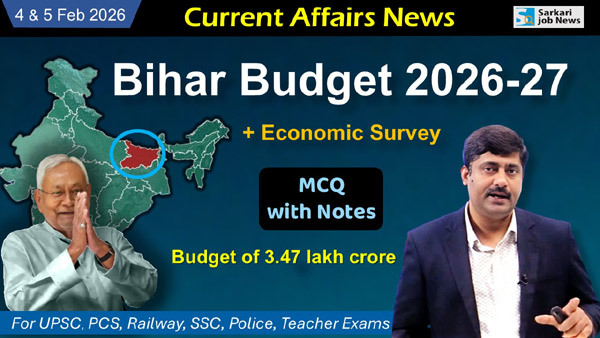
This is the current affairs of 4 & 5 February 2026. Here are questions and answers of daily current affairs for better preparation of competitive exams for government jobs.
1. In the Budget 2026–27, what amount of expenditure target has the Bihar government set?
a. ₹2.37 lakh crore
b. ₹2.78 lakh crore
c. ₹3.16 lakh crore
d. ₹3.47 lakh crore
Answer: d. ₹3.47 lakh crore (₹3,47,589 crore)
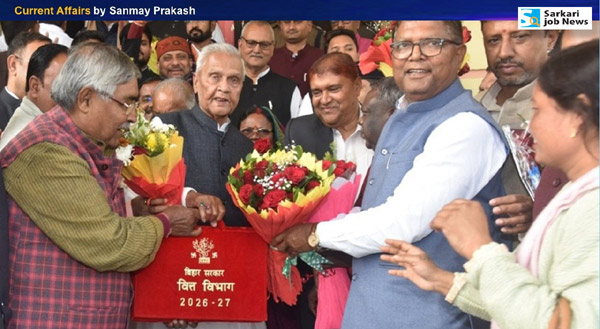
– Bihar Finance Minister Bijendra Prasad Yadav presented the budget for the financial year 2026–27 on 3 February 2026.
– The Chief Minister of the state is Nitish Kumar.
Facts
– Budget for FY 2026–27: ₹3.47 lakh crore (₹3,47,589 crore)
– Budget for FY 2025–26: ₹3.16 lakh crore
– Difference compared to previous budget: ₹30,694 crore
Target of Income in the Budget: ₹3.47 lakh crore (₹3,47,752 crore)
– Revenue receipts: ₹2.85 lakh crore
– Capital receipts: ₹61,939 crore (includes ₹61,939 crore as new loans and ₹536 crore as loan recovery)
Note:
– Revenue receipts: earnings from taxes; own revenue structure
– Capital receipts: loan recovery and new borrowings
Revenue Surplus
– In this budget, the estimated revenue surplus is ₹1,143 crore. This is 0.09% of GSDP, and the financial position has been claimed to be “good.”
– In the previous budget, the revenue surplus was ₹8,831 crore.
Income Breakdown
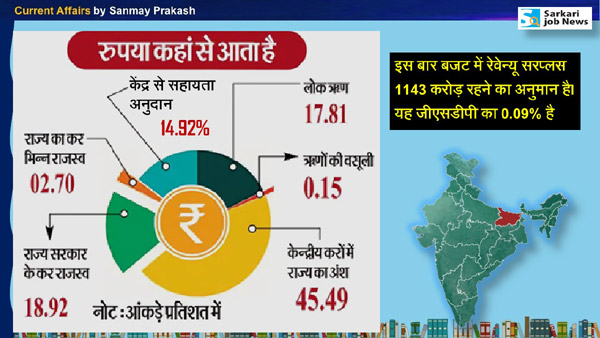
– State’s share in central taxes: 45.49%
– State government’s tax revenue: 18.92%
– Public debt: 17.81%
– Grants from the central government: 14.92%
– State’s non-tax revenue: 2.70%
– Loan recovery: 0.15%
Target of Expenditure in the Budget: ₹3.47 lakh crore (₹3,47,589 crore)
– Revenue expenditure: ₹2,84,133 crore
– Capital expenditure: ₹63,455 crore
Note:
– Revenue expenditure: salaries and schemes
– Capital expenditure: new construction and long-term capital works
Expenditure can also be classified as:
– Scheme expenditure: ₹1,22,155 crore
– Establishment & commitment expenditure: ₹2,25,434 crore
Expenditure Breakdown
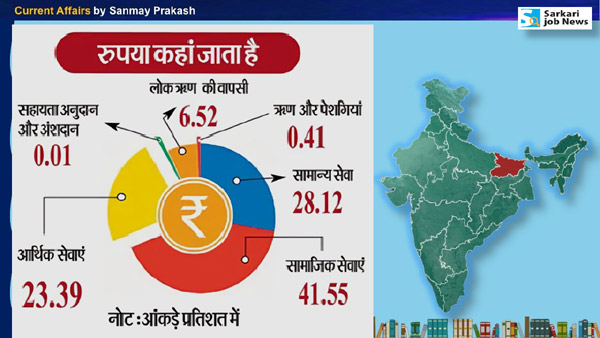
– Social services: 41.55%
– General services: 28.12%
– Economic services: 23.39%
– Repayment of public debt: 6.52%
– Loans and advances: 0.41%
– Grants-in-aid and contributions: 0.01%
Note:
– Social services: government spending on human resource development and social security
– General services: services related to governance, administration, and law and order
– Economic services: services related to enhancing economic activity and production capacity
—————
2. In the Bihar Budget 2026–27, which department or sector has the provision for maximum expenditure?
a. Health
b. Education
c. Rural Development
d. Energy
Answer: b. Education (₹60,204 crore for education and ₹8,012 crore for higher education; total 19.62% of the budget, i.e., ₹68,216 crore)
– Education has been divided into two parts.
– A new Higher Education Department has been created.
– Total allocation for education: ₹68,216 crore.
836 PM Shri Schools
– 836 PM Shri schools have been selected in Bihar.
– These include 47 middle schools (Classes 6–8) and 789 higher secondary schools.
——————-
3. Budget allocation to major items or departments of Bihar
– Education Department: ₹60,204.61 crore
– Higher Education Department: ₹8,012.34 crore
– Interest payments: ₹35,363.67 crore
– Pension: ₹35,170.48 crore
– Rural Development: ₹23,701.18 crore
– Health Department: ₹21,270.41 crore
– Home Department: ₹20,132.87 crore
– Energy Department: ₹18,737.06 crore
– Urban Development Department: ₹15,237 crore
– Rural Works Department: ₹11,312.18 crore
– Panchayati Raj: ₹10,955.51 crore
– Social Welfare Department: ₹8,470.06 crore
– Road Construction: ₹7,404.79 crore
– Water Resources Department: ₹7,127.35 crore
– Building Construction Department: ₹6,153.72 crore
– Disaster Management: ₹4,799.27 crore
– Finance Department: ₹3,741.52 crore
– Agriculture Department: ₹3,446.45 crore
– Industries Department: ₹3,337.64 crore
– Planning & Development: ₹2,596.57 crore
– Public Health Engineering: ₹2,469.35 crore
– Fisheries, Animal Husbandry & Dairy: ₹1,915.97 crore
– Backward & Extremely Backward Welfare: ₹1,749.44 crore
– Youth Employment & Skill Development: ₹1,379.58 crore
– Cooperation Department: ₹1,201.41 crore
———————-
4. What is the estimated Gross State Domestic Product (GSDP) at current prices for FY 2026–27 in the Bihar budget?
a. ₹13,09,155 crore
b. ₹9,45,565 crore
c. ₹7,46,417 crore
d. ₹10,97,264 crore
Answer: a. ₹13,09,155 crore
Estimated GSDP (at current prices):
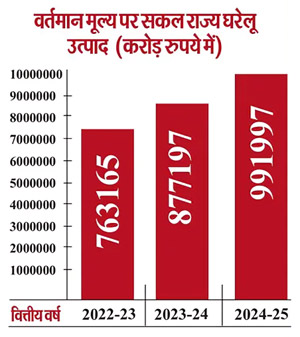
– FY 2026–27: ₹13,09,155 crore
– FY 2025–26: ₹11,39,804 crore (estimated growth 14.9%)
– FY 2024–25: ₹9,91,997 crore
– FY 2023–24: ₹8,77,197 crore
– FY 2022–23: ₹7,63,165 crore
What is GSDP?
– GDP is the total value of goods and services produced in a country in a specific period.
– Similarly, the total value of goods and services produced in a state during a financial year is called GSDP.
——————
5. According to the Bihar Budget 2026–27, what is the estimated GSDP growth rate for FY 2025–26?
a. 11.9%
b. 13.9%
c. 14.9%
d. 16.9%
Answer: c. 14.9%
– Bihar’s growth rate in 2025–26 is expected to be 14.9%.
– In 2024–25, Bihar recorded a growth rate of 13.1%.
– India’s GDP growth rate for 2025–26 is estimated at 7.4%.
—————-
6. In the Budget 2026–27, what percentage of GSDP has the Bihar government set as the target for the state’s fiscal deficit?
a. 0.47%
b. 1.98%
c. 2.47%
d. 2.99%
Answer: d. 2.99% (₹39,111 crore)
– Based on current prices, Bihar’s Gross State Domestic Product (GSDP) for 2026–27 is estimated to be ₹13,09,155 crore.
– The fiscal deficit is estimated to be 2.99% of GSDP (₹39,111 crore).
– This is below the debt ceiling of 3% prescribed by the central government.
Fiscal Deficit = Total Non-Debt Expenditure – Total Non-Debt Receipts
– Total Non-Debt Expenditure means total expenditure excluding borrowings.
– Total Non-Debt Receipts means revenue receipts and capital receipts excluding borrowings.
– The amount that remains after subtracting revenue receipts, recovery of loans, and repayment of loans (Total Non-Debt Receipts) from total expenditure is called the fiscal deficit.
What are the disadvantages of a fiscal deficit?
– When governments spend more or provide tax concessions, there is a fear that they will be forced to borrow more money.
– When governments borrow more, they either leave less money available for private individuals and companies to borrow—thereby increasing interest rates for everyone—or they are forced to print money, which leads to inflation. Inflation also works like a tax because it reduces the purchasing power of people’s money.
——————-
7. According to the Bihar Budget 2026–27, what is the amount of public debt on the state in this financial year?
a. ₹2,97,908 crore
b. ₹1,97,908 crore
c. ₹3,88,554 crore
d. ₹3,32,740 crore
Answer: c. ₹3,88,554 crore
– In 2026–27, public debt is estimated to be ₹3,88,554 crore, which is 29.68% of GSDP (₹13,09,155 crore) at current prices.
– In the previous budget (2025–26), public debt was estimated at ₹3,32,740 crore.
Note: Including liabilities under the public account, total debt in 2026–27 is estimated to be ₹4,46,326.07 crore, which is 34.09% of GSDP (₹13,09,155.00 crore).
—————–
8. In the Bihar Budget 2026–27, how much money has been allocated for the schemes under “Seven Resolutions for Developed Bihar (2025–30) – Part 3”?
a. ₹2,040 crore
b. ₹5,972 crore
c. ₹14,800 crore
d. ₹15,040 crore
Answer: c. ₹14,800 crore
Seven Resolutions – Part 3 of the Bihar Government
1. Double employment, double income
2. Prosperous industry – Strong Bihar
3. Prosperity of the state through progress in agriculture
4. Advanced education – Bright future
5. Accessible healthcare – Secure life
6. Strong foundation – Modern expansion
7. Ease of living through dignity/respect for all
——————-
9. What resolutions did the Bihar government announce in the Budget 2026–27?
a. Doubling per capita income
b. Creating one crore employment opportunities
c. Empowering women
d. All of the above
Answer: d. All of the above (i. Doubling per capita income, ii. Creating one crore employment opportunities, iii. Empowering women)
Three major resolutions
i. Doubling per capita income
ii. Creating one crore employment opportunities
iii. Empowering women
Note: Per capita income in 2024–25 was ₹76,490.
————
10. Announcements in the Bihar Budget 2026–27
– State government schemes are based on five core elements—knowledge, science, integrity, aspirations, and dignity.
– A target of ₹50 lakh crore in private investment to increase employment opportunities.
– Model schools and degree colleges in every block; new education cities will be developed.
– Five new expressways will be constructed; all single-lane urban roads will be converted into two-lane roads.
– All diesel-run buses will be converted to CNG and electric.
– To support farmers in agriculture, the state government will provide ₹3,000 annually under the Karpuri Thakur Kisan Samman Nidhi. This will be separate from the central government’s Samman Nidhi.
– Provision has also been made in the budget to operationalize two sugar mills in the cooperative sector.
– The budget provides for the formation of the “Bihar Agri Infrastructure Mission.” An initial investment of ₹1 lakh crore will be made.
– The “Bihar Agriculture Acceleration Mission” includes the establishment of rural agricultural markets. The target of ₹50 lakh crore in private investment and providing an average of 20 lakh jobs annually is also part of this.
Fourth Agriculture Roadmap to be introduced
– Bihar is an agriculture-based state. About 76% of the population depends on it for their livelihood. Agriculture has an interlinked relationship with dairy, animal husbandry, and fisheries. Work is currently underway on the fourth agriculture roadmap in the state. Since the implementation of the roadmaps, agricultural production has increased. Now there is a need to prioritize diversification in agriculture and higher-income crops. The budget provides for the formation of the “Bihar Agri Infrastructure Mission,” with an initial investment of ₹1 lakh crore.
———————
11. According to the Bihar Budget 2026–27, what was the per capita income of the state (at current prices) in 2024–25?
a. ₹59,244
b. ₹66,828
c. ₹76,490
d. ₹98,550
Answer: c. ₹76,490
Per Capita Income
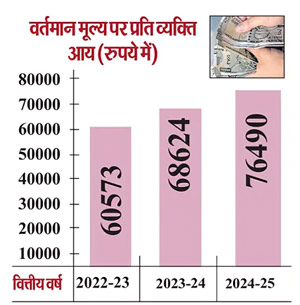
– Year 2024–25: ₹76,490
– Year 2023–24: ₹68,624
– Year 2022–23: ₹60,573
—————-
12. According to the Bihar Economic Survey 2025–26, which of the following are the three most prosperous districts of Bihar?
a. Patna, Begusarai, Munger
b. Sheohar, Araria, Sitamarhi
c. Patna, Muzaffarpur, Ara
d. Begusarai, Patna, Araria
Answer: a. Patna, Begusarai, Munger (Per capita income: Patna – ₹1,31,332; Begusarai – ₹61,566; Munger – ₹54,469)
– Top 3 prosperous districts: Patna, Begusarai, and Munger
– Bottom 3 least prosperous districts: Sheohar, Araria, and Sitamarhi
Per Capita Income (Annual)
– Bihar: ₹76,490
Highest Per Capita Income
– Patna: ₹1,31,332
– Begusarai: ₹61,566
– Munger: ₹54,469
Lowest Per Capita Income
– Sheohar: ₹18,980
– Araria: ₹19,795
– Sitamarhi: ₹21,448
——————–
13. According to the Bihar Economic Survey 2025–26, what are the male labour force participation rates (LFPR) in rural and urban areas respectively?
a. 60.1% and 57.8%
b. 76.8% and 67.8%
c. 86.2% and 77.5%
d. 61.6% and 57.3%
Answer: b. 76.8% and 67.8%
– In Bihar, the male LFPR was 76.8% in rural areas and 67.8% in urban areas.
– Bihar’s female LFPR is 11.2 percentage points lower than the all-India average.
– In rural Bihar, the unemployment rate was 3.3% for men and 0.9% for women.
– In urban areas, 6.9% of male and 9.1% of female workers in Bihar are unemployed.
Note: Labour Force Participation Rate (LFPR) means the proportion of the male and female labour force.
————
14. According to the Bihar Economic Survey 2025–26, to what level did Bihar’s total population growth rate decline during the period 2021–25?
a. 18.5%
b. 14.4%
c. 12.8%
d. 11.2%
Answer: b. 14.4%
– During 2021–25, Bihar’s total population growth rate declined to 14.4%, whereas it was 18.5% during 2011–15.
– In Bihar, the total fertility rate (TFR) is expected to reach the replacement level of 2.1 by 2039.
—————–
15. According to the Bihar Economic Survey 2025–26, what was the average life expectancy at birth in Bihar during the period 2019–23?
a. 68.9 years (male) and 69.7 years (female)
b. 69.5 years (male) and 79.2 years (female)
c. 71.8 years (male) and 89.3 years (female)
d. 78.7 years (male) and 89.8 years (female)
Answer: a. 68.9 years (male) and 69.7 years (female)
– During 2019–23, the average life expectancy at birth in Bihar was 68.9 years for males and 69.7 years for females.
—————-
16. Important facts of the Bihar Economic Survey 2025–26
– The Bihar Economic Survey 2025–26 was presented in the Legislative Assembly on 2 February 2026 by Finance Minister Bijendra Prasad Yadav.
– This is the 20th Economic Survey of the state. It describes the condition and development of Bihar’s economy.
Overview of Bihar’s Economy:
– Bihar’s economic growth was higher than the national average. Bihar’s growth rate was 14.9%, while India’s average growth rate was 12.0%.
– In 2024–25, the estimated Gross State Domestic Product (GSDP) was ₹9,91,997 crore at current prices and ₹5,31,372 crore at constant prices (2011–12).
– In 2024–25, GSDP grew by 13.1% at current prices and 8.6% at constant prices.
– In 2024–25, the estimated Net State Domestic Product (NSDP) was ₹8,99,020 crore at current prices and ₹4,71,322 crore at constant prices (2011–12).
– Bihar’s per capita NSDP at constant prices (2011–12) is estimated at ₹36,342, which is 31.7% of the all-India state average.
– Per capita income increased to ₹76,490 at current prices and ₹40,973 at constant prices.
– Top 3 richest districts: Patna, Begusarai, and Munger
– Bottom 3 poorest districts: Sheohar, Araria, and Sitamarhi
– Patna recorded the highest consumption of petrol, diesel, and LPG.
– Contribution to GSDP: Tertiary sector (services) 54.8%, Secondary sector (industry) 26.8%, and Primary sector (agriculture and natural resources) 18.3%.
– Sector-wise growth at current prices in 2024–25: Primary sector 9.6%, Secondary sector 15.5%, Tertiary sector 13.5%.
– Employment contribution: Primary sector 54%, Secondary sector 24%, Tertiary sector 22%.
– Gross Fixed Capital Formation nearly doubled over the last five years, increasing from ₹17,416 crore to ₹34,905 crore in 2024–25.
Agriculture:
– Gross sown area: 8,207.27 thousand hectares (total of all sowings during the year)
– Net sown area: 5,411.96 thousand hectares (actual agricultural land sown at least once)
– Cropping intensity: 1.52 (on average, 1.52 crops are taken per hectare, meaning about 52% of land is double-cropped)
– Cropping pattern in Bihar (2020–21 to 2024–25): Food grains 95.2%, cereals 89.2%, pulses 6.0%
– Growth recorded: milk production 4.2%, egg production 10.0%, fish production 9.9%
– Total fish production in the fisheries sector was 960 thousand tonnes, with Madhubani as the leading district.
– Schemes: Chief Minister Integrated Chaur Development Scheme, River Ranching Programme, Reservoir Fisheries Development Scheme.
– Government initiatives: Organic Farming Promotion Scheme, Organic Corridor Scheme, Paramparagat Krishi Vikas Yojana.
Enterprises Sector:
– Sugar industry: Riga Sugar Mill was restarted in 2024–25.
– Dairy industry: Average daily milk collection in 2024–25 was 2,252.28 thousand kilograms.
– Textile industry: The state government implemented the Textile and Leather Policy, 2022 under the Bihar Industrial Investment Promotion Policy, 2016.
– Tourism development: Takht Shri Harimandir Ji, Matsyagandha Lake in Saharsa district, Love–Kush Eco-Tourism Park at Valmikinagar.
– Eco-tourism: Provision of ₹100 crore for eco-tourism and park development in 2024–25; Bihar’s third biological park at Raniganj in Araria.
– Initiatives: Bihar State Khadi and Village Industries Board (KVIB), industrial promotion in Bihar, Bihar Industrial Area Development Authority (BIADA).
Labour, Employment and Skill:
– Male LFPR in Bihar was 76.8% in rural areas and 67.8% in urban areas.
– Bihar’s female LFPR is 11.2 percentage points lower than the all-India average.
– In rural Bihar, the unemployment rate was 3.3% for men and 0.9% for women.
– In urban areas, 6.9% of men and 9.1% of women workers are unemployed.
Physical Infrastructure:
– Bihar’s share in India’s total road network is 5.5%.
– With assistance from the Asian Development Bank (ADB), a 6-lane Bihar New Ganga Bridge is being constructed at a cost of ₹4,988 crore.
– Construction of expressways and national highways is ongoing.
– Over the past decade, the road transport sector recorded an average annual growth of 13.4%.
– Bihar’s share in the national rail network is 5.4%.
– Bihar recorded a high growth rate of 20% in the aviation sector.
– Initiatives: PM e-Bus Service, Chief Minister Gram Transport Scheme (MMGPY).
E-Governance:
– E-governance initiatives: CCTNS, CFMS, Cyber Cell, e-Challan, Bihar AI Mission.
– Tele-density coverage is 57.23% and internet density coverage is 43.10%.
– Initiatives: Bihar State Data Centre (BSDC 2.0), Bihar State Wide Area Network (BSWAN 3.0), Bihar Aadhaar Authentication Framework (BAAF), Emergency Response Support System (ERSS).
Power Sector:
– Per capita energy consumption increased to 374 kilowatt-hours.
– At the 19th India Energy Summit, DISCOMs received 13 Innovation and Impact Awards for 2025; NBPDCL and SBPDCL were awarded in various categories.
– BSPTCL received an A+ certification from PFC for five consecutive years from 2020 to 2025.
– Initiatives: Floating solar power plants, solar water pumps, Chief Minister Solar Street Light Scheme, smart metering.
Rural Development:
– Rural development is extremely important for inclusive growth in Bihar, as nearly 90% of the population lives in rural areas.
– JEEViKA: Implementation of the National Rural Livelihood Mission (NRLM) in Bihar; JEEViKA has connected 1.40 crore families through 11.03 lakh self-help groups (SHGs).
– Initiatives: Didi Ki Rasoi, Pashu Sakhi Model, One Stop Facility Centre, Sustainable Livelihood Scheme, Lohiya Swachh Bihar Abhiyan.
Urban Development:
– During 2021–25, Bihar’s total population growth rate declined to 14.4%.
– Bihar’s total fertility rate (TFR) is expected to reach the replacement level of 2.1 by 2039.
– Initiatives: Chief Minister Integrated Urban Development Scheme, Chief Minister Urban Drain–Lane Paving Scheme, rainwater harvesting and artificial groundwater recharge, solid waste management, Smart City Mission, Patna Metro Rail Project.
Human Development:
– Women empowerment: Total expenditure on women increased 3.45 times between 2018–19 and 2023–24.
– Under the Chief Minister Kanya Vivah Yojana, daughters of BPL families marrying at the age of 18 years or above are provided financial assistance of ₹5,000.
– Initiatives: One Stop Centre, Palna Ghar, Women Police Station, Pink Bus initiative, Nayika Apne Jeevan Ki.
Education & Health Sector:
– During 2019–23, the average life expectancy at birth in Bihar was 68.9 years for males and 69.7 years for females.
– During 2001–11, the literacy rate in Bihar increased from 47% to 61.8%, the highest increase among all states.
– Initiatives: e-ShikshaKosh, PM Poshan Scheme, Bhavya initiative, Janani Suraksha Yojana (JSY), immunization, National Health Mission, Samagra Shiksha Abhiyan (SSA), Bihar Student Credit Card Scheme (BSCCY).
Child Development:
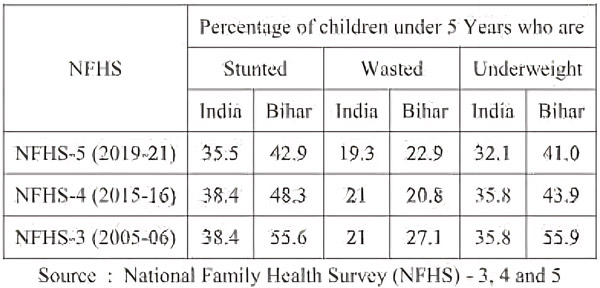
– According to NFHS-5 (2019–21), among children below 5 years of age in Bihar, stunting (severe malnutrition) was 42.9%, wasting was 22.9%, and underweight was 41%.
– These figures are higher than the national averages: stunting 35.5%, wasting 19.3%, and underweight 32.1%.
– Initiatives: Anganwadi services, Poshan Pakhwada, Poshan Tracker, Mission Vatsalya, establishment of Child Protection Units, Juvenile Justice (Care and Protection of Children) Act, 2015.
Environment, Climate Change and Disaster Management:
– Forest area recorded an average annual growth of 10.6% between 2011–12 and 2024–25.
– Forest cover increased by 689 square kilometres over 12 years.
– Initiatives: Department of Environment, Forest and Climate Change, Forest Management Information System (FMIS), Bihar Vanmitra App, e-Parivesh Portal, Hariyali Mission, Bamboo Mission, Conservation and Development of Wetlands in Bihar, Vikramshila Gangetic Dolphin Sanctuary.
– Disaster management initiatives: Establishment of the State Disaster Response Force (SDRF) in 2010, Bihar Disaster Risk Reduction Roadmap (2015–2030), modernization of the State Emergency Operations Centre (SEOC).
PDF Download: Click here