This is the current affairs of 1 – 4 July 2025. Here are questions and answers of daily current affairs for better preparation of competitive exams for government jobs.
PDF Download: Click here
1. Which country’s Constitutional Court suspended its Prime Minister Pyitongtarn Shinawatra in July 2025?
a. Thailand
b. Cambodia
c. Laos
d. Myanmar
Answer: a. Thailand
– On July 1, 2025, Thailand’s Constitutional Court suspended Prime Minister Paetongtarn Shinawatra from her position.
– She is accused of having a phone conversation with Cambodian leader Hun Sen. In that conversation, she referred to Hun Sen as “uncle” and criticized the Thai army commander.
– This is considered a serious matter in Thailand, as the military holds significant influence there.
– After the leak of this conversation, anger spread across the country.
– The court stated that an investigation will be conducted into the complaint against her. If found guilty, she could be permanently removed from office.
Phumtham Wechayachai appointed Acting Prime Minister
– The Prime Minister has accepted the charge of violating ethical conduct, and until the investigation is complete, she will not be able to serve as Prime Minister.
– Until a final decision is made in this case, Deputy Prime Minister Phumtham Wechayachai will lead the government.
– Meanwhile, the Thai King has approved changes in her cabinet.
– In the reshuffle, some old ministers have been removed and new ones have been appointed.
– During this time, Paetongtarn has appointed herself as Minister of Culture. She said she will work to promote Thai culture globally.
Tensions Rise After Death of Cambodian Soldier
– Thailand and Cambodia were once considered among the world’s closest neighboring countries. Until a few years ago, leaders from both nations believed their friendship would never break, as they share a long border and mutual progress was essential for both.
– However, in recent times, the situation has changed significantly, and tensions between the two countries have risen sharply. On May 28, a clash broke out between the armies of both nations at the border, resulting in the death of a Cambodian soldier. This incident occurred at the tri-junction where the borders of Thailand, Cambodia, and Laos meet. Both Thailand and Cambodia claim ownership of this area.
A 118-Year-Old Dispute Between Thailand and Cambodia
– A border of 817 kilometers was drawn between Thailand and Cambodia in 1907.
– At that time, Cambodia was under French rule. Thailand always opposed this, because the map showed the historic Preah Vihear temple as part of Cambodia.
– The dispute over this temple continued for years.
– In 1959, Cambodia took the matter to the International Court of Justice (ICJ), and in 1962 the court ruled that the temple belonged to Cambodia.
– Thailand accepted the verdict but continued to dispute the surrounding land.
– The conflict escalated in 2008 when Cambodia attempted to get the temple listed as a UNESCO World Heritage Site.
– After the temple was granted heritage status, skirmishes broke out again between the two militaries, and by 2011, the situation had worsened to the point where thousands of people were forced to flee their homes.
– Later, Cambodia once again approached the ICJ, and in 2013 the court reaffirmed its earlier ruling that the temple belongs to Cambodia. However, the issue of the border remains unresolved to this day, which continues to fuel tensions between the two nations.
Thailand
– Capital: Bangkok
– King: Vajiralongkorn (Rama X)
(A king of the Chakri dynasty. Thailand is a Buddhist-majority country, but its royal traditions are also influenced by Hinduism. However, the King himself practices Buddhism.)
– Suspended Prime Minister: Paetongtarn Shinawatra (Became PM in August 2024)
– Acting Prime Minister: Phumtham Wechayachai
– Currency: Thai Baht
– Language: Thai
– Population: 71.62 million (2025)
————–
2. Which international sports organization has provided 9.6 lakh footballs under “Football 4 Schools” (F4S), which the Central Government is distributing to children?
a. ICC
b. FIH
c. FIBA
d. FIFA
Answer: d. FIFA
– In July 2025, Union Education Minister Dharmendra Pradhan distributed footballs to children during the “Football for Schools” (F4S) program at PM Shri Kendriya Vidyalaya, Fort William, Kolkata.
– “Football for Schools” (F4S) is a global initiative launched by FIFA in collaboration with UNESCO in 2023.
– The aim of the program is to teach life skills to school children across the world through football and to integrate sports into the education system.
Objectives of the Program:
– To integrate football into school education.
– To develop life skills such as team spirit, discipline, tolerance, and leadership among children.
– To promote holistic development by connecting education and sports.
– The F4S program aims to ensure that football is accessible to all learners without discrimination. Anyone who wants to play football should know that it is possible to do so through their school or community using the facilities available in the country.
Launch in India:
– The program was launched in India in 2023.
– It is being implemented with the support of the Ministry of Education and the All India Football Federation (AIFF).
————–
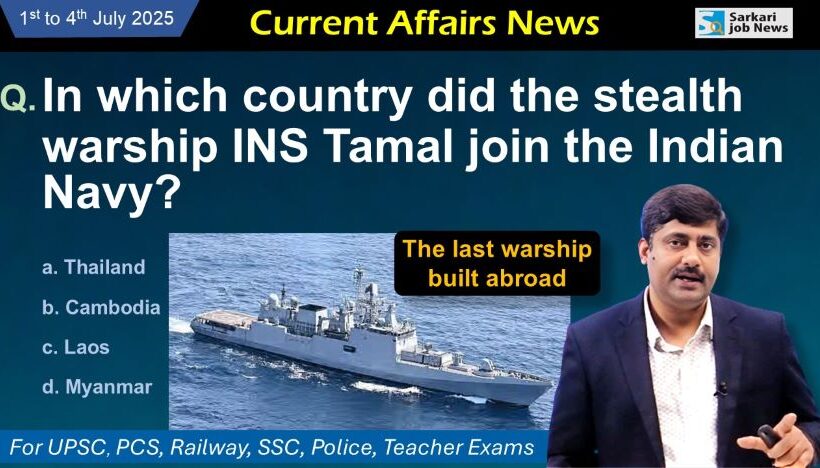
3. The stealth warship INS Tamal, built in which country, joined the Indian Navy in July 2025?
a. Russia
b. France
c. America
d. Britain
Answer: a. Russia
– INS Tamal, built in Russia’s Kaliningrad city, is considered the most lethal warship to date.
– It is the last warship that India has had constructed on foreign soil.
– INS Tamal was commissioned in the presence of Vice Admiral Sanjay J. Singh, Chief of the Western Naval Command of the Navy.
INS Tamal
– It is the eighth frigate of the Talwar class.
– It is an advanced version of the Krivak III-class frigate, built by Russia under Project 1135.6 for the Indian Navy.
– Length: 124.8 meters
– Width: 15.2 meters
– Maximum speed: 30 knots (56 km/h)
– The ship will have 250 sailors and 26 officers on board.
– It is named after the mythological sword of Lord Indra.
– Its greatest strength is the BrahMos supersonic missile, which can destroy land and sea targets located far away within seconds.
– In addition, new-generation vertical launch surface-to-air missiles deployed on the ship provide full protection against aerial attacks.
– Anti-submarine rockets and torpedoes are capable of eliminating any submarine threats, while a 100 mm powerful gun and 30 mm close-in weapon systems can counter close-range dangers.
– The sonar system and advanced radar onboard keep a sharp watch on every activity.
– Multi-role helicopters can take off from its deck, significantly extending its surveillance and attack range from the air.
Emblem: A Bear
– The ship’s emblem is a bear, symbolizing a combination of Jambavant, the Indian mythological character, and the Eurasian Brown Bear, Russia’s national animal.
– The ship’s motto is “Sarvada Sarvatra Vijay”, which means Victory always and everywhere – to defeat the enemy and achieve success at all times and in all places.
Talwar-Class Warships
– INS Tamal (Inducted into the Navy in July 2025)
– INS Tushil (Inducted into the Navy in December 2025)
– Triput (Built in India by Goa Shipyard Limited)
– Tavasya (Currently being built in India by Goa Shipyard Limited)
Towards Indigenization
– The Navy has stated that INS Tamal will be the last imported warship to be inducted into its fleet.
– This is the result of decades of effort toward indigenization of shipbuilding and marks a major milestone on the path to self-reliance in defense.

————–
4. When is International Co-operative Day celebrated?
a. First Monday of July
b. First Tuesday of July
c. First Saturday of July
d. First Sunday of July
Answer: c. First Saturday of July (5 July in 2025)
2025 Theme:
– Cooperatives: Driving Inclusive and Sustainable Solutions for a Better World
– International Co-operative Day brings together individuals, communities and organisations across the world to celebrate the impact of co-operative enterprises.
—————
5. As per the 2024 report of the UN Inter-Agency Group for Child Mortality Estimation (UN IGME), the number of children with zero dose in India is expected to decrease from 0.11% in 2023 to how many% in 2024?
a. 0.01%
b. 0.06%
c. 0.09%
d. 0.10%
Answer: b. 0.06%
Zero Dose:
– According to the World Health Organization (WHO), “zero dose” children are those who either have no access to routine immunization services or have never been vaccinated at all. This includes children who have not received the first dose of DTP (Diphtheria-Tetanus-Pertussis) as well as those who missed other vaccines.
Data:
– According to the Ministry of Health and Family Welfare, the percentage of zero dose children in India (those who have not received even a single vaccine) declined from 0.11% in 2023 to 0.06% in 2024.
– India has achieved a significant milestone in the field of public health.
– Additionally, there has been a 78% decline in under-five child mortality in 2024 compared to 1990 — much higher than the global average of 61%.
– Similarly, the neonatal mortality rate has dropped by 70%,
– while the global decline stands at 54%.
– This report comes at a time when global experts are reviewing public health efforts following the COVID-19 pandemic.
Maternal Mortality Rate
– According to a United Nations report covering the period from 2000 to 2023, India’s maternal mortality rate (MMR) has dropped to 80 per 100,000 live births, representing a total decline of 86%.
Reasons for the Decline
– The Ministry of Health and Family Welfare believes that the Universal Immunization Programme (UIP), which has been running since 1985, is the biggest contributing factor.
– Every year in India, 29 million pregnant women and 26 million infants are vaccinated.
– Free vaccines are provided against 12 diseases, including polio, measles, and hepatitis B.
– Globally, the maternal mortality rate has seen a 48% decline.
Key Initiatives Include:
– Zero Dose Implementation Plan 2024: Implemented in 143 districts across 11 states where the number of unvaccinated children is high.
– Mission Indradhanush (since 2014): Accelerated in 2017 with support from state governments. Under this mission, 54.6 million children and 13.2 million pregnant women were vaccinated—those who were previously unvaccinated or under-vaccinated.
– Pulse Polio Campaign: Through National Immunization Day (NID) and Sub-National Immunization Day (SNID), India has maintained its polio-free status since 2014.
– Village Health and Nutrition Day (VHND): Conducted regularly at the community level for immunization and outreach activities.
– Multi-tiered Task Forces: Task forces at the State (STFI), District (DTFI), and Block (BTFI) levels ensure coordinated and effective implementation.
– Regular IEC (Information, Education, and Communication) Campaigns: Help to increase awareness and address vaccine hesitancy.
————–
6. In which country was ‘Indian Mango Mania 2025’ launched?
a. Saudi Arabia
b. United Arab Emirates (UAE)
c. Oman
d. Qatar
Answer: b. United Arab Emirates (UAE)
– The event was organized by the Agricultural and Processed Food Products Export Development Authority (APEDA) under the Ministry of Commerce and Industry in Abu Dhabi, the capital of the United Arab Emirates (UAE).
– The objective of the event was to enhance the global presence of Indian agricultural products, especially mangoes.
– It also aimed to showcase India’s finest mango varieties to the Indian diaspora spread across the Gulf region.
– The event featured Indian mango varieties with GI tags and regional specialities, including Banarasi Langra, Dussehri, Chausa, Sundarja, Amrapali, Malda, Bharat Bhog, Prabha Shankar, Lakshman Bhog, Mehmood Bahar, Vrindavani, Fasli, and Mallika.
– The campaign was inaugurated by Sanjay Sudhir, India’s Ambassador to the UAE, at Lulu Hypermarket, Khalidiya Mall, Abu Dhabi, in the presence of Mr. Yusuff Ali M.A., Chairman of the Lulu Group.
– The event was also attended by Rohit Mishra, Counselor (Trade & Investment) at the Embassy of India, and Dr. C.B. Singh, Deputy General Manager of APEDA.
– It is worth noting that the UAE continues to be the top export destination for Indian mangoes.
– In 2024, India exported over 12,000 metric tons of mangoes worth USD 20 million to the UAE.
—————
7. When is National Doctor’s Day celebrated?
a. 01 July
b. 30 June
c. 28 June
d. 27 June
Answer: a. 01 July
– This day is celebrated in the honour of doctor and second Chief Minister of West Bengal, Dr Bidhan Chandra Roy.
– He was born on 1 July 1882 in Bihar, and died on this day in July 1962.
– Dr Bidhan Roy was the CM of West Bengal for 14 years.
– He has made a significant contribution in the field of medicine.
– He is also called the architect of Bengal for his visionary leadership.
– He was awarded the Bharat Ratna in the year 1961.
– National Doctor’s Day in India started in the year 1991.
————–
8. Which country, whose 70% population is Muslim, has banned hijab in June 2025?
a. Syria
b. Afghanistan
c. Kazakhstan
d. Pakistan
Answer: c. Kazakhstan
– On June 30, 2025, President Kassym-Jomart Tokayev signed a law banning clothing that covers the face in public places.
– The law states that face-covering garments that conceal a person’s identity cannot be worn in public spaces.
– The President said: _“It is better to wear our national attire instead of face-covering black garments.
– These clothes represent our culture, and they should be promoted.”_
– However, exceptions are allowed in cases of illness, extreme weather, sports, or cultural events.
– Hijab Already Banned in Schools Since 2023
The Kazakh government had already banned the hijab in schools in 2023.
– The government stated that the school uniform policy does not allow the wearing of hijabs.
– In response to this decision, 150 girls dropped out of school.
Hijab Bans in Central Asian Countries
– Kyrgyzstan banned the niqab in 2025. Violation of the rule leads to a fine of $230 (₹20,000). The government says this is necessary for security and identification.
– In Uzbekistan, the burqa and niqab are banned, with fines exceeding $250 (₹22,000) for violations.
Restrictions in African Countries
– In Tunisia, a ban on the niqab in government offices was imposed in 2019 after three suicide bombings in one week. Earlier, Islamic clothing was banned until 2011 but later lifted.
– In Algeria, a ban on the niqab at workplaces was introduced in 2018 to facilitate easy identification. The hijab is allowed, but the niqab is not.
– In Egypt, the niqab was banned in schools in 2023. The hijab is permitted as long as the face remains uncovered.
Why Are These Restrictions Being Imposed?
– These countries state that face-covering garments may pose a security threat because they make it difficult to identify people.
– Additionally, these countries want to promote their national culture and traditions.
– However, some people view these restrictions as an attack on personal freedom.
Kazakhstan
– Capital: Astana
– Prime Minister: Alzhas Bektenov
– President: Kassym-Jomart Kemeluly Tokayev
– Population: 20.3 million (2023)
– Language: Kazakh
– Currency: Kazakhstani Tenge
————–
9. Which country’s President John Mahama gave PM Modi the national award in July 2025?
a. Trinidad and Tobago
b. Argentina
c. Namibia
d. Ghana
Answer: d. Ghana
– On 2nd July, Narendra Modi arrived in Ghana, where he was awarded the Officer of the Order of the Star of Ghana.
– Modi was given a guard of honor with a 21-gun salute there.
– Four MoUs Signed Between Both Countries
First Agreement: To establish a Joint Commission Meeting under the Ministry of External Affairs label.
– Second Agreement: Both countries will share training and experience of experts in traditional medicine.
– Third Agreement: Related to cultural activities, which will promote cultural programs and tourism.
– Fourth Agreement: To set standards (quality rules for products and services), which will boost economic cooperation.
Ghana
– Capital: Accra
– Population: 33.8 million (2023)
– Currency: Ghanaian Cedi
– Language: English
– Neighboring countries: Côte d’Ivoire, Burkina Faso, and Togo
————–
10. When is World UFO Day observed?
a. 2 July
b. 1 July
c. 30 June
d. 29 June
Answer: a. 2 July
– UFO (Unidentified Flying Object) is also called a flying saucer.
– Amid debates about the existence or non-existence of UFOs, World UFO Day has been celebrated since 2001.
– Its purpose is to encourage debate and public research worldwide on the presence of UFOs and aliens.
– Any object seen in the sky that is not made by humans and cannot be explained by natural theories is generally called a UFO.
– In 1953, the United States Air Force named it UFO to keep records and review them later. During the 1940s and 1950s, they were commonly called flying discs.
– The United States has a highly secretive place called Area 51.
– Until a few years ago, the U.S. used to deny the existence of such a place.
– But in 2013, the U.S. declassified some documents and admitted that Area 51 is a special testing area where things like UFOs are also tested.
————–
11. Which country’s Prime Minister Kamala Prasad-Bissessar gave PM Modi its national award in July 2025?
a. Trinidad and Tobago
b. Argentina
c. Namibia
d. Ghana
Answer: a. Trinidad and Tobago
– Prime Minister Kamla Persad-Bissessar of Trinidad and Tobago honored Prime Minister Narendra Modi on 5th July 2025 with the Order of the Republic of Trinidad and Tobago.
– He was awarded for his global leadership, deep engagement with the Indian diaspora, and humanitarian efforts during the COVID-19 pandemic.
Trinidad and Tobago
– Capital – Port of Spain
– President – Christine Kangaloo
– Prime Minister – Kamla Persad-Bissessar
– Currency – Trinidad and Tobago Dollar (TTD)
– Population – 1.5 million
————–
12. When is World Sports Journalists Day celebrated?
a. 2 July
b. 3 July
c. 4 July
d. 5 July
Answer: a. 2 July
– The International Sports Press Association (AIPS) established World Sports Journalists Day in 1994.
—————
13. What is the C-FLOOD system, which was inaugurated by Union Jal Shakti Minister CR Patil?
a. Unified Lightning Forecasting System
b. Unified Drought Forecasting System
c. Unified Flood Forecasting System
d. Unified Storm Forecasting System
Answer: c. Unified Inundation Forecasting System
– The Union Minister of Jal Shakti inaugurated the Unified Inundation Forecasting System, C-FLOOD, in July 2025.
– The aim of this new initiative is to enhance India’s flood management capabilities by providing advanced flood forecasting and early warning systems.
About the C-FLOOD system:
– It is a web-based system that forecasts floods up to two days in advance, down to the village level.
– This system includes flood inundation maps and water level predictions, enabling officials to prepare more effectively for potential floods.
– The initiative aims to improve flood management by integrating data from various national and regional flood modeling agencies into a unified system.
Who developed it:
– C-DAC, Pune
– Central Water Commission (CWC)
– National Remote Sensing Centre (NRSC)
– This initiative is part of the National Supercomputing Mission (NSM), a joint effort between the Ministry of Electronics and Information Technology (MEITY) and the Department of Science and Technology (DST).
Key Features:
=> 2-day forecast at the village level: Provides local flood maps and water level data up to the Gram Panchayat level.
– Hydrodynamic modeling: Uses advanced 2-D simulations powered by high-performance computing (HPC) under the National Supercomputing Mission (NSM).
– Multi-basin coverage: Currently covers Mahanadi, Godavari, and Tapi basins, with plans to include more.
– Real-time data integration: Pulls forecast outputs from national and regional models into an integrated decision-support portal.
– Disaster portal integration: Designed for integration with the National Disaster Management Emergency Response Portal (NDEM).
– Promotes inter-agency collaboration and real-time validation using satellite and ground data.
– Establishes a standard for climate-resilient water management aligned with Developed India @2047 goals.
—————
14. Which neighboring country of India became the President of the United Nations Security Council (UNSC) for the month of July 2025?
a. China
b. Nepal
c. Sri Lanka
d. Pakistan
Answer: d. Pakistan
– However, Pakistan did not get this presidency through voting, but rather because it was their turn in the rotation.
– The Security Council has 15 members, of which ten are non-permanent members with a two-year term.
– Each country becomes the president of the council for one month in alphabetical order.
– Pakistan got this position for the month of July.
Became UNSC Non-Permanent Member by a Large Vote
– Pakistan becoming the president of the United Nations Security Council is not a matter related to India’s or any other country’s foreign policy.
– Pakistan’s two-year tenure as a non-permanent member in the Security Council began in January 2025.
– However, the concerning fact is that Pakistan received 182 votes out of 193 in the General Assembly for the non-permanent membership.
– The reasons behind such strong international support for Pakistan need to be understood.
United Nations Security Council (UNSC)
– Its role is to promote peace and security worldwide by encouraging friendly relations among countries.
– Established in 1945
– Headquarters: New York, USA
– Total Members: 15 (5 permanent and 10 non-permanent)
– Permanent: 5 (USA, Russia, France, China, UK)
– Non-permanent: 10 (two-year term)
Since 1965, the Security Council consists of 15 member countries:
– Five permanent members: China, France, Russia, United Kingdom, and USA
– Ten non-permanent members are elected by the General Assembly based on geographic regions:
– African: 3
– Asia-Pacific: 2
– Latin American and Caribbean Group: 2
– Eastern Europe: 1
– Western European and Others: 2
Note: India held the UNSC presidency in August 2021 and December 2022. At that time, India was a non-permanent member of the UNSC from 1 January 2021 to 31 December 2022.
PDF Download: Click here