
This is the current affairs 4 April 2026. Here are questions and answers of daily current affairs for better preparation of competitive exams for government jobs.
1. What is the goal of NASA’s Artemis II mission?
a. A crewed mission to orbit the Moon
b. A crewed mission to land on the Moon
c. An uncrewed landing on the Moon
d. Sending a vehicle for humans to the Moon
Answer: a. A crewed mission to orbit the Moon
– Launch date: The Artemis II mission was successfully launched on April 1, 2026. (Note: It was earlier scheduled for 2024–25 but was delayed due to technical testing.)
– Launch site: Kennedy Space Center
– Launch vehicle: It was launched by NASA’s Space Launch System (SLS) rocket, the most powerful rocket in the world.
– Spacecraft: The Orion capsule has been used in this mission.
– Name Artemis: From Greek mythology, Artemis is the Goddess of the Moon.
Mission duration and trajectory
– Duration: Approximately 10 days
– Trajectory: The Orion spacecraft will orbit the Earth twice to check systems. After that, it will proceed toward the Moon for a lunar flyby. It uses a free-return trajectory, where the Moon’s gravity naturally pushes the spacecraft back toward Earth (slingshot effect).
– Distance: It will pass about 7,400–10,000 km above the far side of the Moon.
Crew members (astronauts)
– Reid Wiseman (Commander): Experienced pilot from the US Navy
– Victor Glover (Pilot): First Black person to travel to the Moon
– Christina Koch (Mission Specialist): First woman to go on a Moon mission
– Jeremy Hansen (Mission Specialist): Canadian astronaut and first non-American to travel to lunar orbit
Objectives of the mission
– Foundation for the future: A “dress rehearsal” for Artemis III (which will land on the Moon)
– System verification: Testing Orion’s life support, communication, and navigation in deep space
– Human safety: Ensuring safety in radiation and extreme temperatures
Why after 50+ years?
– Since Apollo 17 (1972), humans have not gone to the Moon. Reasons for the new mission:
– Technological advancement: Advanced computing, 3D printing, and autonomous systems
– Permanent presence: Unlike Apollo, Artemis aims to build a permanent base
– Resource exploration: Searching for ice (water) at the Moon’s south pole
– Mars preparation: Using the Moon as a gateway for Mars missions
Challenges
– Radiation: Exposure to harmful cosmic rays outside Earth’s magnetic field
– Heat shield: Re-entry at ~40,000 km/h generates extreme heat
Cost: Artemis program costs over $90 billion
List of manned Moon missions
1968: Apollo 8 – First human mission to reach lunar orbit
1969: Apollo 10 – Final rehearsal before landing
1969: Apollo 11 – First human landing (Neil Armstrong and Buzz Aldrin)
1969: Apollo 12 – Second successful landing
1971: Apollo 14 – Scientific experiments
1971: Apollo 15 – First use of lunar rover
1972: Apollo 16 – Study of lunar highlands
1972: Apollo 17 – Last human mission; Eugene Cernan was the last man on the Moon
2026: Artemis II – Return of humans to lunar orbit after 50 years
Artemis Program
Artemis I: Uncrewed test flight (completed in 2022)
Artemis II: First crewed lunar orbit mission (April 2026)
Artemis III: Planned Moon landing (likely 2027)
Artemis IV: Human landing at the Moon’s south pole (likely 2028)
Artemis V: Sending a lunar terrain vehicle and starting a base (likely 2029)
Artemis VI–XI: Expansion of Lunar Gateway and preparation for Mars missions
—————-
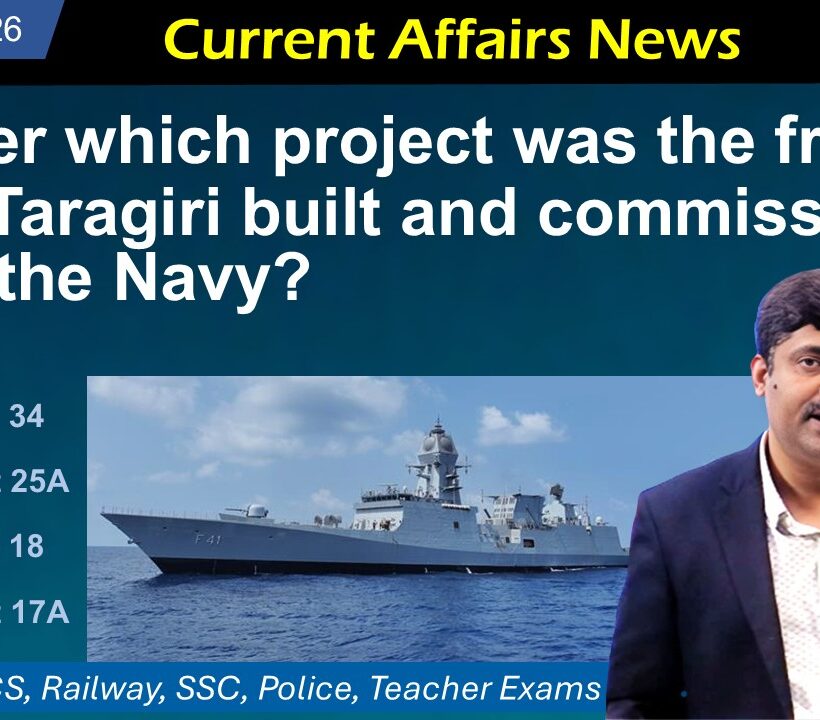
2. Under which project was the stealth guided-missile frigate ‘INS Taragiri’ constructed and commissioned into the Indian Navy?
a. Project 34
b. Project 25A
c. Project 18
d. Project 17A
Answer: d. Project 17A (Nilgiri-class warship)
– INS Taragiri was commissioned into the Indian Navy on April 3, 2026, under the chairmanship of Defence Minister Rajnath Singh.
– Built by Mazagon Dock Shipbuilding Limited under Project 17A.
– Equipped with BrahMos supersonic missiles, MF-Star radar, and medium-range surface-to-air missile systems.
– Armed with 76 mm gun, 30 mm and 12.7 mm close-in weapon systems, anti-submarine rockets, and torpedoes.
Fourth warship of Nilgiri-class
– Total of 7 stealth frigates under Project 17A
– Taragiri is the fourth warship
– Advanced version of the earlier Taragiri (served 1980–2013)
– Designed by Warship Design Bureau
– More advanced than earlier Shivalik-class (P-17) ships
Features
– Weight: 3510 tonnes; Length: 149 m; Width: 17.8 m
Speed: 52 km/h
– Stealth capability (low radar detection)
– Detects enemy activity early
– Capable of fighting in air, water, and underwater
75% indigenous content
– Can stay at sea for long durations
– Dual fuel engine (gas and diesel)
– Can carry at least one helicopter (Kamov or MH-60R)
Project 17A
– Launched in 2019
– Built by MDL (Mumbai) and GRSE (Kolkata)
– Features stealth design and radar evasion
– First ship: Nilgiri (2019)
– Ships named after mountain ranges
—————
3. What is the name of India’s third nuclear-powered submarine inducted into the Navy?
a. INS Arighat
b. INS Paas
c. INS Arihant
d. INS Aridaman
Answer: d. INS Aridaman
– According to Indian Express, details were kept secret
– No official statement issued upon commissioning
– Defence Minister stated: “Aridaman is not just a word, it is power.”
India’s nuclear submarines
– INS Arihant (launched 2009, inducted 2016)
– INS Arighat (commissioned August 2024)
– INS Aridaman (inducted April 2026)
About INS Aridaman
– SSBN (Submersible Ballistic Nuclear Submarine)
– Built at Ship Building Center, Visakhapatnam
– Weight: ~6,000 tonnes (7,000 tonnes submerged)
– Speed: ~44 km/h underwater
– Armed with K-15 and K-4 ballistic missiles
– Crew: 95–100 personnel
– Powered by 83 MW nuclear reactor
– Based on Kalpakkam reactor technology
Difference: Nuclear vs Diesel submarine
– Diesel submarines require oxygen and must surface frequently
Nuclear submarines do not need oxygen and can remain submerged for long durations
—————
4. Which country proposed increasing its defense budget by 42% to $1.5 trillion?
a. Russia
b. China
c. USA
d. France
Answer: c. USA
– Amid tensions with Iran, Trump proposed a $1.5 trillion defense budget
– Current defense budget: ~$839 billion
– Indicates major geopolitical shift
Largest increase since World War II
– 42% increase
– Driven by Iran conflict
– “Gun vs Butter” debate: cutting welfare spending to boost defense
US total budget
– Estimated ~$7 trillion (FY 2027)
– Two-thirds mandatory spending (Social Security, Medicare, etc.)
Defense budget details
– Proposed: $1.5 trillion
– Increase of ~$445 billion from 2026
Non-defense spending
– 10% cut (~$73 billion)
Impact on China, Russia, India
– China: May trigger arms race
– Russia: Pressure to strengthen nuclear deterrence
– India: Both challenge (costs) and opportunity (defense partnerships)
—————-
5. When is the International Mine Awareness and Assistance in Mine Action Day observed?
a. April 5
b. April 4
c. April 3
d. April 2
Answer: b. April 4
– Observed to raise awareness about landmine dangers
– Declared by UN General Assembly on December 8, 2005
– First observed on April 4, 2006
– Campaign theme: “Mine Action Cannot Wait”
————–
6. Ukhnaagiin Nyamaa became the Prime Minister of which country?
a. Mongolia
b. North Korea
c. Kazakhstan
d. Taiwan
Answer: a. Mongolia
– Appointed by Mongolian Parliament
– Member of Mongolian People’s Party
– Received 88 out of 107 votes
– Age: 39
—————
7. The police force of which state was awarded the President’s Colours?
a. Bihar Police
b. Odisha Police
c. Telangana Police
d. West Bengal Police
Answer: b. Odisha Police
– Awarded for meritorious service
– Highest honor for police/military units
Announced on April 1 (Utkal Diwas)
– Recognizes discipline, bravery, professionalism, and public service
————–
8. Which is the only Indian city included in the ‘20 Cities Towards Zero Waste’ list (March 2026)?
a. Indore
b. Surat
c. Varkala
d. Mysore
Answer: c. Varkala (Kerala)
– Recognized by the UN
– Known for waste reduction and circular economy practices
– Supported by UNEP and UN-Habitat
————–
9. Under whose leadership was a virtual emergency meeting held on the Strait of Hormuz crisis?
a. France
b. Britain
c. Germany
d. USA
Answer: b. Britain
– Meeting held on April 2, 2026
– Focus on diplomacy over military action
– India represented by Foreign Secretary Vikram Misri
– US absence was notable
————–
10. What was the deadline set by the government to eliminate Naxalism in India?
a. August 15, 2026
b. March 31, 2026
c. January 26, 2026
d. December 31, 2025
Answer: b. March 31, 2026
– Declared achieved on March 30, 2026 by Home Minister Amit Shah
– Significant decline in Naxal activities
– Origins trace back to Naxalbari uprising (1967)
– Ideology based on Maoism and armed revolution
PDF Download: Click here