
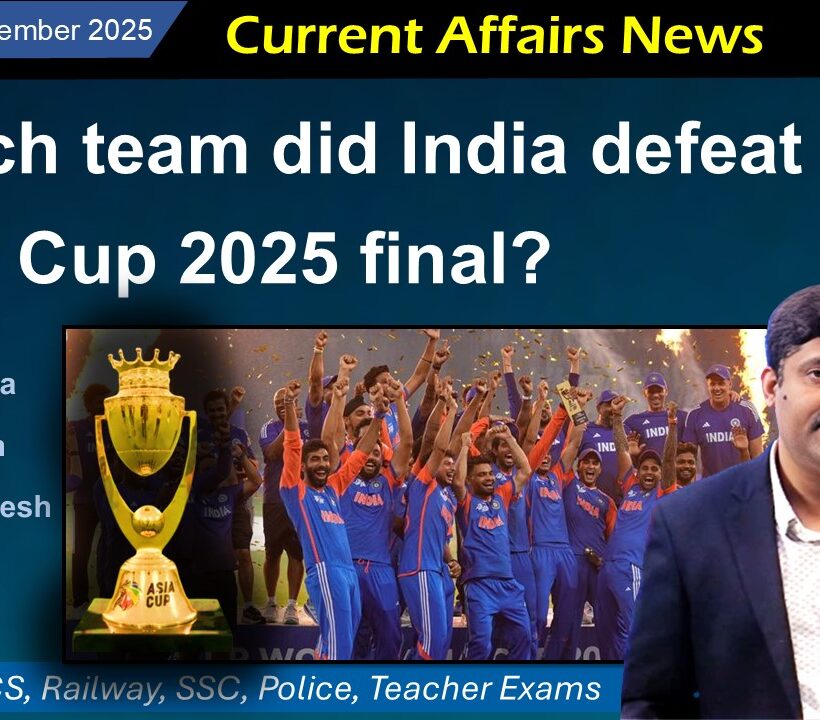
This is the current affairs of 27 to 29 September 2025. Here are questions and answers of daily current affairs for better preparation of competitive exams for government jobs.
PDF Download: Click here
1. Who will become the new President of BCCI in September 2025?
a. Devjit Saikia
b. Arun Thakur
c. Mithun Manhas
d. Rajiv Verma
Answer: c. Mithun Manhas
– He is 45 years old.
– He has become the 47th President of the BCCI (Board of Control for Cricket in India). He succeeded Roger Binny.
– Roger Binny resigned last month after turning 70 years old.
– Mithun Manhas was elected unopposed.
About Mithun Manhas
– Birth – 12 October 1979, Bhalesa (Jammu & Kashmir).
– Domestic Cricket – Played for Delhi for a long time, later also associated with Jammu & Kashmir.
– Record – 157 First-Class matches, 9,714 runs, average ~45.82, 27 centuries.
– IPL – Played for Delhi Daredevils, Pune Warriors, and Chennai Super Kings.
– International Level – Never played for India’s national team (Uncapped).
– Coaching – Served as Assistant Coach for Kings XI Punjab, RCB, Gujarat Titans, etc.
– Administrative Role – Also held important positions in the Jammu & Kashmir Cricket Association.
– BCCI President – Elected unopposed as BCCI President in September 2025; the first person from Jammu & Kashmir to hold this post.
BCCI Election Results
– President: Mithun Manhas
– Vice President: Rajeev Shukla
– Secretary: Devajit Saikia
– IPL Chairman: Arun Thakur
—————-
2. India’s first supersonic jet MiG-21 aircraft was retired on 26 September 2025, in which year was it inducted into the Air Force?
a. 1963
b. 1969
c. 1970
d. 1980
Answer: a. 1963
– A fighter jet was given a farewell at Chandigarh Airbase.
– The aircraft’s services have now officially ended.
– At the farewell ceremony, Air Force Chief A.P. Singh took the final flight along with 6 jets of the 23 Squadron.
– Defence Minister Rajnath Singh, the Chiefs of the three Armed Forces, and several officials from the Defence Ministry attended the ceremony.
– Former airmen who once flew these jets became emotional watching the farewell flight.
– The MiG-21 was given a final salute with a water cannon shower.
– It was India’s first supersonic jet.
– The aircraft was inducted into the Air Force in 1963 at Chandigarh itself.
– Since its first squadron was formed in Chandigarh, a “Memory Lane” was also created here after its farewell.
– This lane showcases the indomitable courage and valor of the MiG-21 from 1963 to 2025.
– The Commanding Officer of the decommissioned MiG-21 Squadron presented the Air Force Chief with a large book in the form of Form-700.
– This book contained all types of pre-flight inspection reports and pilots’ feedback reports after flights.
– The supersonic MiG-21 played a crucial role in the 1965 India-Pakistan War, the 1971 Bangladesh Liberation War, the 1999 Kargil War, and the 2019 Balakot Air Strike.
– Being India’s first supersonic jet, it could fly faster than the speed of sound (332 meters per second).
– Now it will be replaced by the Tejas LCA Mark 1A.
MiG-21: A Major Strength of the Air Force
– The MiG-21 has a maximum speed of 2,175 km/h, which allowed it to swiftly vanish after completing a mission.
– It is capable of carrying air-to-air missiles, bombs, and other equipment.
– Payload capacity is around 3,500 kilograms.
– This aircraft could fly at supersonic speed, faster than other planes of its era.
– Its design is rocket-like and robust.
– With payload, its weight is about 5,300 kilograms.
– It had the ability to carry various types of missiles and other weapons, making it capable of air combat.
– Apart from strike missions, it was also used for training and reconnaissance missions.
—————–
3. Legendary defender and former Bayern Munich star Jerome Boateng announced his retirement from Football; he played for which country?
a. America
b. Germany
c. England
d. France
Answer: b. Germany
– 37-year-old Jerome Boateng announced his retirement on 20 September 2025 through his Instagram account.
– Jerome was part of the German team that won the 2014 FIFA World Cup.
– He began his football career with Hertha BSC, after which he played for Hamburger SV, Manchester City, and eventually Bayern Munich.
– At his peak, he was considered one of the best center-backs in the world.
Leagues/Titles Won
– FIFA World Cup Winner (2014, Brazil)
– × UEFA Champions League Winner (2013, 2020 – with Bayern Munich)
– 9× Bundesliga Titles
– 5× DFB-Pokal (German Cup) Titles
—————-
4. Who was appointed by the Central Government as the new Deputy Governor of RBI in September 2025?
a. Rajendra Kishore
b. Vinod Agarwal
c. Vijay Kumar
d. Shirish Chandra Murmu
Answer: d. Shirish Chandra Murmu
– Shirish Chandra Murmu has been appointed as the Deputy Governor of the Reserve Bank of India (RBI).
– The appointment will be effective from October 9, 2025, and will be for a term of three years.
– He will replace Rajeshwar Rao, whose term ends on October 8, 2025. Rao was in charge of Banking Regulation and other portfolios.
Structure of the RBI
– The RBI has four Deputy Governors, who are in charge of various departments such as Monetary Policy, Financial Markets Regulations, Banking Supervision, and Regulations.
– The Governor is Sanjay Malhotra.
Deputy Governors
– M. Rajeshwar Rao (Since October 9, Shirish Chandra Murmu)
– T. Rabi Shankar
– Swaminathan J
– Dr. Poonam Gupta
Law
– The Governor and Deputy Governors are appointed by the Central Government under the RBI Act 1934.
– It is concerned with financial stability and monetary policy.
—————–
5. Moody’s kept India’s sovereign credit rating unchanged at Baa3 with a stable outlook, what does sovereign credit rating mean?
a. Assessing a country’s military strength
b. Assessing a country’s ability and willingness to repay its debt
c. Assessing a country’s export potential
d. Assessing a country’s education system
Answer: b. Assessing a country’s ability and willingness to repay its debt (Sovereign credit ratings reflect a country’s economic credibility.)
– Moody’s kept India’s sovereign credit rating unchanged at Baa3 with a stable outlook. – While another agency, S&P, upgraded India’s rating from ‘BBB-‘ to ‘BBB’ with a target date of August 2025.
What is a sovereign credit rating?
– A sovereign credit rating is an assessment by international credit rating agencies of a country’s ability and willingness to repay its debt.
– This rating is based on factors such as a country’s economic condition, fiscal health, foreign exchange reserves, political stability, and vulnerability to external shocks (such as a global recession).
Meaning of Credit Rating:
– It is a score or grade given to a country based on its credibility as a borrower. It is similar to how banks and financial institutions give loans to individuals based on their credit scores.
– Sovereign credit ratings are expressed in letters and numbers (e.g., AAA, Baa3).
– High Rating (e.g., AAA): Low risk, strong repayment capacity.
– Low Rating (e.g., C or D): High risk of default.
– Ratings are divided into two categories:
– Investment Grade: Considered safe for investment (e.g., AAA to BBB– on the S&P scale).
– Speculative Grade (Junk): High risk (BB+ and below).
Major Rating Agencies: There are three major global agencies:
– Moody’s: From Aaa (highest) to C (lowest)
– S&P Global Ratings: From AAA (highest) to D (default)
– Fitch Ratings: Same scale as S&P
Note – These agencies update ratings from time to time based on economic data, policy changes, and global events.
Importance of Rating:
– Sovereign rating serves as a benchmark for global investors, lenders, and policymakers. It influences the following:
– Cost of Borrowing: Higher ratings lead to lower interest rates, making borrowing cheaper.
– Investor Confidence: It signals economic stability, thereby attracting FDI and FPI.
– Policy Guidance: Helps governments maintain fiscal discipline (e.g., FRBM Act).
– Economic Credibility: Enhances a country’s reputation globally, making trade negotiations and loans from the IMF/World Bank easier.
What is India’s Rating Like?
– India’s rating generally remains at the lowest investment grade, which reflects moderate risk but a strong economic foundation.
Disadvantages of Low/Stable Rating
– High Interest Rates: A lower rating makes borrowing costlier, which increases the fiscal deficit. India’s debt-to-GDP ratio (~80–85%) could worsen further if ratings decline.
– Reduced Investor Interest: Speculative-grade ratings discourage conservative investors (such as pension funds), leading to possible capital outflows (e.g., the 2013 taper tantrum).
– Vulnerability to External Shocks: Spikes in oil prices or geopolitical tensions can affect ratings, as seen in India’s current account deficit.
– Criticism of Ratings: Agencies face accusations of Western bias, pro-cyclical ratings (downgrades during recessions deepen crises), and lack of transparency. For UPSC, note issues like “rating sovereignty” and the global recognition of domestic agencies like CARE/CRISIL.
India’s Sovereign Rating: Latest Status (29 September 2025) – Updated
– Moody’s Rating: Maintained at ‘Baa3’ (lowest investment grade) with a ‘Stable’ outlook. This indicates:
– Strengths: Strong GDP growth (India is the fastest-growing major economy), robust external position (foreign exchange reserves over $600 billion), and stable domestic financing.
– Weaknesses: High fiscal deficit, heavy debt burden (slow reduction in debt-to-GDP), and revenue base weakened by policies boosting private consumption.
– Other Details: Short-term local currency rating: P-3; Long-term local currency bond rating: A2; Foreign currency bond rating: A3.
– Implications: Resilient despite U.S. tariffs or global policy changes, but limited progress in fiscal consolidation.
For Fiscal Stability, the Government Should Take the Following Corrective Measures:
– Revenue Enhancement: Expand the tax base through GST reforms and improved tax compliance; maximize non-tax revenues (e.g., PSU dividends).
– Expenditure Optimization: Target subsidies, reduce recurrent expenditures, and increase capital spending on infrastructure.
– Debt Management: Adhere to FRBM (Fiscal Responsibility and Budget Management Act, 2003) targets (fiscal deficit 4.5% of GDP) and reduce the debt-to-GDP ratio.
– Policy Coordination: Ensure alignment between monetary and fiscal policies and maintain flexibility to handle global challenges (e.g., tariffs).
These measures will help secure a rating upgrade and ensure sustainable development.
—–

UPSC and State PCS Level Prelims Questions
Q1. Which of the following is the correct implication of Moody’s Baa3 rating for India?
1) It falls under the “investment grade” category.
2) It means that the risks associated with investing in India are of the highest level.
3) It indicates that India’s default risk is lower than that of “speculative grade” countries.
Choose the correct option:
a. 1 and 3 only
b. 1 and 2 only
c. 2 and 3 only
d. 1, 2, and 3
Answer: a. 1 and 3 only
(1 correct) Baa3 = the lowest investment grade category
(2 incorrect) Not “highest risk,” but moderate risk
(3 correct) This represents a better situation than speculative grade (junk) stocks
——
For Mains
For UPSC, this topic is linked to topics like ‘Indian Economy and Planning, Resource Mobilization, Growth and Employment’ under GS Paper 3 (Economy).
Q. Discuss the above statement in the context of:
1) The importance of Sovereign Credit Rating and its potential impact on the Indian economy.
2) What are the positive factors behind Moody’s maintaining India’s rating?
3) What are the prospects and obstacles to India’s rating upgrade?
4) What corrective measures should the government take to maintain fiscal stability?
—————-
6. Whom did India defeat to win the Asia Cup 2025 title?
A. Sri Lanka,
B. Pakistan,
C. Bangladesh,
D. Afghanistan
Answer: B. Pakistan
– India defeated Pakistan by 5 wickets in the final of the Asia Cup 2025 on 28 September 2025.
– India won its 9th Asia Cup title.
Asia Cup 2025 Final
– Between: India and Pakistan
– When: September 28, 2025
– Where: Dubai International Stadium, Dubai.
– Pakistan: All out for 146 in 19.1 overs
– India: Scored 150 in 19.4 overs and won.
– Titles won so far: Nine times.
– India Team Captain: Suryakumar Yadav
– Pakistan Captain: Salman Ali Agha
Full list of award winners – Asia Cup 2025
– Player of the Match (Final): Tilak Verma (69 runs in the final)
– Gamechanger of the Match (Final): Shivam Dubey
– Player of the Tournament: Abhishek Sharma (plus $15,000 and a Heuvel H-9 SUV)
– Most Valuable Player of the Tournament: Kuldeep Yadav
– Most runs: Abhishek Sharma
– Most wickets: Kuldeep Yadav
– Most sixes: Abhishek Sharma
When has India won the final?
Year – Winner – Runner-up
– 1984 – India – Sri Lanka
– 1988 – India – Sri Lanka
– 1990-91 – India – Sri Lanka
– 1995 – India – Sri Lanka
– 2010 – India – Sri Lanka
– 2016 – India – Bangladesh
– 2018 – India – Bangladesh
– 2023 – India – Sri Lanka
– 2025 – India – Pakistan
—————
7. Name the Asian Cricket Council (ACC) chief, from whom the Indian team refused to accept the Asia Cup 2025 champions trophy and their individual medals?
a. Asin Ali
b. Mohsin Naqvi
c. Yusuf Khan
d. Mohammad Afridi
Answer: b. Mohsin Naqvi (He is also the Home Minister of Pakistan.)
Why did they refuse to accept the trophy?
– Because Asian Cricket Council (ACC) chief Mohsin Naqvi insisted he would present the trophy.
– The Indians refused to accept the trophy from him because ACC chief Naqvi is also the chairman of the Pakistan Cricket Board (PCB) and the Home Minister of Pakistan. The ceremony began more than an hour late and ended without the trophy being presented.
—————
8. When is World Tourism Day celebrated?
a. September 20th
b. September 25th
c. September 27th
d. September 28th
Answer: c. September 27th
Theme for 2025
– Tourism and Sustainable Change
– Tourism and Sustainable Transformation
– The United Nations World Tourism Organization (UNWTO) declared World Tourism Day in 1980.
– Its purpose is to promote the social, cultural, economic and environmental importance of tourism.
Importance of Tourism in India:
– Economic Contribution: In the financial year 2022-2023, tourism contributed 5% to GDP and generated 7.6 crore jobs. In 2024, India attracted over 9 million foreign tourists, boosting foreign exchange reserves.
– Cultural Significance: India’s diverse culture, historical sites (e.g., Taj Mahal, Ajanta-Ellora), and religious centers (e.g., Varanasi, Tirupati) promote tourism. This also encourages cultural exchange.
– Sustainable Tourism: Eco-tourism (e.g., Sundarbans, Kerala backwaters) and rural tourism (e.g., Rajasthan, Himachal Pradesh) are being promoted, empowering local communities.
– Policy Efforts: Government initiatives like ‘Atulya Bharat’ and ‘Dekho Apna Desh,’ along with Swadesh Darshan and PRASHAD schemes, strengthen tourism infrastructure. The e-Visa facility has increased the number of foreign tourists.
– Challenges: Inadequate infrastructure, environmental degradation, and regional security concerns hinder tourism development.
—————
9. When is World Rabies Day observed?
a. September 25th
b. September 27th
c. September 28th
d. September 29th
Answer: c. September 28th
– The purpose of celebrating this day is to spread awareness among people about rabies.
– Rabies is a fatal viral disease. The main cause of rabies is bites from domestic or stray dogs.
– India accounts for approximately 20,000 deaths from rabies annually – the highest in the world.
– Around 95% of rabies cases are caused by dog bites.
– The estimated number of dogs in India is 60-70 million, most of which are stray dogs.
– Rabies is 100% preventable if vaccinated and treated at the right time.
Theme for 2025
Act Now: You, Me, Community
————–
10. Who has been appointed as the new MD and CEO of Tata Motors?
a. Shailesh Chandra
b. Vinod Verma
c. Vinayak Singh
d. Rakesh Jadon
Answer: a. Shailesh Chandra
– His term will be for three years, ending on September 30, 2028.
– Shailesh Chandra will also continue as the MD of Tata Passenger Electric Mobility Limited (TPEM).
—————-
PDF Download: Click here