This is the current affairs of 28 & 29 January 2026. Here are questions and answers of daily current affairs for better preparation of competitive exams for government jobs.
PDF Download: Click here
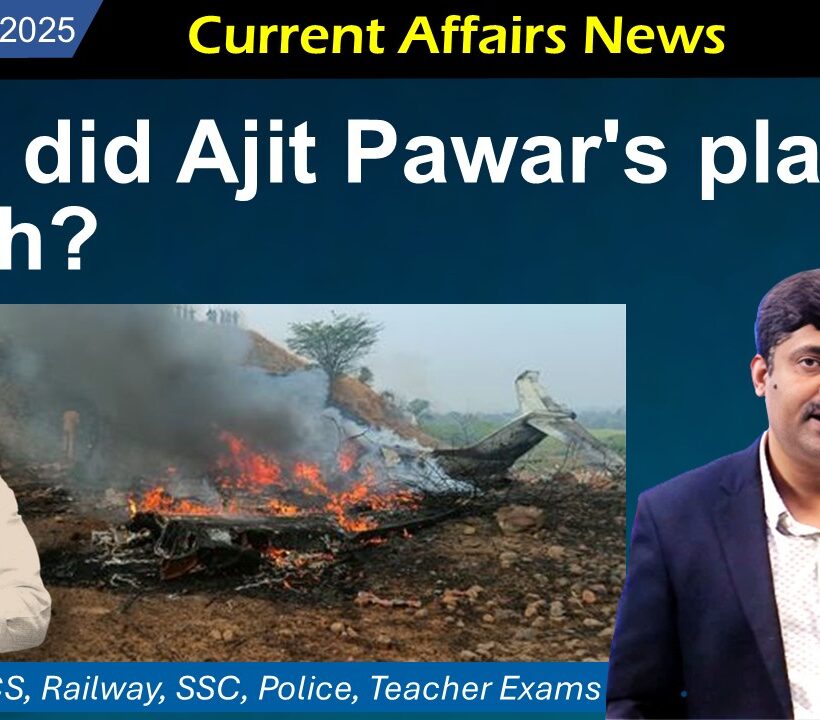
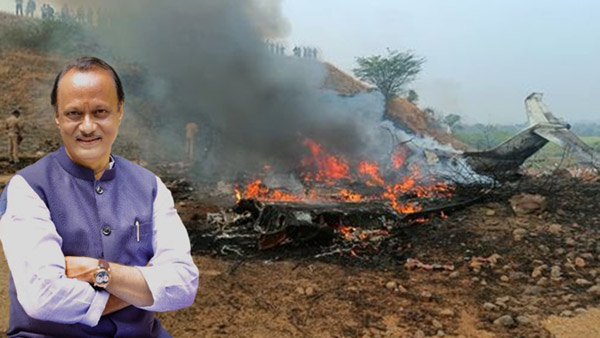
1. In which state did the then Deputy Chief Minister, Ajit Pawar, die in a plane crash on January 28, 2026?
a. Chhattisgarh
b. Madhya Pradesh
c. Maharashtra
d. Gujarat
Answer: c. Maharashtra
– He was 66 years old.
– On the morning of January 28, 2026, at 8:45 am, his plane crashed in Baramati (Pune).
– The accident occurred during landing at Baramati Airport.
– According to local reports quoting an eyewitness present near the accident site, “As soon as the aircraft crashed, there was a loud explosion. It caught fire.”
– Several people, including Ajit Pawar’s personal assistant, security personnel, and plane staff who were on board with him, lost their lives.
– The Directorate General of Civil Aviation (DGCA) confirmed that 5 people were killed in the accident.
– Ajit Pawar was going to address a public meeting in Baramati for the Maharashtra Panchayat elections.
About the aircraft
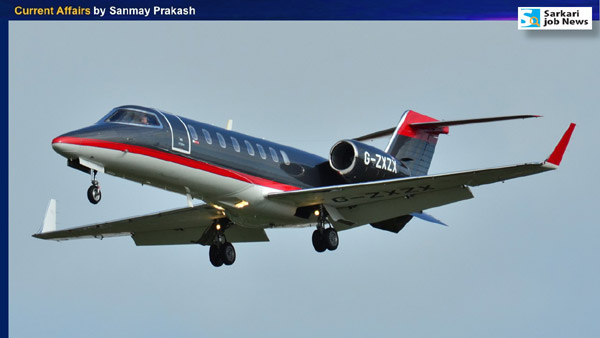
– The crashed aircraft was a premium business jet charter plane.
– It was manufactured by Canada’s Bombardier Aerospace.
– It was operated by Delhi-based private jet charter operator VSR Ventures (VSR Aviation).
– Its name is Learjet-45. It has two engines and is known for fast takeoff and better control and balance.
– Speed: 860–870 km/hr
– Range: about 3,700 km at a time
– Passenger capacity: seating for 6 to 8 passengers
– It is used for business travel, VIP movement, and medical emergencies.
– The aircraft carrying Ajit Pawar was being flown by Pilot Captain Sumit and First Officer Shambhavi Pathak.
Challenges at Baramati Airport
– Baramati Airport is a regional airstrip primarily used for pilot training and private aircraft operations.
– There are no navigational aids available to assist pilots during low visibility.
– Therefore, pilots have to rely heavily on visual cues not only for landing but also to avoid other aircraft. They use radio communication for operations at such airports.
– This is an important detail because the flight operator, VSR, has cited possible visibility-related issues during landing.
– According to the Ministry of Civil Aviation, Baramati is an uncontrolled airport, meaning there is no air traffic control (ATC) tower.
– Even so, at least one senior officer is required to be present for air traffic management at such airports.
– At Baramati Airport, air traffic-related information is provided by instructors or pilots from the flying schools there.
How did the accident happen?
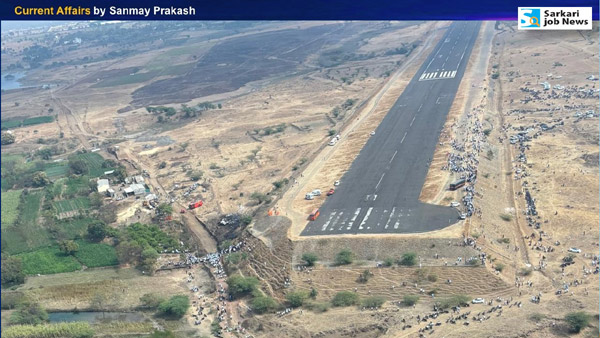
– According to information, the pilots inquired about wind and visibility conditions. The operator informed them that the wind was calm and visibility was about 3,000 meters.
– After this, the pilots approached the airport, but since the runway was not visible, they decided not to land.
– According to sources, preliminary information from the accident site indicates that low visibility conditions in the area may have played a major role in the accident, a factor also mentioned by VSR.
– They circled to attempt landing again. This matches the flight path available on the flight tracking service Flightradar24. The flight made one round and then headed again toward Baramati Airport.
– The aircraft captain had over 15,000 flight hours of extensive experience. The co-pilot had more than 1,500 flight hours of experience.
– After the go-around, the aircraft was asked about its status. The crew reported “final approach on Runway 11.”
– The operator asked whether the runway was visible. The response was: “The runway is not visible yet; we will inform you once it is visible.”
– The ministry said that a few seconds later, the crew reported that the runway was visible.
– After this, the operator gave permission to land the aircraft at 8:43 am. No response was received.
– It was also reported that the pilot did not give any emergency signal during landing.
– He also did not make a ‘Mayday’ call.
– At the time of the incident, no aircraft was flying at the Baramati flying club.
Ajit Pawar
– In 1982, Ajit Pawar began his political career after being elected to the board of a cooperative sugar factory.
– In 1991, he was elected Chairman of the Pune District Central Cooperative Bank.
– In 1991, he was elected to the Lok Sabha for the first time from the Baramati parliamentary constituency and later vacated the seat for his uncle Sharad Pawar.
– Ajit Pawar was elected seven times to the Maharashtra Legislative Assembly from the Baramati Assembly constituency.
– In November 2019, he split the NCP and joined the BJP-led government, becoming Deputy Chief Minister.
– In February 2024, the Election Commission allotted the party name and election symbol to Ajit Pawar’s faction.
– Ajit Pawar had served as Deputy Chief Minister of Maharashtra five times.
———————
2. What type of trade agreement between India and the European Union was announced to be finalized in January 2026?
a. CETA
b. CECA
c. PTA
d. FTA
Answer: d. FTA (Free Trade Agreement)
– Negotiations on the FTA (Free Trade Agreement) concluded on January 27, 2026, after more than two decades.
– This agreement is being called the “Mother of all deals” because it will create a market of nearly 2 billion people.
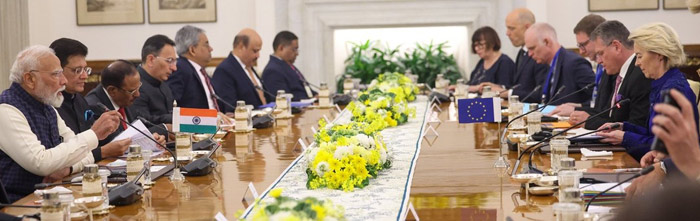
– Indian Prime Minister Narendra Modi, European Commission President Ursula von der Leyen, and European Council President António Luís Santos da Costa announced the completion of negotiations for this deal.
– Under this deal, India will get preferential access on 97% of tariff lines in the European Union.
– Tariffs will be eliminated on about 90.7% of India’s exports to the EU.
– It is India’s largest trade deal.
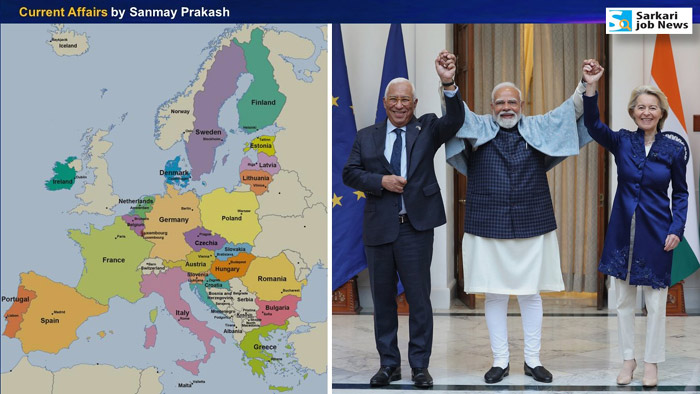
Note – The European Union (EU) is a political-economic union of 27 European countries, aimed at promoting peace, a common market, and cooperation. It coordinates trade, currency (euro), laws, and policies among member states.
Important facts
– Negotiations on the FTA between India and the European Union have been completed.
– After approval by the European Parliament, it will be signed in 2027, meaning it will come into force a year later.
– How much will be implemented immediately and how much gradually will be decided later, but there is an implementation schedule of six to seven years.
– About 87% of exports that used to get the benefit of GSP (Generalised Scheme of Preferences) will have to wait for one year. Under this, many duties had concessions until January 1, 2026.
Benefits to the European Union (EU)
– The EU needs markets for automobile companies. Once this agreement is implemented:
– Autos: High-priced EU cars currently attract 100–110% duty, which will come down to 40% and then after some time to 10%.
– Wine and spirits: Duties of 100–125% will be reduced over 10–15 years; premium brands will get immediate duty reductions.
– Average duty will remain around 9–10%; auto parts at 35%, plastic/chemicals at 10% will be reduced and come into single digits.
Benefits to India
– Baseline tariffs: The European Union has average tariffs of 3–4%; textiles, leather, and engineering face tariffs of up to 10%.
– Most textiles, apparel, leather, footwear, gems, engineering, electronics, and chemicals will have zero or low tariffs.
– Easier access will be available for business services.
– Tariffs will be eliminated on about 90.7% of India’s exports to the EU.
No exemption on CBAM
– The EU’s CBAM (Carbon Border Adjustment Mechanism) is a carbon pricing tool applied to imports of carbon-intensive goods.
– Estimated carbon costs for Indian exporters of 20–35% will apply to some shipments in 2026.
– India did not get an exemption on this. The EU said it can only guarantee that if any country gets a CBAM exemption, India will also get it.
– This will affect steel, aluminum, and engineering exports.
– This is the one challenge that limits the benefits of the deal for Indian exports.
——————-
3. The free trade agreement (FTA) between India and the European Union has been compared to which of the following?
a. The Deal of the Century
b. Mega Deal of All Trade
c. Mother of All Deals
d. The Biggest Trade Gamble
Answer: c. Mother of All Deals
– The proposed agreement finalized in January 2026 is being called the “Mother of all deals.”
– Because it will create a market of nearly 2 billion people.
– This comparison was first announced by European Commission President Ursula von der Leyen.
– She said it is the story of two giants – the world’s second and fourth largest economies. It sends a strong message that cooperation is the best solution to global challenges.
Seventh trade agreement in the last 6 years
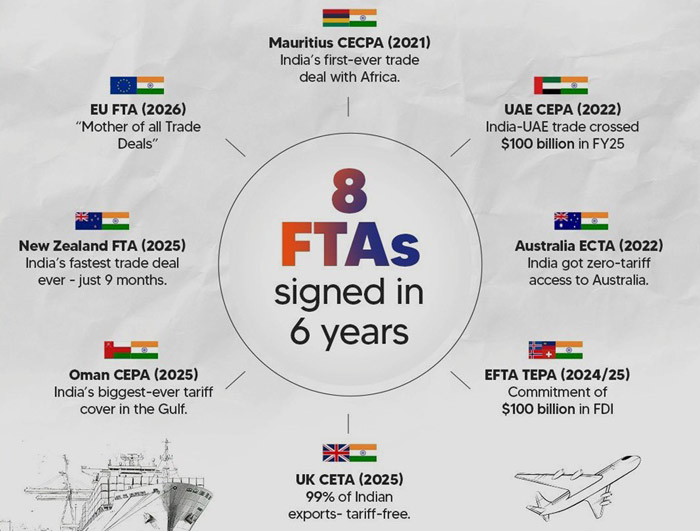
– 2026: European Union (FTA)
– 2025–26: New Zealand (FTA)
– 2025: Oman (CEPA)
– 2025: United Kingdom (CETA)
– 2024–25: EFTA (TEPA)
– 2022: Australia (ECTA)
– 2022: UAE (CEPA)
– 2021: Mauritius (CECPA)
Importance of FTA
– Economic importance: Part of India’s trade diversification strategy amid global trade uncertainties (tariff policies of the Trump administration).
What is a trade agreement?
– It is an agreement between two or more countries to make trade in goods and services easier by reducing or eliminating taxes (duties).
– It benefits companies of both countries because goods become cheaper, leading to higher consumption.
– Trade agreements are generally referred to as FTAs (Free Trade Agreements). However, FTA technically means complete tariff exemption. Since countries have their own priorities, they often reduce tariffs in limited sectors, resulting in agreements with different names. Fully comprehensive FTAs have only been concluded with Sri Lanka and the European Union.
Types of trade agreements
– FTA (Free Trade Agreement): Almost all goods and services are free from customs duties, e.g., Sri Lanka, and negotiations finalized with New Zealand and the EU.
– CETA (Comprehensive Economic and Trade Agreement): New-generation comprehensive trade agreement, e.g., with the UK, covering goods, services, and investment cooperation.
– CECA (Comprehensive Economic Cooperation Agreement): Includes economic and investment cooperation, e.g., with Australia and Singapore.
– CECPA (Comprehensive Economic Cooperation and Partnership Agreement): The word “Partnership” indicates deeper bilateral cooperation, e.g., India–Mauritius.
– CEPA (Comprehensive Economic Partnership Agreement): e.g., between India, Korea, and Japan.
– PTA (Preferential Trade Agreement): Duties are removed on selected goods (e.g., India–Thailand agreement).
– RTA (Regional Trade Agreement): A trade agreement with multiple countries in a region.
– TEPA (Trade and Economic Partnership Agreement): An expanded version covering goods, services, and investment.
————————
4. The two-decade-long negotiations between India and the European Union (EU) on a Free Trade Agreement (FTA) have concluded. When will it be implemented?
a. Year 2027
b. Year 2026
c. Year 2028
d. Year 2029
Answer: a. Year 2027
————-
5. Thirteen important outcomes during the visit of the President of the European Council and the President of the European Commission to India
1. Towards 2030: A joint comprehensive strategic agenda of India–European Union
2. Joint declaration on the conclusion of negotiations on the India–EU Free Trade Agreement
3. Memorandum of Understanding between RBI and the European Securities and Markets Authority (ESMA)
4. Administrative arrangement on advanced electronic signatures and seals
5. Security and defence partnership
6. Launch of negotiations for the India–EU Information Security Agreement
7. Memorandum of Understanding on a comprehensive framework for cooperation on mobility
8. Announcement of the establishment of an EU pilot Legal Gateway Office in India to promote skill mobility
9. Administrative arrangement on cooperation in disaster risk management and emergency response between NDMA and the Directorate-General for European Civil Protection and Humanitarian Aid Operations (DG-ECHO)
10. Formation of a Green Hydrogen Task Force
11. Renewal of the India–EU Scientific and Technological Cooperation Agreement for the period 2025–2030
12. Launch of preliminary talks to enter into a cooperation agreement with India under the Horizon Europe programme
13. Agreement to jointly implement four projects under India–EU trilateral cooperation:
i) Digital innovation and women and youth skill centres;
ii) Solar-based solutions to empower women farmers in agriculture and food systems;
iii) Early warning systems; and
iv) Solar-based sustainable energy transition in Africa and in small island developing states of the Indo-Pacific and Caribbean regions.
——————
6. Inderjit Singh Bindra, former president of which sports organization, passed away on January 25, 2026?
a. BCCI
b. AITA
c. AIFF
d. BAI
Answer: a. BCCI (He served as president from 1993 to 1996)
– He was the BCCI president from 1993 to 1996.
– His hold over the Punjab Cricket Association (PCA) was unmatched.
– He served as PCA chief continuously for 36 years, from 1978 to 2014.
– The magnificent stadium in Mohali was his contribution and was later named ‘I.S. Bindra Stadium’ in his honour.
Brought the World Cup outside England for the first time in 1987
– Until the 1980s, the World Cup was held only in England.
– Bindra, along with NKP Salve and former BCCI president Jagmohan Dalmiya, broke this tradition.
– In 1987, the World Cup was hosted for the first time outside England, in India and Pakistan.
– He united Asian countries like India, Pakistan, and Sri Lanka so that the power centre of cricket could shift towards Asia.
Also held responsibilities in the ICC
– Inderjit Singh Bindra retired from cricket administration in 2014.
– After that, he also held responsibilities in the International Cricket Council (ICC).
– During Sharad Pawar’s tenure as president, he was the ICC’s Principal Advisor.
—————-
7. Which state has completely banned the sale of products made from tobacco and nicotine?
a. Odisha
b. Chhattisgarh
c. Jharkhand
d. West Bengal
Answer: a. Odisha
– The Odisha government issued a notification on January 21, 2026, completely banning the sale of products made from tobacco and nicotine.
– This ban applies to gutkha, pan masala, zarda, khaini, and all other tobacco- and nicotine-containing products.
– However, cigarettes and bidis are not included in this list.
– The government said special drives will be conducted to curb illegal sale and distribution of banned products.
– This ban has been implemented based on guidelines issued by the Supreme Court and the Food Safety and Standards Authority of India (FSSAI).
– Health officials say tobacco- and nicotine-based products cause deadly diseases such as oral cancer, throat cancer, and ailments affecting internal organs.
Odisha
Capital: Bhubaneswar
Governor: Hari Babu Kambhampati
Chief Minister: Mohan Charan Majhi
Population: 41.9 million (2011)
Language: Odia
———————
8. Author and senior journalist Mark Tully passed away on January 25, 2026. Which award had he received?
a. Padma Vibhushan
b. Knighthood
c. Padma Bhushan
d. Both b and c
Answer: d. Both b and c (Padma Bhushan in 2005 and Knighthood in 2002)
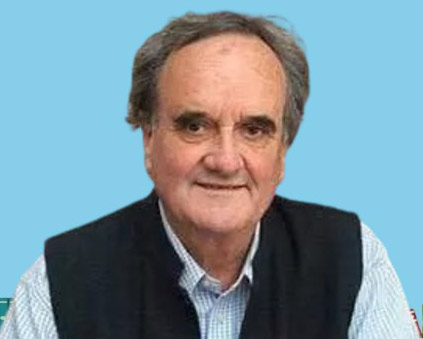
– Mark Tully was born in 1935 in Kolkata to William Scarth Carlyle Tully and Patience Treby.
– At the age of 4, he went to a British boarding school in Darjeeling.
– From the age of 9 onwards, he went to England for further studies.
– After studying at Cambridge, Mark Tully expressed a desire to become a priest in the Church of England, but after two terms at Lincoln Theological College, he abandoned the idea.
– He later became a journalist with the BBC and was then posted to India.
– He was banned from entering India during 1975–77 when Indira Gandhi imposed press censorship during the Emergency.
Associated with the BBC for 30 years
– He worked with the British Broadcasting Corporation (BBC) for 30 years before resigning in July 1994.
– Mark Tully was the BBC’s India correspondent during the 1971 India-Pakistan war, after which Bangladesh was formed.
– As a BBC correspondent, he covered all major events in India, including the India-Pakistan conflict, the Bhopal gas tragedy, Operation Blue Star and the subsequent assassination of Indira Gandhi, the assassination of Rajiv Gandhi, and the demolition of the Babri Masjid.
– He married Margaret in 2001 and has four children in London.
– He lived in India with his girlfriend Gillian Wright.
– Mark Tully was awarded a Knighthood in 2002.
– The Government of India honoured him with the Padma Bhushan in 2005.
Famous books written on India
– No Full Stops in India
– India in Slow Motion
– The Heart of India
– Amritsar: Mrs Gandhi’s Last Battle (1985)
– India’s Unending Journey (2008)
– The Road Ahead (2011)
His latest book
– Upcountry Tales: Once Upon a Time in the Heart of India (2017)
———————
9. Which country’s team did the International Cricket Council (ICC) include in the 2026 T20 World Cup in place of Bangladesh?
a. USA
b. Pakistan
c. Scotland
d. Italy
Answer: c. Scotland
– The T20 World Cup is starting from February 7.
– ICC Chairman Jay Shah officially informed Bangladesh Cricket Board (BCB) President Aminul Islam Bulbul on January 23, 2026.
– Scotland has been included in the T20 World Cup in place of Bangladesh.
Reason
– Tensions arose with India after the killing of Hindus in Bangladesh. The BCCI did not allow Mustafizur Rahman to play in the IPL.
– He had been bought by Kolkata Knight Riders (KKR) for ₹9.2 crore.
– But on January 3, he was dropped from the team on BCCI’s instructions.
– Angered by this, the Bangladesh government banned the broadcast of IPL matches in its country.
– After this, citing player safety, they also demanded a change of venue for the T20 World Cup starting on February
Note – Scotland is a country of the United Kingdom. It is the northern part of Great Britain.
—————-
10. Who has become the first player in the world to win their 400th singles match at a Grand Slam tournament?
a. Naomi Osaka
b. Novak Djokovic
c. Andre Agassi
d. Roger Federer
Answer: b. Novak Djokovic
– Serbian tennis legend Novak Djokovic achieved this feat on January 24, 2026, during the Australian Open.
– Novak Djokovic reached this milestone by winning 400 matches out of more than 455 Grand Slam matches.
– In this regard, Roger Federer (369 wins) is second and Rafael Nadal (314 wins) is third.
– Novak Djokovic is a 24-time Grand Slam champion.
– The 38-year-old Djokovic is playing in Australia aiming to win the 25th Grand Slam title of his career.
——————
11. Who became the first player to score a century in the Women’s Premier League (WPL)?
a. Georgia Voll
b. Harmanpreet Kaur
c. Nat Sciver-Brunt
d. Smriti Mandhana
Answer: c. Nat Sciver-Brunt (scored a century on January 26, 2026, while playing for Mumbai Indians)
– The 16th match of the WPL was played on January 26, 2026, at Kotambi Cricket Stadium in Vadodara.
– In this match, England’s Nat Sciver-Brunt scored the first century while playing for Mumbai Indians.
– Nat Sciver-Brunt scored an unbeaten 100 runs off 57 balls.
– Her strike rate was 175.44.
– No other player has scored a century in the history of the WPL so far.
PDF Download: Click here