
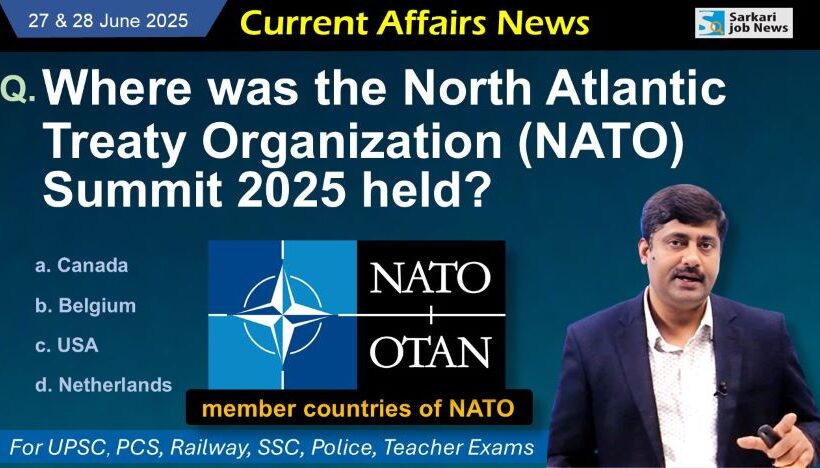
This is the current affairs of 27 & 28 June 2025. Here are questions and answers of daily current affairs for better preparation of competitive exams for government jobs.
PDF Download: Click here
1. Who has been appointed by the Central Government as the new chief of the intelligence agency “R&AW”?
a. Rajiv Sinha
b. Parag Jain
c. Rajiv Jain
d. Rajendra Verma
Answer: b. Parag Jain
– The Central Government has appointed Parag Jain as the new chief of the intelligence agency “RAW” (R&AW).
– The Union Cabinet took this decision on June 28, 2025.
– His tenure will begin on July 1, 2025, and will last for two years.
– His official designation is “Secretary”, which is the title for the head of RAW.
– He is known as the mastermind behind “Operation Sindoor”.
– He replaces Ravi Sinha, whose term ended on June 30.
About RAW (Research and Analysis Wing)
– The Research and Analysis Wing (RAW) is India’s foreign intelligence agency.
– Established: September 21, 1968
– First Secretary: Rameshwar Nath Kao
– RAW operates under the Cabinet Secretariat.
– Its Secretary reports to the National Security Advisor on a daily basis.
– The agency’s primary tasks include gathering foreign intelligence, counter-terrorism, counter-proliferation, advising Indian policymakers, and advancing India’s foreign strategic interests.
About Parag Jain
– He is a 1989-batch Indian Police Service (IPS) officer from the Punjab cadre.
– He was promoted to the rank of Director General of Police (DGP) in Punjab on January 1, 2021. However, since he was serving on central deputation at that time, he received only nominal benefits of the promotion.
– Before becoming the chief of RAW, Parag Jain was heading the Aviation Research Centre (ARC), which is a part of RAW.
– This centre is responsible for aerial surveillance, SIGINT operations, photo reconnaissance flights (photoint), border monitoring, and imagery intelligence (IMINT).
– Jain is known for his exceptional expertise in integrating both Human Intelligence (HUMINT) and Technical Intelligence (TECHINT).
Contribution in Operation Sindoor
– He is known as the mastermind behind Operation Sindoor, which provided intelligence support enabling the armed forces to carry out precise strikes on terrorist infrastructure in Pakistan and Pakistan-occupied Kashmir (PoK).
– He was the head of the Aviation Research Centre (ARC) during the operation.
– On May 7, India launched strikes across the border and Line of Control on nine terrorist camps, which included the headquarters of banned terrorist organizations Jaish-e-Mohammed and Lashkar-e-Taiba.
– The missile strikes were based on precise intelligence gathered by the team under Jain’s leadership.
– Although the missile strikes took just a few minutes, insiders emphasized that years of groundwork and diligent network building made such precision possible.
– With his extensive on-ground experience in Kashmir, Jain is well-positioned to counter ongoing efforts to rebuild terrorist infrastructure in PoK.
– He also has broad experience addressing challenges in the neighborhood and issues related to Khalistani terrorist groups.
– He played a significant role during the reorganization of the erstwhile state of Jammu and Kashmir in 2019.
Jain’s Foreign Mission Experience
– Parag Jain has also served in Indian missions in Sri Lanka and Canada.
– During his tenure in Canada, he monitored Khalistani terrorist modules operating from Canadian soil.
————–
2. In which district did the Union Cabinet decide to establish the International Potato Research Center?
a. Agra
b. Shimla
c. Bhowali
d. Jalandhar
Answer: a. Agra
– The Central Government has approved the establishment of the South Asia Regional Center of the International Potato Center (CIP), based in Peru, in Singna village of Agra district, Uttar Pradesh.
– This decision was taken by the Union Cabinet on June 25, 2025.
– This will be South Asia’s largest potato research center.
– Singna currently has a government-owned potato farm spread over 138 hectares.
– The new branch of the International Potato Center (CIP) will be set up on 10 hectares of this land.
Project Cost: ₹171 Crores
– The total cost of the project is ₹171 crore, out of which India will contribute ₹111 crore, and the International Potato Center (CIP) will contribute ₹60 crore.
– The Uttar Pradesh Government has provided 10 hectares of land for this project.
About the International Potato Center (CIP)
– The International Potato Center (known as CIP, which stands for the Spanish name “Centro Internacional de la Papa”)
– It is headquartered in Lima, the capital of Peru.
– Established in 1971, the center focuses on research related to potato, sweet potato, and Andean roots and tubers.
– The potato crop is native to the Peru-Bolivian Andes region of Latin America and was spread across the world by the Spanish and Portuguese colonizers.
– Potatoes were introduced to India in the 17th century.
– The center is one of the leading global research and development organizations focused on potato and sweet potato.
– Before Agra, the center had only two branches worldwide.
– Apart from Peru, research on potatoes is also being conducted in China and Africa. The Singna center in Agra will now be the third such research facility globally.
Center in Singna, Agra
– The center will focus on developing potato varieties that do not currently exist in India or cannot thrive in the climatic conditions of Agra and surrounding areas.
– On May 20, 2025, members of the Peru-based International Potato Board inspected the Singna farm.
– The establishment of this center is being carried out with the support of the Ministry of Agriculture, Government of India.
Project Cost
– The total cost of the project is ₹171 crore.
– Out of this, India is contributing ₹111.5 crore,
– While the remaining ₹60 crore is being financed by CIP.
Why Is This Initiative Important?
– After rice and wheat, potato is the third most widely available food crop in the world.
– Sweet potato ranks sixth, after maize (corn) and cassava.
– Although India is the world’s second-largest producer of potatoes, after China, its average yield is only 25 tons per hectare.
– This is nearly half of the potential yield, which is around 50 tons per hectare.
– A major reason for these low numbers is the lack of availability of high-quality seeds.
– The establishment of this center will boost domestic potato seed production, thereby reducing India’s dependence on seed imports from neighboring countries.
– The International Potato Center (CIP) will bring its global scientific expertise in potato conservation and genetics to India.
Major Potato-Producing States in India
– Uttar Pradesh and West Bengal lead in potato production, each contributing around 15 million tons in 2020–21.
– Bihar produces around 9 million tons, while Gujarat, Madhya Pradesh, and Punjab also make significant contributions.
————–
3. Which year was the hottest ever recorded in the World Meteorological Organisation’s (WMO) State of the Climate in Asia 2024 report?
a. Year 2023
b. Year 2024
c. Year 2025
d. Year 2022
Answer: b. Year 2024
– The World Meteorological Organization (WMO) released its “State of the Climate in Asia 2024” report in June 2025.
– According to the report, the year 2024 was the hottest year ever recorded in Asia, marked by widespread and prolonged heatwaves.
– Based on all six datasets used by WMO for global average temperature monitoring, 2024 recorded the highest global average temperature for the period 1850–2024.
– This surpassed the previous record of 1.45°C set in 2023.
– WMO Secretary-General Celeste Saulo stated that every year from 2015 to 2024 has been among the ten hottest years on record.
– The report highlights record-breaking temperatures in Asia, rising sea levels, rapid glacier melt, and extreme weather events such as devastating storms and floods.
Severe Glacier Loss
– Out of 24 glaciers in the Central Himalayas and Tien Shan, 23 suffered severe damage, increasing various risks.
– These include floods from glacial lake outbursts, landslides, and long-term threats to water security.
– At the same time, extreme rainfall caused widespread devastation in several countries in the region, resulting in heavy casualties.
Deadly Weather Events (In 2024)
– UAE: Highest 24-hour rainfall since 1949 — 259.5 mm.
– Nepal Floods (September 2024): 246 deaths, economic loss of NPR 12.85 billion.
– India (Kerala): Over 350 deaths in Wayanad district due to heavy rainfall.
– China: 4.8 million people affected by drought, crop destruction, significant economic losses.
– India: Over 1,300 deaths due to storms and lightning, including 72 deaths on July 10 alone.
– Heatwaves claimed more than 450 lives.
– Sri Lanka Floods (December 2024): 450,000 people affected, over 5,000 displaced.
Cyclones in 2024
– Remal (Bay of Bengal): Wind speeds reached 111 km/h, causing flooding up to 2.5 meters in Bangladesh and India.
– Asna (Arabian Sea): Only the third cyclone to form in this region since 1891.
– Dana and Fengal: Fengal crossed Sri Lanka and struck India, resulting in casualties and displacement.

————–
4. Where was the North Atlantic Treaty Organisation (NATO) Summit 2025 held?
a. Canada
b. Belgium
c. USA
d. Netherlands
Answer: d. Netherlands (The Hague)
– For the first time, the NATO Summit was held at the World Forum in The Hague, Netherlands, from June 24–25, 2025.
– Since NATO’s founding in 1949, this was the first occasion that the Netherlands hosted the summit.
– The event was attended by around 45 heads of state and government from 32 member countries and partner nations.
What is NATO?
– NATO stands for the North Atlantic Treaty Organization.
– It is a military and political alliance of countries from Europe and North America.
– After World War II, the Soviet Union and the United States emerged as the two dominant powers, both vying for global influence. This rivalry led to deteriorating relations and the beginning of the Cold War.
– To counter the Soviet threat, the U.S. and European nations formed a military alliance.
– Founded on April 4, 1949, NATO’s headquarters is located in Brussels, Belgium.
– At the time of its founding, NATO had 12 member countries, including the United States. Today, it has 32 member nations, including 30 from Europe and 2 from North America.
– The primary responsibility of NATO is the defense of its member countries and their populations.
– According to Article 5 of the NATO Charter, an attack on any one member is considered an attack on all members.
– Türkiye (Turkey), which joined NATO in 1952, is the alliance’s only Muslim-majority member nation.
The member countries of NATO are:
– Sweden
– Finland
– Albania
– Belgium
– Bulgaria
– Canada
– Croatia
– Czech Republic
– Denmark
– Estonia
– France
– Germany
– Greece
– Hungary
– Iceland
– Italy
– Latvia
– Lithuania
– Luxembourg
– Montenegro
– Netherlands
– North Macedonia
– Norway
– Poland
– Portugal
– Romania
– Slovakia
– Slovenia
– Spain
– Turkey
– United Kingdom
– United States
Note – Finland and Sweden are the 32nd and 31st members of NATO (North Atlantic Treaty Organization).
Netherlands
– Capital : Amsterdam
– Monarch : William Alexander
– PM : Dick Schopf
– Currency : Euro
—————
5. At the NATO summit, member countries agreed to increase their defense budget by how much percent in the next 10 years?
a. 2%
b. 3%
c. 5%
d. 8%
Answer: c. 5%
– NATO Members to Increase Defense Spending to 5% of GDP in Next 10 Years
– At the NATO Summit held in The Hague, Netherlands, U.S. President Donald Trump urged European countries to increase their defense spending.
– Trump wants all member countries to spend 5% of their GDP on defense.
– As of 2024, the total contribution of European countries to NATO’s defense spending is only 30%, which averages to about 2% of their GDP.
– Meanwhile, the United States accounts for nearly 66% of NATO’s defense spending.
NATO’s 3.5% – 1.5% Spending Proposal
– Amid ongoing disagreements within NATO, Secretary-General Mark Rutte proposed a new plan.
– According to this proposal, member countries must spend 3.5% of their GDP directly on military forces and weapons, and 1.5% on activities related to defense.
– The definition of the 1.5% spending is broad and flexible, meaning countries can interpret it in their own way and classify many expenditures as ‘defense spending’.
– Some countries, such as Poland, Estonia, and Lithuania — which face greater threats from Russia — are making every effort to meet this target.
– Other European countries are lagging significantly behind this goal. For many, this level of spending is challenging and they may not reach it until 2032 or even 2035.
Spain Opposes NATO’s 5% Defense Spending Proposal
– Spain has stated that it has an agreement with NATO to not adhere to the 5% spending target, while U.S. President Donald Trump said that this figure should not apply to the United States, but only to its allies.
– Spain made it clear that it cannot spend 5% of its GDP on defense.
– Opposing the proposal, Spain said it will not spend more than 2.1% of its GDP on defense.
– Prime Minister Pedro Sánchez’s government is already facing corruption issues and political pressure, making it even more difficult to increase spending.
– Countries like France, Italy, Canada, and Belgium are also uncomfortable with increasing defense spending to such levels.
NATO Overview
– Founded: April 4, 1949
– Headquarters: Belgium
– Secretary-General: Mark Rutte
————–
6. Which state of India got the hosting of World Police and Fire Games (WPFG) 2029?
a. Uttarakhand
b. Madhya Pradesh
c. Rajasthan
d. Gujarat
Answer: d. Gujarat
– The event will be organised in collaboration with the Ministry of Home Affairs, Government of India and the Government of Gujarat.
– The event will be held in Ahmedabad, Gandhinagar and Ekta Nagar in Gujarat.
– More than 10,000 athletes from 70 countries will participate.
– Planning for the first World Police and Fire Games began in 1983, which were held in San Jose, California in 1985.
—————
7. From which academic session, the Central Board of Secondary Education (CBSE) announced to allow class 10 students to appear for board exams twice a year?
a. 2025-26
b. 2026-27
c. 2027-28
d. 2028-29
Answer: b. 2026-27
– The first examination will be mandatory, and students who pass it will have the option to improve their scores in up to three academic subjects through a second optional examination.
– Only those students who pass in at least three subjects in the first exam will be eligible to appear in the second exam.
– This significant change aligns with the objectives of the National Education Policy (NEP) 2020, which emphasizes making the examination system more flexible, student-centric, and stress-free.
————–
8. When is MSME (Micro, Small and Medium Enterprises) Day celebrated?
a. 26 June
b. 27 June
c. 28 June
d. 29 June
Answer: b. 27 June
– The United Nations General Assembly adopted this day in the year 2017.
– The first World MSME Day was celebrated in 2018.
– Micro, small and medium-sized enterprises (MSMEs) are the backbone of the global economy, accounting for 90% of businesses and 60% to 70% of employment.
– MSMEs are providing financial independence to the most vulnerable sections of our society.
—————
9. ICC implemented stop clock rule in test cricket, under this every new over has to start within how many seconds after the end of the previous over?
a. 30 seconds
b. 60 seconds
c. 120 seconds
d. 180 seconds
Answer: b. 60 seconds
Stop Clock Rule
– Every new over must start within 60 seconds of the end of the previous over.
– An electronic clock will be displayed on the field.
– A warning will be given for the first two violations.
– A 5 run penalty will be given to the batting team for the third delay.
– Warnings will be reset after 80 overs.
Objective of the change
– To increase the pace and attraction of Test cricket.
– To encourage discipline in fielding teams.
—————
10. In which city and country did Prime Minister Narendra Modi participate as a guest in the G7 Summit 2025?
a. Ottawa, Canada
b. Kananaskis, Canada
c. Toronto, Canada
d. New York, USA
Answer: b. Kananaskis, Canada
– Kananaskis is a district in the Alberta province of Canada.
– Dates of the Summit: June 16–17, 2025
– This was the 51st G7 Summit.
PM Modi Attends G7 on Invitation
– India is not a member of the G7, but was invited for the 12th time.
– During the G7 Outreach Session, Prime Minister Narendra Modi urged G7 leaders to accelerate global action against terrorism, stressing the need for strict measures against those who promote and support terrorism.
Key Agendas Discussed at the G7 Summit
– Strengthening global security and diplomacy
– Adopting a united stance on regional conflicts such as the Israel-Iran tensions and the Russia-Ukraine war
– Enhancing strategic cooperation in sectors like energy security, technology, and trade
Trump: Removing Russia from G8 Was a Big Mistake
– Former U.S. President Donald Trump met with Canadian PM Mark Carney.
– After the meeting, Trump said:
– “The G7 used to be G8. Barack Obama and Justin Trudeau were among those who didn’t want Russia included, and I would say that was a mistake.”
– G7 Member Countries : Canada, France, Germany, Italy, Japan, United Kingdom, United States, and the European Union
– Countries Invited to the 2025 G7 Summit : Australia, Brazil, India, Mexico, South Africa, South Korea, and Ukraine
—————
11. When is National Statistics Day celebrated?
a. 27 June
b. 28 June
c. 29 June
d. 30 June
Answer: c. 29 June
Theme 2025
– 75 Years of National Sample Survey
– This day is celebrated on the birth anniversary of Prasanta Chandra Mahalanobis.
– He was a genius of statistics.
– He was born on 29 June 1893.
– The Indian Statistical Institute, which conducts census and other surveys in the country, was founded in 1931 by Mahalanobis.
– In 2007, the central government announced to celebrate Statistics Day on 29 June.
– This day is celebrated to create public awareness about the importance of statistics in formulating socio-economic policies.
—————
12. When is the International Day of the Tropics celebrated?
a. 27 June
b. 28 June
c. 29 June
d. 30 June
Answer: c. 29 June
– This day was declared by the United Nations General Assembly in 2016.
– The tropics are the region of the Earth located between the Tropic of Cancer and the Tropic of Capricorn.
– Although tropical regions cover 40% of the Earth’s surface, they host 80% of the world’s biodiversity. Despite this, they are facing the fastest rate of ecosystem loss due to deforestation, climate crisis, and urbanization.
– The purpose of this day is to celebrate the extraordinary diversity of the tropics while highlighting the unique challenges and opportunities faced by nations in this region.
PDF Download: Click here