
This is the current affairs of 28th February 2026. Here are questions and answers of daily current affairs for better preparation of competitive exams for government jobs.
1. What new base year did the Central Government implement for Gross Domestic Product (GDP)?
a. 2020-21
b. 2022-23
c. 2023-24
d. 2024-25
Answer: b. 2022-23
What is Base Year?
– The base year is the reference year against which GDP and other national income figures are measured.
– The prices of this year are considered constant to calculate the real growth rate.
Main Objectives of Changing the Base Year
– The structure of the economy changes over time (for example, expansion of the services sector, growth of the digital economy).
– A new base year properly reflects these changes.
– Updating in line with the IMF and the System of National Accounts (SNA).
What is GDP?
– Gross Domestic Product (GDP) is one of the most common indicators used to track the health of an economy.
– GDP refers to the total value of all goods and services produced in a country in one year or one quarter.
– GDP is the biggest measure of a country’s economic development.
– Higher GDP means the country’s economy is growing and generating more employment.
– Lower GDP means economic slowdown and rising unemployment.
Calculation Formula: GDP = C + I + G + (X – M)
C = Consumer Expenditure
I = Industrial Investment
G = Government Expenditure
X = Export
M = Import
Base Year is Changed Every Five Years
– The ministry aims for a five-year revision cycle, but 2017-18 was found unsuitable because GST was implemented that year.
– The years 2019-20 and 2020-21 were affected by the COVID-19 pandemic, and 2021-22 saw significant recovery.
First Real GDP Figure on 2022-23 Base Year
– The Central Government has set 2022-23 as the new base year for GDP.
– The first GDP figure based on this base year was released for the third quarter (October-December) of 2025-26.
– Earlier, figures were released based on the 2011-12 base year.
Why was 2022-23 Chosen as the Base Year?
– Because it is a normal post-COVID year with strong and broad-based data across all sectors of the economy, making it suitable for the new series of annual and quarterly national accounts estimates.
– Extensive use of administrative data including GST, annual surveys, and updated ratios.
– Double Deflation method adopted in agriculture and manufacturing, and Proportional Denton Benchmarking applied in quarterly estimates.
– Better coordination of production and expenditure sides through COICOP 2018 classification and Supply and Use Table (SUT).
– In the new series, the real GDP growth rate for 2025-26 is estimated at 7.6%, higher than previous estimates.
What is COICOP 2018?
– COICOP (Classification of Individual Consumption According to Purpose) 2018.
– An international consumption classification system developed under the United Nations’ System of National Accounts (SNA).
– It shows the purpose for which people spend money, such as food and beverages, housing, clothing, transport, education, health, communication, and entertainment.
– It includes digital services, e-commerce, and modern consumption patterns.
– Makes international comparison easier.
Impact on Fiscal Mathematics
– According to the new series, the size of the economy in 2025-26 is expected to be ₹345.47 lakh crore, about 3.3% lower than earlier advance estimates based on the old series.
– Additionally, the size of the economy for both 2023-24 and 2024-25 has been revised downward by 3.8%.
– Economists say this may increase the fiscal deficit ratio for past years and make the planned path of debt reduction more challenging.
—————-
2. What was the real GDP growth rate of India in the third quarter (October-December) of the financial year 2025-26?
a. 5.8%
b. 6.5%
c. 7.8%
d. 8.1%
Answer: c. 7.8% (First GDP figure on 2022-23 base year)
Who Released the GDP Growth Data?
– The National Statistical Office (NSO) released the data on 27 February 2026.
– NSO is an organization under the Ministry of Statistics and Programme Implementation.
Difference Between Real GDP and Nominal GDP
– Real GDP: Total value of goods and services produced in a country in one year, calculated at constant prices of a fixed base year. Inflation effect is removed.
– Nominal GDP: Total value of final goods and services produced in a country in one year, calculated at current prices. Comparison is made with the previous year.
First Real GDP Figure on 2022-23 Base Year
– The Central Government has set 2022-23 as the new base year for GDP.
– The first GDP figure based on this base year was released for the third quarter (October-December) of 2025-26.
– Earlier, figures were released based on the 2011-12 base year.
Third Quarter of 2025-26: October to December 2025
– Real GDP growth rate: 7.8% (compared to the third quarter of the previous financial year)
Total Real GDP in rupees: ₹84.54 lakh crore
– Nominal GDP growth rate: 8.9%
– Nominal GDP in rupees: ₹90.91 lakh crore
Second Quarter of 2025-26: July-September 2025
– GDP growth rate: 8.4% (compared to the second quarter of the previous financial year) {Revised figure}
First Quarter of 2025-26: April-June 2025
– GDP growth rate: 6.7% (compared to the second quarter of the previous financial year) {Revised figure}
GVA Growth Rate: 7.8%
What is GVA?
– In simple terms, GVA indicates the total output and income generated in an economy.
– It shows the value of goods and services produced during a given period after deducting input costs and raw material costs. Subsidies are excluded.
– It also indicates how much production has taken place in a particular sector or industry.
– From a national accounting perspective, GDP minus taxes plus subsidies gives GVA at the macro level.
—————
3. Which Gulf country has imposed a complete ban on the import of poultry meat and eggs from 40 countries, including India, due to bird flu cases across the world?
a. Saudi Arabia
b. UAE
c. Bahrain
d. Qatar
Answer: a. Saudi Arabia
– The decision was taken by the Saudi Food and Drug Authority (SFDA).
– Partial restrictions have also been imposed on certain regions of 16 other countries.
– However, heat-treated poultry products meeting approved safety standards are exempted from the ban.
Countries Under Complete Ban
– Bangladesh, India, China, United Kingdom, Germany, South Korea, Egypt, Japan, Indonesia, Vietnam, Afghanistan, Azerbaijan, Bosnia and Herzegovina, Bulgaria, Cameroon, Cambodia, Côte d’Ivoire, Djibouti, Ghana, Hong Kong, Iran, Iraq, Kazakhstan, Laos, Libya, Mexico, Mongolia, Myanmar, Nepal, Niger, Nigeria, North Korea, Palestine, Serbia, Slovenia, South Africa, Sudan, Taiwan, and Montenegro.
Countries Under Partial Ban (16)
– Australia, United States, Italy, Belgium, Poland, France, Canada, Malaysia, Philippines, Austria, Denmark, Romania, Zimbabwe, Bhutan, Togo, Democratic Republic of Congo.
What is H5N1 Bird Flu?
– H5N1 bird flu is a virus that infects birds such as chickens, turkeys, pigeons, and quails.
– The virus is found in the feces of infected birds as well as in fluids from their eyes, nose, or mouth.
– In February 2026, in the United States, the H5N1 virus infected animals like goats, cows, and cats, which had not been seen before.
– A person may be at risk if exposed for a long time to infected animals or birds.
– Bird flu does not usually infect humans directly, but infection can occur by touching eyes, nose, or mouth after handling infected birds or visiting infected areas.
Symptoms of H5N1 Bird Flu
– Can spread through eyes, nose, and mouth.
– Symptoms range from breathing difficulty, fever, and cough to severe pneumonia.
– In severe cases, it may cause seizures or even death.
– No Impact on Indian Poultry Sector
– The ban by Saudi Arabia will have no significant impact on the Indian poultry sector.
– According to DGCIS data, India exported 79.74 tons of poultry to Saudi Arabia in 2024-25, valued at $0.10 million.
– This is a small portion of total poultry exports, which exceeded 10.34 lakh tons worth $168.77 million in 2024-25.
Saudi Arabia
Capital: Riyadh
Crown Prince: Mohammed bin Salman Al Saud
Population: 37 million
Currency: Riyal
Language: Arabic
Neighbouring Countries: Jordan, Iraq, Kuwait, Qatar, United Arab Emirates (UAE), Bahrain (via King Fahd Causeway), Yemen, and Oman.
—————-
4. In which state was Sanjay Gandhi Biological Park closed to the general public for a week in February-March due to bird flu cases?
a. Uttar Pradesh
b. Punjab
c. Bihar
d. Jharkhand
Answer: c. Bihar
– Infection in chickens in Patna was confirmed in the last week of February 2026.
– As a precaution, the zoo was closed to visitors and morning walkers until 7 March.
– After confirmation of bird flu, feeding chicken to carnivorous animals in the zoo was stopped.
– The zoo director Hemant Patil stated that bird flu risk remains high between February and March every year, and precautions were already in place.
—————-
5. OpenAI has appointed which Indian-origin official as its Chief People Officer?
a. Rahul Patil
b. Arvind KC
c. Vijaye Raji
d. Jayshree Ullal
Answer: b. Arvind KC
– OpenAI made this appointment on 25 February 2026.
– He will replace Julia Villagra, who is now an advisor to the company.
– Earlier, Arvind served as Chief People and Systems Officer in the gaming division at Roblox.
– He has also held leadership positions at major tech companies like Google, Palantir, and Facebook (now Meta).
– He completed his bachelor’s degree in Chemical Engineering from the University Institute of Chemical Technology, Mumbai.
—————-
6. Senior leader R. Nallakannu passed away on 25 February 2026. He was associated with which party?
a. Revolutionary Socialist Party (RSP)
b. Communist Party of India (Marxist) [CPI-M]
c. Trinamool Congress
d. Communist Party of India (CPI)
Answer: d. Communist Party of India (CPI)
– The 101-year-old CPI leader from Tamil Nadu passed away due to illness.
– He was popularly known as ‘Comrade RNK’.
– Born on 26 December 1925 in Perumpathu village near Srivaikundam in Thoothukudi district, Tamil Nadu.
– He joined CPI in 1946 during British rule.
– He led farmers’ organizations for nearly 25 years.
– After the death of CPM leader N. Sankaraiah in 2023, Nallakannu was the last centenarian communist leader in the state.
– He received the Ambedkar Award (2008) and the ‘Thagaisal Tamizhar’ Award (2023).
—————
7. The Union Home Ministry (MHA) released India’s first National Counter-Terrorism Policy. What is its name?
a. Prahaar
b. Counter Prahaar
c. No Terrorism
d. Terrorism-Prahaar
Answer: a. Prahaar
– PRAHAAR (Prevention, Response, Aggregation of Capacities, Human Rights and Rule of Law, Attenuating Radicalization, Aligning International Efforts, Recovery and Resilience).
– The central theme of the eight-page policy is zero tolerance towards terrorism.
– The policy states that India is prepared to tackle modern challenges like cyberattacks, the dark web, and drones.
– It mentions that violent extremist elements operating from foreign soil have been conspiring to promote terrorist activities in India.
– India does not associate terrorism with any religion or race but keeps a close watch on organizations like Al-Qaeda and ISIS.
—————
8. Border clashes between which neighbouring countries of India led to war-like conditions, with both carrying out air strikes on each other’s capital?
a. Afghanistan and China
b. Pakistan and Iran
c. Bangladesh and Myanmar
d. Afghanistan and Pakistan
Answer: d. Afghanistan and Pakistan
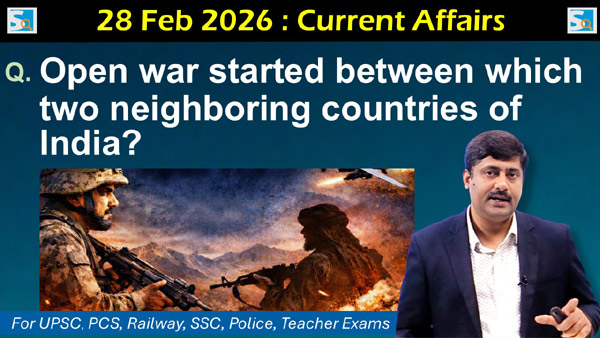
– On 27 February 2026, Pakistan bombed Kabul and several major Afghan cities.
– Pakistan’s Defence Minister Khawaja Asif declared “open war” after months of retaliatory clashes.
– The Taliban claimed to have targeted key installations including the Faizabad military base in Islamabad.
– Taliban spokesperson Zabihullah Mujahid claimed 55 Pakistani soldiers were killed.
– Pakistan launched ‘Operation Ghazab Lil Haq’ and carried out attacks in several Afghan provinces.
– Pakistan claims 274 Afghan fighters were killed and over 400 injured.
– The Afghan side claims it has the bodies of 23 Pakistani soldiers and captured a Pakistani army headquarters and 19 posts.
– Both countries are using drones against each other.
Reasons for Conflict
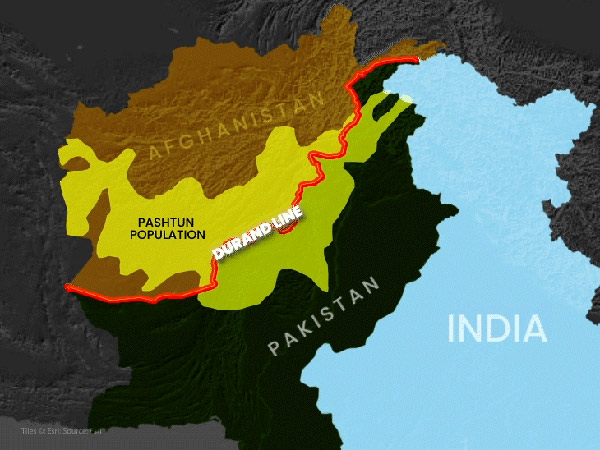
First Reason – Durand Line:
– A 2,640 km border drawn in 1893 between British India and Afghanistan.
– Divides Pashtun and Baloch tribes.
– Afghanistan has never fully recognized this line.
– After 1947, Pakistan inherited the border, but Afghanistan rejected it and demanded ‘Pashtunistan’.
– The Taliban also refuses to recognize the Durand Line.
Second Reason
– Pakistan expected the Taliban to act as a dependent ally.
– The Taliban tried to assert autonomy, increasing tensions.
– Frequent border clashes escalated into serious conflicts, including in October 2025.
Third Reason
– Tehrik-e-Taliban Pakistan (TTP), also known as Pakistani Taliban.
– Organizationally different but ideologically aligned with Afghan Taliban.
– TTP aims to replicate Taliban success in Pakistan’s tribal areas.
India’s Statement
– On 22 February 2026, India strongly condemned Pakistan’s air strikes on Afghan territory.
– India termed it an attempt to externalize Pakistan’s internal failures and reaffirmed support for Afghanistan’s sovereignty and territorial integrity.
—————
9. When is National Science Day celebrated?
a. 26 February
b. 27 February
c. 28 February
d. 29 February
Answer: c. 28 February
Theme 2026
– Women in Science: Catalyzing Viksit Bharat
Why is National Science Day Celebrated?
– To mark the contribution of scientists to national development.
– Dedicated to the discovery of the Raman Effect.
– On 28 February 1928, C.V. Raman discovered the Raman Effect.
– He received the Nobel Prize in 1930.
– The day has been celebrated annually since 1986.
What is Raman Effect?
– It explains how light waves scatter and change when passing through different substances.
– Spectroscopy studies the interaction between matter and electromagnetic radiation.
—————-
10. When was Rare Disease Day observed in 2026?
a. 23 February
b. 24 February
c. 27 February
d. 28 February
Answer: d. 28 February
Theme 2026
– More Than You Can Imagine
– Rare Disease Day is observed every year on the last day of February.
– Its objective is to raise awareness about rare diseases.
– It also aims to improve access to treatment for patients and their families.
– Around 350 million people worldwide suffer from rare diseases.
– Generally, a rare disease affects fewer than 100 people per 100,000 population.
– In India, a disease is considered rare if it affects 1 in 5,000 people.
PDF Download: Click here