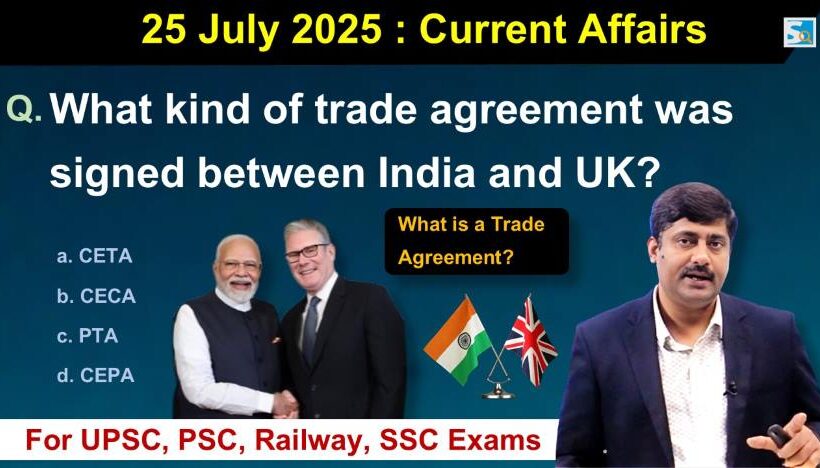
This is the current affairs of 25 July 2025. Here are questions and answers of daily current affairs for better preparation of competitive exams for government jobs.
PDF Download: Click here
1. What kind of trade agreement was signed between India and the United Kingdom in July 2025?
a. CETA
b. CECA
c. PTA
d. CEPA
Answer: a. CETA (Comprehensive Economic and Trade Agreement)
What is a Trade Agreement?
– A trade agreement is an arrangement between two or more countries to facilitate the trade of goods and services between them by reducing or eliminating taxes (duties) on these exchanges.
– This benefits companies in both countries, as their products become cheaper, encouraging more purchases.
– Trade agreements are commonly referred to as FTAs (Free Trade Agreements). However, an FTA technically means complete exemption from tariffs (import duties). Since each country has its own priorities, they often agree to reduce tariffs only in selected sectors. That’s why agreements are signed under different names. India has a fully-fledged FTA only with Sri Lanka.
India – UK Trade Agreement: CETA
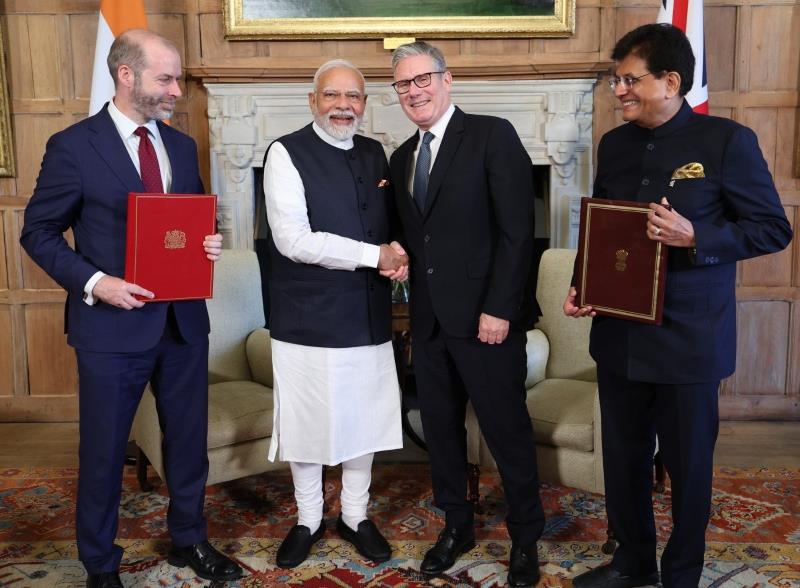
– On July 24, 2025, India and the United Kingdom signed the CETA (Comprehensive Economic and Trade Agreement).
– The agreement was signed by India’s Union Minister of Commerce and Industry, Piyush Goyal, and the UK’s Secretary of State for Business and Trade, Jonathan Reynolds, on July 24, 2025.
– It was signed in London in the presence of Indian Prime Minister Narendra Modi and UK Prime Minister Keir Starmer.
– Negotiations for this agreement had been ongoing for three years between the two countries.
– The agreement still awaits approval from the British Parliament.
– This approval process may take between 6 months to 1 year. The deal was finalized earlier on May 6.
This is the UK’s Largest Trade Agreement Since Brexit
– This is the United Kingdom’s largest trade agreement since its exit from the European Union (Brexit).
– It is estimated that this agreement will lead to a $34 billion increase in trade between the two countries.
– Previously, the UK’s largest trade deal was with Australia in 2020, which was expected to boost trade by $3.1 billion.
– Since Brexit, the UK has signed trade deals with over 70 countries.
Why is this Agreement Important for Both Countries?
– The UK is India’s 16th largest trading partner, while India is the UK’s 11th largest partner.
– Bilateral trade between the two countries is approximately $60 billion, with a positive trade balance in India’s favor.
– According to Indian government estimates, this trade volume is expected to double by 2030.
– As per British government assessments, this new trade agreement will further increase bilateral trade by $34 billion.
– The agreement comes at a time when global trade is experiencing uncertainty due to the tariff policies of U.S. President Donald Trump.
Bilateral Trade Between India and the UK
– India’s exports to the UK: ₹2.75 lakh crore
– UK’s exports to India: ₹1.85 lakh crore
– UK’s trade deficit: ₹90,700 crore
– The UK accounts for 2% of India’s total trade.
Exports from India
– Chemicals
– Readymade garments
– Auto parts
– Toys
– Marine products
– Gems and jewellery
Exports from UK
– Whiskey
– Gin
– Medical devices
– Cosmetics
– Mutton
– Salmon
– Biscuits
Benefits for India
– 99% of India’s exports to the UK will receive tariff (import duty) relief.
– India has secured market access for key employment-generating sectors such as textiles, footwear, gems and jewelry, and marine products. The UK will eliminate tariffs of up to 20% on these goods.
– Indian negotiators have also successfully pushed for tariff elimination on approximately 99.7% of tariff lines in the food sector. Many food products previously faced duties as high as 70%.
– India has gained improved market access in export-oriented sectors like marine and animal products — including seafood, dairy, and meat — where duties have been reduced from 20% to zero.
– This means that Indian goods exported to the UK will now face either very low or no import taxes.
– Tariffs on automobile exports from India have been reduced from 100% to 10%.
– Under the social security agreement, Indian workers temporarily staying in the UK and their employers will be exempted from paying social security contributions for up to three years.
– Indian industry is optimistic about CETA, expecting a surge in exports. Textiles are one of the top goods exported to the UK.
– Kirit Bhansali, Chairman of the Gems & Jewellery Export Promotion Council (GJEPC), estimated in a social media post that exports in this sector could grow by $2.5 billion over the next two years, doubling bilateral trade in gems and jewelry to $7 billion.
Benefits for the UK
– This agreement also brings significant advantages for British companies. They will now find it easier to sell products such as whisky, cars, and other goods in the Indian market.
– India will reduce tariffs on these products from 15% to 3%.
– The agreement could boost bilateral trade by up to ₹3 lakh crore (₹3 trillion) per year.
– For the first time, India has agreed to reduce tariffs on alcohol products made in the UK, including whisky, brandy, rum, vodka, liqueurs, mead, cider, and tequila.
– These alcoholic beverages, which currently face a 150% base import duty, will see significant reductions.
– Tariffs will be lowered from 110% in Year 1 to 75% by Year 10.
What Will Be the Economic Benefits?
– This deal will boost Indian exports and help create jobs.
– In FY 2023–24, India exported merchandise worth $12.9 billion (₹1.12 lakh crore) to the UK.
– The deal will help India move closer to its $1 trillion export target by 2030.
– It will also increase India’s access to developed markets.
Are There Any Concerns?
1. Concerns in Agriculture and MSMEs
– Agriculture and MSMEs are two key sectors where concerns have been raised.
– Vijoo Krishnan, General Secretary of the All India Kisan Sabha, pointed to India’s previous FTA with Sri Lanka, which led to a significant drop in prices of domestically produced spices and tea.
– He also cited the ASEAN FTA’s impact on rubber — where rubber prices fell from ₹230/kg in 2011 to ₹170/kg by 2025.
– He believes FTAs create an “unequal framework” for Indian farmers and MSMEs.
– “Indian farmers typically operate on small land holdings, many with less than five acres. The same is not true for farmers in developed countries.”
A Bad Deal for Public Health?
– The deal will allow tariff-free access to UK-made food products like biscuits, chocolates, and soft drinks in India, lowering their prices.
– Many of these products fall into the HFSS (High Fat, Sugar, and Salt) category, which pose long-term health risks.
– India and many other countries are already battling a rising tide of lifestyle-related diseases.
Case Study: Mexico
– In 1992, when Mexico signed the NAFTA (North American Free Trade Agreement) with the USA and Canada, it failed to implement strong public health protections.
– In the years that followed: There was a surge in imports of cheap sugary drinks, snacks, and processed foods.
– Consumption of high-fat foods spiked.
– This led to a significant rise in diet-related illnesses, obesity, and diabetes.
– Mexico was only able to slow this trend in 2014, after introducing strict public health measures like a ‘soda tax’ and warning labels.
—-
Types of Trade Agreements
– FTA (Free Trade Agreement): No customs duties on all types of goods and services.
Example: India–Sri Lanka
– CETA (Comprehensive Economic and Trade Agreement): A new-generation broad trade agreement including goods, services, and investment cooperation.
Example: India–UK
– CECA (Comprehensive Economic Cooperation Agreement): Includes economic and investment cooperation.
Examples: India–Australia, India–Singapore
– CECPA (Comprehensive Economic Cooperation and Partnership Agreement): The word “partnership” indicates deeper bilateral cooperation. Example: India–Mauritius
– CEPA (Comprehensive Economic Partnership Agreement): Examples: India–South Korea, India–Japan
– PTA (Preferential Trade Agreement): Tariff relief on select products only. Example: India–Thailand
– RTA (Regional Trade Agreement): Trade agreement with multiple countries within a region.
(e.g., ASEAN-related agreements)
– TEPA (Trade and Economic Partnership Agreement): An extended version covering goods, services, and investment.
India’s Trade Agreements: Year-wise List (till 2025)
– Year, Country, Type of Agreement, Key Features
– 2025, United Kingdom (UK), CETA, Goods, Services, Investment; Agreement on Trade and Intellectual Property
– 2022, Australia, ECTA → CECA (2023), 96% Indian products tariff-free and opportunities for students/services/investment/IP
– 2022, UAE, CEPA, $100 billion trade target in 10 years
– 2021, Mauritius, CECPA, Goods, Services and Investment Cooperation. First African Agreement
– 2014, Bangladesh, PTA, tariff concession on limited items
– 2011, Malaysia, CECA, Goods + Services + Investment
– 2011, Nepal, Revised Trade Treaty, enhanced border trade and cooperation
– 2010, Japan, CEPA, exemption on 90% of products; Services and investments also included
– 2009, South Korea, CEPA, Deeper Economic Cooperation
– 2006, Bhutan, PTA, Traditional and Border Trade Support
– 2005, Singapore, CECA, Special Agreement on Services and Investment
– 2003, Thailand, Early Harvest Scheme, initial concession on 82 items
– 1998, Sri Lanka, FTA, India’s first bilateral FTA
Regional/Multilateral Trade Agreements: With India
Year, Country /grouping agreement, key feature/status
– 2024–25 : EFTA (Switzerland, Norway, Iceland, Liechtenstein), India–EFTA TEPA, TEPA signed 10 March 2024, effective 1 October 2025; $100 billion (₹8 lakh crore+) investment & 1 million jobs
– 2010–15 : ASEAN (10 members), ASEAN–India FTA (Goods + Services), Goods FTA effective 1 January 2010 – Services & Investment Agreement effective 2015 – 90% tariff reduction
– 2004–09 : Mercosur (Latin America trading group – Brazil, Argentina, Uruguay and Paraguay), India–Mercosur PTA, framework 2004, effective 2009; Primary PTA Agreements
– 2006 : SAARC (8 members), SAFTA (South Asian Free Trade Area), effective 1 January 2006, aim to zero tariffs by 2012
UK
– Capital: London
– Currency: Pound
– Monarch: King Charles III
– PM: Keir Starmer
– Neighbouring Country: Ireland
—————-
2.
In which two countries of Southeast Asia, border conflicts turned violent in July 2025 and rockets and bombs were dropped on each other?
a. Cambodia and Laos
b. Thailand and Myanmar
c. Philippines and Thailand
d. Thailand and Cambodia
d. Thailand and Cambodia
—————-
3. The dispute between Thailand and Cambodia over which Hindu temple took the form of a violent military conflict?
a. Wat Arun Temple
b. Wat Phra Kaew Temple
c. Preah Vihear Temple and Ta Muen Thom Temple
d. Wat Pho Temple
Answer: c. Preah Vihear Temple and Ta Muen Thom Temple
Thailand-Cambodia Border Conflict Turns Violent (July 24, 2025)
– On July 24, 2025, a border conflict between Thailand and Cambodia escalated into violence, resulting in the deaths of several people, most of whom were civilians, and leaving many others injured.
– The military tensions intensified in July 2025 when Thai soldiers advanced toward the ‘Ta Muen Thom’ temple (a Khmer Hindu temple) located near the border and surrounded it with barbed wire fencing.
– Both the Preah Vihear Temple and Ta Muen Thom Temple are dedicated to Lord Shiva.
– These temples are situated on the border between Thailand’s Sisaket province and Cambodia’s Preah Vihear province. Both countries claim ownership of the site and consider it part of their cultural and historical heritage.
– The situation escalated further after a landmine explosion on July 23, 2025, injured five Thai soldiers. In response, Thailand recalled its ambassador from Cambodia and expelled Cambodia’s envoy from Bangkok.
Conflict Escalates
– Thailand carried out two airstrikes on Cambodian military positions using F-16 fighter jets.
– Thailand claimed the strikes were an act of self-defense, in response to rocket attacks launched by Cambodia.
– Cambodia’s Ministry of Defense stated that Thai aircraft dropped bombs on a road near the Preah Vihear Temple, a UNESCO World Heritage Site.
– Cambodia’s Ministry of Culture announced its intention to seek justice under international law for damage caused to the historic site.
– Both sides accused each other of initiating the violence, including allegations of drone deployments and troop advancements.
– The fighting involved small arms, artillery, and rockets, and reportedly spread to at least six locations along the 800-kilometer-long border.
– Leadership in both Thailand and Cambodia is not as strong or authoritative as in previous years, contributing to instability.
Evacuations and Humanitarian Impact
– Thailand: Over 40,000 people have been evacuated from border areas. In the provinces of Surin and Buriram, children and the elderly have taken shelter in concrete bunkers and evacuation centers.
– Cambodia: More than 4,000 villagers from Oddar Meanchey province have been displaced. They are now living in temporary shelters around 30 kilometers from the border.
History of Thailand–Cambodia Conflict
– The roots of the Thailand–Cambodia dispute go back more than a hundred years, to the period after French colonial rule, when Cambodia’s borders were drawn.
– Tensions formally escalated in 2008, when Cambodia attempted to register the 11th-century Preah Vihear Temple—located in a disputed area—as a UNESCO World Heritage Site.
– Thailand strongly opposed this move, leading to multiple clashes between the two countries over the years, resulting in deaths of both soldiers and civilians.
Regional and International Implications
– This conflict represents a rare military confrontation between ASEAN member states, testing the organization’s ability to mediate.
– Malaysian Prime Minister Anwar Ibrahim and the Singapore Ministry of Foreign Affairs have called for de-escalation and dialogue.
– China, a major trade partner and investor in both countries, has offered to mediate—potentially seizing a diplomatic opportunity amid growing regional caution over U.S. influence in Southeast Asia.
Thailand
– Capital: Bangkok
– King: Vajiralongkorn (Rama X) {King of the Chakri dynasty, Thailand is a Buddhist-majority country, but its royal traditions are also influenced by Hinduism. Although the king himself follows Buddhism}
– Suspended PM: Piatongtarn Shinawatra (became PM in August 2024.)
– Acting PM: Phumtham Vechayachai
– Currency: Thai Baht
– Language: Thai
– Population: 71.62 million (2025)
– Neighboring countries: Myanmar, Laos, Cambodia, Malaysia
Cambodia
– Capital: Phnom Penh
– Monarch: Norodom Sihamoni
– Prime Minister: Hun Manet
– Currency: Riel
– Language: Khmer
—————
4. When is Kargil Vijay Diwas celebrated?
a. 28 July
b. 27 July
c. 26 July
d. 25 July
Answer: c. 26 July
– This day is celebrated every year on 26th July to remember the sacrifices made by the soldiers in the Kargil War in the year 1999.
– It was fought for more than 60 days (between May and July 1999) and finally India regained control over all its territories.
– The war ended on 26th July 1999.
– Operation Vijay was launched by the Indian Army to take back Indian territories from Pakistani intruders in the Kargil-Dras sector.
—————
5. For how long did the Supreme Court issue an order not to arrest the accused in a matrimonial dispute {Section 498A of IPC (Section 85 of BNS)}?
a. one month
b. two months
c. six months
d. 2 years
Answer: b. two months
– On July 24, 2025, the Supreme Court of India delivered a significant verdict, stating that in marital disputes, no arrests or legal action shall be taken for two months after a complaint or FIR is filed.
– The court ruled that such cases must be referred to a Family Welfare Committee (FWC) during this period.
The Judgment
– A bench comprising Chief Justice B.R. Gavai and Justice A.G. Masih upheld protective measures laid down by the Allahabad High Court, aimed at preventing the misuse of Section 498A of the IPC (now Section 85 of the Bharatiya Nyaya Sanhita – BNS) in marital disputes.
– The Supreme Court approved the formation of Family Welfare Committees (FWCs) as a safeguard mechanism.
– The Court has directed that all districts across the country implement these guidelines through relevant and competent authorities for effective execution.
– The judgment affirmed that the safeguards issued by the High Court to prevent misuse of the law in matrimonial disputes are within the legal framework.
Marital Dispute Can Be Closed Upon Settlement: Supreme Court
– The Supreme Court has ruled that if a settlement is reached between the parties through the efforts of the Family Welfare Committee (FWC), then the District and Sessions Judge, or any other senior judicial officer designated by the judge in the district, shall be free to dispose of the case, including closing the criminal proceedings.
– Referring to a specific case, the Court noted that a woman and her family had falsely implicated her husband and his family in a criminal case.
– Due to the false charges, the woman’s husband and father-in-law were imprisoned for a long period.
– The wife had filed serious charges under: Section 498A (Dowry Harassment), Section 307 (Attempt to Murder), and Section 376 (Rape) of the IPC.
– As a result, the husband spent 109 days in jail, and the father 103 days.
– The Supreme Court emphasized that after every complaint or FIR under Section 498A and related provisions, efforts must be made to resolve the issue before proceeding further.
Supreme Court’s Instructions
– The Family Welfare Committee will call both parties for personal discussions, assisted by four senior elders, and will try to resolve issues or misunderstandings during the cooling-off period.
– After careful deliberation, the committee will prepare a detailed report.
– After two months, this report will be submitted to the relevant magistrate or police officers, under whose jurisdiction the complaint or FIR was filed.
————–
6. Who has been appointed as the new Mission Director of Atal Innovation Mission (AIM) by the Central Government?
a. Rakesh Waghla
b. Ramesh Upadhyay
c. Deepak Bagla
d. Rajan Parihar
Answer: c. Deepak Bagla
– He previously served as the Managing Director and CEO of Invest India.
Atal Innovation Mission (AIM)
– Atal Innovation Mission (AIM) is a flagship initiative under NITI Aayog, launched with the aim of promoting innovation and supporting startups.
– It aims to create an ecosystem that nurtures curiosity, creativity and problem-solving skills, especially among students and budding entrepreneurs.
– It was launched by NITI Aayog in 2016.
– Atal Innovation Mission (AIM) 2.0 was launched in 2024.
—————
7. Who has been appointed as the MD and CEO of GIFT City?
a. Sanjay Kaul
b. Ramesh Upadhyay
c. Deepak Bagla
d. Rajan Parihar
Answer: a. Sanjay Kaul
– He is a 2001 batch Kerala cadre IAS officer
GIFT City
– GIFT (Gujarat International Finance Tec-City) is India’s first smart city focused on international financial services.
—————-
8. Notification for Bihar assembly elections will be issued in October
– The announcement of Bihar assembly elections will be made in early October and along with it the notification will be issued.
– Voting will be held in the last week of October and the first week of November.
– Due to the Election Commission fixing the date of final publication of the voter list in Bihar as 30 September, there will be very few days left for the assembly elections.
– During this time, after voting on all 243 seats of the state, the election results will also be released by 10 or 12 November.
Term of the Assembly till 22 November
– The term of the current assembly of Bihar is scheduled till November 22, 2025. In such a situation, the commission will have very little time left to complete the election preparations before this. This is happening due to the special intensive revision of the voter list.
—————
9. Bihar Assembly passed Jananayak Karpuri Thakur Skill University Bill 2025, who will be the chancellor of this university?
a. President
b. Governor
c. Chief Minister
d. Prime Minister
Answer: c. Chief Minister
– Bihar Assembly Passes Jananayak Karpoori Thakur Skill University Bill, 2025
On July 23, 2025, the Bihar Legislative Assembly passed the Jananayak Karpoori Thakur Skill University Bill, 2025.
– This clears the way for the establishment of Jananayak Karpoori Thakur University.
– With its establishment, Bihar will be positioned as a center for skilled workforce.
– It will also prepare the youth of the state for global competition.
– Institutions related to skill development and training will be affiliated with this university.
Chief Minister to Be Chancellor
– The Chief Minister will be the Chancellor of this university.
– This is the fourth university in which the Chief Minister is given the role of Chancellor.
– Previously, the Chief Minister is also the Chancellor of the Health Sciences University, Engineering University, and Sports University.
– According to the government, having the Chief Minister as Chancellor will allow faster decisions related to universities.
—————
10. After Pandit Jawaharlal Nehru, who is the second Prime Minister to hold the post of Prime Minister for the longest time continuously, leaving Indira Gandhi behind?
a. Narendra Modi
b. Manmohan Singh
c. Narasimha Rao
d. HD Deve Gowda
Answer: a. Narendra Modi
– On 25 July 2025, Prime Minister Narendra Modi became the second longest-serving Prime Minister in the history of India.
– On this day, PM Modi completed 4,078 days in office, surpassing the record of former Prime Minister Indira Gandhi.
– Indira Gandhi served as Prime Minister for 4,077 consecutive days — from 24 January 1966 to 24 March 1977.
– Apart from Pandit Jawaharlal Nehru, Narendra Modi is the only Prime Minister to have won three consecutive general elections.
– Including both state and central leadership, Modi has led governments for 24 years, which is a record in Indian political history.
PDF Download: Click here