This is the current affairs of 21 February 2026. Here are questions and answers of daily current affairs for better preparation of competitive exams for government jobs.
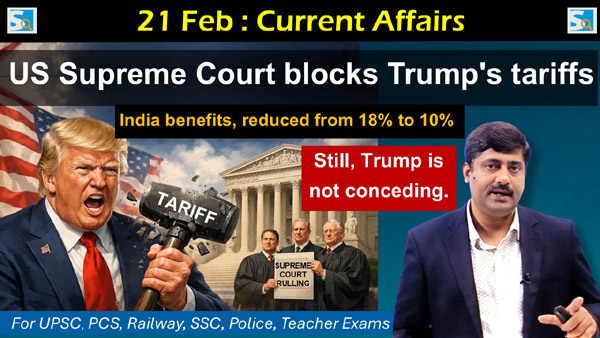
1. How much percent tariff did Trump impose on the world including India after the US Supreme Court declared the tariff illegal?
a. 10%
b. 20%
c. 30%
d. 50%
Answer: a. 10%
– The U.S. Supreme Court took away Donald Trump’s tariff authority.
– The Supreme Court held that Trump was misusing the emergency powers granted to the U.S. President by imposing excessive tariffs on multiple countries. This was the biggest agenda of his second term, which lost momentum after the decision.
– Tariffs had become the hallmark of his administration, but the Supreme Court ruled that Trump had abused his authority.
10% tariff imposed
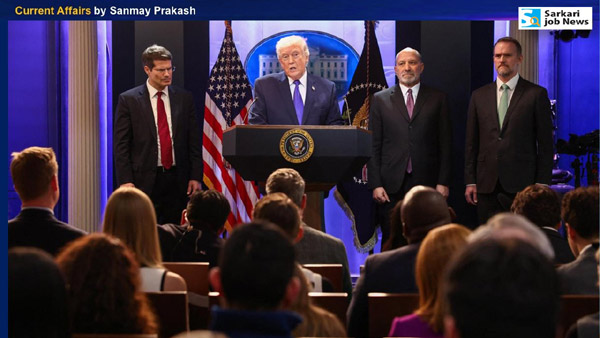
– Within three hours of the U.S. Supreme Court’s decision cancelling the tariffs, Donald Trump imposed a 10% global tariff worldwide in February 2026.
– In his statement, he said he was signing an order to impose a 10% global tariff.
– Earlier, on 20 February 2026, the Supreme Court had declared President Donald Trump’s global tariff illegal and struck it down. The Court stated that without Congressional approval, the tariff was unlawful.
– In a 6–3 majority decision, the Supreme Court said that under the Constitution, the power to impose taxes and tariffs lies with Congress, not the President.
– Instead of seeking Congressional approval, the Trump administration had used the International Emergency Economic Powers Act of 1977. Under this law, declaring an emergency allowed Trump to issue immediate orders bypassing Congress.
Trump’s response
– Trump criticized the decision, saying: “It is very disappointing. I am ashamed of some of the judges of the Court. They are a disgrace to the country and lack the courage to do what is right for our nation.”
Tariff on India: 10%
– Regarding the trade deal with India, Trump said there would be no changes and called PM Modi a good friend.
– A White House official stated that countries with trade agreements with the U.S., including the UK, India, and the European Union, would now face a uniform 10% global tariff under Section 122 instead of previously negotiated rates.
– As a result, India’s total tariff would reduce from 18% to 10%.
Tariffs under Section 122
– Section 122 is part of the U.S. Trade Act of 1974.
– It allows the U.S. President to impose immediate tariffs if the country faces a sudden trade deficit or economic threat.
– Under this provision, temporary tariffs can be imposed without a lengthy investigation process.
– Usually, such tariffs can remain in effect for up to 150 days, during which the government reviews the situation and decides further action.
– Imposing a uniform 10% global tariff on all trading partners means that higher tariff rates on certain countries would automatically be reduced.
$200 billion collected in tariffs; refund uncertain
– According to a New York Times report, since the beginning of last year, the Trump administration has collected over $200 billion in tariffs.
– After the Supreme Court decision, uncertainty remains about whether this amount will have to be refunded.
– It is unclear whether the government will be required to return the collected money to companies.
– The Trump administration had earlier stated that if it lost the case, trade agreements with several countries might have to be withdrawn and substantial refunds might be required.
—————
2. India signed the Pax Silica agreement led by whom?
a. China
b. Russia
c. USA
d. India
Answer: c. USA
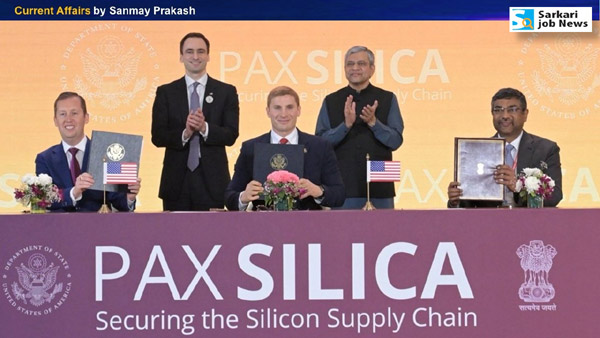
– India and the United States signed the ‘Pax Silica’ agreement in February 2026.
– On this occasion, India’s Union Minister for Electronics and IT Ashwini Vaishnaw, U.S. Under Secretary for Economic Affairs Jacob Helberg, and the U.S. Ambassador were present.
What is Pax Silica?
– Pax Silica is a U.S.-led international technology alliance launched in December 2025 during the Trump administration.
– It focuses on building secure, resilient, and innovation-driven supply chains for advanced technologies such as Artificial Intelligence (AI) and semiconductors.
– “Pax” is a Latin word meaning peace, stability, and long-term prosperity. “Silica” refers to silicon dioxide (SiO₂), which is refined into pure silicon used in computer chips and AI hardware.
– The name symbolizes technological leadership in the AI era and peace and stability among trusted partners — essentially “peace through chips and AI.”
Why did Trump create Pax Silica?
– The U.S. wants semiconductor-AI supply chains to remain within “trusted countries.”
– To reduce dependence on China.
– By including India and other democratic nations, the U.S. strengthens a “China alternative.”
– India’s participation positions it as an active player in the emerging “chip-AI economy,” strengthening economic growth and trade influence.
Members
– United States
– India
– Japan
– South Korea
– Singapore
– Netherlands
– United Kingdom
– Israel
– United Arab Emirates
– Australia
—————
3. The International Paralympic Committee (IPC) lifted the ban on which countries, allowing their athletes to compete under their national flags?
a. Japan and Russia
b. Belarus and Bangladesh
c. Iran and Cyprus
d. Russia and Belarus
Answer: d. Russia and Belarus
– After bans imposed in 2022, the International Paralympic Committee (IPC) officially lifted the suspension on Russia and Belarus in February 2026.
– Athletes from both countries will now compete under their national flags at the Milan-Cortina 2026 Winter Paralympics, and their national anthems will be played if they win medals.
Reasons for the ban on Russia
– State-sponsored doping scandal revealed after the 2014 Sochi Olympics
– The 2022 Russia-Ukraine conflict, viewed as a violation of the Olympic Truce
– Since then, Russia’s participation in many international sporting events had been restricted or allowed only under neutral status.
—————
4. India gifted which maritime neighbouring island nation its first high-speed ferry?
a. Nepal
b. Bangladesh
c. Bhutan
d. Maldives
Answer: d. Maldives
– The ferry was built with India’s assistance.
– Along with it, the Rajje Transport Link (RTL) services between Faafu and Dhaalu Atolls were launched.
– This initiative is part of India’s continued support under the High Impact Community Development Project (HICDP) Phase-III agreement.
– It strengthens maritime connectivity and reflects India’s commitment to its ‘Neighbourhood First’ policy.
– The agreement was signed between India and the Maldives in January 2025.
– Of the proposed 12 ferries, the first high-speed ferry has been handed over to the Maldives.
Maldives
– Capital – Male
– President – Mohamed Muizzu
—————
5. When is the Foundation Day of Mizoram celebrated?
a. 21 February
b. 20 February
c. 19 February
d. 18 February
Answer: b. 20 February
– Like many other northeastern states, Mizoram was part of Assam until 1972.
– It became a Union Territory in 1972.
– On 20 February 1987, Mizoram was granted statehood and became India’s 23rd state.
– It is a northeastern state of India.
Mizoram
– Capital: Aizawl
– Chief Minister: Lalduhoma
– Governor: VK Singh
– Neighboring States: Manipur, Assam, Tripura
– Neighboring Countries: Myanmar, Bangladesh
—————
6. When is the Foundation Day of Arunachal Pradesh celebrated?
a. 22 February
b. 21 February
c. 20 February
d. 19 February
Answer: c. 20 February
– Arunachal Pradesh became a full-fledged state on 20 February 1987.
– Until 1972, it was known as the North-East Frontier Agency (NEFA).
Arunachal Pradesh
– Capital: Itanagar
– Chief Minister: Pema Khandu
– Governor: K. T. Parnaik
– Neighboring Countries: Bhutan, China, Myanmar
– Neighboring State: Assam
————–
7. Where was the 13th edition of naval exercise MILAN-2026 inaugurated, in which 74 countries participated?
a. Delhi
b. Visakhapatnam
c. Kolkata
d. Thiruvananthapuram
Answer: b. Visakhapatnam
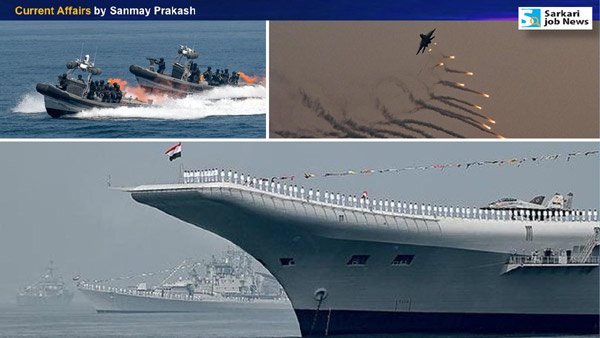
– Defence Minister Rajnath Singh inaugurated the 13th edition of Exercise MILAN-2026 in Visakhapatnam, Andhra Pradesh.
– Held in February 2026, this multilateral naval exercise saw participation from 74 countries.
– It is the largest and most inclusive edition in Indian history.
– Exercise MILAN is a biennial multilateral naval exercise hosted by the Indian Navy.
– It began in 1995 as a small regional initiative aimed at enhancing cooperation among friendly navies in the Indian Ocean Region (IOR).
—————
8. When is World Pangolin Day celebrated?
a. First Saturday of February
b. Second Saturday of February
c. Third Saturday of February
d. Fourth Saturday of February
Answer: c. Third Saturday of February (21 February in 2026)
– The purpose of the day is to raise awareness about these mammals.
About Pangolins
– Their bodies are covered with keratin scales.
– These scales help them defend against predators.
– Pangolins are the only mammals with such scales.
– They are found naturally in Africa and Asia.
– Their tongue can extend longer than their body.
– The name comes from the Malay word “pengguling,” meaning “one who rolls up.”
– Pangolins are the most trafficked mammals in the world due to demand for their meat and scales.
—————
9. Literary figure Mani Shankar Mukhopadhyay passed away on 20 February 2026. He was associated with which linguistic literature?
a. Hindi
b. Urdu
c. Bengali
d. Bhojpuri
Answer: c. Bengali
– He was popularly known as Shankar in literary circles.
– He passed away at the age of 93.
– During his long literary career, he wrote nearly 100 novels and short stories.
– His works “Seemabaddha” and “Jana Aranya” were adapted into films by renowned filmmaker Satyajit Ray in 1971 and 1975 as part of the famous Calcutta Trilogy.
– In 2021, he received the Sahitya Akademi Award for his literary contributions.
—————
10. When is International Mother Language Day celebrated?
a. 20 February
b. 21 February
c. 22 February
d. 23 February
Answer: b. 21 February
– The idea of observing International Mother Language Day was initiated by Bangladesh and approved at the 1999 UNESCO General Conference.
Languages are disappearing worldwide
– It is estimated that every three and a half months, a language dies somewhere in the world. Along with it, centuries-old culture and knowledge disappear irreversibly.
– According to Ethnologue, of the 7,139 languages currently spoken worldwide, 42% (3,018) are endangered and at various stages of extinction.
– Half of the world’s population speaks just 24 languages, including Mandarin Chinese, Spanish, English, Hindi, Portuguese, Bengali, Russian, Japanese, Javanese, and German.
– While these languages are spoken by hundreds of millions, the other half of the world’s population speaks about 7,000 languages.
– Ethnologue’s analysis shows that half of the world’s languages are spoken by fewer than 10,000 people.
– Only 1% of the world’s population speaks nearly 5,000 languages. Surprisingly, 0.1% (about 8 million people) keep 3,500 languages alive.
Language crisis in India
– The Central Institute of Indian Languages has identified 117 endangered languages in India, each spoken by fewer than 10,000 people. Most of these languages are found in biodiversity-rich regions.
PDF Download: Click here