This is the current affairs of 18 October 2025. Here are questions and answers of daily current affairs for better preparation of competitive exams for government jobs.
PDF Download: Click here
Q1. Three cricketers of which country died in Pakistan’s air strike?
a. China
b. Afghanistan
c. USA
d. Iran
Answer: b. Afghanistan
– On October 17, 2025, Pakistan carried out an airstrike in Afghanistan’s Paktika province.
– Several people were killed in the attack, including three club cricket players.
– The Afghanistan Cricket Board (ACB) has confirmed the incident. Seven civilians were injured in the attack.
– In response to this incident, the ACB announced its withdrawal from the Tri T20 Series scheduled to be held in Pakistan in November.
– The ACB stated that this decision was taken to honor the slain cricketers.
– The tournament was to feature teams from Pakistan, Afghanistan, and Sri Lanka.
– Both countries had agreed to a 48-hour ceasefire on the evening of October 15, following the conflict that began on October 8.
– The conflict resumed after this period ended.
Players were attacked while returning after playing a cricket match
– The Afghanistan Cricket Board (ACB) issued a statement on social media platform X stating that the attack targeted players Kabir, Sibghatullah, and Haroon, who were returning to Sharana, the capital of Paktika province, after playing a friendly cricket match.
– The team was scheduled to play matches against Pakistan on November 17 and 23.
– It would have been the first time Afghanistan played against Pakistan on Pakistani soil.
– However, earlier Afghanistan had played matches in Pakistan during the 2023 Asia Cup and this year’s Champions Trophy, but at that time, it did not face the host team Pakistan.
Taliban paraded Pakistani soldiers’ pants
– BBC journalist Dawood Junbish shared a picture on social media showing Taliban fighters displaying Pakistani soldiers’ pants and weapons in a public square.
– According to the report, after the Taliban’s counterattack, some Pakistani soldiers abandoned their military posts near the Durand Line and fled.
– Taliban fighters seized the pants and weapons from these posts and displayed them as symbols of victory.
Afghanistan sent tanks to the border
– Several Afghan civilians were killed and more than 100 were injured in Pakistani airstrikes in Kabul and Kandahar, after which Afghanistan deployed tanks along the border.
——-
Q2. Which University successfully cultivated wheat for the first time using the ‘sand soiling’ technique in Ajmer on sand brought from the Thar Desert, thereby increasing the possibility of farming in desert lands?
a. Central University of Rajasthan
b. Maharaja Ganga Singh University
c. University of Kota
d. Agricultural University, Jodhpur
Answer: a. Central University of Rajasthan
– Scientists at the Central University of Rajasthan successfully grew wheat for the first time on Thar Desert sand.
– For this, they used a new ‘desert soilification’ technique that involves an indigenous bio-formulation solution.
– The research was conducted in Ajmer, where a 300-square-foot area was created to simulate Thar Desert conditions.
– 100 tons of sand were brought from the Thar Desert in Jaisalmer.
– Using the ‘desert soilification’ technique, wheat was successfully cultivated for the first time.
– The objective of this experiment is to prevent the desert’s expansion, which is gradually moving toward the NCR region due to the degradation of the Aravalli mountain range.
– This experiment is considered a significant step toward making barren land fertile in the future.
‘Desert Soilification’ Technique
– Scientists from the Central University of Rajasthan (CUoR) used two main components to transform desert sand into fertile soil-like land:
1. Bio-formulation (organic solution) – an indigenous technique containing microorganisms and organic elements.
2. Polymer (a type of organic gel) – helps retain water and binds sand particles together, making it soil-like.
– After laboratory tests using three crops—millet, guar, and chickpea—on three bio-tools, this scientific innovation was transferred to field-level wheat cultivation.
Features of the technique:
– Wheat-4079 (an indigenous variety) seeds were sown in two phases.
– Using bio-formulation technology, the crop required only three irrigations instead of the usual 5–6.
– The bio-formulation improved water retention in sand, bound the sand particles together, and enhanced the crop’s stress resistance.
– In field trials, millet, guar gum, and chickpeas were also tested, where researchers achieved 54% higher yields in bio-formulation-treated sand.
——–
Q3. Where was the India-Indonesia joint bilateral maritime exercise ‘Samudra Shakti-2025’ held?
a. Jakarta
b. Visakhapatnam
c. Kochi
d. Medan
Answer: b. Visakhapatnam
Samudra Shakti–2025
Date: 14–17 October 2025
– Venue: Visakhapatnam
– Forces involved: Indian Navy and Indonesian Navy
– Host: Indian Navy
– Edition: Fifth
– Paricipating units: INS Kavaratti (Anti-Submarine Corvette of Eastern Fleet, ENC) and KRI John Lie (Corvette of the Indonesian Navy equipped with a helicopter).
Exercises conducted:
– Helicopter take-off and landing drills
– Air attack defense drills
– Weapons firing drills
– Visit, Board, Search, and Seizure (VBSS) operations
Objective of Samudra Shakti:
– ‘Samudra Shakti’ is a significant bilateral exercise aimed at enhancing interoperability between the two navies, strengthening mutual understanding, and sharing best practices.
– The exercise reflects both nations’ shared commitment to maintaining stability and peace in the Indo-Pacific region.
Indonesia
– The world’s largest archipelagic country, with over 17,000 islands (such as Java, Sumatra, Borneo), covering about 1.9 million sq km.
– Capital: Jakarta
– President: Prabowo Subianto
– Currncy: Indonesian Rupiah
– Population: 283.5 million (2024)
———
Q4. For which term has India been elected as a member of the United Nations Human Rights Council (UNHRC)?
a. 2025–26 term
b. 2026–28 term
c. 2026–29 term
d. 2025–30 term
Answer: b. 2026–28 term (India’s seventh term)
– India’s three-year term will begin on January 1, 2026.
– India has been elected as a member seven times: 2006–2007, 2008–2010, 2012–2014, 2015–2017, 2019–2021, 2022–2024, and now 2026–2028.
– It was not a member in 2011, 2018, and 2025.
Seat distribution among five regional groups:
– African States: 13 seats
– Asia-Pacific States: 13 seats
– Eastern European States: 6 seats
– Latin American & Caribbean States: 8 seats
– Western European & Other States: 7 seats
Other elected members:
– Angola, Chile, Ecuador, Egypt, Estonia, Iraq, Italy, Mauritius, Pakistan, Slovenia, South Africa, the United Kingdom, and Vietnam — for the term beginning January 1, 2026.
UNHRC: United Nations Human Rights Council
– An inter-governmental body within the United Nations system.
– Part of: UN General Assembly (UNGA)
– Mandate: To strengthen the promotion and protection of human rights worldwide.
– Established: 2006 (replacing the former UN Commission on Human Rights)
– Headquarters: Geneva, Switzerland
– Secretariat: Office of the United Nations High Commissioner for Human Rights (OHCHR)
– Total member countries: 47


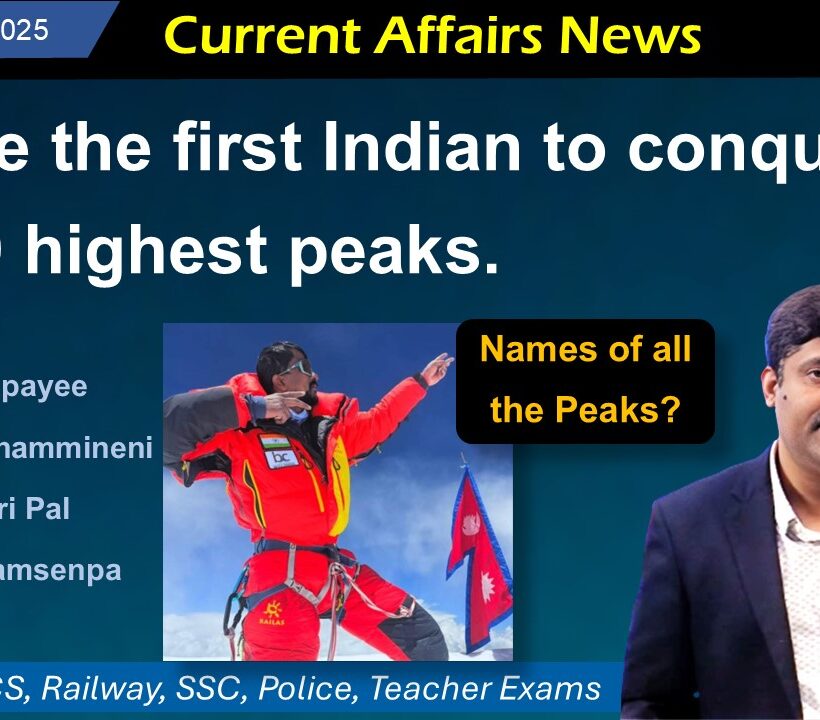
Q5. Name the first Indian mountaineer to climb nine of the world’s 14 highest peaks?
a. Arjun Vajpayee
b. Bharat Thammineni
c. Bachendri Pal
d. Anshu Jamsenpa
Answer: b. Bharat Thammineni (36 years old)
– He achieved this feat on October 14.
– According to NDTV, he successfully climbed Mount Cho Oyu (8,188 m), the sixth-highest mountain in the world.
Peaks climbed:
– May 2017 – Mount Everest
– September 2018 – Mount Manaslu
– May 2019 – Mount Lhotse
– March 2022 – Mount Annapurna
– April 2022 – Mount Kanchenjunga
– May 2023 – Mount Makalu
– October 2024 – Mount Shishapangma
– April 2025 – Mount Dhaulagiri
– October 2025 – Mount Cho Oyu
(All these peaks are above 8,000 meters.)
Remaining five highest peaks:
– Mount K2
– Nanga Parbat
– Gasherbrum I
– Gasherbrum II
– Broad Peak — all located in Pakistan and currently restricted for Indian climbers.
Other important facts:
– “Everest Man”: Kami Rita Sherpa – holds the record for the most ascents of Mount Everest (31 times).
– Youngest Indian climber to scale all seven continents’ highest peaks: Vishwanath Kartikeya Padakanti (16 years old) from Hyderabad.
——-
Q6. Former Chief Minister of which state Ravi Naik passed away on October 15, 2025?
a. Maharashtra
b. Goa
c. Bihar
d. Uttar Pradesh
Answer: b. Goa
– He died due to cardiac arrest at the age of 79.
– He is survived by his wife, two sons, one daughter-in-law, and three grandchildren.
Legislative career:
1. 1984 – Elected from Ponda (Maharashtrawadi Gomantak Party – MGP)
2. 1989 – Elected from Marcaim (MGP)
3. 1999 – Elected from Ponda (Congress)
4. 2002 – Re-elected from Ponda (Congress)
5. 2007 – Again won from Ponda (Congress)
6. 2017 – Won from Ponda (Congress)
7. 2022 – Won from Ponda (Bharatiya Janata Party – BJP)
– Total: 7-time MLA
– Also elected as MP from North Goa in 1998 (Congress).
Chief Ministerial tenure:
– First term: January 1991 – May 1993, led a coalition government (Progressive Democratic Front).
– Second term: April 2–8, 1994 (only 6 days) — the shortest CM tenure in Goa’s history.
———
Q7. When is International Day for the Eradication of Poverty celebrated?
a. October 16
b. October 17
c. October 18
d. October 19
Answer: b. October 17
Theme for 2025:
“Ending Social and Institutional Maltreatment – Acting together for just, peaceful, and inclusive societies.”
– The day aims to raise awareness about global poverty and the need for its eradication, especially in developing countries.
– It was declared by the UN General Assembly in 1992.
———–
Q8. When is the Raising Day of National Security Guards (NSG) celebrated?
a. October 15
b. October 16
c. October 17
d. October 18
Answer: b. October 16
– National Security Guards (NSG) Raising Day is celebrated on October 16.
– The NSG Commando Force was established on October 16, 1984, during Operation Blue Star.
———–
Q9. The female labour force participation rate (LFPR) in India has increased to what in 2023–24?
a. 23.3%
b. 31.2%
c. 40.5%
d. 41.7%
Answer: d. 41.7%
– The female Labour Force Participation Rate (LFPR) in India is a key socio-economic indicator showing how inclusive economic growth is.
– According to the government’s (PIB) October 2025 release “Building Inclusive Workplaces — Empowering Women for a Viksit Bharat,”
– As per the Periodic Labour Force Survey (PLFS) 2023–24, LFPR fell from 31.2% in 2011–12 to 23.3% in 2017–18, indicating women’s withdrawal from the labour market.
– However, it sharply rose to 41.7% in 2023–24, reflecting renewed participation of women in economic activities.
– Though promising for gender equality, deeper analysis shows persistent challenges in job quality, pay, and sectoral distribution.
Rise driven by rural women
– The increase in FLFPR is mainly due to rural women’s participation, not urban.
– Economic stress, inflation, and the need to supplement family income have pushed more women into work-related activities — mostly informal or unpaid roles.
Return to agriculture instead of diversification
– Contrary to expectations of structural transformation, women are returning to agriculture rather than moving out of it.
– Female share in agriculture rose from 71.1% (2018–19) to 76.9% (2023–24), while their presence in industrial and service sectors declined.
Rise in unpaid and self-employment:
– Female participation mainly increased in unpaid family labour and self-employed work, not wage or salaried jobs.
– Between 2017–18 and 2023–24:
– Women reporting “domestic duties” fell from 57.8% to 35.7%.
– “Helpers in household enterprises” rose from 9.1% to 19.6%.
– “Self-employed/employers” rose from 4.5% to 14.6%.
– This shows a shift from unpaid domestic work to unpaid or low-paid self-employment.
Hence, the rise in participation reflects economic distress, not real economic empowerment.
Note: The increase in women’s labour participation in India reflects resilience, not empowerment. True progress lies in turning this quantitative rise into quality employment, fair wages, and equal opportunities — essential for achieving SDG 5: Gender Equality.
————–
Q10. Which country became the first to prevent the transmission of three serious diseases (HIV, HBV, Syphilis) from mother to child?
a. India
b. Japan
c. Maldives
d. Indonesia
Answer: c. Maldives
– The Maldives has become the first country in the world to achieve the “triple elimination” of mother-to-child transmission (MTCT) of HIV, Hepatitis B, and Syphilis.
– The announcement was made by the World Health Organization (WHO) in October 2025.
Triple Elimination means: Sustained success in preventing mother-to-child (vertical) transmission of the three diseases:
1. HIV (Human Immunodeficiency Virus) – causes AIDS.
2. Hepatitis B (HBV) – affects the liver.
3. Syphilis – a bacterial sexually transmitted infection that can cause serious complications in fetuses if untreated.
WHO Director-General Dr. Tedros Adhanom Ghebreyesus praised the Maldives’ leadership and commitment to maternal and child health.
Maldives:
– Capital: Malé
– President: Mohamed Muizzu
– Currency: Maldivian Rufiyaa
—————-
PDF Download: Click here