This is the current affairs of 13 September 2025. Here are questions and answers of daily current affairs for better preparation of competitive exams for government jobs.
PDF Download: Click here
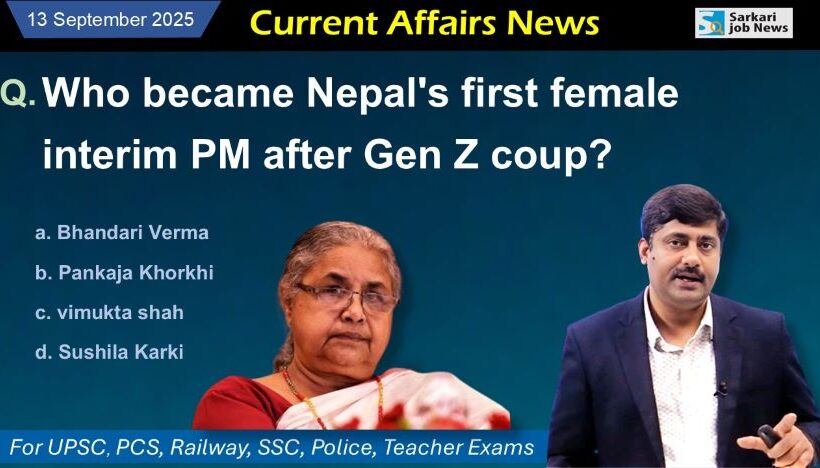
1. Who became the interim and first female Prime Minister after the coup in Nepal by Gen Z?
a. Bhandari Verma
b. Pankaja Khorkhi
c. vimukta shah
d. Sushila Kirki
Answer: d. Sushila Karki
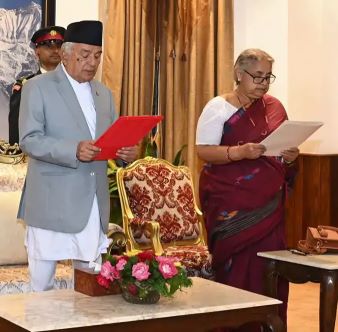
– After four days of Gen Z-led protests, violence, arson, and a coup, Nepal’s reins have come into the hands of Sushila Karki.
– On September 12, 2025, Nepal’s President Ram Chandra Paudel appointed former Chief Justice Sushila Karki as the country’s new interim Prime Minister.
– She is Nepal’s first female Prime Minister. She was also the first female Chief Justice of the Nepal Supreme Court.
– Notably, when she was the Chief Justice, the ruling parties had made an unsuccessful attempt to remove her through impeachment.
– Now, due to the demands of Gen Z youth, she has been made the interim Prime Minister.
– She will form a cabinet that will oversee the upcoming elections scheduled to take place within six months.
– Notably, when she was the Chief Justice, the ruling parties had made an unsuccessful attempt to remove her through impeachment.
– Now, due to the demands of Gen Z youth, she has been made the interim Prime Minister.
Parliament Dissolved in Nepal, Elections Announced
– The President dissolved the Parliament on September 12, 2025.
– This came as signs began to emerge that the political turmoil in Nepal, ongoing for several days, was beginning to settle.
– President Ram Chandra Paudel announced elections for the House of Representatives to be held on March 5, 2026.
Why Was the Parliament Dissolved?
– Nepal’s President Ram Chandra Paudel held multiple rounds of discussions with Ms. Sushila Karki and other legal experts, with support from the military.
– The President was deeply concerned that if the Parliament remained intact while appointing a new head of government, the new cabinet might not be held accountable, as there would be no functioning oversight body.
– However, Ms. Karki supported the protestors’ demand to dissolve the Parliament.
– The protestors argued that if the Parliament wasn’t dissolved, the same old political parties—against whom they had been fighting—would continue to retain control and influence.
– Gen Z youth made it clear that dissolving the House was non-negotiable.
– Kathmandu’s Mayor Balen Shah also supported this demand.
How Did India Respond?
– The Indian Ministry of External Affairs issued a statement welcoming the formation of Nepal’s new interim government.
– The statement said, “We welcome the formation of a new interim government in Nepal under the leadership of the Hon’ble Mrs. Sushila Karki. We hope this will promote peace and stability.”
– It further stated, “As a close neighbor, a democratic nation, and a long-term development partner, India will continue to work with Nepal for the prosperity and well-being of the people of both countries.”
About Sushila Karki
– Date of Birth: June 7, 1952
– Place of Birth: Biratnagar, Nepal
– Age: 73 years
Education:
– Bachelor’s Degree in Political Science – Banaras Hindu University (BHU), India
– Bachelor of Laws (LLB) – Tribhuvan University, Nepal
– Postgraduate in Law – Banaras Hindu University (BHU), India
Profession:
– Began her career as a lawyer and later became a judge.
Key Positions Held:
– Appointed as a Justice of the Supreme Court of Nepal in 2009
– Became the first female Chief Justice of Nepal in 2016
Achievements and Contributions
– Advocate of Transparency – She is known for promoting transparency and integrity within the judiciary.
– Symbol of Women Empowerment – Her appointment as Chief Justice in a patriarchal society like Nepal is considered a historic event.
– Role in Constitution Implementation – She delivered key verdicts on several sensitive issues related to Nepal’s new Constitution (2015).
– Impartiality – Her tenure was marked by her refusal to bow to political pressure.
Why is Sushila Karki’s Tenure Considered Significant?
– Sushila Karki is passionate about reading and writing. She has written extensively on political and historical topics.
– As Chief Justice, she delivered strong anti-corruption rulings, which made her popular among the general public.
– She is also known in Nepal’s judiciary as the “Iron Lady.”
– Though her tenure as Chief Justice was brief (2016–2017), it left a lasting impact.
– In 2017, an attempt was made to bring an impeachment motion against her in Parliament, but it failed due to public pressure and widespread opposition, which only strengthened her public image.
————
2. What was India’s stand during the voting of the ‘New York Declaration’ of the United Nations General Assembly (UNGA), which talked about a peaceful and two-state solution to the Palestine issue and was passed with an overwhelming majority?
a. Vote in favour
b. Vote against
c. Absent
d. None of these
Answer: a. Vote in favour (On 12 September, this proposal was passed with an overwhelming majority of 142 countries)
– The United Nations General Assembly (UNGA) approved the “New York Declaration”, which calls for clear, time-bound, and irreversible steps toward a two-state solution between Israel and Palestine.
– The resolution, presented by France and Saudi Arabia, was passed with overwhelming support from 142 countries.
– 10 countries voted against the proposal, while 12 countries abstained from voting.
India’s Position
– India voted in favor of the resolution.
– This clearly indicates India’s recognition of the two-state solution and its support for the establishment of a Palestinian state.
Countries opposing the proposal (10)
– Israel, USA, Argentina, Hungary, Micronesia, Nauru, Palau, Papua New Guinea, Paraguay and Tonga
Why Was This Proposal Brought Forward?
– The proposal was prompted by the inhumane actions carried out by Israel in the Gaza region, which forced many countries to respond.
– According to Gaza’s Ministry of Health, nearly 60,000 people have died.
– Meanwhile, Israeli Prime Minister Benjamin Netanyahu has announced full control over Gaza.
– Many countries interpret this as a sign that more bloodshed and destruction may be imminent.
Features of the Proposal
– To prepare a roadmap for establishing peace between Palestine and Israel.
– The proposal includes condemnation of the attacks carried out by Hamas on Israel on October 7, 2023.
– It demands Hamas to lay down arms and release the hostages.
– It also expresses concern for human rights, basic facilities, protection of civilian life, and improvement of the humanitarian situation in Gaza.
Nature of the Proposal
– This proposal is not binding. It serves only to create political and moral pressure.
– Its purpose is to gather international support to move the Israel-Palestine conflict towards peace.
– Only proposals from the United Nations Security Council are binding.
Future Possibilities
– With the proposal’s passage, there is hope that the international community will increase pressure for the recognition of a Palestinian state and peaceful coexistence with Israel.
– Additionally, there may be improvements in humanitarian aid access and security conditions in the conflict zone.
However, the chances of immediate ground-level change are low because:
– Israel’s Policy – Israel maintains a hard stance, citing security concerns and the threat posed by Hamas.
– US Support – Israel often receives diplomatic and military backing from the United States.
– Internal Politics of Arab Countries – Arab nations are unable to unite and exert strong, coordinated pressure.
– Division Between Hamas and Fatah (Palestinian National Liberation Movement) – Palestinian leadership is fragmented, which hampers progress toward a two-state solution.
– PLO (Palestine Liberation Organization) – The umbrella organization for all factions, with Fatah being the most powerful.
Palestine
– The Palestinian people are demanding an independent state (country).
– Although Palestine is considered a country, it does not have full recognition at the United Nations. It holds only the status of a non-member observer state. This status was granted by the UN General Assembly in 2012.
– While this status allows Palestine to participate in most UN activities, it does not include voting rights in the main organs or bodies of the United Nations.
#Israel’s Occupation of Palestine – A Brief History#
Ottoman Empire Period (1517–1917)
– The Palestine region (West Bank, Gaza, Jerusalem, etc.) was part of the Ottoman Empire.
British Mandate (1917–1947)
– After World War I, Britain established the British Mandate of Palestine.
– In the 1917 Balfour Declaration, Britain supported the creation of a “Jewish national home.”
United Nations Partition Plan (1947)
– The UN proposed dividing Palestine into two parts:
– One Jewish state
– One Arab (Palestinian) state
– Jerusalem was to be placed under international administration.
– Arab countries and Palestinians rejected this plan.
1948 – Establishment of Israel and First Arab-Israeli War
– Israel declared independence in May 1948.
– Arab countries launched a war, but Israel captured more territory.
– Millions of Palestinians became refugees (Nakba).
1967 – Six-Day War
– Israel defeated Egypt, Jordan, and Syria, capturing:
– West Bank (including East Jerusalem), previously under Jordanian control
– Gaza Strip, previously under Egyptian control
– Golan Heights, part of Syria
– This marked the beginning of the status of Occupied Palestinian Territories.
1970s–1980s
– Israel began establishing Jewish settlements in the occupied territories.
– Palestinian resistance movements (PLO and later Hamas) intensified.
1993 – Oslo Accords
– An agreement was reached between Israel and the PLO.
– The Palestinian Authority was created, granting limited self-rule in parts of the West Bank and Gaza.
Post-2000 – Second Intifada and Withdrawal from Gaza
– 2000–2005: A major uprising occurred in Palestine (Second Intifada).
– 2005: Israel withdrew its military from Gaza but retained control over Gaza’s borders, sea, and airspace.
2007 to Present – Hamas vs. Fatah
– Hamas took control of Gaza, while Fatah/PLO governs the West Bank.
– Israel has maintained a blockade on Gaza and conducted periodic military operations.
– Jewish settlements in the West Bank have continued to expand, shrinking Palestinian land.
Summary:
– 1948: Israel was established → displacement of Palestinians.
– 1967: Israel occupied the West Bank, Gaza, and East Jerusalem.
– Till today: Israeli settlements continue in the West Bank, and Gaza remains under blockade.
————
3. When is World First Aid Day celebrated?
a. First Saturday of September
b. Second Saturday of September
c. Third Saturday of September
d. Fourth Saturday of September
Answer: b. Second Saturday of September (13 September in 2025)
Theme 2025
– First Aid and Climate Change
– This year’s theme emphasizes how essential it is for communities to be prepared for climate-related disasters like floods, heatwaves, and wildfires. In such situations, knowledge of first aid can often play a decisive role in saving lives.
– This day was initiated by the International Federation of Red Cross and Red Crescent Societies (IFRC) in the year 2000.
– The day highlights the importance of first aid during injuries or accidents.
————
4. Which former Prime Minister of India was posthumously honored with the PV Narasimha Rao Award in September 2025?
a. Atal Bihari Vajpayee
b. Jawaharlal Nehru
c. HD Deve Gowda
d. Dr. Manmohan Singh
Answer: d. Dr. Manmohan Singh
– He was posthumously honored with the PV Narasimha Rao Memorial Award for his contributions to India’s economic transformation and nation-building.
– This information was given in a statement by the PV Narasimha Rao Memorial Foundation based in Hyderabad.
– Last week, Gursharan Kaur, wife of Manmohan Singh, received the award on his behalf.
– The award was presented by Montek Singh Ahluwalia, former Deputy Chairman of the Planning Commission and Senior Fellow at the Centre for Social and Economic Progress.
– The award was established by PVNM Foundation to recognize outstanding contributions in the field of economics.
————
5. What was the retail inflation rate in the country in August 2025?
a. 1.55%
b. 2.07%
c. 3.22%
d. 4.48%
Answer: b. 2.07%
– Retail inflation in India was recorded at 2.07% in August 2025.
– This is within the RBI’s inflation target range of 2-6%.
– Food inflation was at -0.69%.
– The main reason for the reduction in the inflation rate was an increase in headline inflation and food inflation, mainly due to rising prices of vegetables, meat and fish, oils and fats, personal care, and eggs.
Inflation in Rural and Urban Areas
– In rural India, inflation rose to 1.69% in August, up from 1.18% in July.
– In urban areas, it stood at 2.47%.
Who Releases the Retail Inflation Report?
– The NSO (National Statistical Office) is responsible for releasing the retail inflation report.
– NSO functions under the Ministry of Statistics and Programme Implementation.
How is Retail Inflation Determined?
– It is calculated based on the Consumer Price Index (CPI).
– CPI measures inflation in items such as food, fruits, clothing, footwear, housing, fuel, electricity, and others.
– As consumers, we buy goods from the retail market. CPI reflects the changes in prices related to these goods and services. It measures the average price we pay for products and services.
How Does Inflation Affect Us?
– Inflation is directly related to purchasing power. For example, if the inflation rate is 6%, then the value of ₹100 earned is effectively only ₹94.
– Therefore, investments should be made considering inflation; otherwise, the value of your money will decrease over time.
How Does RBI Control Inflation?
– To control inflation, the flow of money (liquidity) in the market is reduced.
– The Reserve Bank of India (RBI) does this by increasing or decreasing the repo rate.
– When inflation rises, RBI increases the repo rate; when inflation falls too low, RBI decreases the repo rate.
– Inflation has been under control recently, which is why RBI did not change the repo rate for the ninth consecutive time in August.
Inflation Target Set by RBI
– RBI sets the inflation target based on the Consumer Price Index (CPI) at 4%, with a tolerance of ±2%.
– Inflation below 2% or above 6% is considered unfavorable for the country’s economic growth.
————
6. CP Radhakrishnan became which 4th Vice President of India?
a. 14th
b. 15th
c. 16th
d. 17th
Answer: b. 15th
C. P. Radhakrishnan Becomes India’s 15th Vice President
– Chandrapuram Ponnusami (C. P.) Radhakrishnan was sworn in as India’s 15th Vice President on 12 September 2025.
– The oath-taking ceremony was administered by President Droupadi Murmu at the Rashtrapati Bhavan in New Delhi.
– The Vice Presidential election was held on 9 September 2025.
– NDA candidate C. P. Radhakrishnan received 452 first preference votes.
– The INDIA candidate, Sudarshan Reddy, received 300 first preference votes.
– Radhakrishnan won by a margin of 152 votes.
– A total of 752 votes were declared valid, while some votes were invalidated.
– Prior to this, Radhakrishnan served as the Governor of Maharashtra.
About the 15th Vice President C. P. Radhakrishnan
– Full name: Chandrapuram Ponnusami Radhakrishnan.
– Born on 20 October 1957.
– Elected as Member of Parliament from Coimbatore in 1998 and 1999.
– He was very close to becoming a Union Minister, but due to confusion caused by similar names, party managers mistakenly gave the position to another leader, Ponn Radhakrishnan.
– Served as BJP President of Tamil Nadu from 2004 to 2007.
– In 2016, he was appointed Chairman of the Coir Board based in Kochi. During his tenure, India’s coir exports reached a record ₹2,532 crore.
(Note: Coir is a natural, versatile, and eco-friendly fiber obtained from the outer husk of coconut, used to make ropes, mats, brushes, furniture, and gardening products.)
– Became Governor of Jharkhand in 2023. (Also held additional charge as Governor of Telangana and Lieutenant Governor of Puducherry.)
– Appointed Governor of Maharashtra in 2024.
– Won the Vice Presidential election in September 2025.
————
7. When is National Forest Martyrs Day celebrated?
a. 10 September
b. 11 September
c. 12 September
d. 10 December
Answer: b. 11 September
Theme for 2025
– “Remember the Martyrs, Protect the Forests”
– In India, those who have sacrificed their lives protecting forests and the environment are honored.
– This day is connected to a special historical event.
– In 1730, the Khejarli Massacre took place in Rajasthan.
– Led by Amrita Devi Bishnoi, more than 363 villagers sacrificed their lives by hugging the Khejri trees to prevent the king’s soldiers from cutting them down.
– This unparalleled sacrifice became a symbol of environmental conservation and later inspired the Chipko Movement of the 1970s.
– To honor this bravery and dedication, the Ministry of Environment, Forest and Climate Change (MoEFCC) declared 11 September as National Forest Martyrs Day in 2013.
————
8. Which medal did Indian player Isha Singh win in women’s 10m air pistol at the ISSF World Cup 2025 held in China?
a. Gold
b. Silver
c. Bronze
d. None of these
Answer: a. Gold
– The event was held at the Ningbo Olympic Sports Center in Zhejiang, China.
– She won the gold medal in the women’s 10m air pistol event.
– With this victory, she ended India’s medal drought at the ISSF World Cup Rifle/Pistol.
————
9. When is World Suicide Prevention Day observed?
a. 10 September
b. 10 October
c. 10 November
d. 10 December
Answer: a. 10 September
Theme 2025
– Changing the Narrative on Suicide
About the Day
– Started in: 2003, through a collaboration between the International Association for Suicide Prevention (IASP) and the World Health Organization (WHO).
– Objective: To spread awareness about suicide prevention, highlight risk factors, and strengthen support systems aimed at reducing suicide rates.
————
10. According to the World Health Organization (WHO), how many people in the world suffer from mental health problems due to which one in every 100 deaths is due to suicide?
a. More than one billion
b. More than 50 crores
c. More than 20 crores
d. More than one crore
Answer: a. More than one billion
Global Suicide Data
– 1 out of every 100 deaths worldwide is caused by suicide.
– According to new data released by the World Health Organization (WHO), an estimated 727,000 people across all age groups died by suicide in 2021.
– Suicides accounted for 1.1% of all global deaths in 2021, meaning 1 in every 100 deaths was due to suicide.
– For every suicide, there are more than 20 suicide attempts.
– WHO also states that over 1 billion people globally are struggling with mental health disorders.
Suicide in India (2021)
– Total suicides: 1,77,567
– Men: 1,00,719
– Women: 76,848
What Are the Major Mental Health Disorders?
– The most commonly observed mental disorders are anxiety and depression. In 2021, these two conditions were responsible for more than two-thirds of all mental health-related issues globally.
– Between 2011 and 2021, the number of people suffering from mental health disorders increased faster than the population growth rate.
– As a result, the global age-standardized prevalence of mental health conditions reached 13.6%, which is 0.9% higher than a decade ago.
What Are the Challenges to Comprehensive Mental Healthcare in India?
– According to The Indian Express, Dr. Pratima Murthy, Director of the National Institute of Mental Health and Neurosciences (NIMHANS), says that India lacks sufficient mental health institutions.
– There is a need for dedicated wards and trained professionals for mental health care in both general and specialized hospitals.
– Although treatment for severe cases is available in mental hospitals, the approach to treatment needs to change — patients should be treated with dignity and receive professional care, rather than being confined.
– Large hospitals can also serve as training centers for mental healthcare professionals.
– A major concern is that many mental hospitals lack basic facilities, and cases of abuse, neglect, and violence against patients are reported.
– Additionally, government spending on mental health services is very low, leading to a shortage of both treatment options and essential resources.
World Health Organization (WHO)
– Established: 1948
– Headquarters: Geneva, Switzerland
– Director-General: Dr. Tedros Adhanom Ghebreyesus
PDF Download: Click here