
This is the current affairs of 12 & 13 October 2025. Here are questions and answers of daily current affairs for better preparation of competitive exams for government jobs.
PDF Download: Click here
1. Which neighboring country of India did 58 Pakistani soldiers die in a border clash with in October 2025?
a. China
b. Iran
c. Afghanistan
d. Uzbekistan
Answer: c. Afghanistan
– Border dispute between Afghanistan and Pakistan and
– On the night of October 11, there was gunfire between the armies of both countries on the international border (disputed Durand Line) between Afghanistan and Pakistan.
– It started from Afghanistan. Not one or two, but firing simultaneously on six fronts.
– This attack was in retaliation for Pakistan’s alleged airstrike that took place three days earlier on Kabul. This tension is linked to the activity of groups like Tehrik-e-Taliban Pakistan (TTP), which Pakistan accuses of taking shelter in Afghanistan.
– The Taliban government’s spokesperson said that Afghan security forces have captured 25 Pakistani military posts. In this action, 58 Pakistani soldiers were killed, while 30 others were injured.
– In response, the Pakistani army said that only 25 of its soldiers were killed, while it had eliminated 200 Taliban fighters.
– The situation deteriorated so much that Qatar, Iran, and Saudi Arabia had to intervene.
– At the behest of Qatar and Saudi Arabia, the Taliban stopped the firing.
– After this, the Afghan Ministry of Defense said – Our operation ended at midnight. If Pakistan violates the Afghan border again, our army is fully prepared to defend the country.
Afghanistan’s Foreign Minister told Pakistan to mend its ways
– When the firing was going on between Afghanistan and Pakistan, Taliban regime (Afghanistan)’s Foreign Minister Mawlawi Amir Khan Muttaqi, in a press meet organized at the embassy in Delhi, advised Pakistan to mend its ways:
– Mocking Pakistan, he said that our neighbors are Iran, China, Tajikistan, Uzbekistan, Turkmenistan…. they have no complaints. Why is the entire problem with Pakistan? Pakistan should look in the mirror…
– He said – “Afghanistan is also a free country of this region. When peace has come there, why are people troubled?… Peace and progress in Afghanistan is in the welfare of the entire region… We want good relations with Pakistan as we want with Hindustan. Do not test the morale of Afghans. If (someone) does, first ask the British, then the Soviet Union, then America, then NATO, so that you understand that playing such a game with Afghanistan is not good.”
Accusation of Pakistan sheltering ISIS terrorists
– The Taliban has accused Pakistan of sheltering ISIS terrorists on its soil.
– The Taliban, calling these terrorists a threat to Afghanistan as well as the whole world, asked to expel them from Pakistan or hand them over to Afghanistan.
– The Taliban spokesperson said that Afghanistan had eliminated all elements spreading instability, but now their new bases have been set up in Pakistan’s Khyber Pakhtunkhwa region.
– They alleged that new fighters are being brought to these bases via Karachi and Islamabad airports and trained there.
– Mujahid also claimed that the plans for attacks in Iran and Russia were also made from these Pakistani bases.
Pakistan said – Will give a befitting reply like India
– In a statement issued by the Pakistani Home Ministry, it was said that Afghanistan will also be given a befitting reply like India, so that it does not dare to look at Pakistan with bad eyes.
Tehrik-e-Taliban
– Tehrik-e-Taliban Pakistan (TTP), also known as the Pakistani Taliban, was established in 2007 by forming a coalition of various militant groups.
– It is inspired by but separate from the Afghan Taliban, and is mainly active in Khyber Pakhtunkhwa and Balochistan.
– TTP’s objective is to establish a Sharia-based Islamic emirate in Pakistan, and it considers the Pakistani army and government as its main enemies.
– After the Taliban came to power in Afghanistan, TTP regained strength.
– Pakistan accuses the Afghan Taliban of sheltering TTP and carrying out attacks on Pakistan from Afghan soil.
– TTP carried out hundreds of attacks in 2022-2024, resulting in deaths of soldiers and civilians.
Why the fight between Pakistan and TTP?
– After the US attack on Afghanistan in 2001, Pakistan sided with America. This angered TTP, which considers it against Islam.
– TTP believes that the Pakistan government does not follow true Islam, so it attacks it.
– TTP has deep ties with the Afghan Taliban. Both groups support each other.
– After the Afghan Taliban came to power in 2021, Pakistan targeted TTP and carried out attacks in Afghanistan.
– TTP exploits complaints like poverty, unemployment, and neglect by the government in the Pashtun community.
Pakistan is irritated by Muttaqi’s India visit
– Pakistan is irritated by the joint statement of India-Afghanistan. Its frustration is due to mentioning Jammu-Kashmir as part of India. The Pakistani Foreign Ministry has lodged a strong protest with the Afghan ambassador in Islamabad over the statement. Anger has been expressed over Muttaqi’s statements on Pakistan and terrorism given in the Delhi press conference.
————–
2. The border dispute between Afghanistan and Pakistan is about which disputed British line, where a bloody conflict took place between the two?
a. McMahon Line
b. Durand Line
c. Radcliffe Line
d. Johnson Line
Answer: b. Durand Line (The Durand Line is a 2,640 kilometer long border line between Afghanistan and Pakistan, which was drawn in 1893 (132 years ago) under an agreement by Sir Mortimer Durand, Foreign Secretary of British India, with Afghanistan’s Amir Abdur Rahman Khan. This line divides Pashtun and Baloch tribes, who are historically the same cultural and ethnic group. Afghanistan does not recognize this line)
Current situation (October 2025):
– Recently, on October 11-12, 2025, heavy clashes took place along the Durand Line, in which Afghanistan claimed the death of 58 Pakistani soldiers, while Pakistan accused of Afghan attack.
– Taliban-ruled Afghanistan opened fire in response to Pakistani airstrikes, due to which the border was closed and trade was affected.
– This tension is linked to the activity of groups like Tehrik-e-Taliban Pakistan (TTP), which Pakistan accuses of taking shelter in Afghanistan.
– Incidents of fencing and infiltration on the border between both countries are common, which are increasing regional instability.
Major lines drawn by the British and disputes
1) Radcliffe Line (Radcliffe Line)
– Drawn in 1947 by Sir Cyril Radcliffe during the partition of India.
– It divides the Punjab and Bengal provinces between India and Pakistan (then West Pakistan), with a length of about 3,323 km.
– As a result, millions were displaced and communal violence occurred. It became the basis for the India-Bangladesh border (as East Pakistan).
2) McMahon Line (McMahon Line)
– Drawn in 1914 during the Shimla Conference by Sir Henry McMahon between British India and Tibet (present China).
– It defines the approximately 890 km long eastern Himalayan border (Arunachal Pradesh area), but China does not recognize it, leading to the 1962 war and today’s border dispute.
3) Johnson Line (Johnson Line)
– Proposed in 1865 by British surveyor Sir William Johnson between Ladakh (British India) and Tibet (China), which includes the Aksai Chin area in India.
– It later developed as the Ardagh-Johnson Line. Dispute: China rejects it and refers to the Macartney-MacDonald Line, leading to the Sino-Indian border dispute. The 1962 war and recent Ladakh clashes are linked to this.
4) Macdonald Line (Macdonald Line)
– In 1899, the British Indian Government proposed the Macartney-MacDonald Line to China under the leadership of Sir Claude MacDonald, which leaves some parts of Aksai Chin in China.
– It was drawn to stop Russian expansion. Dispute: India does not recognize it and emphasizes the Johnson Line, while China considers it valid.
– It is a major part of the Sino (China)-Indian border dispute.
5) Durand Line (Durand Line)
– The Durand Line is a 2,640 kilometer long border line between Afghanistan and Pakistan, which was drawn in 1893 under an agreement by Sir Mortimer Durand, Foreign Secretary of British India, with Afghanistan’s Amir Abdur Rahman Khan.
– This line divides Pashtun and Baloch tribes, who are historically the same cultural and ethnic group.
– Afghanistan has never fully recognized this line, as it is considered a result of British imperialism.
– After the partition of India in 1947, Pakistan inherited this border, but Afghanistan rejected it and demanded ‘Pashtunistan’ (a separate country for Pashtuns).
————–


————-
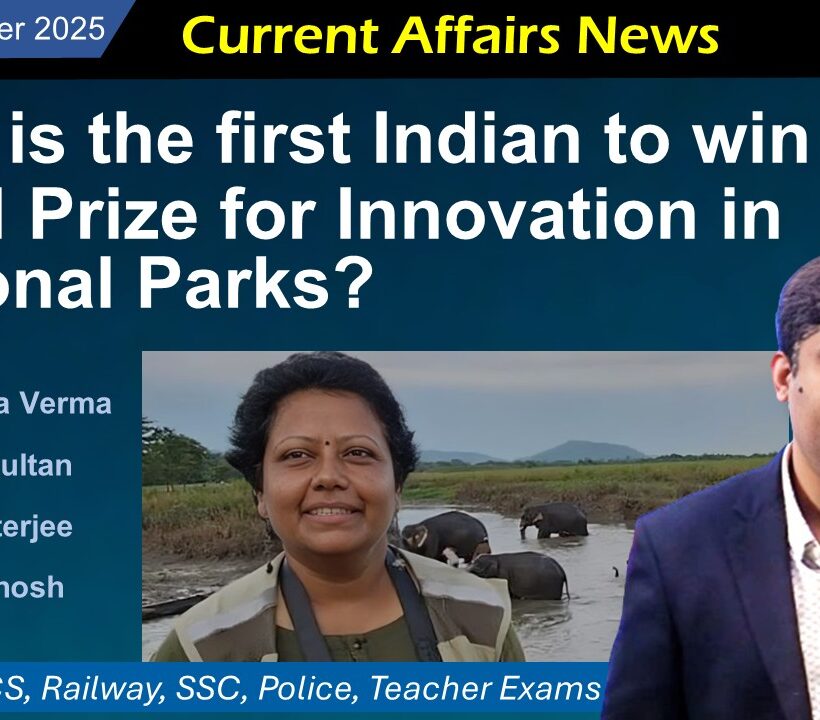
3. Who is the first Indian to win the IUCN (International Union for Conservation of Nature) award for innovation in national parks?
a. Rashmika Verma
b. Roman Sultan
c. Ajit Chatterjee
d. Sonali Ghosh
Answer: d. Sonali Ghosh (Director of Kaziranga National Park and Tiger Reserve, Assam)
– IUCN (International Union for Conservation of Nature) has announced this award.
– Award recipient: Sonali Ghosh, Director of Kaziranga National Park and Tiger Reserve
– Award name: IUCN Award for Innovation in National Parks.
– Announcement date: October 2024 (during the IUCN World Conservation Congress in Abu Dhabi)
– Objective: Recognition of innovation in national park management, especially through AI, drone surveillance, and real-time data analytics for wildlife conservation.
– Location: Kaziranga National Park, Assam, India. It is a UNESCO World Heritage Site and home to endangered species including the One-horned Rhinoceros.
– Main achievements: Under her leadership, the population of one-horned rhinos increased from 2,613 in 2018 to 3,802 in 2022. Along with community-based eco-development initiatives in flood-affected areas and technological integration in anti-poaching efforts.
IUCN (International Union for Conservation of Nature)
– Establishment: Established in 1948 in Gland, Switzerland.
– Membership: Works with more than 140 countries and over 1,000 NGOs.
– Main objective: Nature conservation, biodiversity protection, and addressing global environmental issues.
– Famous work: Red List of Threatened Species – database of endangered species, like Indian one-horned rhino or snow leopard.
– Other roles: Advising governments on policy, creating guidelines for sustainable development.
– Contribution in India: Awarding projects like Kaziranga National Park and support in local conservation.
– Collaboration: Collaboration with international bodies like UN to save the planet.
—————
4. What is the objective of the PM Dhan-Dhanya Krishi Yojana (PMDDKY), which was launched by PM Modi in October 2025?
a. To increase agricultural production in 100 low-productivity districts
b. To promote export of rice crop
c. To achieve self-reliance in pulse production
d. To promote aquaculture
Answer: a. To increase agricultural production in 100 low-productivity districts
– Prime Minister Narendra Modi launched two major new agricultural schemes ‘PM Dhan Dhanya Krishi Yojana’ (PMDDKY) and ‘Mission for Self-Reliance in Pulses’ on October 11, 2025.
– Their total cost is 35,440 crore rupees.
– This announcement was made during a dialogue with farmers at the Indian Agricultural Research Institute on the birth anniversary of Bharat Ratna Lok Nayak Jayaprakash Narayan.
PM Dhan Dhanya Krishi Yojana (PMDDKY)
– Objective: To increase agricultural productivity, crop intensity, and credit reach in backward districts. It is part of agricultural reforms started since 2014.
– Coverage: Targets 100 agricultural districts with low productivity, medium crop intensity, and below-average credit reach.
– Funding: Total amount of 24,000 crore rupees from integration of existing schemes.
– Benefits: Upliftment of selected districts, better resources and market access for farmers.
————–
5. Under the ‘Mission for Self-Reliance in Pulses’, what is the target of pulse production by 2030-31?
a. 150 lakh tons
b. 250 lakh tons
c. 350 lakh tons
d. 450 lakh tons
Answer: c. 350 lakh tons
– India is the world’s largest pulse producer country, yet it imports about 25-30% of its total requirement of pulses, mainly from Canada, Australia, and Myanmar. This import dependence not only wastes foreign exchange but also endangers food security due to fluctuations in global prices and supply chain vulnerabilities.
Mission for Self-Reliance in Pulses
– Mission’s objective: To achieve self-reliance in pulse production, reduce dependence on imports, and ensure food security. PM Modi called it a “campaign to empower future generations.”
Coverage: Focus on pulse cultivation across the country; targets for area expansion, production increase, and yield improvement by 2030-31.
– Funding: 11,440 crore rupees.
– Implementation: Approved by the Cabinet on October 1, 2025; from 2025-26 to 2030-31.
– Benefits: Opportunities for farmers in pulse cultivation will increase; target of 350 lakh tons production, 310 lakh hectares area, and 1,130 kg/ha yield by 2030-31.
Why is the Mission for Self-Reliance in Pulses necessary
– Strengthening food security: Pulses are a major source of protein, especially for the vegetarian population. Self-reliance will ensure domestic availability, which will be protected from inflation and global crises (like the Ukraine war). This mission targets full self-reliance by 2030-31, strengthening food security.
– Reducing import dependence: The mission targets a 30% reduction in imports by 2027, saving foreign exchange and providing better markets to farmers.
– Soil health and sustainable agriculture: Pulses do nitrogen fixation, which increases soil fertility. This mission will promote pulse cultivation in rice-fallow areas, improving soil health and helping to combat the effects of climate change. However, climate stress and competition from other crops will remain challenges.
—————
6. Which minister represented the Government of India in the ‘Gaza Peace Summit’ (October 2025)?
a. Rajyavardhan Singh Rathore
b. Amit Shah
c. S Jaishankar
d. Kirti Vardhan Singh
Answer: d. Kirti Vardhan Singh (Minister of State for External Affairs) {The summit was organized on October 13, 2025 in Sharm-al-Sheikh, Egypt.}
– In this summit, Egyptian President Abdel Fattah al-Sisi had invited several world leaders including the Indian Prime Minister. However, the invitation from Egypt was declined due to short notice.
– However, Minister of State for External Affairs Kirti Vardhan Singh represented India.
– Prime Minister Modi congratulated US President Donald Trump on the phone over the ceasefire.
About the Gaza Peace Summit
– Conference details: Held on October 13, 2025 in Sharm al-Sheikh (Egypt), signing of Israel-Hamas ceasefire agreement.
– Objective: End the war in Gaza, restore regional stability, and reduce Palestinian suffering.
– Organizers: Egyptian President Abdel Fattah al-Sisi and US President Donald Trump.
– Main events: Hamas will release 20 living Israeli hostages and bodies of the dead, in exchange Israel will free about 2,000 Palestinian prisoners (hostages related to 2023 attacks).
– Other participants: UN Secretary-General Antonio Guterres, UK PM Keir Starmer, President of the European Council Antonio Costa, Palestinian President Mahmoud Abbas, leaders from France, Italy, Spain, UK, Gulf countries. Pakistan’s PM Shehbaz Sharif confirmed. About 20 world leaders will participate.
– Absences: Israel, Hamas, and Palestine Authority (PA) refused to participate, although Abbas’s presence may represent PA. Iran rejected the invitation.
Significance:
– This summit is not only an effort to end the Gaza conflict but will also promote broader peace in the Middle East (like Israel-Palestine two-state solution).
– It is linked to SDG 16 (peace and justice) and reflects cooperation of global powers (America, Europe, Arab countries).
– For India, it will strengthen strategic partnership with Egypt and economic corridor (IMEC – India-Middle East-Europe Economic Corridor).
– Work on this corridor is stalled due to the Hamas-Israel war.
—————-
7. When is World Post Day celebrated?
a. 7 October
b. 8 October
c. 9 October
d. 10 October
Answer: c. 9 October
2025 theme :
– Post For People: Local Service
– It is celebrated worldwide on 9 October to highlight the utility of the post office.
– On this day in 1874, the Universal Postal Union was established.
– This day is declared by the United Nations.
—————
8. When is National Post Day celebrated?
a. 7 October
b. 8 October
c. 9 October
d. 10 October
Answer: d. 10 October
– It is celebrated every year on 10 October and it is an extension of World Post Day, which is celebrated on 9 October.
– National Post Week is celebrated in India from 9 October to 13 October.
– For about 150 years or more, the Post Department has been working as the backbone of the country.
– It has played an important role in the country by becoming a major means of communication.
– In 1854, Governor General Lord Dalhousie laid the foundation of India Post.
—————
9. Who became the Prime Minister of France again in October 2025 after resigning in just 27 days?
a. Gerald Darmanin
b. Sebastien Lecornu
c. Rachida Dati
d. Bruno Le Maire
Answer: b. Sebastien Lecornu
– He resigned on October 9 after a 27-day tenure.
– However, on October 10, 2025, President Emmanuel Macron appointed Sebastien Lecornu as Prime Minister again.
– He was the 6th Prime Minister since President Emmanuel Macron was re-elected in 2022. While in 13 months, he is the fifth PM.
What is the difference between Prime Minister and President in France
– France’s President = Face of the nation, head of foreign policy and defense.
– France’s Prime Minister = Driver of the government, accountable to parliament, head of internal policy and administration
What is the “Semi-Presidential System” in France?
– France follows the “Semi-Presidential System”, which was established by the constitution of the Fifth Republic (implemented since 1958). Due to this, there are both President and Prime Minister there, and the division of powers between the two is clear.
– Here the main executive power is with the President and the Prime Minister works on their instructions.
President (President of France)
– Directly elected by the people (5-year term) → meaning the President’s legitimacy is the strongest.
– The President is the Head of State.
Main roles:
– Control over foreign policy and defense.
– Supreme commander of France’s armed forces.
– Signing international treaties and representing the country.
– Appoints the Prime Minister (but considering the majority in the National Assembly).
– Can dissolve the National Assembly (like Lok Sabha).
– Special powers in emergency situations.
Prime Minister (Prime Minister of France)
– Appointed by the President, but the condition is that the leader of the party/coalition with majority in the National Assembly becomes the Prime Minister.
– The Prime Minister is the Head of Government.
Main roles:
– Accountable to Parliament.
– Operation of the country’s domestic policies.
– Implementing laws and running administration.
– Overseeing the functioning of government departments/ministries.
– Implementing the President’s orders and laws.
“Cohabitation” situation
– If the President’s and the majority party in the National Assembly are different, the President has to appoint the Prime Minister of the opposition majority.
– This situation is called “Cohabitation” in French politics.
– In such a case, the President handles foreign policy and the Prime Minister handles internal policy.
—————
10. When is Indian Foreign Service Day celebrated?
a. 06 October
b. 07 October
c. 08 October
d. 09 October
Answer: d. 09 October
– This day has been celebrated since the year 2011.
– Indian Foreign Service was established on 09 October 1946, this day is celebrated to commemorate it.
—————
11. Which state government announced the ‘Gomti River Rejuvenation Mission’?
a. Bihar
b. Haryana
c. Madhya Pradesh
d. Uttar Pradesh
Answer: d. Uttar Pradesh
– Chief Minister Yogi Adityanath made this announcement.
– He said that this will not be just an administrative project, but a mass movement initiative run with the participation of every section of society.
– Short-term-long-term strategy should be prepared so that not a single drop of sewage falls into Gomti. Legal action will be taken by identifying infiltrators in illegal settlements, so that cleanliness and security can be ensured on the banks of Gomti.
– The mission’s scope will cover the entire flow area of the Gomti River from Pilibhit to Ghazipur, so that Gomti can attain a clean, uninterrupted-pure form throughout its extent.
About Gomti River
– Gomti River is a major river of Uttar Pradesh, which is a tributary of the Ganga. It holds cultural and religious importance, but is affected by pollution.
– Origin and source: Originates from Gomati Lake (Fulhar Lake) in Madhotanda, Pilibhit district. Height about 200 meters. Starts as a narrow stream.
– Length and course: Total length 960 km. Flows entirely in Uttar Pradesh. Joins Ganga at Kaithi, Varanasi. Average water flow 234 cubic meters/second. Flows meandering 30 km in Lucknow, where a lake is formed by the barrage.
– Major cities and towns: 20 towns affected in the catchment area, such as Lucknow, Lakhimpur Kheri, Sultanpur, Jaunpur. Provides water supply to Lucknow.
PDF Download: Click here