This is the current affairs 10 March 2026. Here are questions and answers of daily current affairs for better preparation of competitive exams for government jobs.
a. Assam
b. Nagaland
c. Arunachal Pradesh
d. Manipur
Answer: c. Arunachal Pradesh
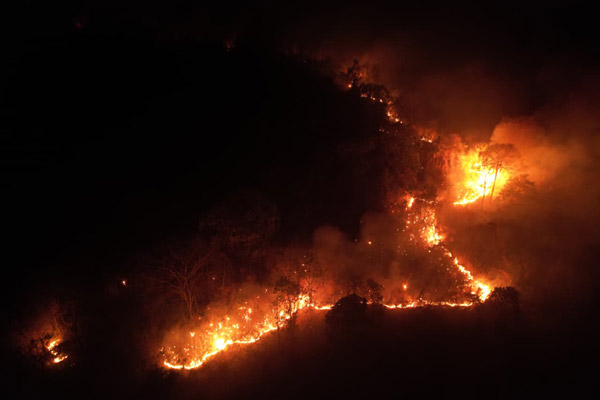
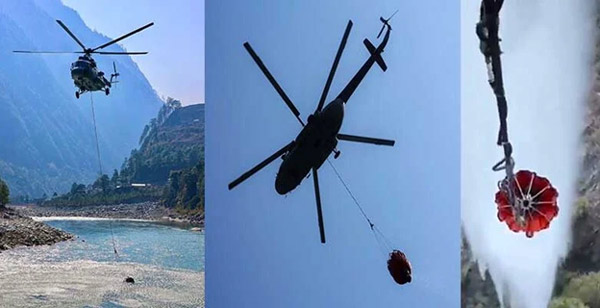
– The Indian Air Force (IAF) deployed Mi-17 V5 helicopters to control a major forest fire in the Mebo and Sigar areas of Pasighat in Arunachal Pradesh.
– The helicopter dropped about 66,000 litres of water in multiple sorties to control the fire.
Where did the fire occur?
– Location: Pasighat in East Siang district of Arunachal Pradesh
– Main areas: Mebo and Sigar, around Pasighat
– The fire spread to forest areas near the Sigar military base.
– Experts suggest possible causes such as dry vegetation, dry weather, strong winds, human activity, or the spread of a small fire.
– Forest fires are more frequent in Northeast India during March–April.
– The fire spread across several mountain slopes and dense forests.
– The rugged terrain and steep ridges made it difficult to control the fire from the ground.
Arunachal Pradesh
– Capital: Itanagar
– Chief Minister: Pema Khandu
– Governor: Kaiwalya Trivikram Parnaik
—————
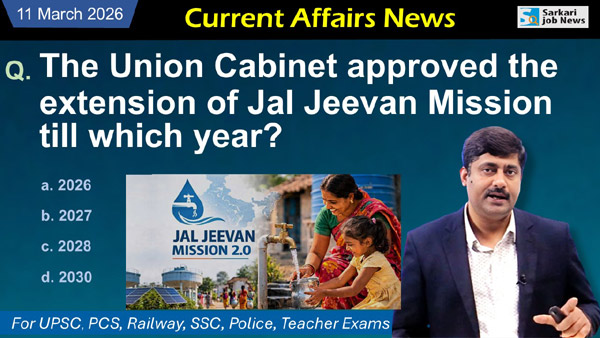
2. The Union Cabinet approved the extension of Jal Jeevan Mission till which year?
a. 2026
b. 2027
c. 2028
d. 2030
Answer: c. 2028
– The Union Cabinet took this decision on 10 March 2026.
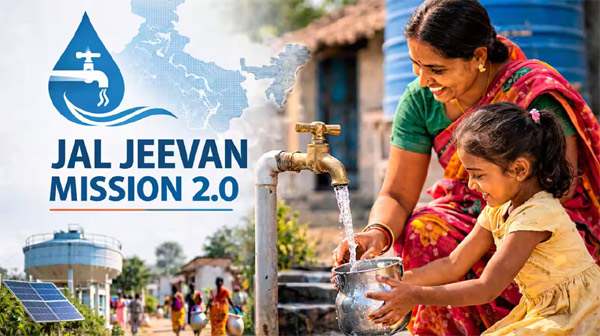
– Jal Jeevan Mission (JJM) is a flagship scheme of the Government of India launched in 2019.
– Under it, a national digital framework called “Sujalam Bharat” will be implemented to digitally track the water supply system, in which every village will be given a unique Sujal Village ID.
– The programme will shift focus from “infrastructure creation to service delivery,” supported by an institutional ecosystem for drinking water management and sustainable rural piped water supply.
Jal Jeevan Mission (JJM)
– Launched: 2019
– Ministry: Ministry of Jal Shakti
– Objective: To provide safe drinking water through tap connections to every rural household.
Key facts
– In 2019, only 3.23 crore (17%) rural households had tap water connections.
– By January 2026, more than 12.56 crore new connections had been provided.
– Total coverage has reached about 81% of rural households.
JJM 2.0 (Extension till 2028)
– Target: Tap water connections to 19.36 crore rural households.
– Change in focus: Earlier infrastructure construction, now service delivery and sustainable water management.
– Digital mapping of village water supply systems through the Sujalam Bharat digital platform.
Long-term goal
– To ensure 24×7 safe drinking water supply in rural areas under the “Viksit Bharat @2047” vision.
—————
3. Who released the document “Defence Forces Vision 2047: A Roadmap for a Future-Ready Indian Military”?
a. Narendra Modi
b. Rajnath Singh
c. Ajit Doval
d. Anil Chauhan
Answer: b. Rajnath Singh
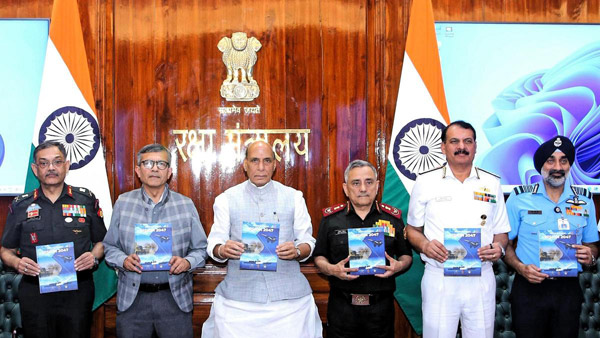
– Defence Minister Rajnath Singh released the vision document “Defence Forces Vision 2047” in March 2026.
– Its aim is to transform India’s armed forces into a modern, integrated, and technologically advanced military power by 2047.
What is Defence Forces Vision 2047?
– It is a long-term strategy for the modernization of the Indian armed forces.
– Goal: To prepare the military for future wars by 2047 (100 years of independence).
Who prepared it?
– The document was prepared by the Headquarters Integrated Defence Staff.
Main objectives
– To make the military modern, integrated, and technologically advanced.
– To develop multi-domain warfare capability (land, sea, air, cyber, and space).
– To address evolving geo-strategic and technological challenges.
Key focus areas
– Enhancing jointness and coordination among the three armed forces.
– Progress toward Integrated Theatre Commands.
– Military organization, capability development, and technological upgrades.
– Aligning with the goal of Viksit Bharat 2047 to make India a strong and modern military power.
—————
4. Who was the Chief Executive Officer (CEO) of IndiGo who resigned in March 2026?
a. Ronojoy Dutta
b. Pieter Elbers
c. Rahul Bhatia
d. Ajit Singh
Answer: b. Pieter Elbers
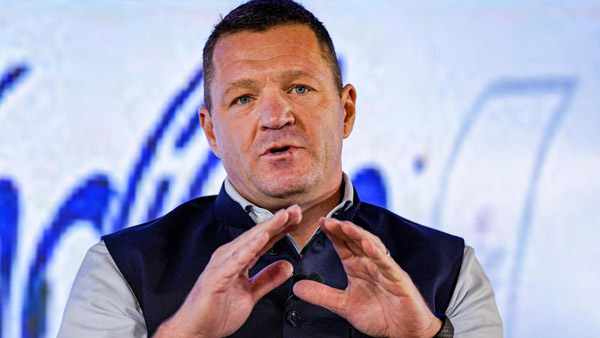
– Pieter Elbers, CEO of India’s largest airline IndiGo, resigned from his position in March 2026.
– Pieter Elbers is a citizen of the Netherlands.
– After his resignation, the company’s co-founder and Managing Director Rahul Bhatia took charge of the company on an interim basis.
Why the resignation is being discussed
– IndiGo faced a major operational crisis in December 2025.
– Around 4,500 flights had to be cancelled, affecting thousands of passengers.
Main reason for the crisis
– Flights were cancelled because the airline could not adjust schedules according to new Flight Duty Time Limitation (FDTL) rules related to pilot duty and rest hours.
– The Directorate General of Civil Aviation (DGCA) investigated the matter, imposed a fine, and kept the airline under strict monitoring.
Facts about IndiGo
– India’s largest airline with more than 60–65% domestic market share.
– Operates a fleet of about 440 aircraft.
– Established: 2006
– Founders: Rahul Bhatia and Rakesh Gangwal
—————
5. The Government of India amended the FDI rules in March 2026 vide Press Note-3 (2020). Which of the following statements is correct regarding investments from countries sharing land borders with India?
a. All such investments have now been brought fully under the automatic route.
b. Some investments with a non-controlling stake of up to 10% have been allowed under the automatic route.
c. All such investments have been completely banned.
d. Investment is allowed only in the defence sector.
Answer: b. Some investments with a non-controlling stake of up to 10% have been allowed under the automatic route.
– The central government has relaxed certain rules for Foreign Direct Investment (FDI) coming from countries sharing land borders with India (such as China, Bangladesh, Pakistan, etc.).
– This change has been made by amending Press Note-3 issued in 2020.
– In 2020, India-China relations became tense after the Galwan clash.
– After that, India banned more than 200 Chinese apps and tightened investment rules.

What was the earlier rule? (2020 – Press Note 3)
– In April 2020, India changed its FDI policy.
– Any investment from countries sharing a land border with India could only come through the Government Route.
– The objective was to prevent foreign companies from acquiring Indian companies at low valuations, especially during COVID-19 when company valuations had fallen.
Which countries did this rule apply to?
Seven countries sharing land borders with India:
– China
– Pakistan
– Bangladesh
– Nepal
– Bhutan
– Myanmar
– Afghanistan
What impact did Press Note-3 have in 2020?
– Earlier, many Chinese companies invested in Indian startups and tech companies.
– After government approval became mandatory, the process slowed down and several investments were halted.
– Indian startups had earlier received large investments from Chinese venture capital funds.
– Due to stricter rules, funding sources became limited.
– China’s participation in electronics, auto components, and tech sectors declined.
– Many companies had to look for investors from other countries.
– Approval for several proposals took months or even years.
What changes have been made now?
– Under the new policy, if investors from these countries hold a non-controlling stake of up to 10%, investment may be allowed through the Automatic Route in some cases.
– A 60-day decision timeline has been set for investment proposals in certain manufacturing sectors.
– A clear definition of “Beneficial Ownership” has also been added.
Objectives
– Increase FDI in India
– Promote the manufacturing sector
– Strengthen India’s role in global supply chains
– Bring technology and capital
—————
6. When is No Smoking Day celebrated?
a. Fourth Wednesday of March
b. Third Wednesday of March
c. Second Wednesday of March
d. First Wednesday of March
Answer: c. Second Wednesday of March (11 March in 2026)
– This day is observed to raise awareness among people worldwide about the harmful effects of smoking.
– Smoking affects the nervous system, respiratory tract, cardiovascular system, digestive system, hair, skin, and nails.
————–
7. Which decision did the Uttar Pradesh cabinet take to increase transparency in land registration?
a. Abolishing stamp duty
b. Making the registration process fully online
c. Making verification of Khatauni and ownership records mandatory before registration
d. Making permission of the Gram Panchayat mandatory for buying and selling land
Answer: c. Making verification of Khatauni and ownership records mandatory before registration
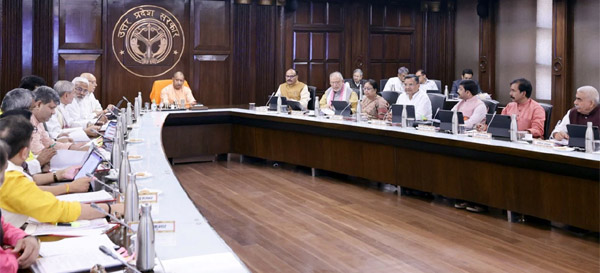
– The Uttar Pradesh cabinet approved amendments to the Registration Act, 1908 to enable stricter scrutiny of documents before the registration of land or other immovable property.
– Objective: To curb fraudulent registrations and land mafia activities.
Major change
– Matching of Khatauni and ownership documents will now be mandatory.
– The Sub-Registrar will have the authority to refuse registration if documents related to ownership, title, mutation, identity, or transfer rights are not available.
– New sections have been added to the law to confirm legal ownership before registration.
—————
8. Which state cabinet approved the Chief Minister Village Transport Scheme-2026?
a. Bihar
b. Uttar Pradesh
c. Punjab
d. Andhra Pradesh
Answer: b. Uttar Pradesh
– The Uttar Pradesh cabinet approved the Chief Minister Village Transport Scheme-2026 in March 2026.
– Around 12,200 remote villages will be connected with bus services.
– Small 28-seater buses will be operated.
Rules for Ola-Uber
– App-based taxi companies must register with the Transport Department.
– Application fee is about ₹25,000 and ₹5 lakh for the company.
————–
9. Which Assembly passed the proposal to include the Mizo language in the 8th Schedule of the Constitution?
a. Tripura
b. Kerala
c. Punjab
d. Mizoram
Answer: d. Mizoram
– The Mizoram Legislative Assembly unanimously passed a resolution demanding inclusion of the Mizo language in the Eighth Schedule of the Indian Constitution.
– Chief Minister Lalduhoma appreciated the efforts of the Mizo Language Development Board, which initiated the proposal.
About the Eighth Schedule of the Constitution
– A total of 22 languages are included in the Eighth Schedule.
– These include Assamese, Bengali, Gujarati, Hindi, Kannada, Kashmiri, Konkani, Malayalam, Manipuri, Marathi, Nepali, Odia, Punjabi, Sanskrit, Sindhi, Tamil, Telugu, Urdu, Bodo, Santali, Maithili, and Dogri.
—————
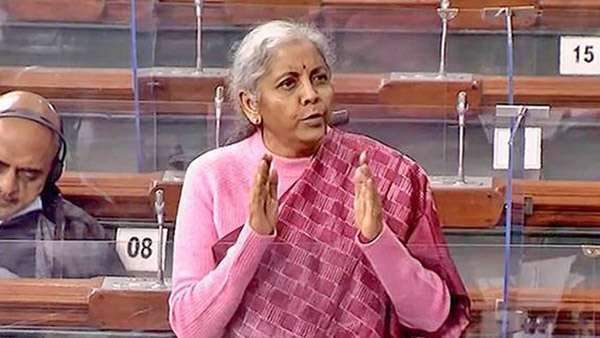
10. For the financial year 2025–26, how many rupees has the central government sought approval from the Lok Sabha as Gross Additional Expenditure?
a. ₹1.32 lakh crore
b. ₹2.81 lakh crore
c. ₹3.50 lakh crore
d. ₹4.10 lakh crore
Answer: b. ₹2.81 lakh crore
– The central government has requested approval from the Lok Sabha for ₹2.81 lakh crore as Gross Additional Expenditure for FY 2025–26.
– This amount has been presented through Supplementary Demands for Grants and includes additional spending on fertilizer subsidy, food subsidy, defence services, and other economic requirements.
What is Gross Additional Expenditure?
– When the government needs to spend more than the amount allocated in the budget, it seeks additional funds from Parliament.
– This is called Supplementary Demands for Grants.
– It is brought under Article 115 of the Constitution.
Does it get added to the budget?
– Yes. After Parliament’s approval, it becomes part of the total government expenditure for that financial year.
– In other words, it becomes a revised form of the original budget.
Parliamentary process
– The government presents Supplementary Demands for Grants.
– The Lok Sabha approves them.
– After that, the Appropriation Bill is passed.
– Then the government can spend additional money from the Consolidated Fund of India.
– This is related to Article 114 of the Constitution.
– Without the Appropriation Act, the government cannot withdraw money from the Consolidated Fund.
– Appropriation Act = Legal authorization by Parliament allowing the government to spend money from the Consolidated Fund.
Key fact for FY 2025–26
– The government has sought approval for ₹2.81 lakh crore as Gross Additional Expenditure.
PDF Download: Click here